
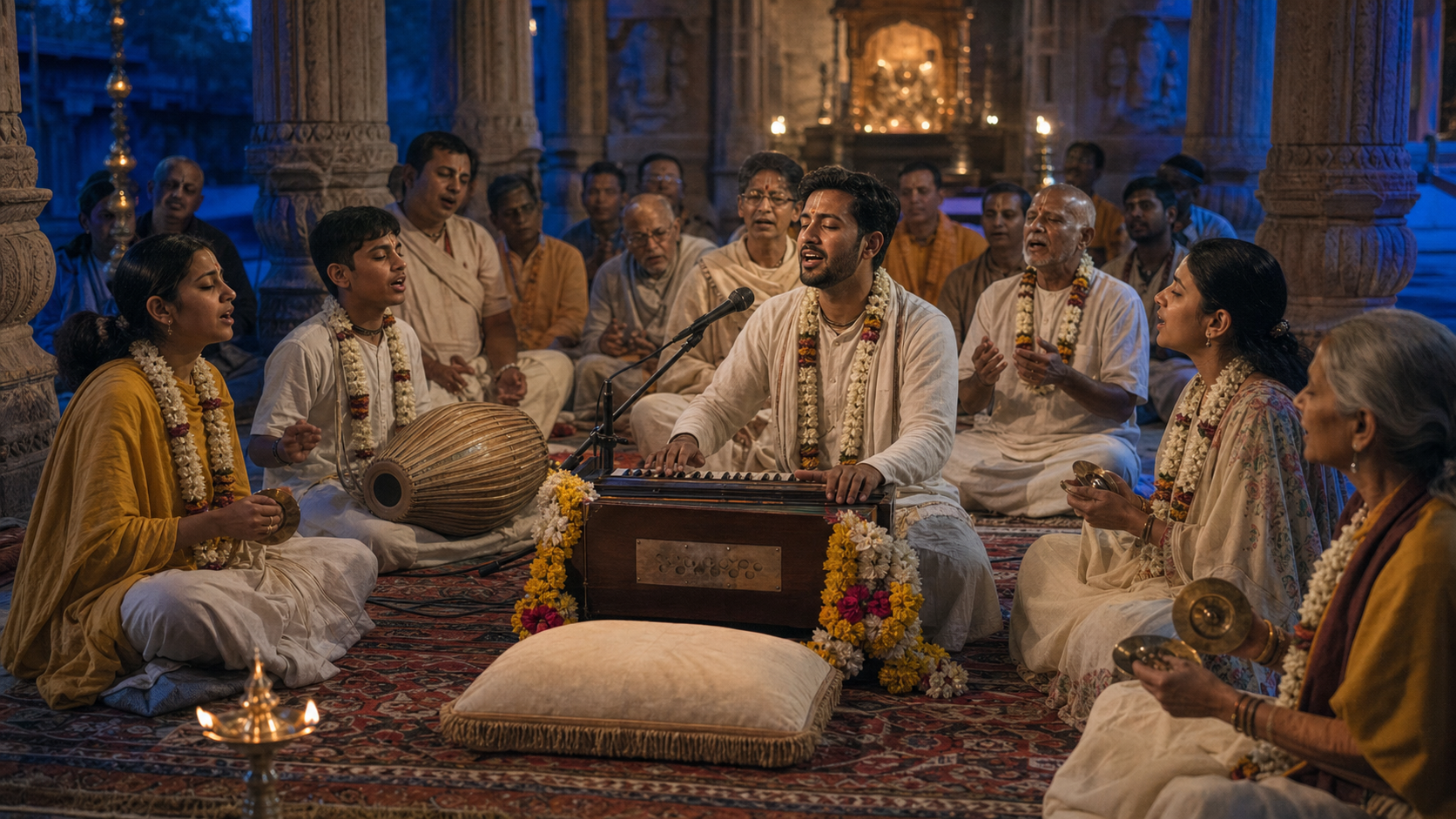
You can be deeply moved by Aindra Prabhu’s kirtan legacy and still feel unsure about what to do with it. Should you reproduce a familiar melody, seek the same emotional intensity, or simply play recordings and remember him?
The more useful answer begins with purpose. A kirtan legacy survives when the holy name becomes easier to hear, answer, and remember through your chanting. Musical imitation may preserve a sound; disciplined devotional practice preserves what that sound was meant to serve.
Preserve the devotional principle, not just the musical surface
In 2026, devotees marked the sixteenth disappearance day of Aindra Prabhu. In Vaishnava practice, a disappearance day is more than an anniversary of loss. It asks whether the departed devotee’s service is still shaping the living community.
That question protects remembrance from becoming nostalgia. You don’t honor a kirtaniya merely by collecting favorite recordings, identifying melodies, or recreating a dramatic crescendo. Those things can help, but they can also turn kirtan into a preserved musical object. The deeper inheritance is a culture in which chanting is central, sustained, congregational, and directed toward Krishna rather than toward the reputation of the leader.
A practical way to carry that inheritance is to make three commitments:
- Keep the holy name primary. The leader, melody, instruments, and arrangement must help people hear the mantra rather than compete with it.
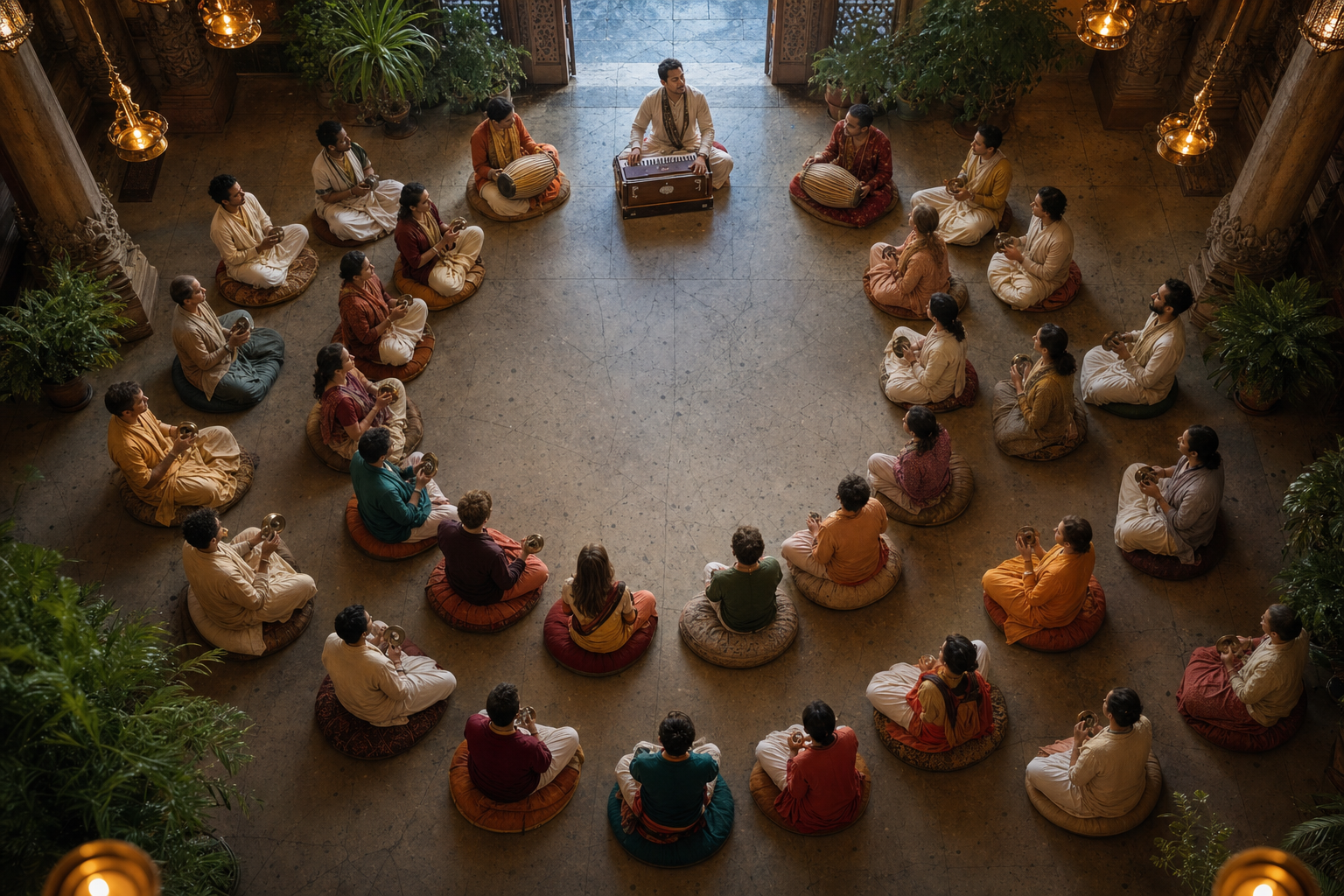
- Treat the congregation as participants. A responsive room is more important than an impressive solo voice.
- Let intensity grow from attention. Speed, volume, and ornament can express devotion, but they cannot manufacture it.
This distinction also gives you freedom. You don’t need Aindra Prabhu’s vocal range, musical vocabulary, or historical setting to serve the same devotional aim. Use the instruments available to you. Choose a melody your congregation can answer. Adapt the duration to the occasion. Fidelity to a legacy doesn’t require pretending that every circumstance is identical.
Put hearing back at the center of chanting
The Hare Krishna maha-mantra is complete in its familiar form: Hare Krishna, Hare Krishna, Krishna Krishna, Hare Hare; Hare Rama, Hare Rama, Rama Rama, Hare Hare. A leader’s first responsibility is to give that mantra clearly enough that the congregation can receive and return it.
Devotional life is sustained by hearing and chanting about Krishna through his name, instruction, and pastimes. That pairing matters. Kirtan isn’t only the act of producing sacred sound. It is also the discipline of receiving it. If you stop listening while you lead, the chanting can remain technically competent while losing its reciprocal character.
Use this sequence when you lead:
- Choose a comfortable pitch. Set the key for the congregation, not for the highest note you can reach. If the response sounds strained, lower it.
- Give the complete mantra plainly. Establish the words and melodic shape before adding runs, held notes, or rhythmic surprises.
- Listen to the response. Notice whether the syllables remain distinct and whether people enter together. Their answer tells you whether your call was usable.
- Repeat before varying. Let the congregation learn a phrase through repetition before replacing it with another idea.
- Change one musical dimension at a time. If you alter melody, speed, volume, and rhythmic density together, the congregation has to chase the leader. Change one, allow the response to settle, and then decide whether another change serves the chant.
The test is simple: can people return the mantra with greater confidence after several cycles? If they cannot, more complexity is unlikely to help. Lower the pitch, shorten the melodic detour, soften the instruments, or repeat the established phrase. Simplicity is not a retreat from devotion. It is often the condition that lets devotion become shared.
Let feeling ripen instead of trying to perform it
Chanting with feeling doesn’t mean sounding emotional on command. A trembling voice, closed eyes, raised volume, or prolonged note may accompany genuine absorption, but none of them proves it. Once an outward sign becomes a target, your attention can shift from Krishna’s name to the impression you are making.
When strong emotion isn’t present, don’t counterfeit it. Offer the attention you actually have. Pronounce the names carefully. Hear the response. Notice when your mind has moved toward musical control, self-consciousness, or anticipation of the next change, and bring it back to the mantra now being sung.
Four checkpoints can keep feeling honest:
- Diction: Can the names still be heard, or have ornament and instrument volume blurred them?
- Listening: Are you receiving the congregation’s response, or using that time to plan your next display?
- Intention: Are you helping others chant, or trying to create a particular image of yourself as a kirtan leader?
- Dependence: Can you remain attentive when the kirtan is musically modest and emotionally quiet?
Before beginning, set a plain inward intention: may Krishna’s name be heard clearly, and may everyone be able to respond. That intention gives you a standard for decisions once the kirtan starts. If an ornament hides the words, leave it out. If a change confuses the response, return to the established phrase. If the congregation begins chanting with strength, support it instead of immediately redirecting attention to yourself.
When emotion does arise, protect its devotional direction. You don’t need to suppress it, but you also don’t need to convert the moment into a spectacle. Keep the mantra audible, keep the response open, and let the congregation remain inside the chanting rather than becoming an audience for the leader’s state.
Read the congregation instead of chasing intensity
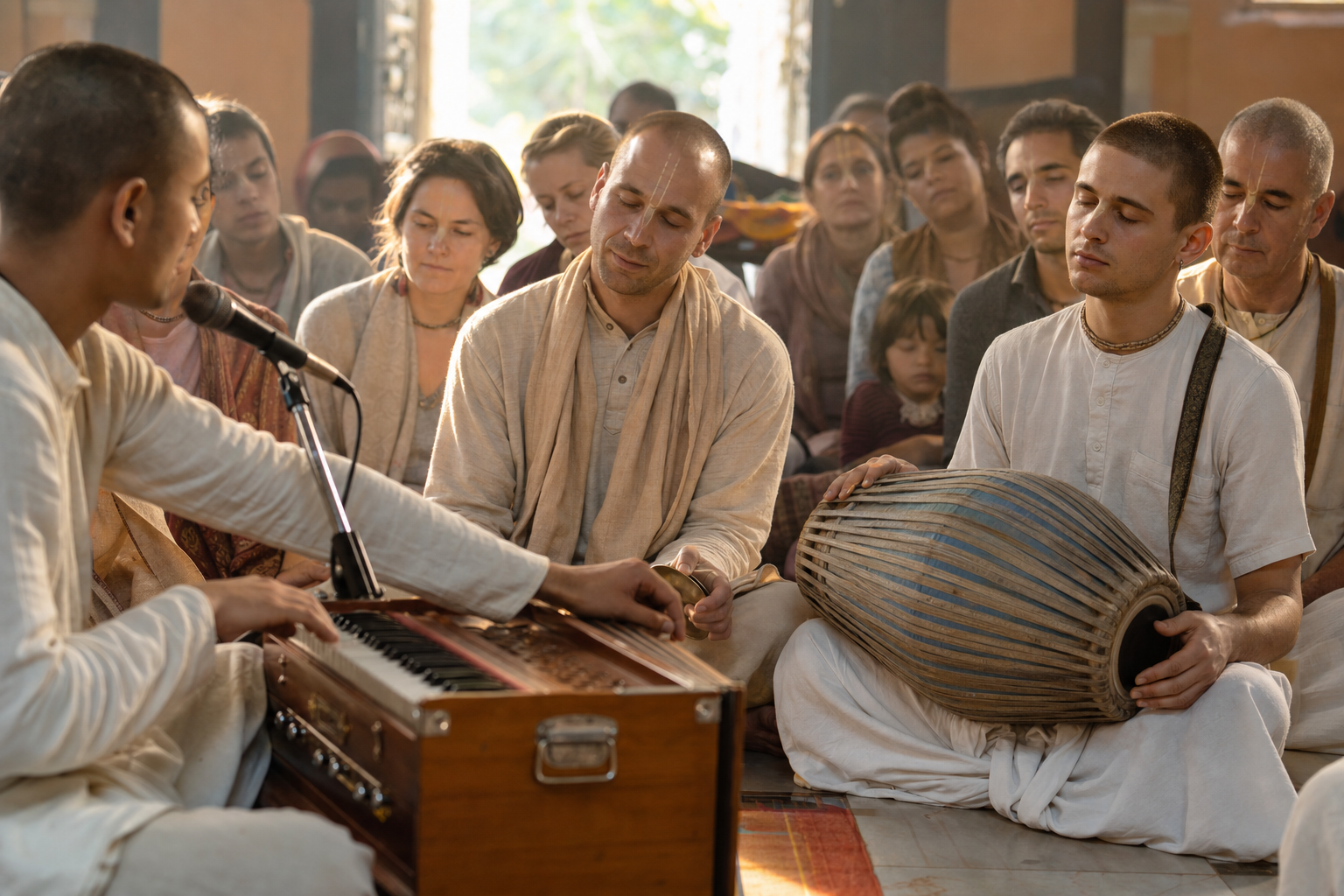
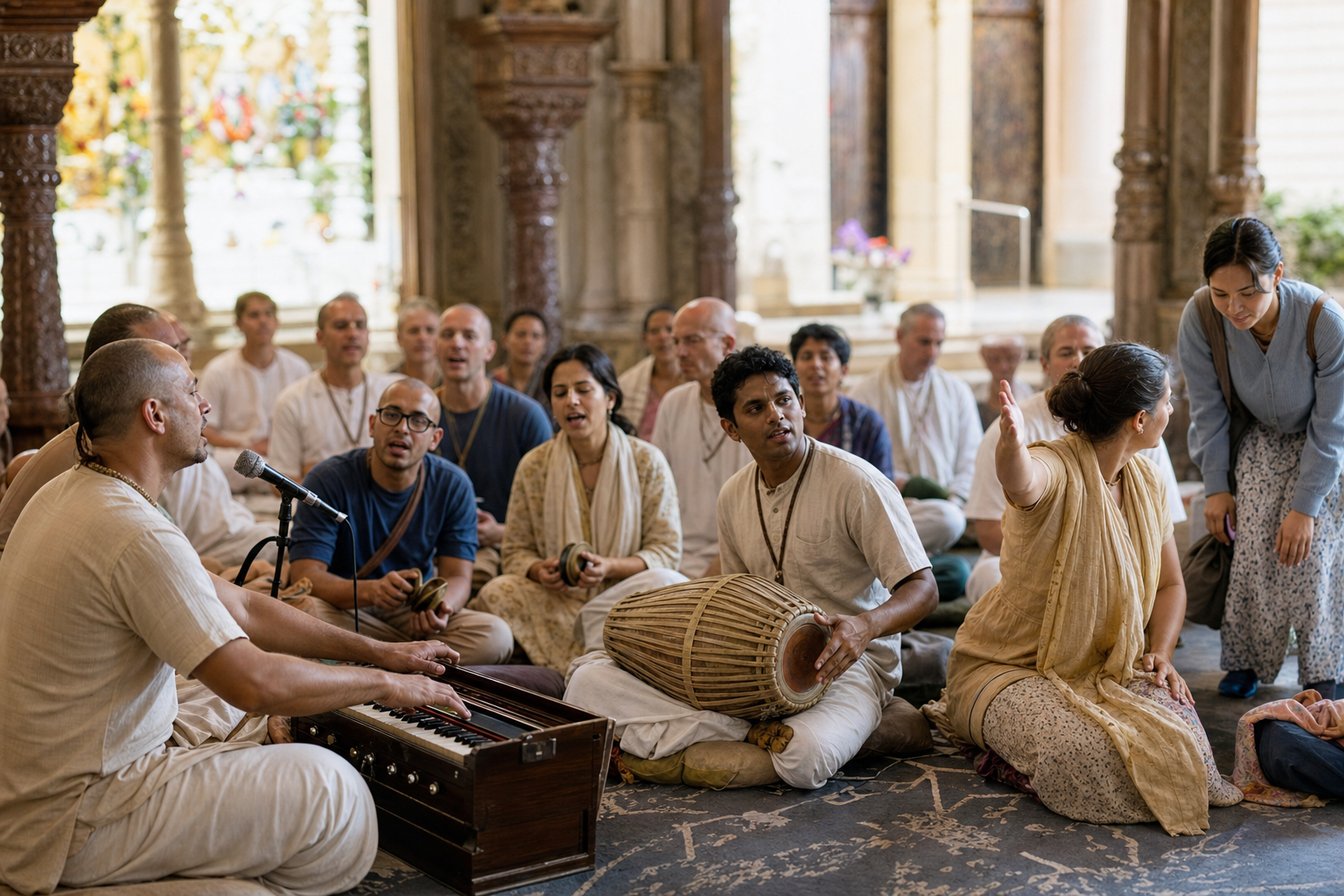
A loud room is not automatically a participatory room. People may be enthusiastic yet unable to follow the pitch, locate the rhythmic entrance, or hear themselves over the instruments. The leader has to notice the difference between collective chanting and collective noise.
| What you notice | What may be happening | What to change |
|---|---|---|
| The response becomes thin | The pitch or melodic line is too demanding | Lower the key and return to a simpler phrase |
| People enter at different moments | The end of the call or the rhythmic cue is unclear | Complete the phrase cleanly and leave an unmistakable space for the answer |
| The words disappear beneath the instruments | Accompaniment has become the dominant sound | Reduce instrumental volume until every name is distinct |
| The room peaks quickly and then loses focus | Speed, volume, and complexity increased too early | Return to a steady cycle and rebuild through repetition |
| The leader’s voice sounds strained | The key is too high or the lead has gone on too long | Lower the key, share the lead, or bring the kirtan to a composed close |
Restraint is especially important during transitions. If every new melody must be faster and louder than the previous one, you leave yourself nowhere to go except exhaustion. A quieter passage can restore attention to the names. A repeated phrase can reunite a scattered response. A deliberate ending can leave the mantra present in the mind instead of leaving only the memory of a musical peak.
If you are learning from a recording associated with Aindra Prabhu’s legacy, don’t remain a passive listener. Supply the response aloud. Notice which phrases you can reproduce without losing the words. Select one accessible melody and practice holding its pitch steadily. Then lead it for other people and let their response, not your attachment to the recording, reveal what needs adjustment.
Afterward, ask three concrete questions: Were Krishna’s names easy to hear? Did the congregation’s response become more confident? Could another capable devotee have carried the chant without the whole structure collapsing? These questions turn reverence into training.
Key takeaways for carrying the legacy forward
- Honor Aindra Prabhu’s kirtan legacy by protecting the purpose of congregational chanting, not merely by reproducing a recognizable sound.
- Lead with a comfortable pitch, a clear mantra, and enough repetition for the congregation to respond confidently.
- Let hearing govern the call. The response is part of the kirtan, not a pause before the leader’s next musical idea.
- Don’t use musical intensity as proof of devotional feeling. Give honest attention and allow feeling to develop in its own time.
- When participation weakens, simplify something specific: pitch, melody, tempo, instrumental volume, or the frequency of transitions.
At your next kirtan, make one disciplined change: begin in a comfortable key, establish one simple melody, and refuse to vary it until the response is clear and settled. If the names become easier to hear and the congregation chants more fully, keep that lesson. This is how a kirtan legacy remains alive: not as a museum of melodies, but as a devotional practice passed from attentive singer to attentive singer.
References
- Dandavats — In Loving Remembrance: 16th Disappearance Day of HG Aindra Prabhu
- Dandavats — Chanting with Feeling | H.G. Prabhupada Priya Dasi | 2026-07-15 | ISV