
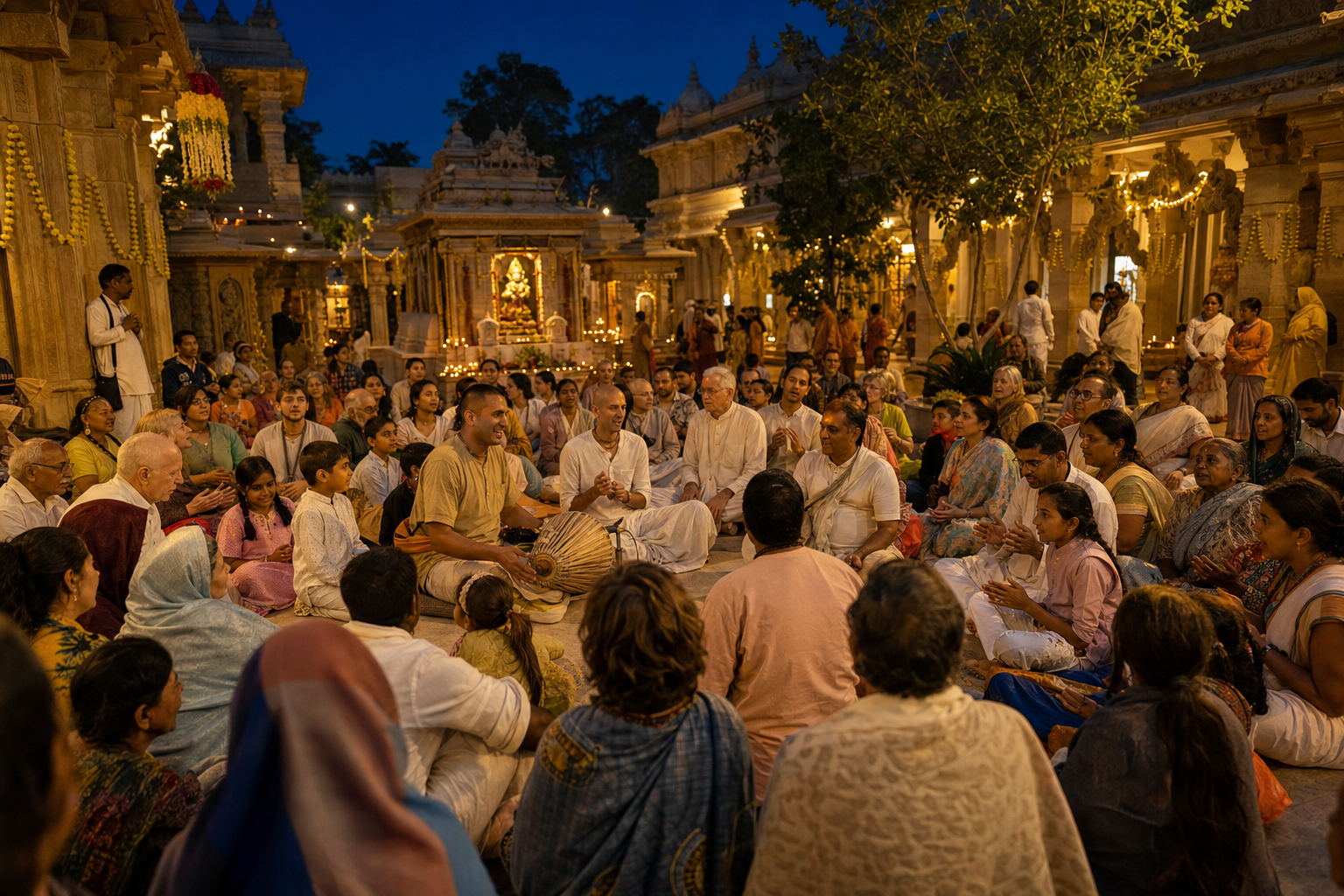
You have found an ISKCON drama or festival and are wondering what actually happens there, how much you need to know, and whether a newcomer can participate without feeling awkward. You do not need to arrive with every custom memorised. You do need to recognise that the gathering is devotional before it is performative.
That distinction changes how you prepare, what you watch, and how you respond. It also helps you receive the art on its own terms rather than reducing it to either religious instruction or cultural entertainment.
Read the event as devotional art, not only as a show
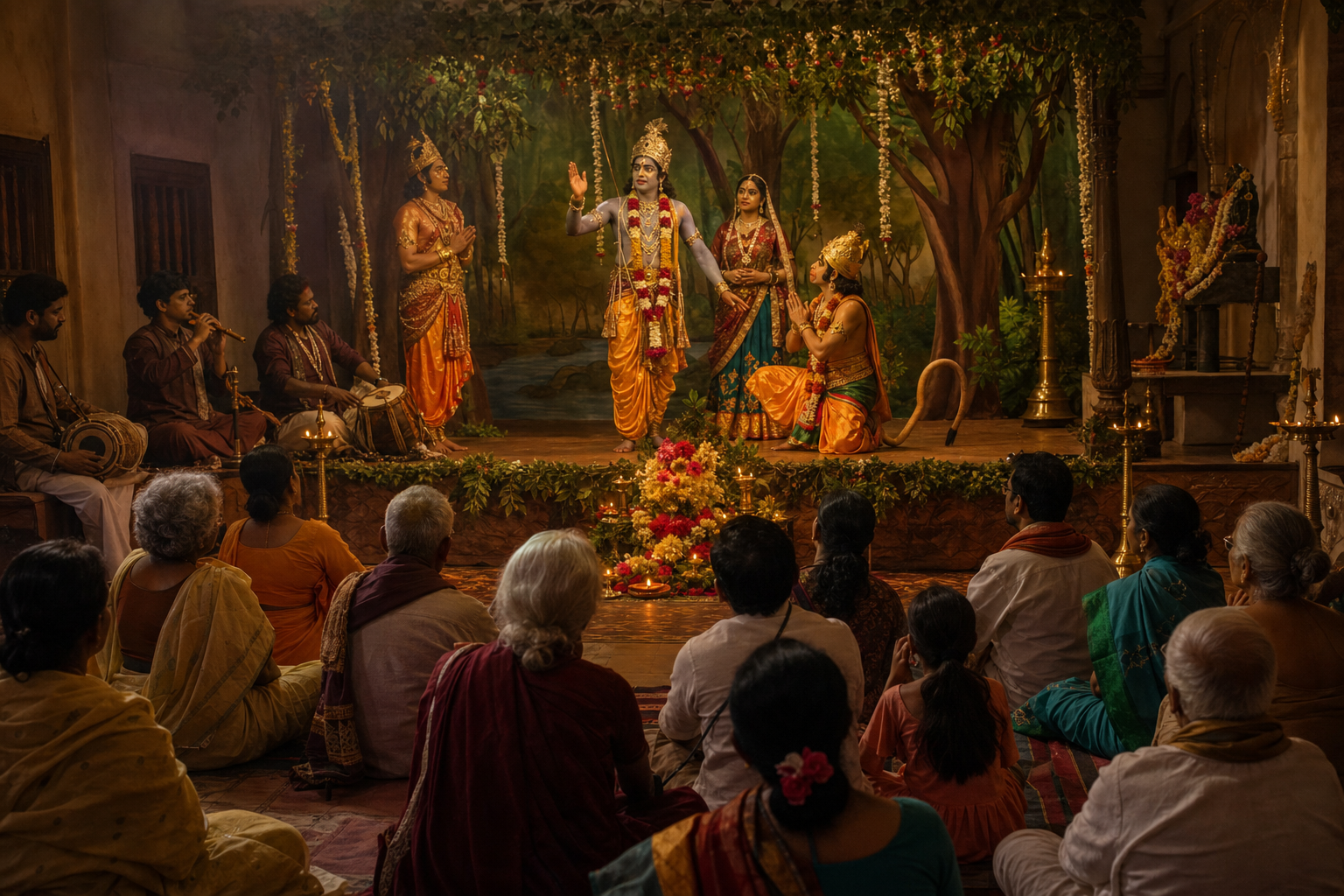
In an ordinary theatre, you might judge the evening by acting, pacing, design, and applause. Those things still matter in devotional theatre, but they are not the whole measure. The deeper question is whether the artistic form directs attention beyond the performers and toward a sacred relationship, teaching, character, or quality.
Rehearsal, narration, gesture, costume, decoration, music, movement, and attentive viewing can all become forms of service when they are organised around remembrance rather than self-display. This does not mean that technical quality is unimportant. It means that virtuosity serves the devotional purpose instead of becoming the purpose.
As you watch, use three practical questions:
- What does the program repeatedly ask you to remember?
- Which desire or value does it present as worth pursuing?
- When does the audience shift from observing to responding, whether through silence, song, gesture, prayer, or collective attention?
These questions prevent two common misreadings. The first is dismissing the event as entertainment merely because it uses theatre or pageantry. The second is assuming that anything beautiful in a temple setting must automatically communicate its devotional meaning clearly. Look for the relationship between form and purpose.
Drama and festival space ask different things of you
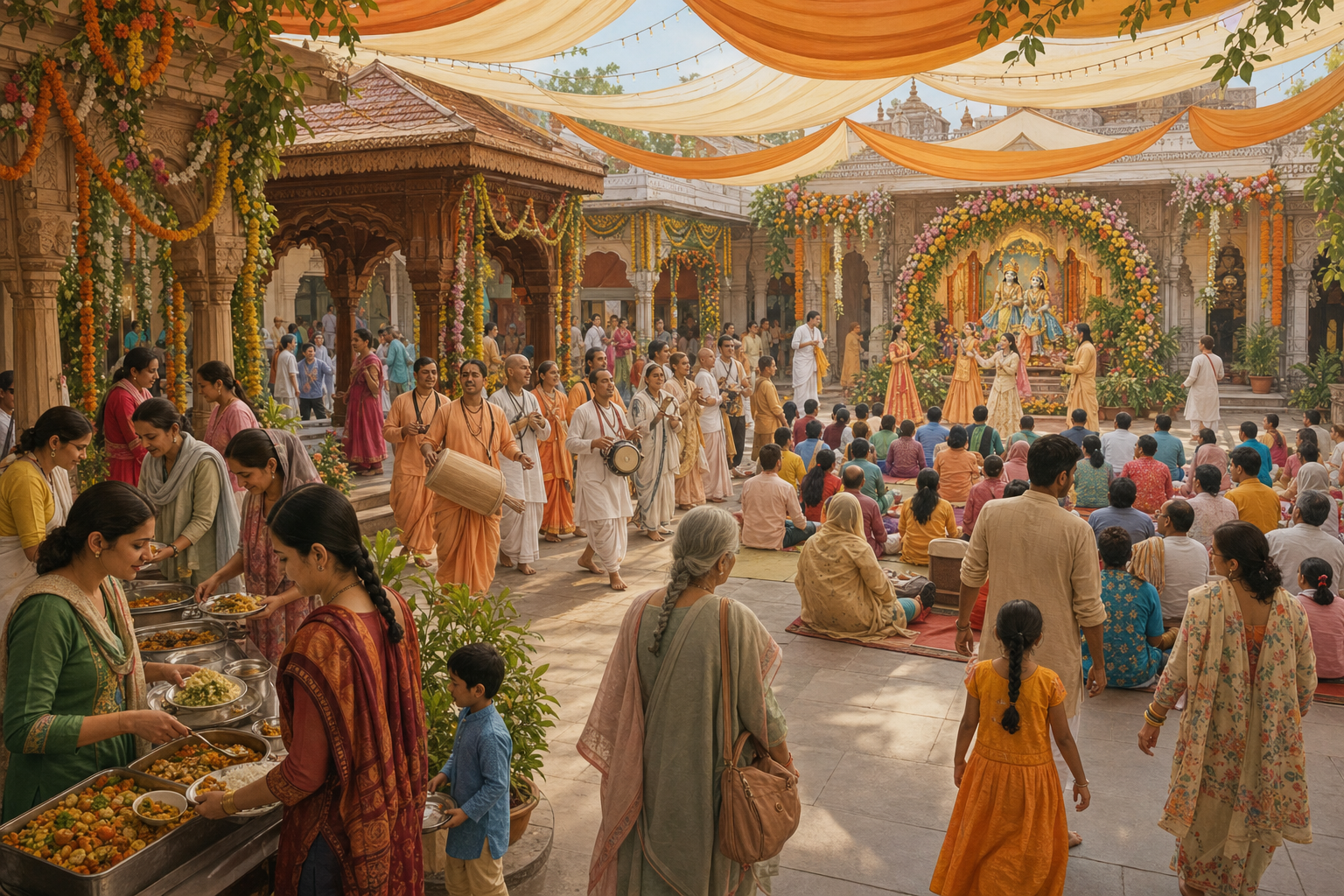
ISKCON devotional arts can take markedly different forms. A staged production such as Gaur Prem – The Greatest Wealth, presented as a 2026 drama festival at ISKCON Chowpatty, invites you to follow a dramatic argument. A Boat Festival with HH Radhanath Swami at the Temple at Bhakti Center announces a gathering organised around a festival form rather than a conventional plot. You will understand more when you adjust your attention accordingly.
At a devotional drama, follow the change in what characters value
The subtitle The Greatest Wealth gives you a useful interpretive key without revealing a plot: watch for what the drama treats as genuine wealth. Do not limit that question to money or possessions. Notice what characters seek, what disappoints them, what redirects them, and what finally appears worthy of trust.
Track three elements even if the language is unfamiliar:
- Desire: What does each central character want at the beginning?
- Turning point: Which encounter, loss, recognition, or decision changes that desire?
- Resolution: What does the final movement ask the audience to value differently?
Gesture and facial expression can carry meaning alongside dialogue. If you recognise abhinaya at work, do not treat it as decorative movement. Watch how the eyes, hands, posture, and distance between characters clarify affection, humility, conflict, or surrender. If music or movement interrupts speech, ask what changed at that transition rather than assuming it is an interlude.
If you lose the narrative, resist inventing a story from costume alone. Note a repeated name, phrase, image, or gesture and ask a volunteer about it after the program. One precise question will usually help more than requesting an explanation of the entire tradition.
At a boat festival, follow the centre of attention
A festival centred on a boat motif does not ask you to track character development in the same way. Instead, notice how the gathering creates a devotional centre and how the community relates to it. Where does attention gather? When do people become quiet? When are they invited to respond? How do movement, sound, decoration, and the arrangement of the space support that focus?
Your physical position is less important than your quality of attention. Pushing forward for a photograph can leave you less engaged than standing farther back and following the whole sequence. Respect any boundary maintained by organisers, and let volunteers manage movement around the central area.
Do not assume that a festival is merely a lecture with decorative activity around it. The arrangement of people, objects, movement, sound, and periods of stillness can carry meaning together. Watch the sequence before deciding which element is the main event.
Resolve the practical questions before you arrive
Confusion about logistics consumes the attention you hoped to give the program. A short check with the host venue can prevent most of it. Confirm event-specific details instead of importing assumptions from another ISKCON temple or a previous festival.
- Confirm the format. Ask whether you are attending a live drama, a festival gathering, a recorded screening, or a program that combines several elements. A video page may preserve a past event, so it is not by itself proof of a new performance date.
- Check the language. Find out whether the spoken portions will be in a language you understand and whether a synopsis, translation, or subtitles will be available. If not, read the brief event description carefully and use its title as your interpretive anchor.
- Ask about arrival and seating. Confirm when entry begins, whether seating is assigned, and whether parts of the program require standing or moving. If you need accessible seating or cannot stand for long periods, contact the venue in advance.
- Learn the photography rule. Permission varies by program and moment. Ask whether photography, recording, or flash is restricted, then keep your device below other people’s sightlines even when recording is allowed.
- Prepare children for the form. Tell them whether they will watch a story, follow a procession-like movement, or sit through spoken portions. Choose a seat that lets you step out quietly if necessary without crossing an active performance or devotional area.
- Ask what participation means. Find out whether visitors are expected simply to observe or may be invited to sing, respond, move, or receive something. An invitation is not a test; you can follow respectfully without copying an action you do not understand.
You do not need a long etiquette manual. The useful information is local and concrete: where to be, what kind of program it is, what language it uses, what participation may occur, and which boundaries the hosts want visitors to observe.
Participate respectfully without pretending
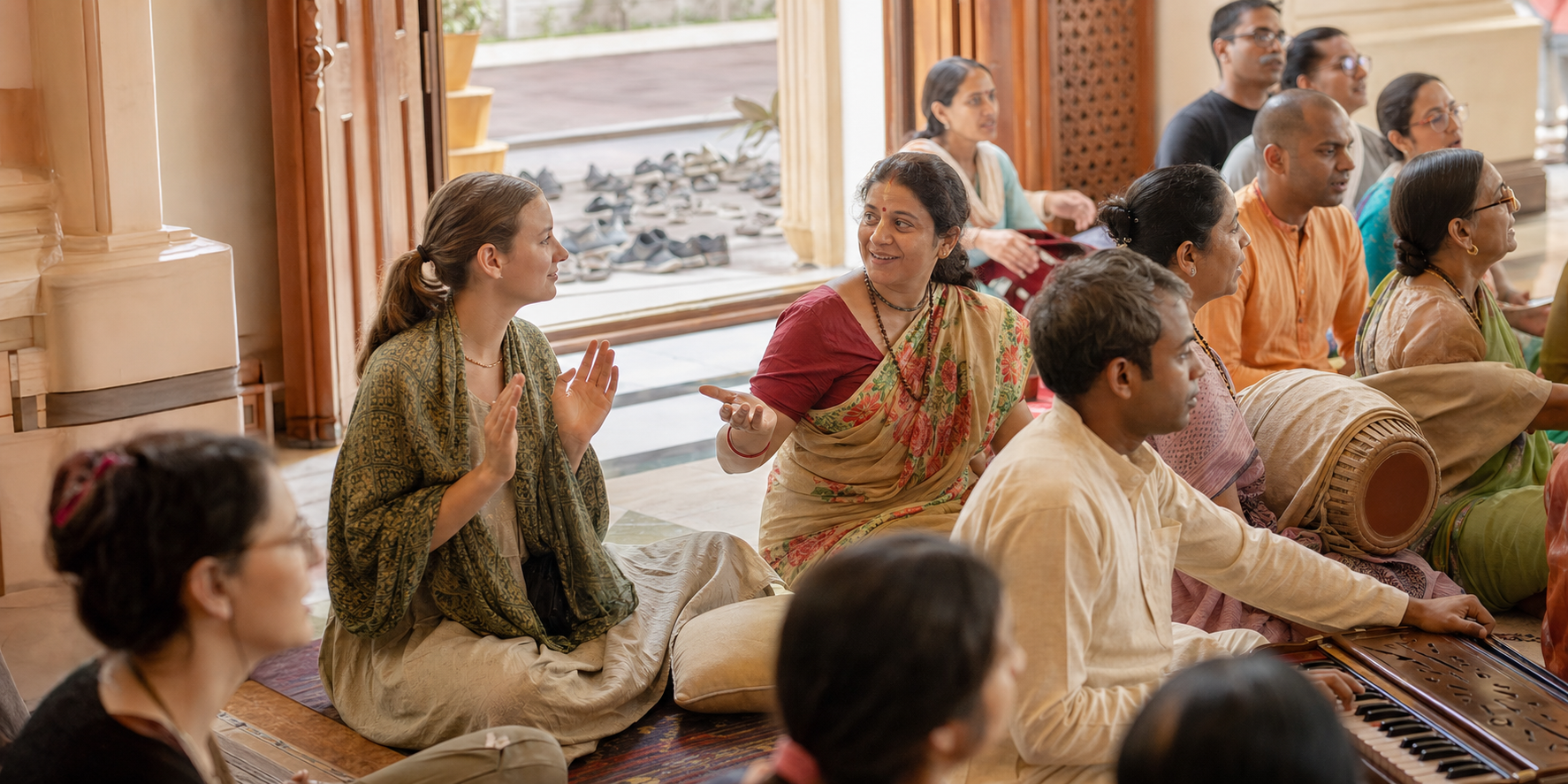
A newcomer sometimes feels caught between two unhelpful choices: remaining so detached that the gathering becomes an exhibit, or imitating every action to appear knowledgeable. Neither is necessary. Respectful participation begins with attention and honesty.
- Follow local cues, not guesses. If the room stands, sits, or becomes quiet, observe before moving. Instructions from the host or volunteers take priority over what you remember from another venue.
- Let devotional transitions finish. Applause and conversation do not always fit the same moments they would in a secular performance. Wait for the room’s response when you are uncertain.
- Keep images secondary. Take a photograph only when permitted, then put the phone away. Watching an entire sequence through a screen makes it harder to notice how its parts relate.
- Do not cross an active boundary for a better view. A clear photograph is not worth interrupting performers, organisers, or worshippers.
- Respond only as far as you understand. You may listen attentively without claiming convictions you do not hold. If a repeated response is open to everyone and you are comfortable joining, follow the group rather than trying to lead it.
- Ask about meaning after the transition. A useful question is, “What was this scene or festival action meant to help us remember?” That invites explanation without demanding a defence of the entire tradition.
- Notice the service behind the presentation. Performers are only the most visible contributors. Direction, rehearsal, clothing, decoration, sound, hospitality, crowd guidance, and cleaning all shape the gathering. Treat volunteers as participants in the devotional work, not merely as event staff.
This approach also helps if you belong to another Dharmic tradition. You can recognise shared disciplines of sacred memory, embodied practice, hospitality, and community service without erasing real theological differences. Respect does not require flattening every tradition into the same vocabulary.
Key takeaways
- Judge devotional art by how form serves remembrance, not by polish alone.
- At a drama, track desire, turning point, and the final definition of what is valuable.
- At a festival organised around a symbolic centre, watch the movement of collective attention rather than searching for a conventional plot.
- Confirm format, language, seating, accessibility, photography, and participation rules with the host venue.
- Follow local cues, preserve other people’s sightlines, and never cross an active boundary for a photograph.
- Ask one precise question afterward and carry one image, gesture, or teaching into further learning.
Choose one gathering and prepare for it deliberately. Resolve the practical questions before you leave home. During the program, notice what your attention is repeatedly brought back to. Afterward, write down one detail you want to understand and ask about that detail. That small discipline turns attendance from passive consumption into a genuine encounter with devotional art.
References
- Dandavats – GAUR PREM – The Greatest Wealth || Drama Festival 2026 || ISKCON Chowpatty
- Dandavats – Boat Festival with HH Radhanath Swami