
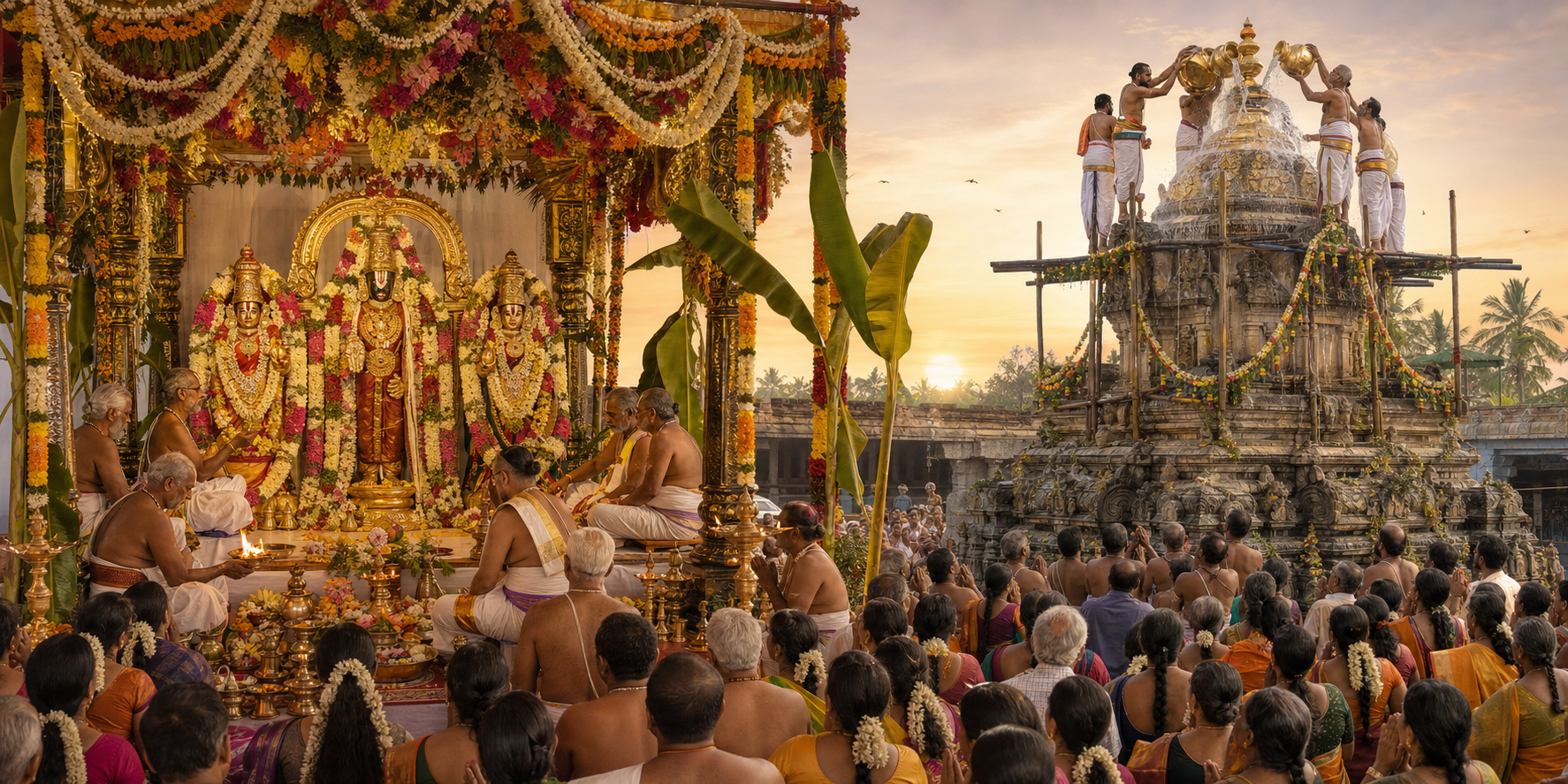
Perhaps a Srinivasa Kalyanam is coming to your district while a Venkateswara temple elsewhere is preparing for Pratishtha and Maha Kumbabhishekam. If you can attend only one, or if your family wants to understand what it will witness, the event names alone do not tell you enough.
Ask one question first: is the rite bringing Venkateswara’s kalyana celebration to a community, or is it sanctifying and renewing worship in a particular temple? Both are expressions of bhakti, but they serve different needs. That difference should guide where you go, what you expect, and how you participate.
First identify what the sacred action is doing
Srinivasa Kalyanam celebrates the ceremonial marriage of Sri Venkateswara and Sri Mahalakshmi. In its traveling form, an organized ritual team carries a structured Vedic observance into a community venue. Devotees who live far from a major temple can then join the sankalpa, witness the kalyana rites, listen to devotional music, and receive prasadam when distribution is part of the local program.
Pratishtha and Maha Kumbabhishekam concern the liturgical life of a fixed temple. Pratishtha sanctifies the temple and its murti. Maha Kumbabhishekam renews that sacred life through the ceremonial use and transfer of sanctified waters. The community is not simply gathering for a visiting observance; it is affirming its continuing relationship with a particular sacred place.
| Question | Traveling Srinivasa Kalyanam | Pratishtha and Maha Kumbabhishekam |
|---|---|---|
| What is central? | The divine marriage of Sri Venkateswara and Sri Mahalakshmi | The sanctification or ritual renewal of a temple and its murti |
| Why is it held there? | To make disciplined participation accessible within a local community | Because the sacred action belongs to that particular temple |
| What will you mainly notice? | Sankalpa, kalyana rites, devotional music, collective worship, and often prasadam | Preparatory vows, consecration rites, sacred waters, and the temple community gathered around a liturgical threshold |
| When is it the better choice? | When you seek accessible family participation in Venkateswara bhakti | When you want to support or witness a defining moment in a temple’s continuing life |
Do not rank the two by crowd size or spectacle. A large traveling celebration remains outreach, while a modest local consecration can mark a decisive transition for a temple. Choose according to the sacred relationship you want to support, not according to which event looks more impressive.
Ritual outreach expands access without confusing sacred roles
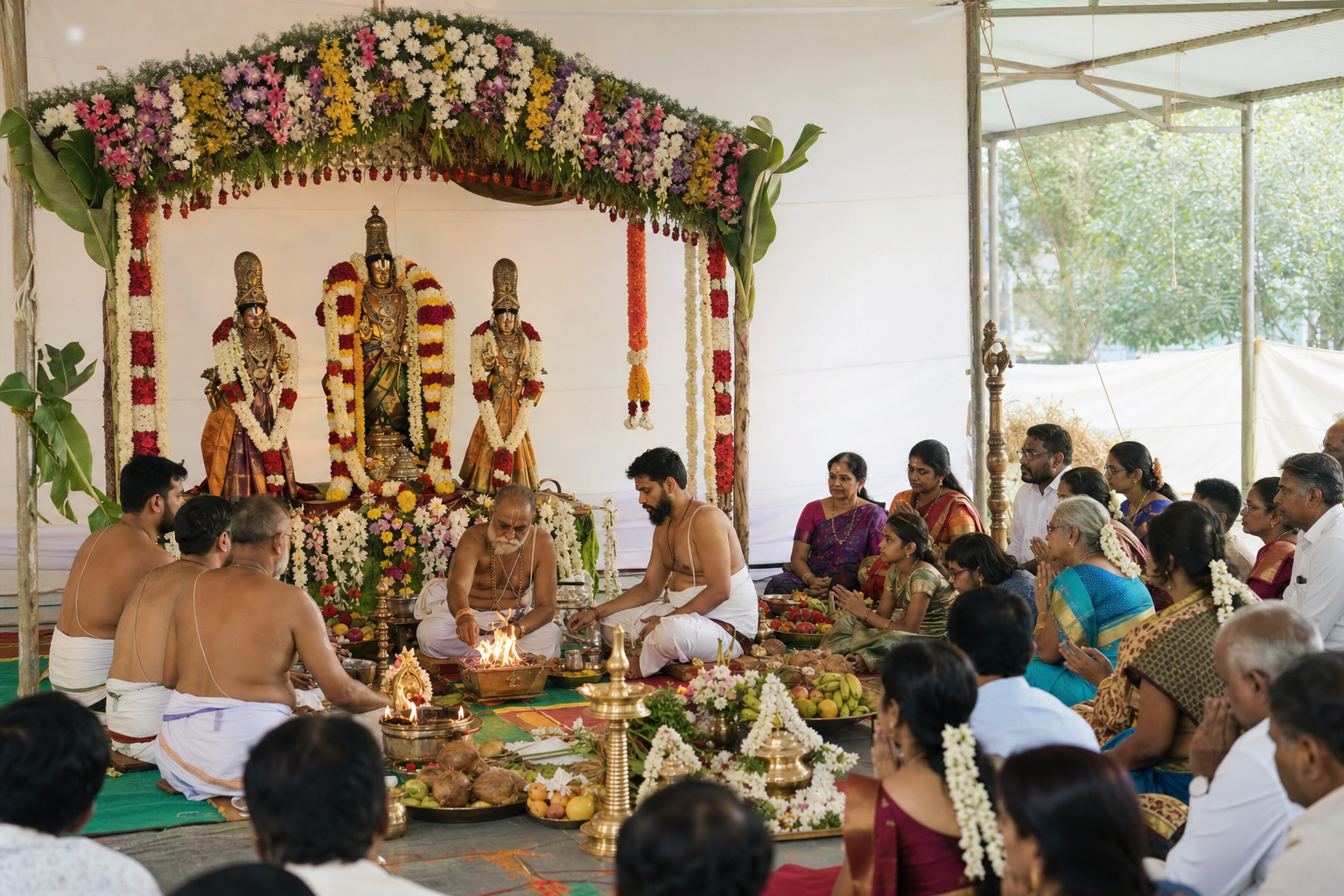
A useful example came from the Tirumala Tirupati Devasthanams’ Srinivasa Kalyanam Project. Between October 27 and November 5, 2025, it scheduled observances at five locations across Srikakulam, Alluri Sitarama Raju, and Anakapalli districts, including Paderu and Lambasingi. One disciplined ritual tradition could thereby reach several communities without requiring every devotee to travel to a major temple center.
That is more than logistical convenience. Pilgrimage remains important, but distance, age, family responsibilities, and travel conditions can limit access. A properly organized local kalyanam lets families enter the rhythm of sankalpa, mantra, music, worship, and prasadam together. The devotee is not reduced to watching a cultural performance; the purpose is collective participation in bhakti.
Accessibility does not mean that every ritual distinction disappears. A hall or open community space hosting Srinivasa Kalyanam does not become a permanently consecrated Venkateswara temple merely because the rite occurred there. Its sacred purpose is real, but its function is different. Outreach brings a specific observance to the people; consecration establishes or renews the liturgical identity of a fixed sacred place.
This distinction matters when you explain the occasion to children. Tell them before arrival that they should watch for three movements: the sankalpa that establishes sacred intent, the kalyana rites that enact the divine marriage, and the sharing of prasadam when arranged. They will understand far more from those visible transitions than from a long lecture given after the event.
The gathering may also welcome people who recognize the wider dharmic values of discipline, seva, non-harm, reverence, and community. That hospitality should not flatten the rite into a generic interfaith ceremony. Srinivasa Kalyanam is a specifically Hindu observance centered on Sri Venkateswara. Respectful inclusion works best when the ritual’s own identity remains clear.
Consecration binds sacred space to continuing responsibility
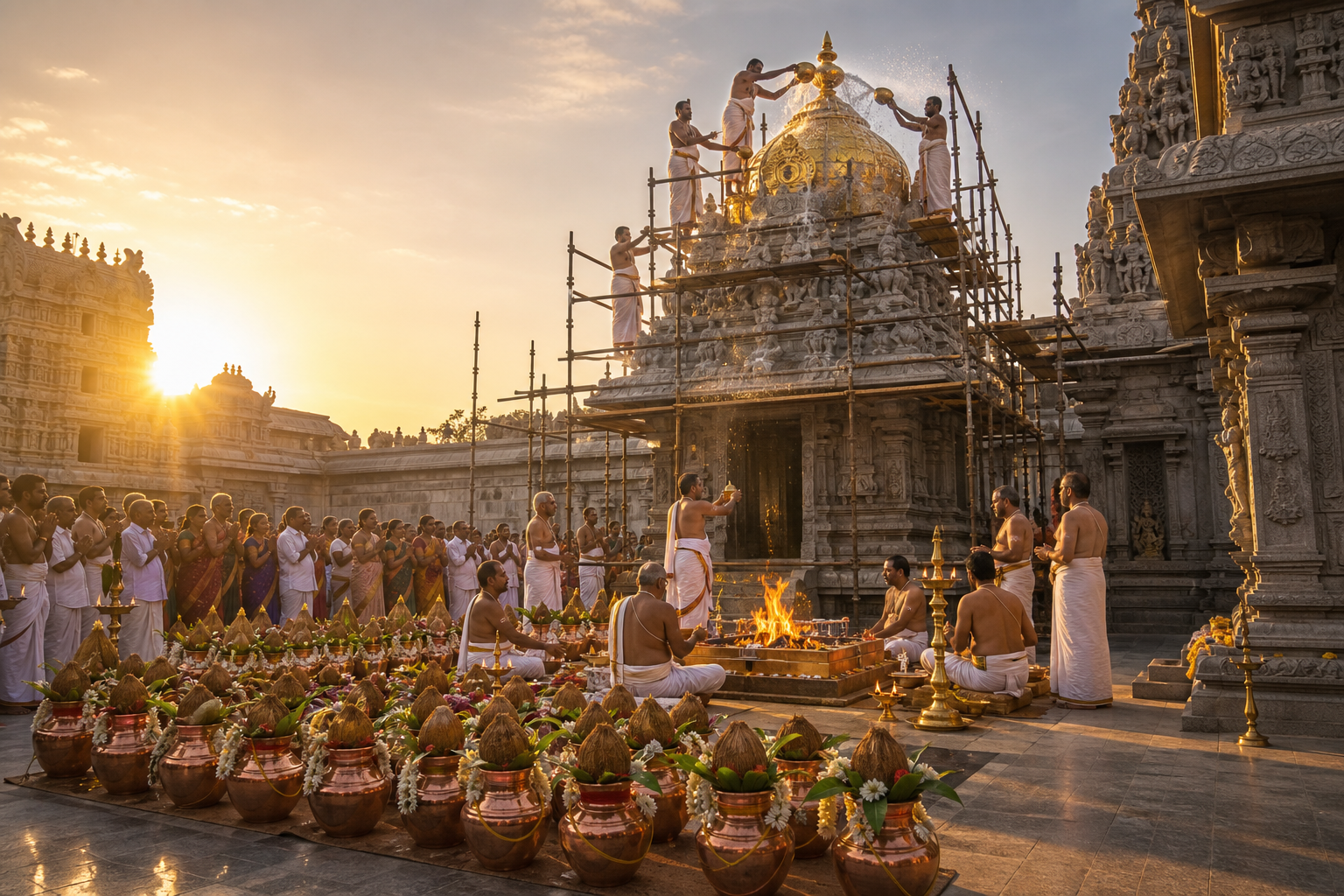
Rajampeta offered a concrete example of the other ritual form. From October 31 to November 3, 2025, a four-day Pratishtha and Maha Kumbabhishekam was held for Sri Venkateswara Swamy Temple in the premises of the 108-foot statue of Sri Tallapaka Annamacharya in Andhra Pradesh’s Annamayya district.
The opening evening included Yajamana Sankalpam. This was not a decorative preface to the more visible ceremonies. Sankalpa formalizes intention and responsibility. Placing it near the beginning shows that consecration is a process with an ethical and devotional foundation, not one dramatic act involving sacred water.
The language of re-energizing a temple should not be reduced to a mechanical idea. Within the ritual logic, Maha Kumbabhishekam renews the bond among the deity, the murti, the sacred structure, the rites performed there, and the worshipping community. The ceremony reaches its practical meaning only when regular worship, reverence, service, and responsible care continue afterward.
The Rajampeta setting added another layer of continuity. Annamacharya’s compositions in praise of Sri Venkateswara have carried devotion through music and poetry across generations. Holding the consecration beside his monumental image joined architecture, ritual, song, and regional memory. You did not need specialist knowledge to recognize the principle: a living temple culture transmits dharma through several forms at once.
If you plan to attend a consecration, do not assume that the first announced session, the most crowded moment, or the final day will necessarily contain the segment you most want to witness. Multi-day programs can separate sankalpa, homa, abhisheka, and related observances. Obtain the final schedule from the temple authorities or district administration, then identify which portions are open to general devotees. When detailed timings have not yet been issued, treat circulating unofficial schedules as provisional.
Prepare as a participant rather than an event spectator
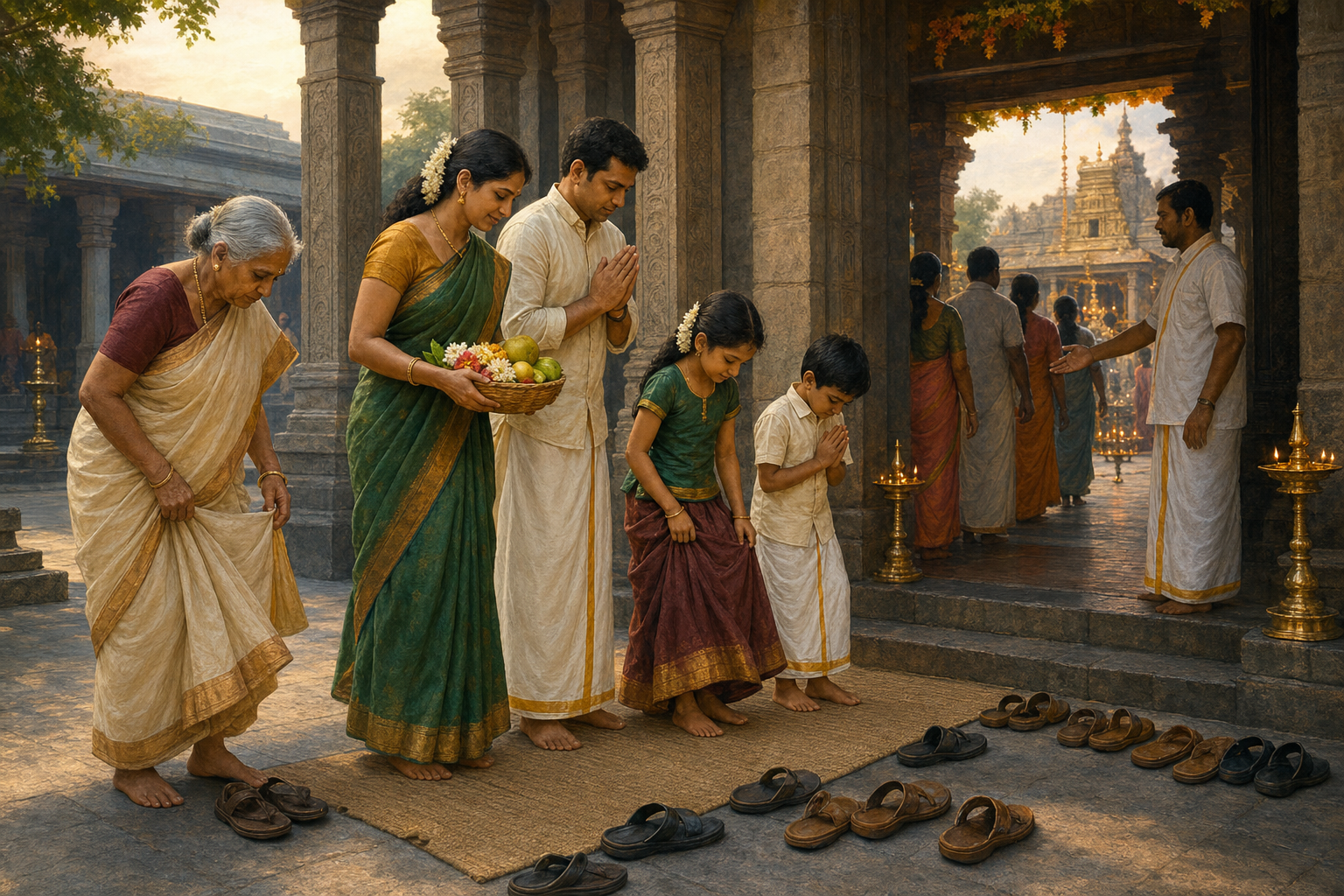
Your preparation should begin with conduct, not photography or travel enthusiasm. The following sequence works for either ritual form while preserving their differences.
- Copy the exact ritual name from the official notice. Srinivasa Kalyanam, Pratishtha, and Maha Kumbabhishekam are not interchangeable labels.
- Verify the final venue, date, access instructions, and ritual timings through official TTD communications, local temple authorities, or the district administration, as applicable.
- Choose a clear purpose before leaving home: joining collective worship, helping children learn the ritual order, supporting the temple community, or offering seva where volunteers request it.
- Arrive early. Large devotional gatherings can require managed entry, and late movement through a seated congregation disrupts both your attention and the attention of others.
- Dress modestly, carry water where permitted, and follow instructions concerning queues, footwear, seating, offerings, and movement near ritual areas.
- Protect the soundscape. Keep conversation and phone use from competing with mantras, devotional music, or instructions from priests and volunteers.
- Bring only simple offerings that the organizers have said they can accept. An offering does not create a claim to special access, seating, or ritual priority.
- Accept prasadam in an orderly way when it is distributed, and join community service only through the arrangements provided. Unrequested intervention can obstruct the people already responsible for the ceremony.
You do not need to understand every mantra to participate seriously. Watch when the congregation becomes quiet, when the sankalpa is made, how offerings move through the ritual, and how volunteers maintain order. These cues reveal the structure of the occasion and keep your attention on worship rather than spectacle.
Key takeaways for choosing and attending
- Choose traveling Srinivasa Kalyanam when accessible participation in the divine marriage ceremony is your main aim.
- Choose Pratishtha or Maha Kumbabhishekam when you want to witness and support a defining moment in the life of a particular temple.
- Do not assume that a community venue becomes a consecrated temple because it hosted a kalyanam.
- Read the final official schedule before traveling, especially when several rites are spread across multiple days.
- Measure your participation by attention, restraint, seva, and respect for the ritual order rather than by proximity to the ceremonial center.
Before committing to travel, write down the exact event name and ask the organizer which segment is intended for general devotees. Plan around that segment, arrive with one clear sankalpa, and be ready to offer one practical act of seva. That small preparation will help you enter the occasion as a devotee rather than merely pass through it as a visitor.
References
- DharmaRenaissance Blog — Essential Guide: Srinivasa Kalyanam, Srikakulam, Anakapalli, Paderu, Lambasingi (Oct–Nov 2025)
- DharmaRenaissance Blog — Complete Guide: Rajampeta Venkateshwara Swamy Maha Kumbabhishekam 2025 Dates & Significance
