

If a municipal tax notice has reached a temple you serve in Kashi, neither paying it blindly nor dismissing it outright is a safe response. Your first task is narrower: identify the property, period, activity and legal classification behind the demand.
That work matters beyond one bill. A temple may contain a sanctum, an anna-daan kitchen, rooms for pilgrims, classrooms and separately operated shops. Treating the whole compound as either entirely charitable or entirely commercial can produce an unfair result. The practical answer is to document each use, insist on published criteria and protect worship and seva without concealing genuinely commercial activity.
Start with the use being taxed, not the label on the gate
The word “temple” does not tell an assessor how every part of a property is used. Nor does the presence of income automatically prove that the entire property is commercial. Donations supporting daily worship are not the same kind of activity as rent from a separately occupied shop. A free meal service is not equivalent to a banquet business. Pilgrim accommodation provided as part of a charitable function may also require a different inquiry from ordinary commercial lodging.
This distinction sits at the heart of the concern over municipal notices issued to temples in Varanasi. The useful question is not simply, “Should temples pay tax?” It is, “What exactly is being assessed, under which rule, and on the basis of which use?”
Begin with three checks:
- Property: Does the notice identify the correct parcel, building, owner or managing institution?
- Use: Has the authority distinguished worship, charity, residence, pilgrim service and commercial occupation?
- Rule: Does the notice state the provision, classification, assessment period and calculation on which the demand rests?
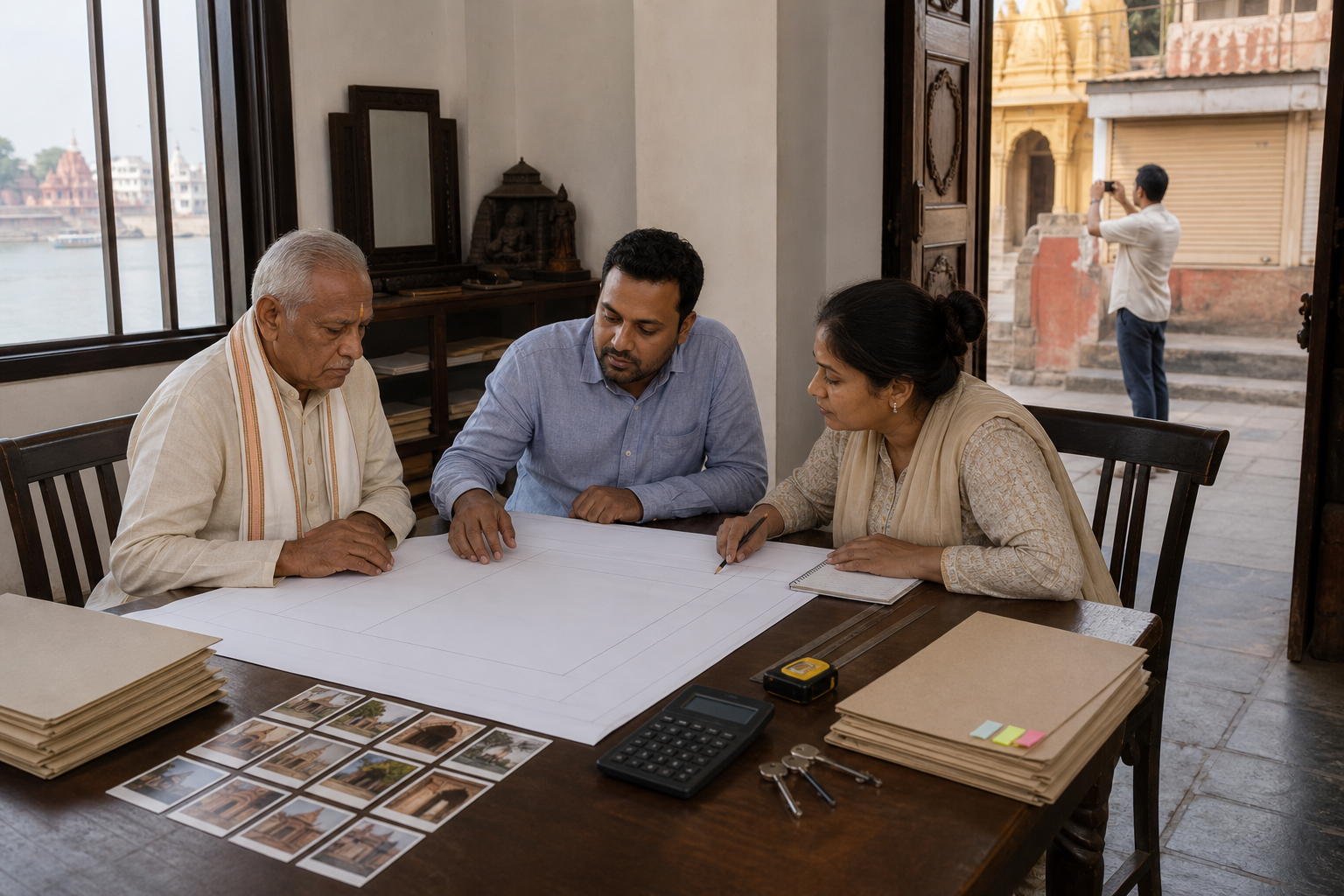
A mixed-use temple property should be mapped before anyone argues about its liability. Prepare a simple floor plan or site sketch and mark the actual use of each area. Where uses change by time rather than location, record that too. A hall used for satsang and free teaching should not be described vaguely as an “event space” if that wording could imply a commercial venue.
| Area or activity | Evidence to assemble | Question the authority must answer |
|---|---|---|
| Sanctum and public worship areas | Site plan, worship schedule and management records | Has public religious use been classified separately? |
| Anna-daan or other charitable service | Service records, expenditure entries and photographs of the working facility | Is the activity being treated as charity or mistaken for a business? |
| Dharmashala or pilgrim rooms | Room list, operating rules, receipts and concession or free-stay records where applicable | What facts support the chosen accommodation classification? |
| Educational or cultural rooms | Class schedules, programme notices and expenditure records | Has non-commercial cultural use been recognised? |
| Separately operated shop or rental unit | Marked floor area, agreement, rent records and separate accounts | Can this unit be assessed without reclassifying the whole temple? |
Articles 25 and 26 of the Constitution provide an important framework for religious freedom and the management of religious affairs. They do not, by themselves, reveal whether a particular municipal calculation is correct. That depends on the applicable law, local policy and facts of the property. If a deadline or substantial demand is involved, have a lawyer familiar with municipal and property matters examine the actual notice rather than relying on general claims circulated in public debate.
Living heritage is a public function, not a decorative status
Kashi’s sacred places are not preserved merely by maintaining stone walls. Heritage remains alive because worship continues, pilgrims arrive, festivals are observed, knowledge is transmitted and seva reaches people. Temples in the city can support anna-daan, education, cultural programmes and accommodation for pilgrims. A policy that records only the assessed building and ignores these functions sees the structure but misses the institution.
“Living heritage” should not become a vague slogan or an excuse for opaque finances. It should lead to three testable standards:
- Continuity: Is the place actively used for worship, observance, learning or a related tradition?
- Public or charitable benefit: What service is actually offered, to whom, and on what terms?
- Accountable separation: Can trustees distinguish donations and charitable spending from rent, sales or other commercial receipts?
The stronger the records, the harder it is for either side to rely on assumptions. Temple managers should maintain a modest “use and seva file” throughout the year, not assemble one only after a dispute begins. It can contain:
- A current map of the premises showing worship, charitable, residential and commercial areas.
- A calendar or register of recurring worship, teaching, cultural and service activities.
- Separate accounting entries for donations, charitable expenditure, pilgrim services, rent and sales.
- Copies of prior assessments, registrations, permissions, correspondence and acknowledgements.
- Lease or licence documents for any third-party commercial unit, with its area clearly identified.
Do not alter records, backdate descriptions or temporarily stage an activity to influence an inspection. That creates legal risk and damages the credibility of legitimate claims. If historic records are incomplete, state what is missing and begin keeping accurate records from the present date.
This discipline also protects Dharmic institutions from a broader danger: public sympathy can weaken when every revenue-generating use is described as seva. A defensible position is more precise. Worship and verifiable charity deserve heritage-sensitive treatment; a clearly demarcated commercial unit can be considered separately under published rules.
What to do when a temple receives a municipal notice
A public campaign does not stop an administrative deadline unless the competent authority formally says so. If you are responsible for the property, preserve the temple’s procedural position first. Dialogue, representation and collective advocacy can continue alongside that work.
- Record receipt immediately. Note when and how the notice was received. Scan every page and preserve the envelope, delivery record and attachments.
- Extract the operative details. Write down the property or assessment identifier, tax head, assessment period, amount, classification, cited provision, response deadline and office named in the notice. Do not assume that the heading contains the whole demand.
- Verify the property description. Compare names, addresses, boundaries and recorded areas with the temple’s documents. Mark discrepancies without writing on the original notice.
- Prepare a use map. Divide the premises into worship, charitable, residential, pilgrim-service and commercial areas. Attach evidence for each area rather than making one undifferentiated claim about the temple.
- Request the basis in writing. Ask for the applicable rule, classification criteria, calculation and inspection material. Keep a stamped acknowledgement or another reliable record of submission.
- File the required objection or response on time. A request for dialogue should not replace a formal filing. If the notice is unclear, a local lawyer can identify the correct forum and protect against avoidable procedural loss.
- Coordinate without surrendering control of the file. Temple associations can compare classifications and identify inconsistent treatment, but each institution should retain its own complete record. Redact bank details, personal identity information and other unnecessary confidential material before sharing documents publicly.
When several temples receive similar notices, compare fields rather than rumours. Were the same rules cited? Were worship areas and rented units treated separately? Did field staff ask the same questions? Were calculation sheets provided? A structured comparison can reveal whether the problem is a mistaken property record, inconsistent implementation or a policy that needs revision.
For devotees who are not trustees, the most useful support is practical. Help digitise old records, document recurring seva, obtain qualified legal or accounting assistance, or fund an accurate property survey where one is needed. Do not publish a notice with personal information exposed, pressure a manager to ignore a deadline, or turn an unresolved classification question into a claim that no civic obligation can ever apply.
A heritage-sensitive framework Varanasi can actually administer
Municipal finance is a real civic need. So are religious freedom, public charity and the continuity of Kashi’s sacred life. The two responsibilities can coexist if the system taxes by documented use and gives similarly situated institutions the same treatment.
A workable Varanasi framework would include the following:
- Published classifications. Define public worship, charitable activity, pilgrim accommodation, institutional residence and commercial use in accessible Hindi and English guidance.
- Mixed-use assessment. Allow a separately identified commercial unit to be considered without automatically converting the sanctum, kitchen, classroom or charitable hall into commercial property.
- A joint review mechanism. Bring municipal officials, relevant experts and representatives of affected religious institutions together to examine disputed categories and recurring implementation problems.
- A temporary pause for genuinely disputed demands. Where classification is under formal review, pausing coercive recovery can prevent avoidable harm without erasing the eventual legal outcome.
- Written reasons and a correction path. Every affected institution should be able to see the rule, facts and calculation used, then know where and by when an error can be challenged.
- Consistent documentation and audits. Use the same evidence standards across comparable institutions and assess clearly demarcated commercial activity through transparent criteria.
The same neutral principles should apply to similarly situated Hindu, Buddhist, Jain and Sikh institutions. This is not achieved by pretending their traditions and property arrangements are identical. It is achieved by using clear categories, respecting religious and charitable functions, and avoiding selective or improvised enforcement.
Temple representatives also have responsibilities in such a framework. They should disclose the use of each area accurately, keep charitable and commercial accounts distinguishable, cooperate with lawful inspections and correct property records when they are wrong. Reciprocity is what converts an exemption or rebate from a political favour into a credible rule of governance.
The call from saints for dialogue and transparent treatment offers the right direction, provided dialogue produces written criteria and reviewable decisions. A meeting alone cannot resolve the next disputed notice. A published system can.
Key takeaways
- A temple tax notice is first a property-use and classification question. Identify the exact rule, period, calculation and part of the premises at issue.
- Map worship, anna-daan, education, pilgrim service, residence and commercial occupation separately, then support each description with contemporaneous records.
- Constitutional religious-freedom protections frame the dispute, but the validity of a particular demand requires examination of the applicable law and facts.
- Do not let public protest or an informal assurance replace a response required by the notice. Preserve deadlines and seek qualified local advice where legal exposure is material.
- Varanasi should publish bilingual criteria, permit mixed-use assessment, pause genuinely disputed recovery during review and provide written reasons.
- Living-heritage protection is strongest when temples pair their claim to continuity and seva with transparent separation of charitable and commercial activity.
If you manage a temple, begin with a one-page property-use map and a complete copy of the notice. If you speak for devotees, ask for transparent classification rather than a slogan broad enough to hide the real issue. If you serve in civic administration, publish the criteria before the next assessment cycle creates another dispute.
Kashi can protect seva and collect legitimate civic revenue without treating one as the enemy of the other. The durable path is precise documentation, due process and a policy that recognises a temple as both a physical property and a continuing sacred institution.



References
