

You have two calendars open, and they place the same Ekadashi on different days. Before you assume that one of them is wrong, check the city, sampradaya and rule used to assign the fasting date. A Hindu sacred calendar is not merely a list of Gregorian dates.
You can avoid most calendar confusion by deciding which Panchang and temple tradition will govern your household, recording the rule behind each observance, and treating unconfirmed dates as provisional. That method is especially useful when planning the 2025–2026 Pushya Masam and the recurring Ekadashi cycle of 2026.
Why two correct calendars can assign different Ekadashi dates
Ekadashi is the eleventh tithi of each lunar fortnight. It therefore arises twice in a lunar month: once during Shukla Paksha, the waxing fortnight, and once during Krishna Paksha, the waning fortnight. The Gregorian date on which you keep the vrata depends on more than the appearance of the eleventh tithi somewhere within a civil day.
The decisive question is often whether the relevant tithi prevails at local sunrise. Smartha observance commonly uses sunrise-based considerations, while Vaishnava and Gauna traditions may apply other calendrical rules. The result can be a one-day difference in the prescribed fast without either community having miscalculated its own observance.
Location matters as well. Sunrise and tithi boundaries depend on place, so a calendar prepared for one city should not automatically govern a household in another region or country. This becomes particularly important for diaspora families who receive dates from relatives in Bharat while worshipping with a local temple elsewhere.
When dates disagree, compare them in this order:
- Confirm that both entries refer to the same Ekadashi and the same paksha.
- Check the city or geographical location for which each Panchang was calculated.
- Identify whether the date is intended for Smartha, Vaishnava, Gauna or another community practice.
- Check whether your family normally follows its regional Panchang, its sampradaya or the calendar of the temple where it worships.
- If uncertainty remains, ask the temple which date it will observe and follow that answer consistently rather than switching rules from month to month.
Consistency is more useful than searching for a supposedly universal date. Ekadashi is universally revered, but its calendrical application is not identical across every sampradaya.
Build a calendar that records decisions, not just dates
A bare entry reading “Ekadashi” conceals the information you will need when another calendar disagrees with it. Give every fasting entry enough context to explain itself six months later.
- Observance: Record the name of the vrata or festival and whether it falls in Shukla or Krishna Paksha when that distinction is relevant.
- Authority: Name the regional Panchang, temple calendar or sampradaya schedule you followed.
- Location: Record the city for which the calculation applies, especially if you travel or coordinate worship across countries.
- Fasting date: Put the locally prescribed civil date in the calendar title so the practical commitment is unmistakable.
- Completion: If the trusted calendar supplies a time or window for ending the fast, place it in the same entry rather than relying on memory.
- Community event: Add the temple puja or gathering separately if its timing differs from your household practice.
Use two layers in your annual plan. The first contains recurring principles: two Ekadashis per lunar month, local sunrise calculations, and your chosen community rule. The second contains confirmed Gregorian dates and times. This prevents a provisional internet list from acquiring the authority of your household Panchang merely because it was copied first.
When travel crosses regions or time zones, check the observance again for the place where you will actually be fasting. Do not simply preserve the date calculated for your home city. The sacred calculation follows local time; your digital calendar does not correct its religious meaning automatically.
Make the fast a coherent vrata rather than a food challenge
The practical purpose of planning is to protect the vrata from an ordinary day’s interruptions. Decide its form before the day arrives: when you will pray, which household duties can be simplified, whether you will attend temple, and how you will make room for japa or scriptural reflection.
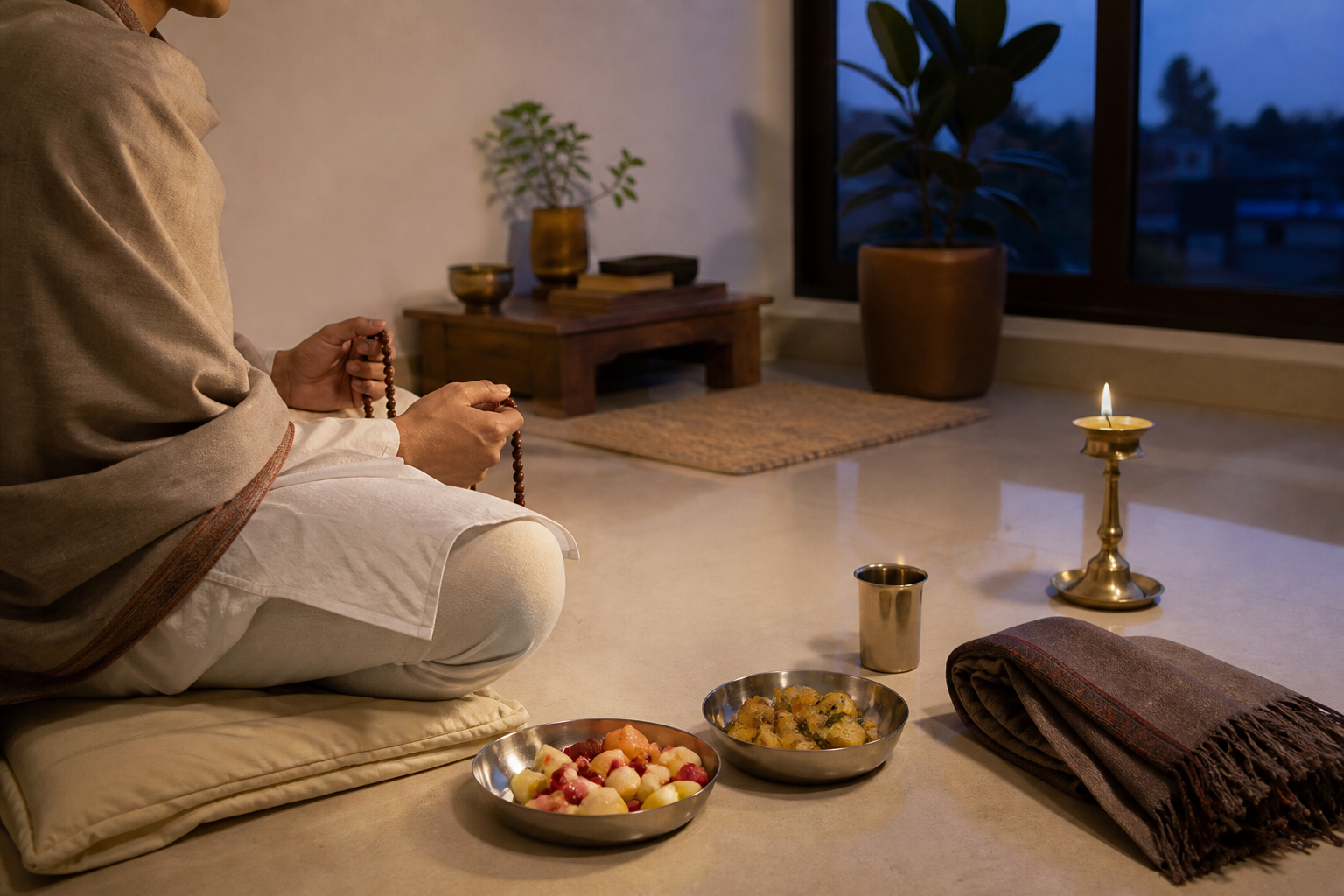
For an Ekadashi centred on Vishnu bhakti, a workable household rhythm can include quiet japa before the day becomes busy, Vishnu Puja, mantra recitation, reflective prayer and simple sattvic food where that form of fasting accords with your tradition. Add one deliberate act of seva or charity so that restraint does not turn inward and become mere endurance.
Choose the degree of food restriction according to the vrata taught in your family or sampradaya and what is safe for you. If restriction could conflict with a medical condition, prescribed treatment or another health need, seek qualified medical guidance and adopt a safe devotional form. A vrata is not a substitute for medical care, and physical extremity is not the measure of bhakti.
The wider dharmic family offers a useful ethical reminder here. Hindu, Buddhist, Jain and Sikh disciplines are not interchangeable calendars, but they give kindred importance to self-restraint, compassion and service. Honour that kinship without erasing the distinct practice of any path.
Use Pushya Masam as a fixed planning anchor
In the Telugu calendar followed in Andhra Pradesh and Telangana, Pushya Masam is the tenth month. For the 2025–2026 cycle, it runs from December 21, 2025 through January 18, 2026. Put that entire span into your calendar as a background period before adding its individual observances.
This dating follows the amanta lunisolar system, in which the lunar month ends with Amavasya. The system is also prevalent in Karnataka, Maharashtra, Goa and Gujarat, but local almanacs can still vary in exact boundary times because geography and sunrise remain relevant. Shared use of amanta reckoning does not remove the need for a local Panchang.
Pushya is treated in parts of South India as less favourable for certain major life-cycle celebrations, especially weddings and large initiations. Do not turn that regional caution into a universal prohibition. If you are planning such a ceremony during this period, ask the family priest or temple about the applicable tradition and the day’s muhurta before signing contracts or announcing a date.
The same month remains well suited to steady forms of sadhana: routine puja, vrata, scriptural learning, dana and service. Give the month one attainable household commitment. You might establish a regular study period, set aside a planned act of charity, or simplify meals and social commitments so daily worship is not repeatedly displaced.
Makara Sankranti falls within this Pushya period and brings an agricultural expression of gratitude into the month’s quieter discipline. Mark the festival within the date range, but confirm its precise local timing through the same Panchang and temple authority you use for the rest of the calendar. Do not infer an exact observance date merely from the month’s boundaries.
Key takeaways for your 2025–2026 calendar
- Ekadashi occurs on the eleventh tithi of both Shukla and Krishna Paksha, but the civil fasting date can differ by one day across calendrical traditions.
- Select one primary regional Panchang and one community authority before entering the full year of dates.
- Record the city, sampradaya, fasting date and any supplied completion window in each calendar entry.
- For Telugu observance in Andhra Pradesh and Telangana, reserve December 21, 2025 through January 18, 2026 for Pushya Masam.
- Use Pushya for worship, learning, dana and service; seek tradition-specific muhurta guidance before scheduling a wedding or major initiation.
- Let the fast organise prayer and conduct. Do not judge its seriousness by physical severity.
Before adding another 2026 observance, write the name of the Panchang, city and temple tradition at the top of your calendar. That single decision will resolve more confusion than collecting another list of dates.


References
- DharmaRenaissance Blog — Ekadashi 2026: Auspicious Vrat Dates and Vishnu Puja Guide for Shukla & Krishna Paksha
- DharmaRenaissance Blog — Pushya Masam 2025–2026: Sacred dates and traditions in the Telugu calendar for AP & Telangana
