
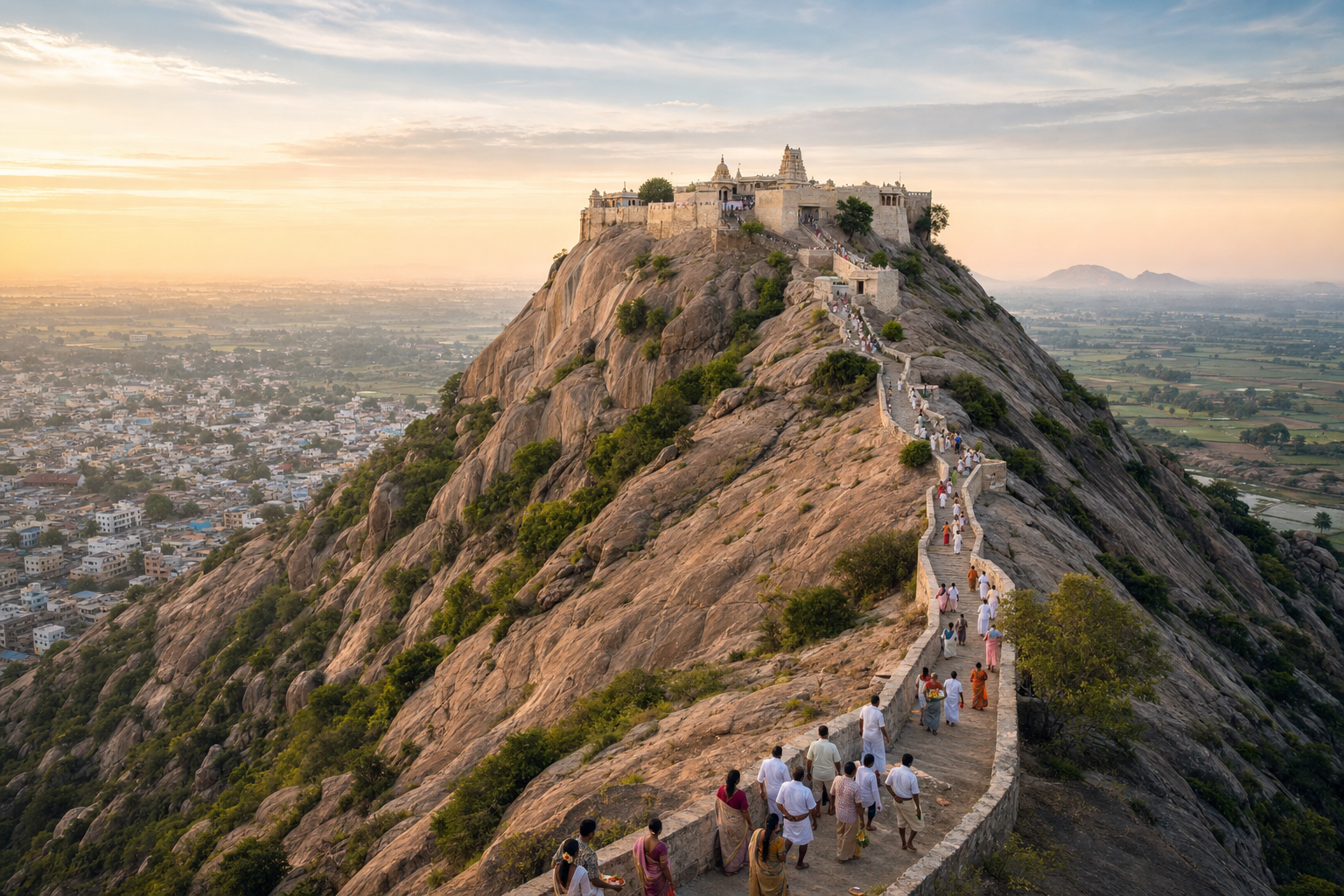
If Tiruchengode is sitting on your itinerary as simply another Murugan temple, pause before you go. Its pilgrimage tradition is built around a particular relationship between the hill, the ascent, the Ardhanarishvara sanctum, and the white, east-facing Sengottuvelan bearing the Vel and rooster emblem. You will miss much of the place if you rush straight to one shrine and leave.
The better approach is to arrive with one question that matters to you, let the climb and Tiruppugazh steady the mind, and read the deity’s iconography as instruction. This is not a prescribed temple ritual. It is a practical way to make your visit a pilgrimage rather than a sightseeing stop.
Read the hill as a single sacred composition
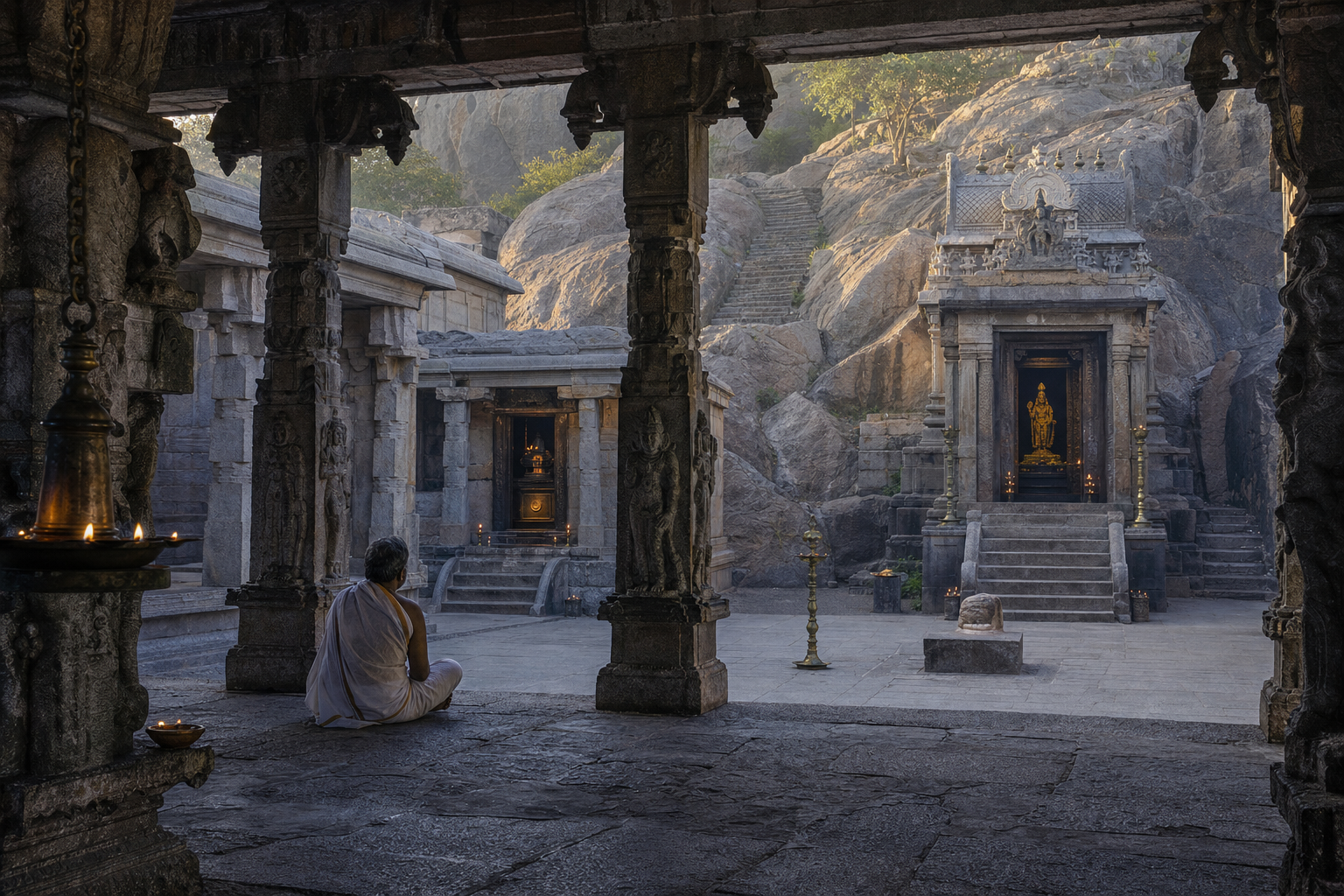
Tiruchengode rises from a granite outcrop in Kongu Nadu, in western Tamil Nadu. The sacred hill is not divided into unrelated religious attractions. Sengottuvelan shares it with the renowned Ardhanarishvara sanctum, bringing Subrahmanya into a larger Shaiva-Shakta-Subrahmanya sacred setting.
That relationship should shape your visit. Ardhanarishvara presents Shiva and Shakti in one form; Sengottuvelan presents their son as the bearer of wisdom, discipline, and courageous action. The two darshans do not compete. Together they move from divine completeness to the power that acts within the world.
Do not invent a mandatory order between the sanctums, and follow any sequence indicated by the temple’s priests or local practice. What matters is that you make room for both. If you approach only Murugan and ignore the wider complex, you lose the theological grammar of the hill. If you see only Ardhanarishvara and treat Sengottuvelan as a minor addition, you miss the distinctive Murugan tradition that made Tiruchengode part of Tamil sacred geography.
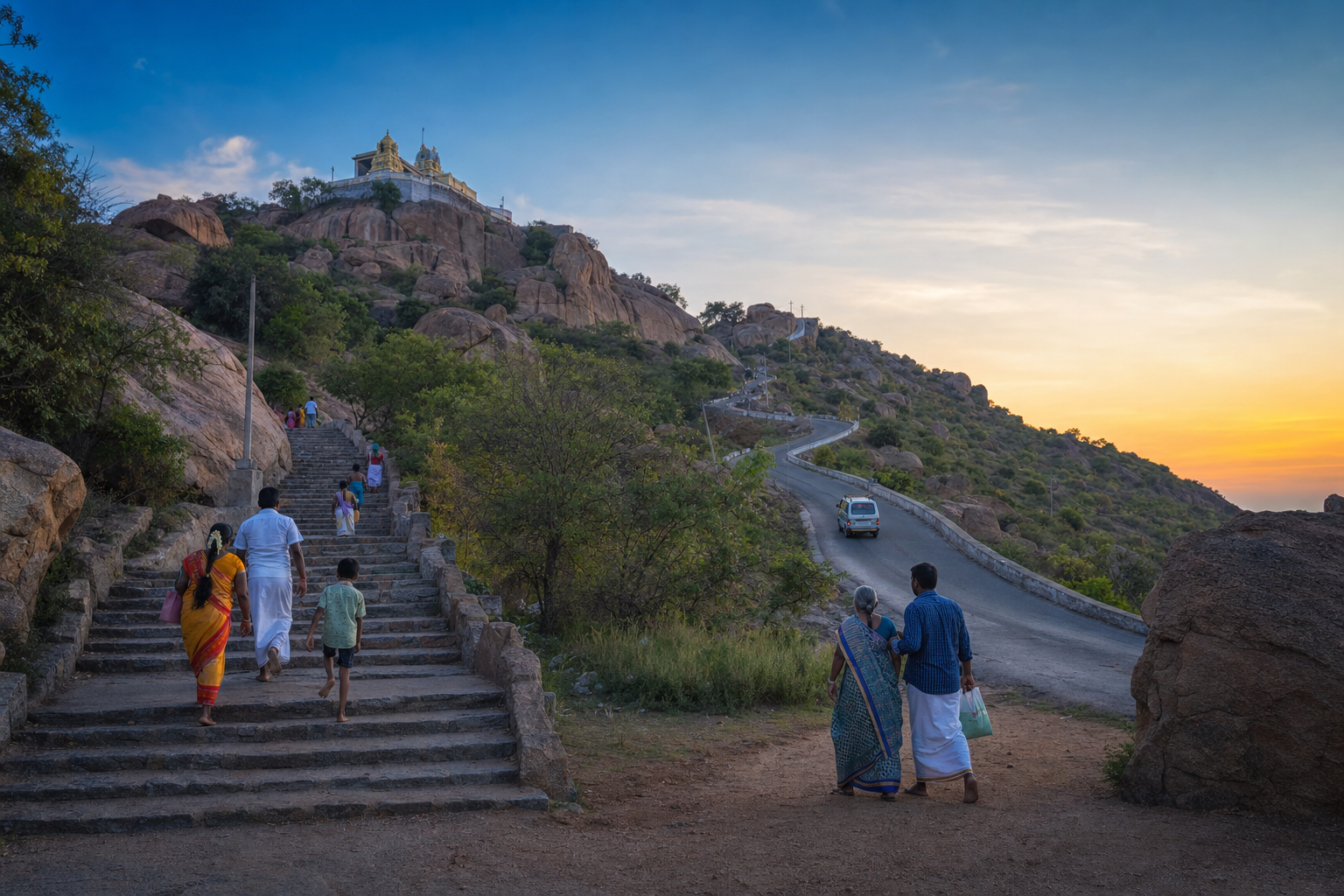
The physical setting reinforces this unity. Rock-cut steps, circumambulatory routes, and pillared mantapas adapt worship to the slope, changing how you encounter space, light, and breeze as you move. Stylistic and inscriptional indications point toward successive patronage through Chola, post-Chola, and Nayaka phases. Do not try to force the whole complex into a single construction date. Notice instead how generations preserved a living shrine by adding to it.
This setting also carries a wider Dharmic resonance without making different traditions identical. Murugan’s wisdom, restraint, and fearlessness can be understood beside Buddhist commitments to ethical conduct and insight, Jain commitments to right conduct and non-possession, and the Sikh ideals of fearlessness, freedom from hatred, and seva. For you as a pilgrim, the shared point is practical: spiritual clarity must become disciplined conduct.
Make the ascent part of your sankalpa
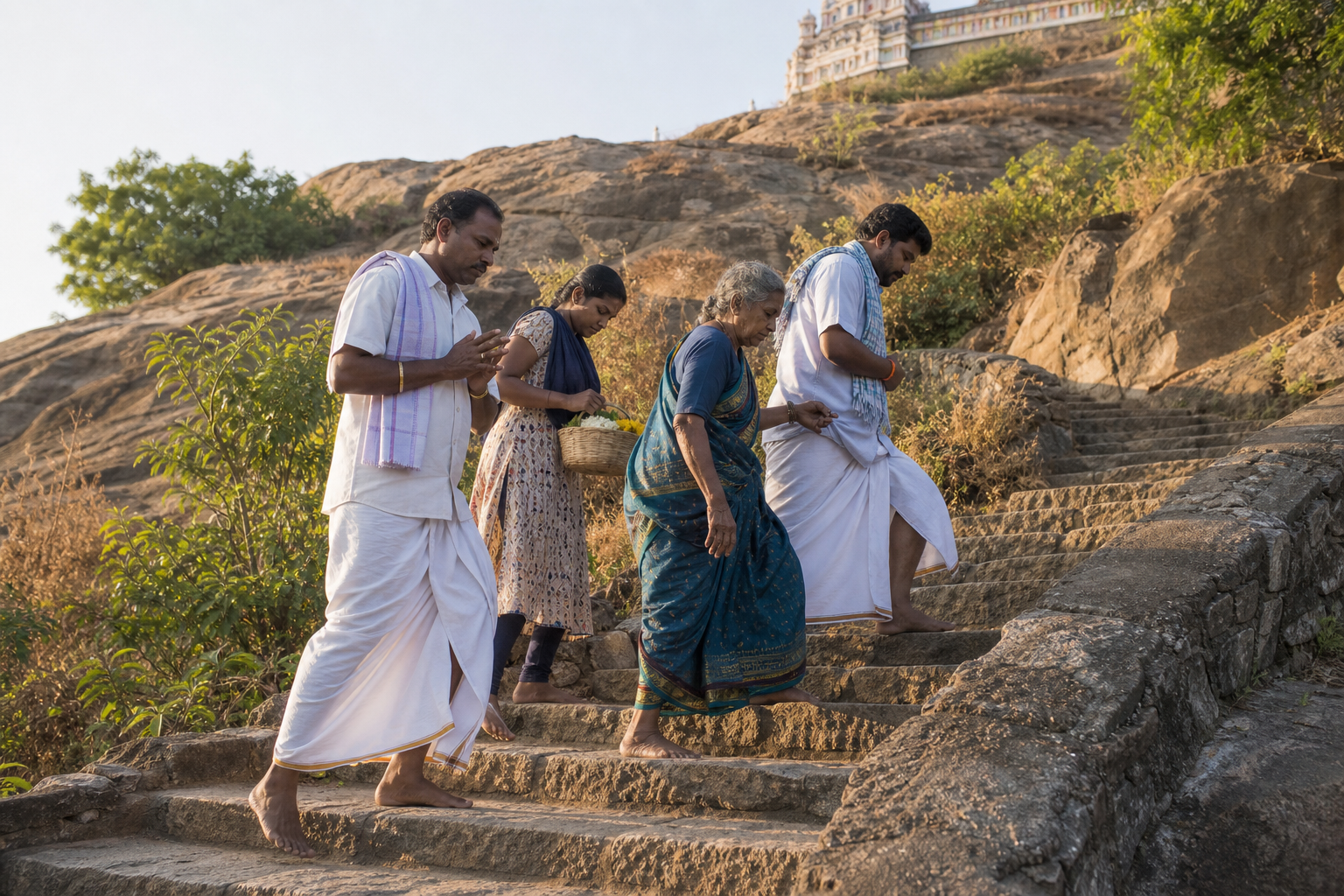
You can reach the summit by the stone-cut steps or by road. The steps naturally lend themselves to physical discipline, but the number of steps you climb is not a measure of devotion. If heat, health, age, or mobility makes the ascent unsafe, use the drive and follow current local guidance. A pilgrimage weakened by avoidable injury serves neither the devotee nor the deity.
Whichever route you use, begin with a sankalpa: name the purpose of the visit in one plain sentence. It may be a decision you have delayed, a duty you are resisting, or a habit that keeps clouding your judgement. Tiruchengode’s Vel symbolism is particularly suited to such a pilgrimage because it asks for discernment followed by action, not a vague request for life to become easier.
- Before starting upward, identify one confusion you want to see clearly. Keep it specific enough that you will recognise an answer.
- During the ascent or drive, reduce unnecessary conversation. Use a Murugan nama, a Tiruppugazh hymn you know, or deliberate silence instead of treating the route as dead time.
- At natural pauses, notice your impulse to hurry. Resume without turning the pause into an obstruction for other pilgrims.
- Before darshan, bring your question back to mind once. Then stop rehearsing it and give your attention to Sengottuvelan’s form.
- After darshan, write or state one action that follows from the clarity you sought. If no action is yet clear, do not manufacture an omen; carry the question home and continue the discipline.
This sequence is a personal devotional framework, not a replacement for archana, pradakshina, or the temple’s established order. Its purpose is to stop the outer climb and inner intention from separating. Even when you travel by vehicle, you can preserve that connection by keeping the approach quiet and resisting the urge to arrive distracted by calls, photographs, or itinerary pressure.
Meet Sengottuvelan through sight and sound
Read the icon without reducing it to decoration
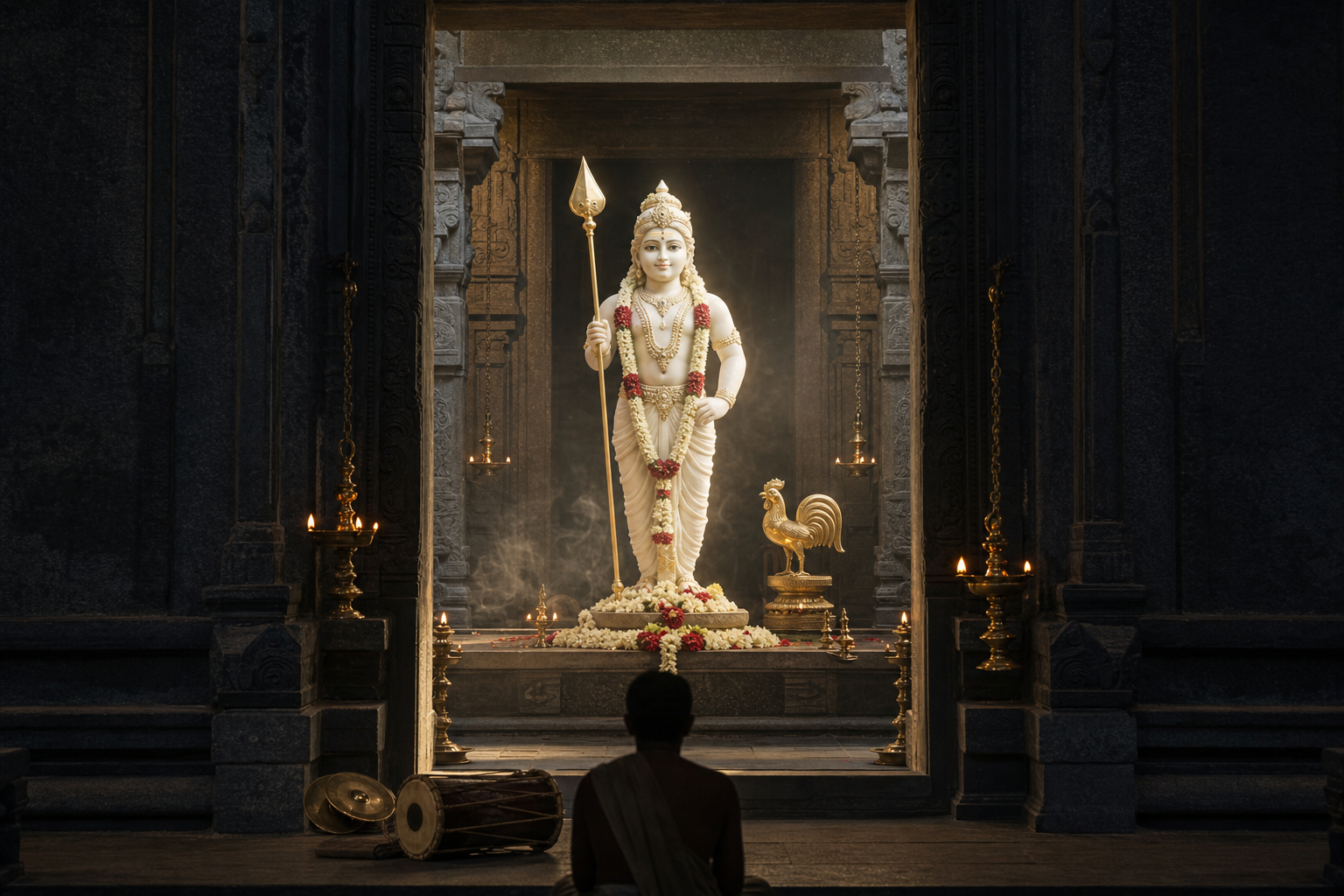
Sengottuvelan is conventionally understood as the lord of the eminent Vel. At Tiruchengode, the deity’s white appearance, eastward orientation, spear, and seval kodi form a coherent field of meaning. They are not merely visual details to record before moving on.
The Vel signifies viveka, the capacity to distinguish clearly, as well as kshatra, courage governed by dharma. It therefore challenges two common evasions at once. Insight without action becomes hesitation; force without discernment becomes recklessness. The weapon in Murugan’s hand represents the disciplined union of the two.
The rooster standard adds vigilance. In the Surapadma cycle told in the Skanda Purana and the Tamil Kanda Puranam, the defeated asura is connected with the peacock that becomes Murugan’s vehicle and the rooster that becomes his standard. Victory is consequently carried forward as remembrance. The lesson for a pilgrim is not merely to defeat one bad impulse, but to remain awake when it tries to return in another form.
The white surface directs attention toward sattva: clarity, steadiness, and calm. The eastward gaze evokes sunrise, renewal, and a worthy beginning. Hold the elements together during darshan. Ask where the Vel must separate truth from excuse, where the rooster must keep you vigilant, and what a sattvic response would look like after you leave the hill.
Let Tiruppugazh supply the sound of the pilgrimage
Arunagirinathar, the 15th-century Murugan devotee credited with more than 1,300 Tiruppugazh hymns, placed Tiruchengode within a broad network of Tamil Murugan pilgrimage. His compositions unite intricate metre, music-sensitive phrasing, precise theology, and direct devotion. At this hill, Tiruppugazh is not background music. Its disciplined rhythm gives an audible form to the concentrated mind symbolised by the Vel.
If Tiruppugazh is sung during your visit, listen before reaching for your phone. You do not need technical knowledge of metre or raga to follow its devotional movement. Attend to repetition, breath, and the way a group holds a demanding rhythm together. If you already practise the hymns, choose a Tiruchengode composition from a reliable text before travelling rather than improvising at the sanctum.
If no singing occurs while you are there, the pilgrimage has not failed. Do not assume that a remembered dawn atmosphere guarantees a performance at a particular hour. Abhishekam, alangaram, archana, and pradakshina remain central parts of the temple’s living worship tradition. Participate only through the arrangements provided by the temple, and let silence do the work when music is absent.
Choose the day and route for the pilgrimage you need
Your first decision is whether you want collective festival worship or a less compressed visit centred on contemplation. Tiruchengode follows the classical Murugan cycle, including Vaikasi Visakam, Skanda Sashti and Soorasamharam, Karthigai Deepam, Panguni Uthiram, Aadi and Thai observances, and monthly Sashti. Choose a festival because you want its particular ritual meaning and shared devotion, not merely because it is the most prominent date on a calendar.
If you want time to study the icon, include Ardhanarishvara in the pilgrimage, and sit with your sankalpa, consider a non-festival visit. That choice does not guarantee an empty temple, just as a festival choice does not tell you the exact access arrangements. Confirm the current temple calendar, opening hours, road conditions, step access, and special restrictions before leaving. The deity’s eastward orientation carries sunrise symbolism, but it does not by itself guarantee that you can obtain dawn darshan on the day you choose.
Tiruchengode is in Namakkal district between Salem and Erode and is well connected by road within the Kongu region. Erode and Salem are the principal railheads identified with access to the town, while broader air connections run through Coimbatore and Tiruchirappalli. Use those places as planning anchors, but verify your actual connection and onward transport rather than relying on a sacred-circuit map as a timetable.
If Tiruchengode is one stop in a longer Murugan journey through places such as Palani, Thiruchendur, Swamimalai, or Marudamalai, resist compressing it into whatever time remains. Its distinctive contribution is the meeting of Sengottuvelan, Ardhanarishvara, hill ascent, and Tiruppugazh. Allow enough time for that relationship to become visible. A rushed summit photograph does not disclose it.
Pilgrimage etiquette is also conservation practice. Keep paths clear, follow local rules for photography and offerings, avoid touching or marking old masonry and painted surfaces, and carry litter away from the hill. Tiruchengode’s ritual continuity depends on protecting the physical setting in which that ritual occurs. Respect for the icon cannot be separated from respect for the stone, music, workers, priests, and fellow devotees who sustain its worship.
Key takeaways
- Approach Sengottuvelan and Ardhanarishvara as parts of one sacred hill rather than unrelated stops.
- Bring one definite sankalpa: a confusion requiring discernment, a duty requiring courage, or a habit requiring vigilance.
- Read the Vel as wise action, the rooster as sustained alertness, the white form as sattvic clarity, and the eastward gaze as renewal.
- Use the steps if they are safe for you; use the road without guilt when health, heat, age, or mobility makes climbing unwise.
- Choose festival dates for collective observance and a non-festival visit when sustained contemplation is your priority.
- Verify current timings, access conditions, and ritual arrangements instead of assuming that symbolic sunrise, remembered music, or a festival name guarantees a particular experience.
Before you leave home, write the one sentence you will carry up the hill. After darshan, add one action beneath it. That small discipline gives Sengottuvelan’s Vel somewhere to enter your life: not as a souvenir of Tiruchengode, but as clearer conduct when you return.
References
