
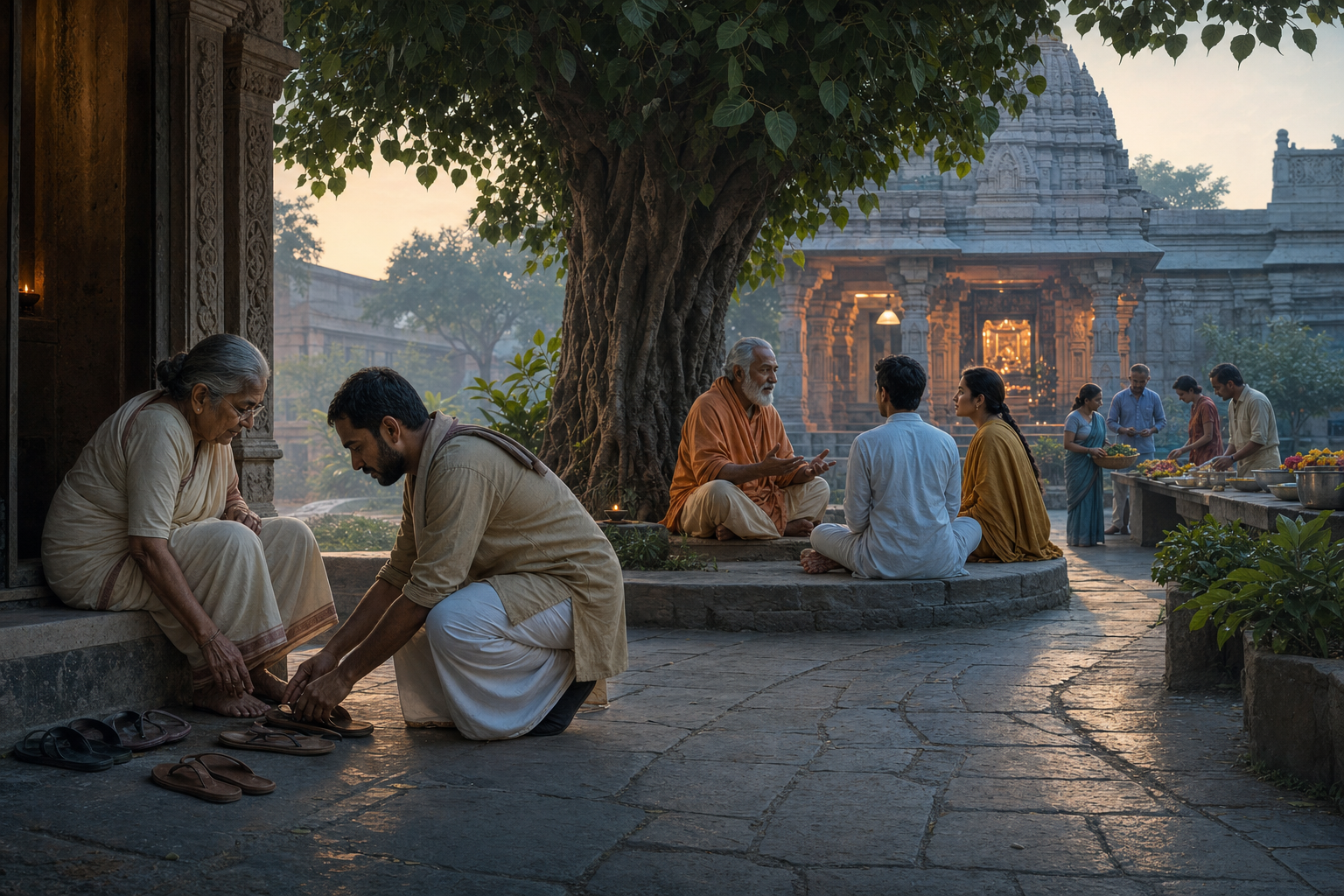
You trust your guru, practise the teaching, and feel the connection inwardly. Then a plain question arises: do you still need to visit a temple, or has the guru relationship made temple practice unnecessary?
A direct connection with a guru does not settle that question by itself. The useful question is what each part of your spiritual life is doing to you. Guru guidance should correct and orient you. Temple practice should help place devotion within sacred form and community. Seva should carry both into conduct that is less governed by self-interest.
Stop asking which practice replaces the other
A guru and a temple are not interchangeable. A guru may give teaching, discipline, clarification, and a living example of the path. A temple gives sacred space, inherited forms of worship, and the presence of a community whose devotion does not depend on your private mood.
Temple-going also performs cultural and sociological work alongside its spiritual meaning. You enter a space shaped by generations rather than designed around your preferences. You stand among children, elders, newcomers, regular devotees, and people whose ways of worship may differ from yours. That shared setting reminds you that dharma is more than a private experience.
The guru-shishya relationship does not automatically perform that communal work. Nor does temple attendance replace personal instruction. You can visit temples frequently while avoiding every difficult teaching. You can also speak constantly about your guru while becoming detached from the duties and relationships through which dharma must be lived.
Different sampradayas give different weight to temple worship, home practice, pilgrimage, meditation, mantra, and service. If your guru has given an explicit instruction, do not flatten it into a universal rule. Clarify its scope. Is it a discipline for your present stage of sadhana, a response to particular circumstances, or a lasting expectation? Does it concern a particular form of worship, or temple-going as such? Clarity prevents both convenience and social pressure from disguising themselves as obedience.
Before changing your temple practice, ask:
- What has my guru actually asked me to practise, rather than what have I inferred?
- What does the temple give me that home practice does not: ritual rhythm, humility among others, cultural continuity, or responsibility toward a community?
- Am I withdrawing because my discipline has genuinely deepened, or because travel, crowds, disagreement, or inconvenience have become unwelcome?
- If I remove temple practice, what will preserve the remembrance, accountability, and service that it supported?
Use the temple as a practice, not proof of piety
The value of a temple visit is not measured by how visibly moved you feel. A quiet visit may steady your conduct for days. An intense experience may change nothing once you return home. Instead of judging the visit by emotion, give it a clear movement: preparation, attention, and follow-through.
- Set an intention before entering. Complete the thought: I am here to remember, receive, offer, or correct something. This keeps the visit from becoming a hurried transaction.
- Examine the shape of your prayer. If every thought is a request, add gratitude and a willingness to serve. Asking for help is not wrong, but devotion becomes narrow when the Divine is treated only as the fulfiller of personal wants.
- Watch your conduct around the ritual. The way you treat relatives, strangers, other devotees, and temple workers is part of the visit. Impatience outside the sanctum cannot be separated neatly from reverence inside it.
- Carry an obligation home. Let darshan lead to a concrete duty: repairing a relationship, completing neglected work, helping someone without display, or restraining a habit that harms others.
- Leave without demanding a sensation. Sacred practice is not a failed transaction merely because you did not feel peaceful, inspired, or transformed on command.
The social side of temple life also needs discipline. Participate in community without allowing the visit to collapse into gossip, status-seeking, or sectarian competition. If crowds make attention difficult, choose a quieter time when possible. If a local custom is unfamiliar, ask respectfully instead of assuming that unfamiliarity means error. If you encounter conduct that troubles you, distinguish between a correctable human failing and the value of the institution itself.
You do not have to pretend every temple visit is ideal. The practical aim is to use the temple well: receive what it uniquely offers, contribute to its shared life, and refuse to turn attendance into a certificate of spiritual superiority.
Let the guru connection become correction, not identity
A direct connection with a guru is easiest to misunderstand when closeness becomes a claim of rank. Feeling known, blessed, or inwardly connected can be meaningful, but none of those feelings proves that the teaching has entered your conduct. The sounder test is correction: what becomes more truthful, disciplined, compassionate, or dependable because you received the guidance?
After hearing a teaching, name the behaviour it asks you to change. If you cannot identify any consequence beyond feeling reassured, inspired, or special, stay with the teaching longer. Upadesha should not remain a collection of memorable words.
- Do not use the guru’s name to end a discussion that you have not understood well enough to explain.
- Distinguish the guru’s instruction from your preferences and from the opinions of other disciples.
- Notice when you apply demanding teachings to others while granting yourself exemptions.
- When an instruction seems unclear, ask a concise question about the expected practice instead of building a large conclusion on an assumption.
- Judge progress by conduct under inconvenience, not only by devotion during satsang, darshan, or meditation.
Do not make the guru relationship a permission slip to disdain temple-goers as merely external. Outward practice can be empty, but inward claims can be empty too. A person who bows before a murti may be learning humility through the body. A person who meditates on the guru may be learning inward steadiness. Either practice can become mechanical, and either can become transformative.
The same caution applies in reverse. Temple regularity does not justify dismissing a devotee whose discipline is centred on guru-given practice at home. Look for the fruit before making a judgement: sincerity, responsibility, restraint, service, and the ability to respect paths other than one’s own.
Make selfless living the test that joins them
A durable spiritual orientation asks you to loosen the grip of I-me-mine and dedicate life to a larger purpose or to service. This does not mean erasing your personality, neglecting legitimate needs, or allowing others to exploit you. It means that your comfort, recognition, and advantage stop being the only claims that matter.
This is where temple and guru meet ordinary life. Darshan becomes conduct when reverence changes how you treat the people who cannot reward you. Guru guidance becomes conduct when you perform a necessary duty even after the inspiration has faded. Seva reveals whether your spiritual life is widening your concern or merely decorating the self.
You do not need a dramatic project before you can serve. Family responsibility, honest work, care for a dependent person, support for a temple or community, and patient attention to someone in difficulty can all become fields of seva. The important shift is from asking what the act will add to your identity to asking what the situation genuinely requires.
Use this discipline to keep service honest:
- Name the real need. Do not decide what another person needs merely because it gives you the role you want to play.
- Work within your capacity. Service that destroys essential family duties, health, or financial stability is unlikely to remain steady. Boundaries can protect the duty rather than oppose it.
- Prefer reliability to display. Choose work you can continue after praise and novelty disappear.
- Preserve dignity. Help without turning another person’s difficulty into evidence of your virtue.
- Release ownership. Do not treat the person, temple, or community you helped as owing you influence.
- Examine the residue. Resentment, hunger for recognition, and the desire to control the outcome are signs that self-interest has re-entered the act. Notice them without abandoning the duty; correct the motive as you continue.
This gives you a practical diagnostic. If temple attendance feeds pride, change the way you attend. If guru affiliation feeds superiority, return from the affiliation to the instruction. If seva becomes control, ask the recipient what is actually useful. If your practice collapses when nobody notices it, keep more of it private for a while.
Key takeaways
- Guru connection and temple practice need not compete; they often serve different spiritual, cultural, and communal functions.
- Follow lineage-specific guidance with clarity about its scope instead of turning a personal instruction into a rule for everyone.
- Measure temple practice by what you carry into daily conduct, not by attendance, emotion, or social recognition alone.
- Measure guru connection by correction and disciplined action, not by a feeling of special access.
- Use seva to test both practices: devotion should gradually make your duties less self-centred, more reliable, and more respectful of others.
- If you remove a practice, name what will preserve the remembrance, accountability, community, or service that the practice previously supplied.
At your next temple visit, satsang, or period of home practice, carry this question: what must become less self-centred in my conduct? Then choose an act that answers it. The passage from darshan and upadesha into lived dharma is where temple, guru, and seva belong together.

References
- Hindu Pad — Is it necessary to visit temples if one has direct connection with the Guru?
- Hindu Pad — Main Mantra for Happy Life