
If you are preparing for your first major South Indian temple festival, the hardest question is not simply when to arrive. You need to know which ritual you hope to witness, which timings may change, and how to move through a crowded sacred space without turning darshan into a contest.
The useful shift is to stop treating the festival as a single event with a fixed opening time. It is an ordered cycle of purification, preparation, worship, revelation, and procession. Once you can read that cycle, you can plan intelligently while remaining receptive to the temple’s actual rhythm.
Read the festival as a sequence, not a show
South Indian temples share a ritual vocabulary, but they do not follow one interchangeable script. Agamic discipline, the presiding deity, the temple’s sampradaya, and local custom determine what happens and in what order. Learn the grammar, then defer to the temple in front of you.
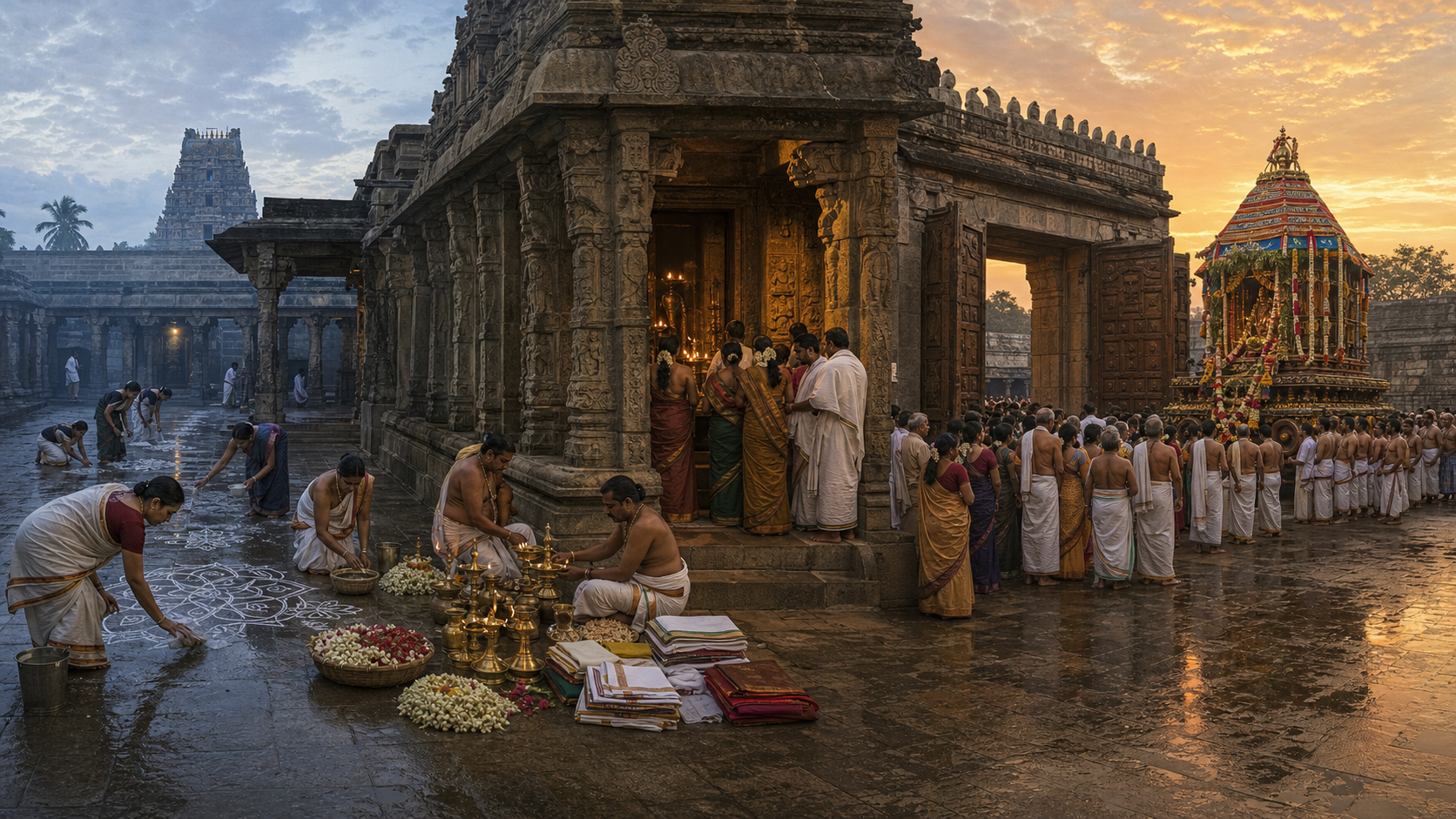
- Purification prepares the sacred space. Some observances begin before the principal festival day with a formal cleansing of the temple. At Tirupati’s Sri Govindaraja Swamy Temple, for example, Koil Alwar Tirumanjanam was scheduled from 7 a.m. to 9 a.m. on December 25, 2025, before Vaikuntha Ekadasi on December 30. Priests and temple staff cleanse key areas, recite mantras, and restore ceremonial order. Access to parts of the complex may be restricted while this is underway.
- Abhishekam ritually bathes the deity. On a major festival day, this may occur before dawn and well before the largest public queues form. If abhishekam is your priority, arriving only for the most widely advertised darshan window may be too late.
- Alankaram adorns the deity after the ritual bathing. This is not decorative delay. The form presented for darshan has been deliberately prepared for that sacred occasion.
- Archana and deeparadhana gather attention around mantra, offering, and light. Maha Deeparadhana can be a central moment of collective worship, but its time remains subordinate to the completion of the preceding rites.
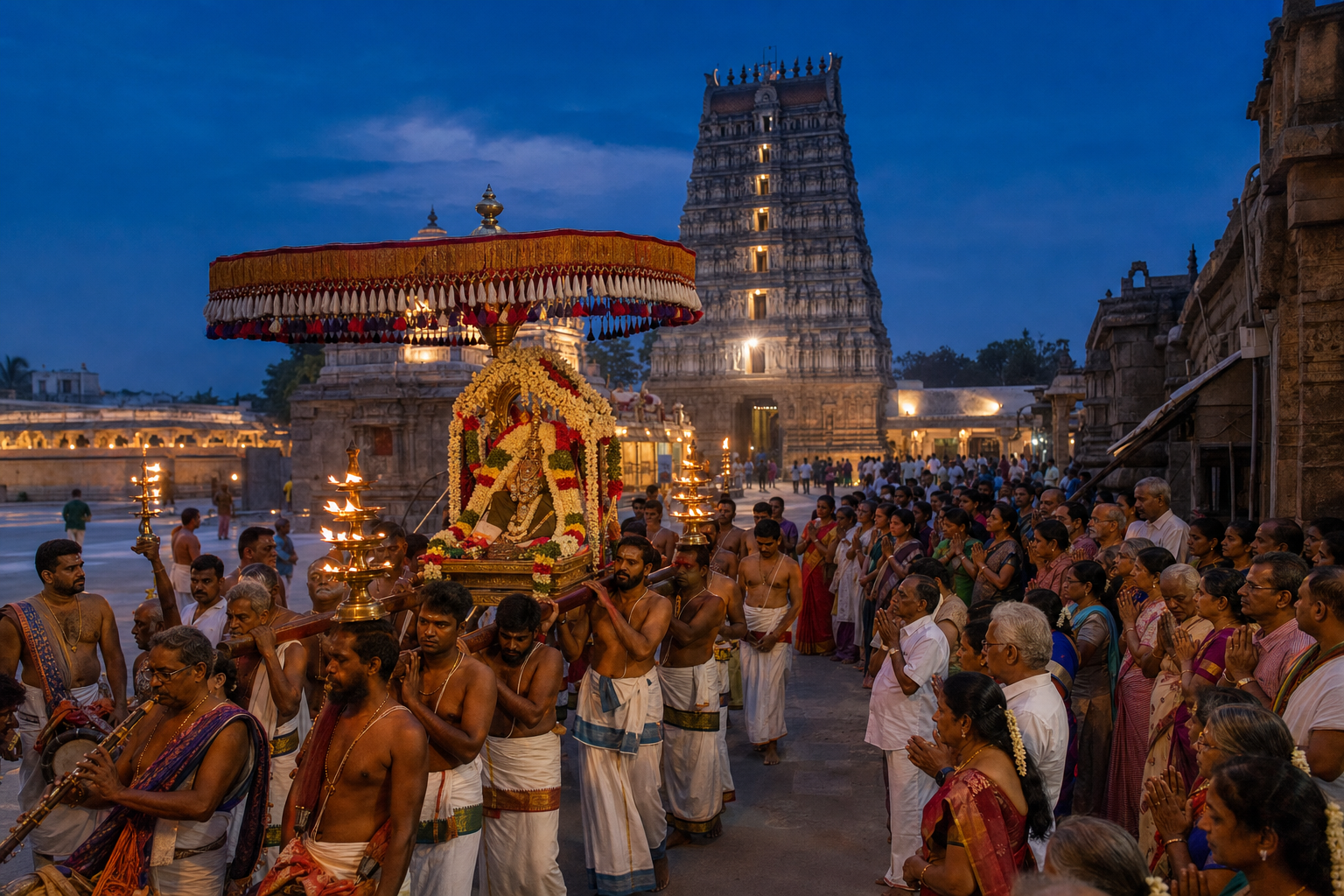
- Procession carries the festival into the temple’s prakaras and, where customary, beyond the immediate sanctum setting. A ratha utsavam or another processional form is therefore not an optional cultural performance attached to worship. It belongs to the ritual life of the festival.
Chidambaram makes this pattern especially clear. During Arudra Darisanam, the customary sequence includes a pre-dawn abhishekam for Nataraja and Sivakamasundari, alankaram, special archana, Maha Deeparadhana, and processions through the prakaras. The order gives you a map of the day, but it does not give you a guaranteed clock.
This distinction prevents a common mistake. A temporarily closed passage, a queue that pauses, or a darshan window that starts later than expected does not necessarily mean the festival is disorganized. The public movement of pilgrims has to accommodate ritual completion, safety, and the physical movement of the procession.
Choose the darshan first, then build the journey around it
You probably cannot witness every important rite from the ideal position, especially at a heavily attended festival. Decide what matters most before booking your travel. Your plan for a pre-dawn abhishekam should look different from a plan centred on the main procession.
- If you want an early abhishekam, arrive the previous evening. Locate the relevant entrance, read the queue signs, and confirm whether a separate line or access rule applies.
- If the procession is your priority, confirm its route rather than assuming that the best place is beside the sanctum. Procession paths and crowd arrangements can change.
- If you are travelling with children or elderly relatives, choose one essential ritual moment. Use the temple’s advisory to seek a less congested period instead of trying to remain through every stage.
- If ordinary sanctum darshan matters more than festival spectacle, check whether purification, decoration, or procession work will temporarily limit access.
- Keep your return journey flexible. A customary sequence can help you estimate the shape of the day, but ritual and crowd requirements can move the practical finish time.
For Arudra Darisanam at Chidambaram, precise puja windows, procession routes, security arrangements, and special darshan provisions are announced closer to the observance. That is the model to follow elsewhere as well: use the customary order for early planning, then use the temple’s current public notice for final decisions.
Do not copy a timetable from a previous year and treat it as a promise. Festival dates may be governed by the sacred calendar, while operational timings still depend on that year’s ritual and crowd arrangements. Reserve accommodation early where a festival draws large numbers, but wait for the current notice before locking yourself into a narrow arrival or departure window.
Make three practical choices before entering the crowd
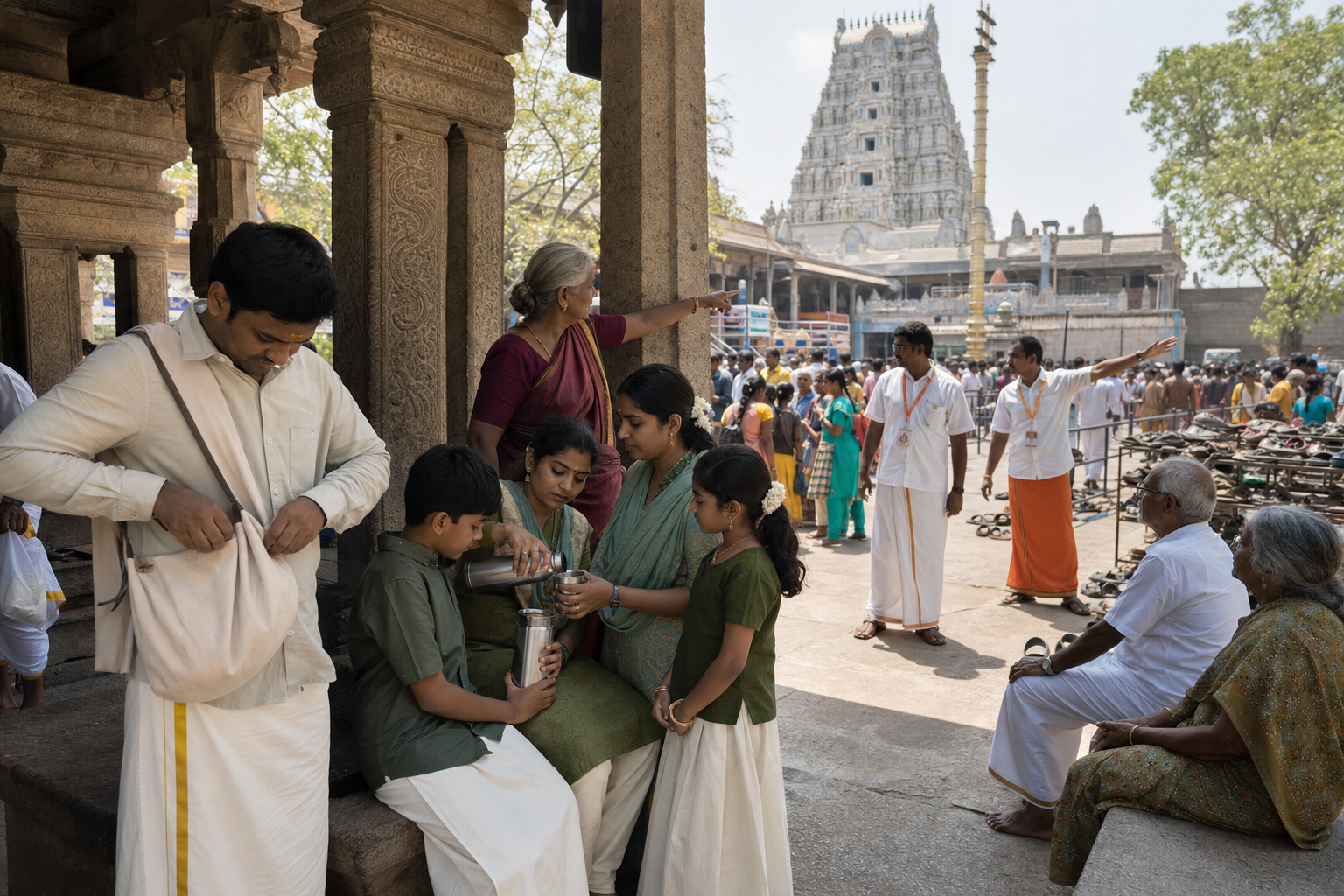
A pilgrim’s preparation becomes much easier when three decisions have already been made: which ritual is the priority, how the group will remain together, and what can be left behind.
- Name one primary darshan and one acceptable fallback. If access changes, you will be able to respond without arguing over the entire plan at the temple gate.
- Agree on a waiting point with your family before joining a queue. Do not depend on being able to stop a moving line or retrace your path through a dense crowd.
- Carry only essentials. Extra bags slow security checks, tire the person carrying them, and make it harder to move with the queue or procession.
Your clothing and conduct should reflect where you are. Traditional attire covering the shoulders and knees is generally expected, while silence near sanctums, queue discipline, and compliance with volunteer directions protect the experience for everyone. Temple-specific rules always take precedence.
Keep the phone away unless photography is clearly permitted. Flash photography in a restricted area is not a harmless way to preserve a memory; it disregards the temple’s rules and distracts people during worship. If you are uncertain, do not take the picture.
Do not measure the worth of your pilgrimage by how close you get to the front. A few extra feet of physical proximity gained by pushing, blocking a passage, or disputing with another pilgrim comes at the cost of the discipline the visit is meant to cultivate. Follow the line, make room when directed, and accept that darshan is shared.
Let the ritual tell you what to notice
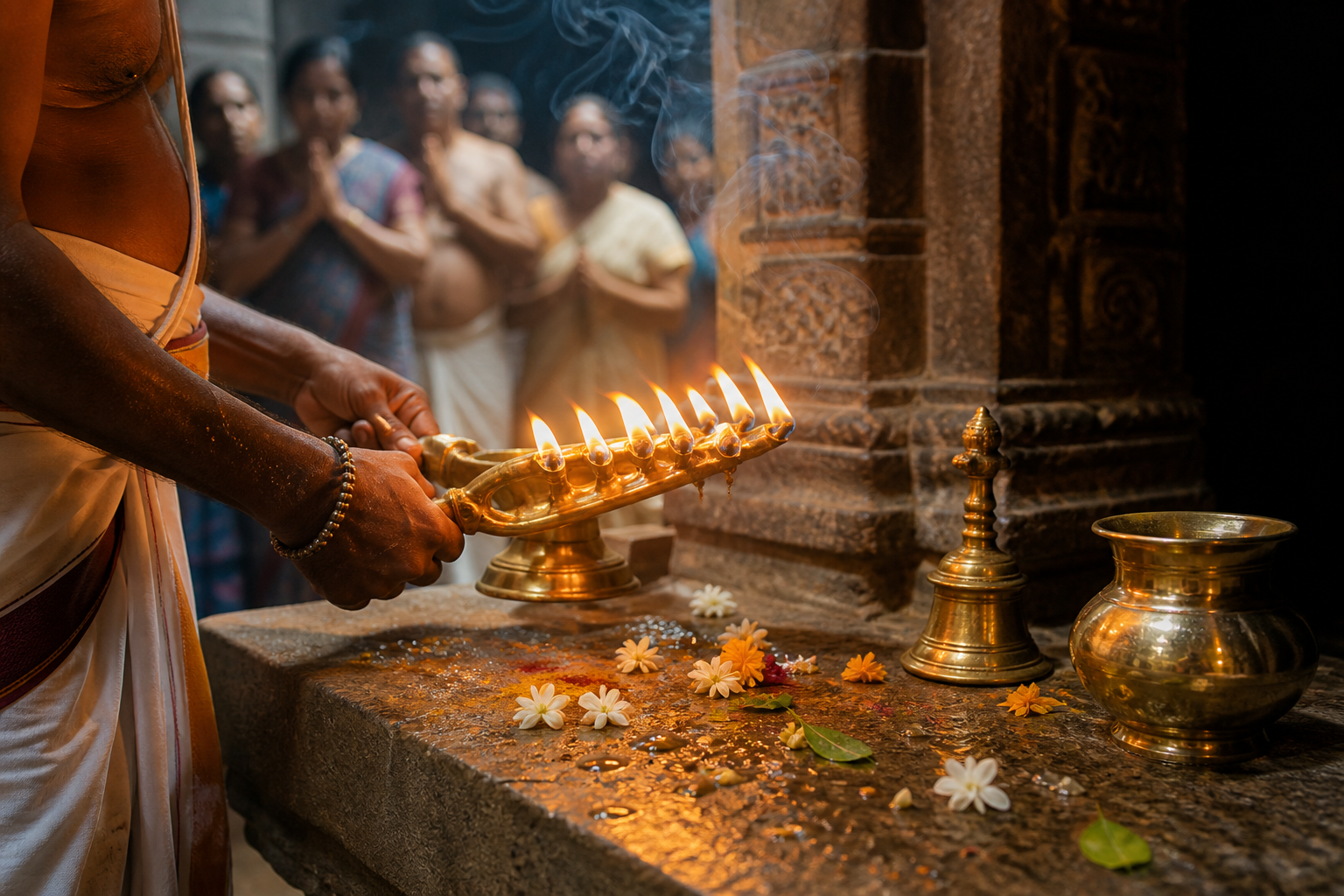
A festival becomes more intelligible when you watch relationships rather than isolated spectacles. Notice what is cleansed before worship, how the deity is prepared before being revealed, how sound changes around deeparadhana, and how a procession carries sacred presence from the inner ritual space into a wider community.
Koil Alwar Tirumanjanam offers a particularly practical lesson. Its Parimalam mixture commonly includes aromatic materials such as turmeric, camphor, and sandalwood, but the meaning of the rite is larger than its ingredients. Physical cleaning, mantra, restricted access, and the restoration of ceremonial order work together. The festival begins with readiness, not with the arrival of the largest crowd.
At Chidambaram, the sacred geography adds another layer. The Nataraja temple is associated with Akasha, or aether, within the Pancha Bhoota Stala tradition. The other elemental temples are Thiruvanaikaval Jambukeswara for water, Kanchi Ekambareswara for earth, Thiruvannamalai Annamalaiyar for fire, and Sri Kalahasti for air. Nataraja’s Ananda Tandava therefore meets a theology of space in which worship, movement, art, and the cosmos are read together.
You do not need to master every symbol during one visit. Walk slowly when the crowd permits. Listen to the Vedic chanting and temple music instead of filling every pause with conversation. Watch the transition from abhishekam to alankaram, or from sanctum worship to procession. One transition understood well is more valuable than a hurried attempt to collect every sight.
The broader Dharmic resonance should be handled with equal care. Hindu Agamic worship is not interchangeable with Buddhist, Jain, or Sikh practice. Yet discipline, seva, care for sacred places, and the cultivation of inward stillness can be recognised across the Dharmic family without erasing the distinct theology and ritual form of each tradition.
Key takeaways for your next festival visit
- Learn the ritual order before looking for exact times: purification, abhishekam, alankaram, archana, deeparadhana, and procession each create different access conditions.
- Select one priority darshan. A clear priority helps you choose when to arrive and what to relinquish if the crowd plan changes.
- Use only the temple’s current notice for final timings, routes, queue categories, and security instructions.
- Arrive the previous evening when an early ritual matters, especially if you need to identify entrances and queue signage.
- Carry little, dress for a sacred space, respect photography restrictions, and follow volunteers without treating the queue as a competition.
- Pay attention to transitions between rites. They reveal the festival’s meaning more clearly than a checklist of disconnected sights.
Before your next pilgrimage, write down the single ritual you most want to witness and the part of the customary sequence in which it occurs. Build a flexible journey around that choice, then confirm the details when the temple issues its notice. You will arrive with a plan, but also with the patience needed to let the temple set the pace.
References
- DharmaRenaissance Blog – Arudra Darisanam 2026 at Chidambaram Natarajar: Schedule Overview, Ritual Sequence, Pilgrim Guide
- DharmaRenaissance Blog – Dec 25, 2025: Koil Alwar Tirumanjanam at Govindarajaswamy Temple for Vaikuntha Ekadasi
