
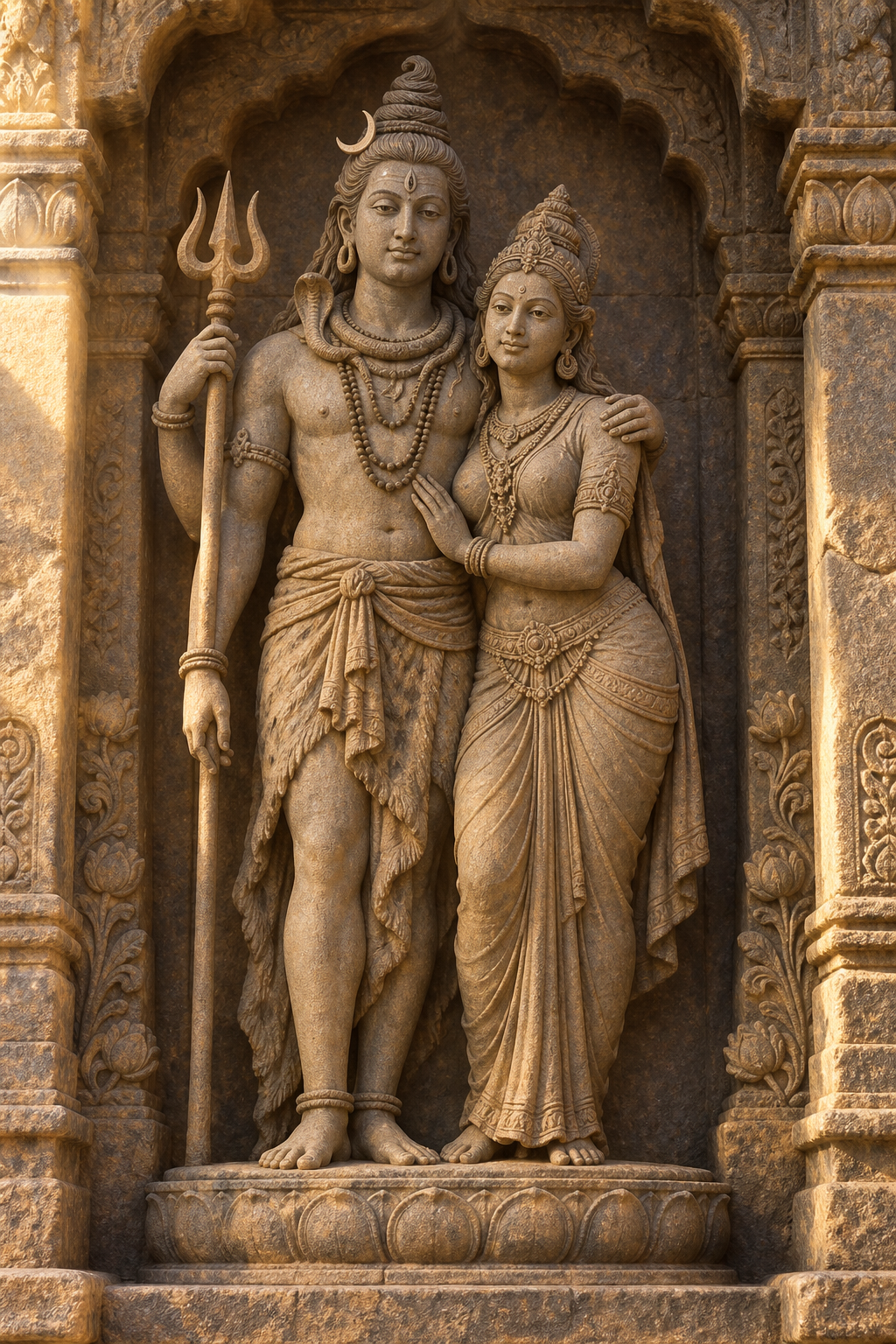
If you have stood before an Alingana Murti and wondered whether you were looking at a domestic scene, a romantic image, or a philosophical teaching, begin with a simpler question: what does the embrace allow you to see that two separate images would not?
The answer is not that Shiva and Parvati lose themselves in each other. They remain distinct, yet neither is presented as isolated or complete through isolation. Their closeness turns relationship itself into sacred instruction. Once you notice that, the murti can reshape how you understand divine power, marriage, spiritual discipline, and your own way of relating to others.
Read the form before assigning it a philosophy
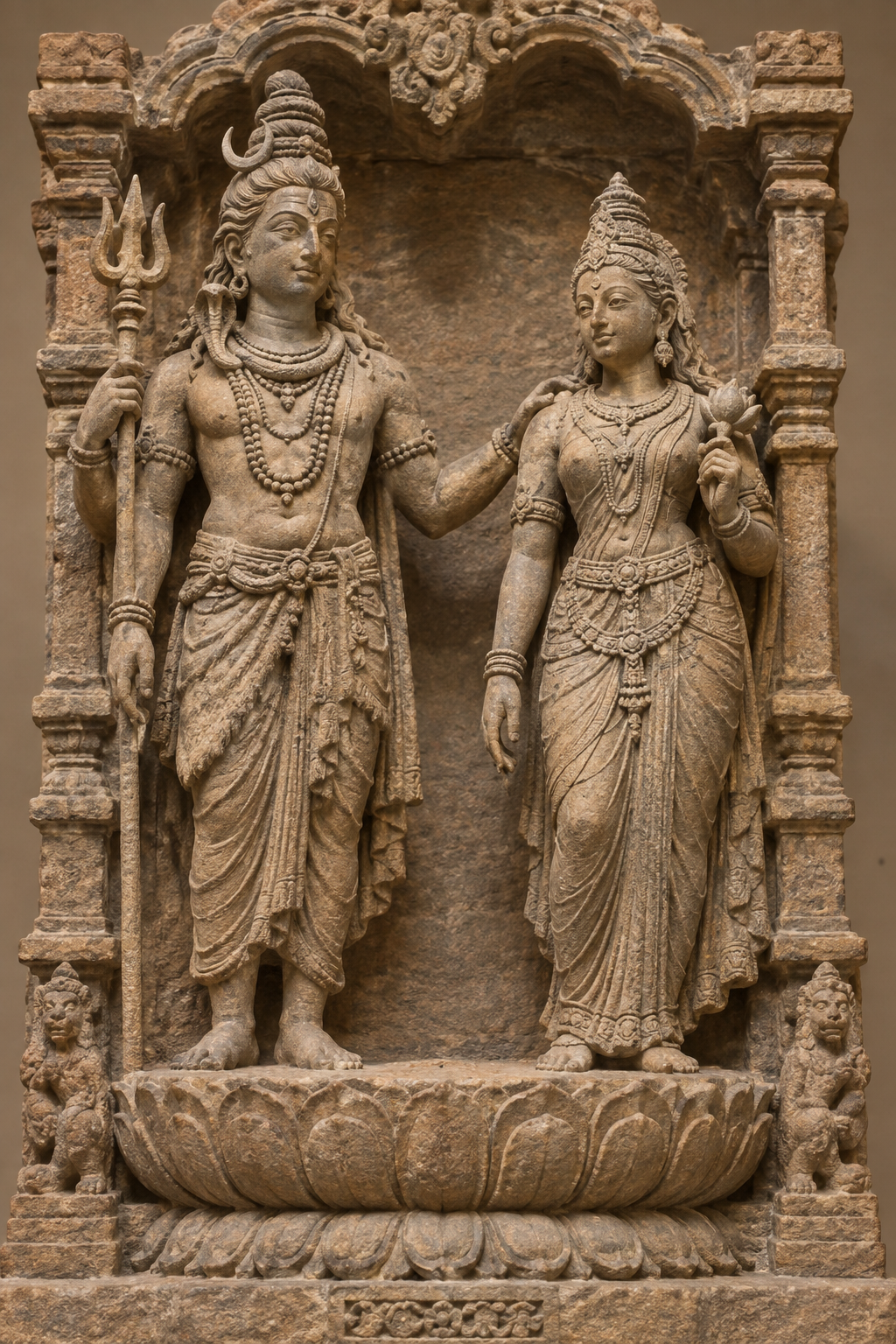
Alingana means an embrace, while murti refers to a sacred embodied form through which the divine becomes available to vision, worship, and contemplation. In this representation, Shiva and Parvati stand beside one another, turn gently toward each other, and share an intimate embrace. The form is especially associated with temple imagery in South India.
Three visible features should guide your reading. First, the deities stand together rather than occupying unrelated spaces. Second, each remains recognizably himself or herself. Third, the embrace introduces tenderness without turning the image into an ordinary private moment. These details establish the basic grammar of the murti: nearness without absorption, difference without estrangement, and affection without loss of dignity.
This is why reading the image as merely erotic is too shallow. Human affection provides the visual language, but the meaning reaches beyond physical attraction. The embrace makes an invisible relationship visible. It shows unity not as a theory but as mutual presence.
It is equally limiting to treat Parvati as a decorative companion added to an otherwise self-sufficient Shiva. The composition asks you to look at both figures and at the relation between them. Removing that relation would remove the distinctive teaching of the form.
Sacred union does not mean erasing difference

The Alingana Murti holds together two truths that people often separate. Shiva and Parvati are not interchangeable, yet their distinction does not produce opposition. They are close without becoming indistinguishable. That balance is the heart of the symbolism.
In a common philosophical reading, Shiva signifies pure awareness, stillness, and the unchanging ground of being. Parvati is Shakti, the power through which life, movement, expression, and transformation become possible. The embrace therefore signifies more than cooperation between two deities. It presents consciousness and power as inseparable dimensions of reality.
Stillness without power would never become manifest. Power without an intelligible ground would lack direction. The murti brings the two into one field of vision so that you do not mistake transcendence for lifeless withdrawal or activity for self-sufficient force. What appears motionless and what appears dynamic belong together.
This does not require you to reduce Shiva and Parvati to abstract concepts. Hindu murtis are not rebuses in which each feature has only one correct verbal translation. They are worshipped presences as well as bearers of meaning. Philosophical interpretation should deepen darshan, not replace devotion with a decoding exercise.
The form also offers a practical test for claims about unity. Real unity does not demand that one side disappear. If an interpretation makes Shiva active and Parvati passive, or makes one essential and the other secondary, it has failed to account for the visible reciprocity of the embrace. Likewise, if unity is taken to mean that all distinctions are meaningless, the two recognizable figures have been ignored. The murti preserves relationship precisely by preserving both relation and difference.
Three tensions resolved in the divine embrace
The yogi and the householder
Shiva is deeply associated with tapas, meditation, detachment, and the freedom of the ascetic. Yet he is also present here in intimate relation with Parvati. The two dimensions do not cancel each other. The embrace corrects the assumption that spiritual seriousness requires emotional barrenness or rejection of all human bonds.
For a householder, this matters. Family life need not be treated as time stolen from spiritual life. Care, fidelity, patience, restraint, and shared duty can become disciplines of dharma. At the same time, the image does not license possessiveness. Shiva and Parvati remain distinct sacred persons; closeness is not ownership.
Power and tenderness
Modern viewers often imagine power as distance, hardness, or domination. The Alingana Murti presents another possibility. Divine stature is not diminished by affection. Shiva’s greatness does not depend on emotional remoteness, and Parvati’s Shakti is not weakened by tenderness.
You can apply that distinction immediately. When firmness is required, ask whether you are protecting dharma or merely protecting your pride. When tenderness is required, ask whether you are truly present or simply avoiding a difficult truth. The murti does not choose strength over gentleness. It reveals mature strength as capable of gentleness.
The cosmic and the personal
The embrace is personal enough to be recognizable and cosmic enough to exceed biography. You can see a divine couple, but you can also contemplate the union of awareness and energy, rest and action, transcendence and manifestation. The personal form prevents the philosophy from becoming cold. The cosmic meaning prevents affection from being reduced to sentiment.
Calling the embrace cosmic does not turn it into a scientific diagram or a claim about physical astronomy. It means that the relation displayed by Shiva and Parvati expresses something fundamental about existence: reality is not adequately understood through isolated principles. Life emerges through relation, complementarity, and the meeting of powers that remain distinguishable without becoming enemies.
Key takeaways
- The Alingana Murti shows sacred intimacy rather than merely private romance.
- Shiva and Parvati remain distinct within the embrace, so union is not the destruction of identity.
- A philosophical reading sees Shiva as awareness and Parvati as Shakti, the power of manifestation.
- The form joins ascetic depth with household relationship instead of forcing a choice between them.
- Tenderness is presented as compatible with divine strength, not as its opposite.
- The most faithful interpretation begins with the actual posture and allows devotion, ethics, and philosophy to illuminate one another.
How to receive the murti during darshan
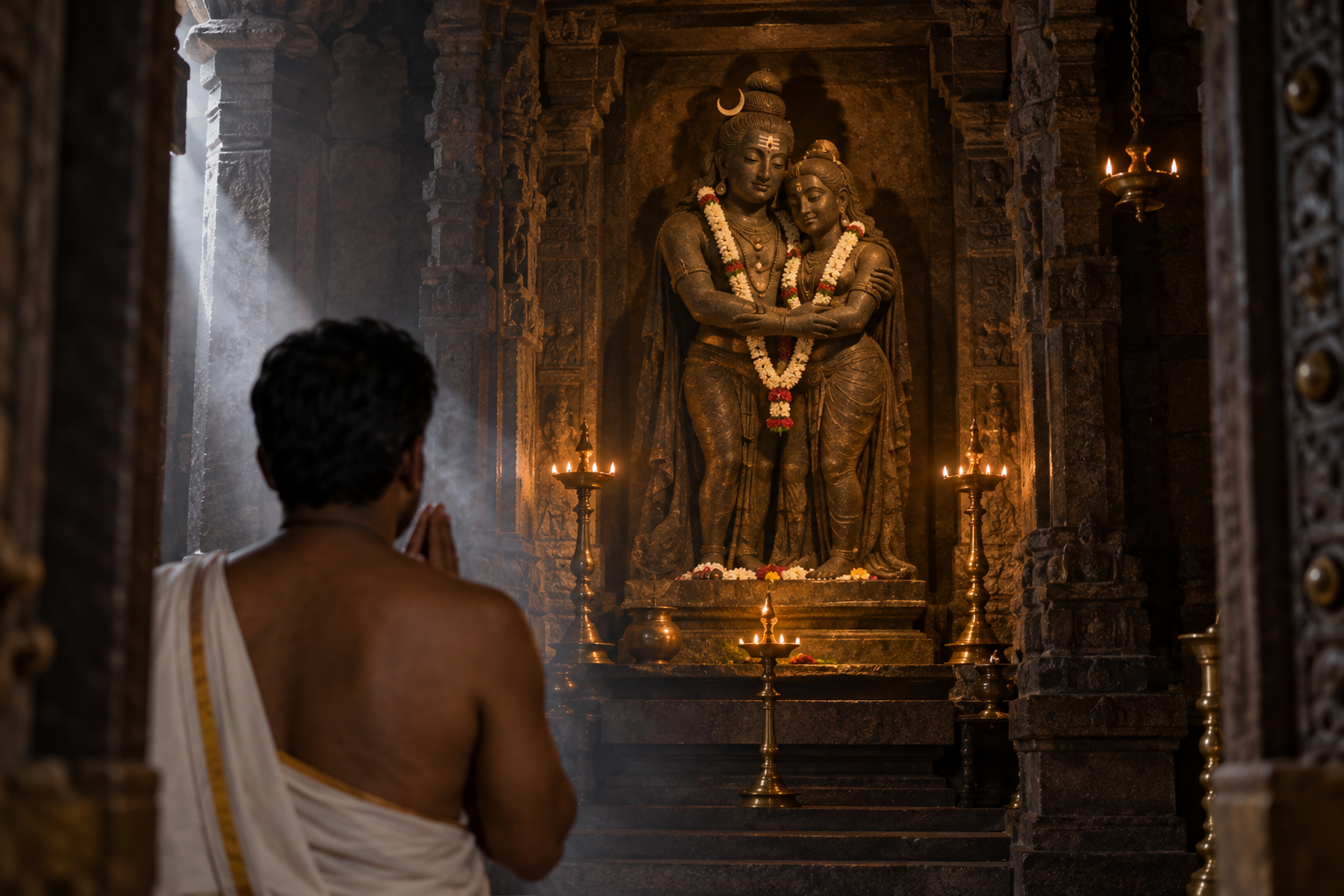
You do not need an elaborate private ritual to contemplate this form. In a temple, follow the temple’s established practice and allow the image to set the pace. A short sequence of attention can keep you from rushing past the embrace or reducing it to a photograph.
- Notice the two figures separately. Attend first to Shiva, then to Parvati, without immediately translating either into an abstract idea.
- Notice the relation. Look at their shared orientation and the nearness created by the embrace.
- Hold distinction and union together. Resist both extremes: two unrelated deities on one side, or one identity in which difference has vanished on the other.
- Choose one tension in your own life: contemplation and action, independence and commitment, firmness and tenderness, or renunciation and responsibility.
- Leave with one concrete practice. Listen without interrupting, perform a neglected household duty, protect time for sadhana, or replace possessiveness with attentive care.
This sequence is a method of reflection, not a claim that every Alingana Murti must receive one fixed interpretation. Temple setting, local tradition, and the guidance of informed practitioners can add layers that a general explanation cannot supply. Pay attention to those contexts rather than assuming that every visual detail has the same meaning everywhere.
If you keep an image of Shiva and Parvati at home, place your reflection where it can affect conduct. Before worship, identify one relationship in which you have confused closeness with control or independence with indifference. Then make your offering and act differently that day. Symbolism becomes spiritually useful when it moves from admiration to disciplined attention.
The Alingana Murti does not ask you to choose between solitary realization and loving relationship. It asks whether your relationships can become truthful enough to support freedom, and whether your freedom can become generous enough to sustain relationship. The next time you meet this form, stay for one extra moment. Look at the space between Shiva and Parvati: it is neither a barrier nor an emptiness, but a bond.
References

Leave a Reply
You must be logged in to post a comment.