
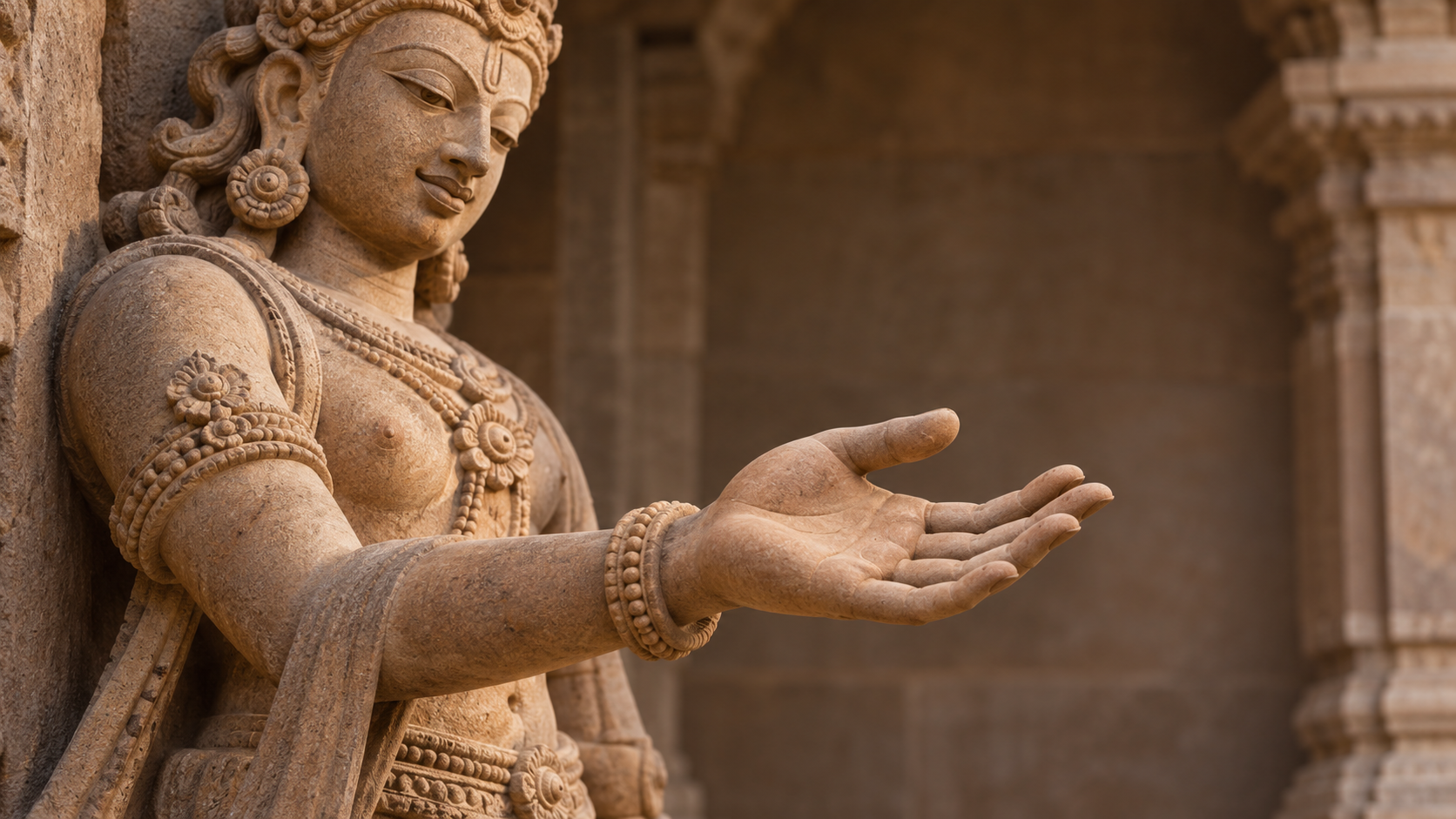
An outstretched hand in a temple image can look instantly familiar. That is exactly where misreading begins. If you call every open palm a blessing or every lowered hand an act of giving, you replace the sculptor’s visual grammar with a guess.
If you are trying to identify Prasarita Hasta, begin with the most defensible claim: the hand is extended. Then examine its direction, palm, fingers, arm, and relationship to the rest of the composition. This approach lets you read the image carefully without forcing one meaning onto every similar pose.
What the name tells you – and what it does not
The term joins two simple ideas. Prasarita comes from a root meaning to extend or spread outward, while hasta means hand. Prasarita Hasta can therefore be understood as an extended, spread, or outstretched hand.
That is a description of form, not yet a complete translation of meaning. The extension may help the figure address a devotee, indicate something, reach toward another figure, present an object, organize a narrative scene, or complete the balance of a multi-armed image. You must determine which possibility fits the sculpture in front of you.
This distinction matters because Hindu sacred sculpture uses a codified visual vocabulary in which bodily posture, hand position, and angle carry meaning. A hand is not isolated punctuation. It works with the shoulders, torso, gaze, attributes, companions, and surrounding space.
Use the name Prasarita Hasta to answer the first question: what is the hand doing spatially? Let the complete image answer the second: what does that extension communicate here?
A six-step method for identifying the gesture
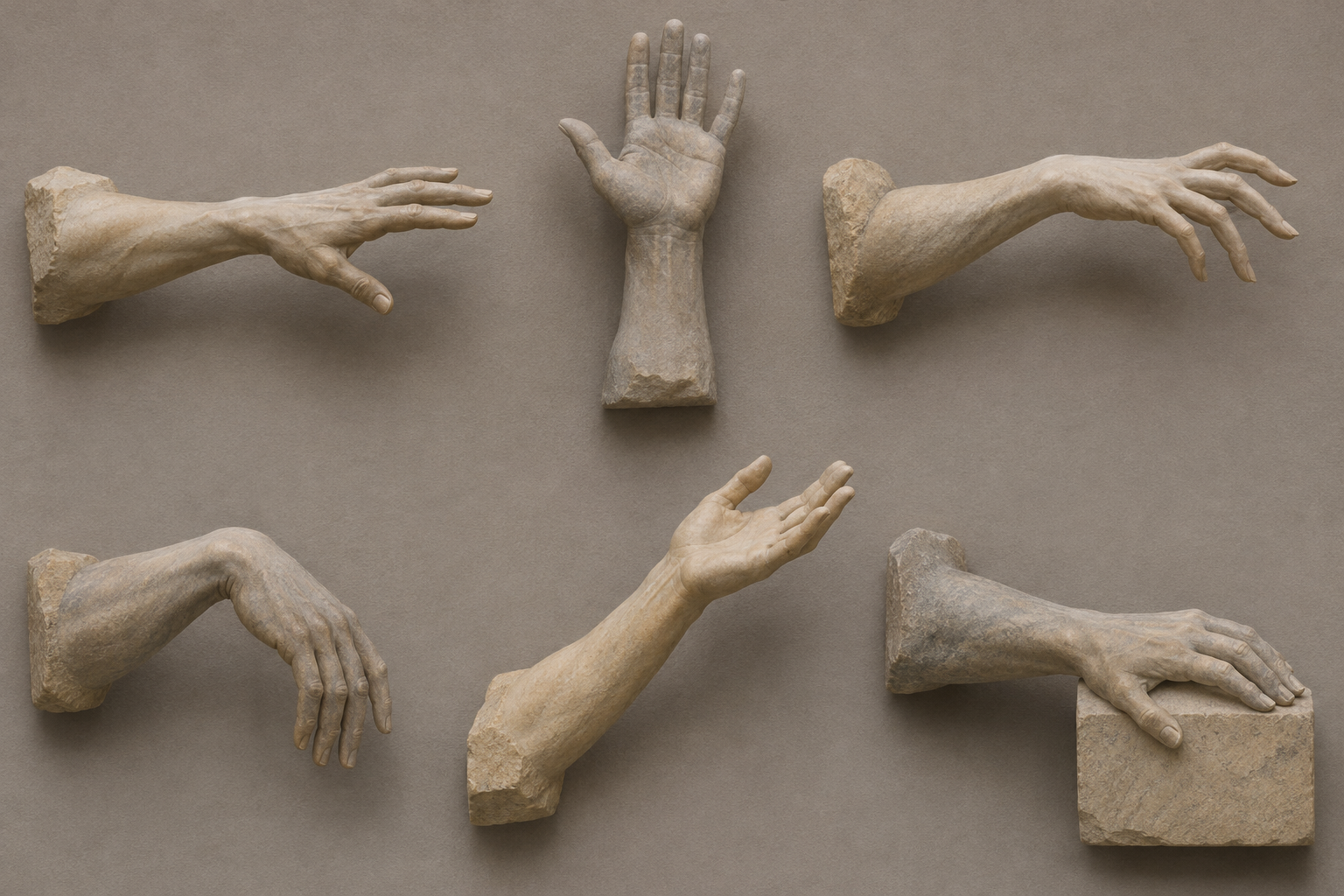
You do not need to recognize every iconographic term before making a useful observation. Work from the whole figure toward the fingertips, recording what you can actually see.
- Establish the kind of image. Is this a central deity, an attendant, a donor, a guardian, or a participant in a narrative panel? A central icon addressing worshippers and a secondary figure reaching into a story may use similar extensions for different purposes.
- Trace the line from shoulder to wrist. Note whether the arm reaches horizontally, rises, descends, crosses the torso, or moves away from it. The entire arm establishes direction; the hand alone may not.
- Observe the palm and fingers. Record whether the palm faces forward, upward, downward, sideways, or toward another figure. Notice whether the fingers are open, gathered, curved, or damaged. Do not infer more precision than the surviving stone permits.
- Follow the hand’s axis. Ask what lies beyond the fingertips: the viewer, another figure, an attribute, the deity’s foot, the ground, or an apparently empty part of the composition. The answer often reveals the relationship created by the extension.
- Compare the other hands. In a multi-armed form, one hand may hold an identifying attribute while another establishes contact with the devotee or directs attention elsewhere. Read the hands as a coordinated group.
- Check the viewing conditions. A frontal photograph can conceal the palm’s true orientation. A missing attribute, broken fingers, later repair, shadow, or an oblique camera angle can also turn an object-bearing hand into what appears to be an empty gesture.
Before assigning symbolic meaning, write one neutral sentence such as: “The right arm extends diagonally downward; the open hand is directed toward the smaller figure.” That sentence separates observation from interpretation. You can then ask what the relationship means.
Do not confuse extension with a complete mudra
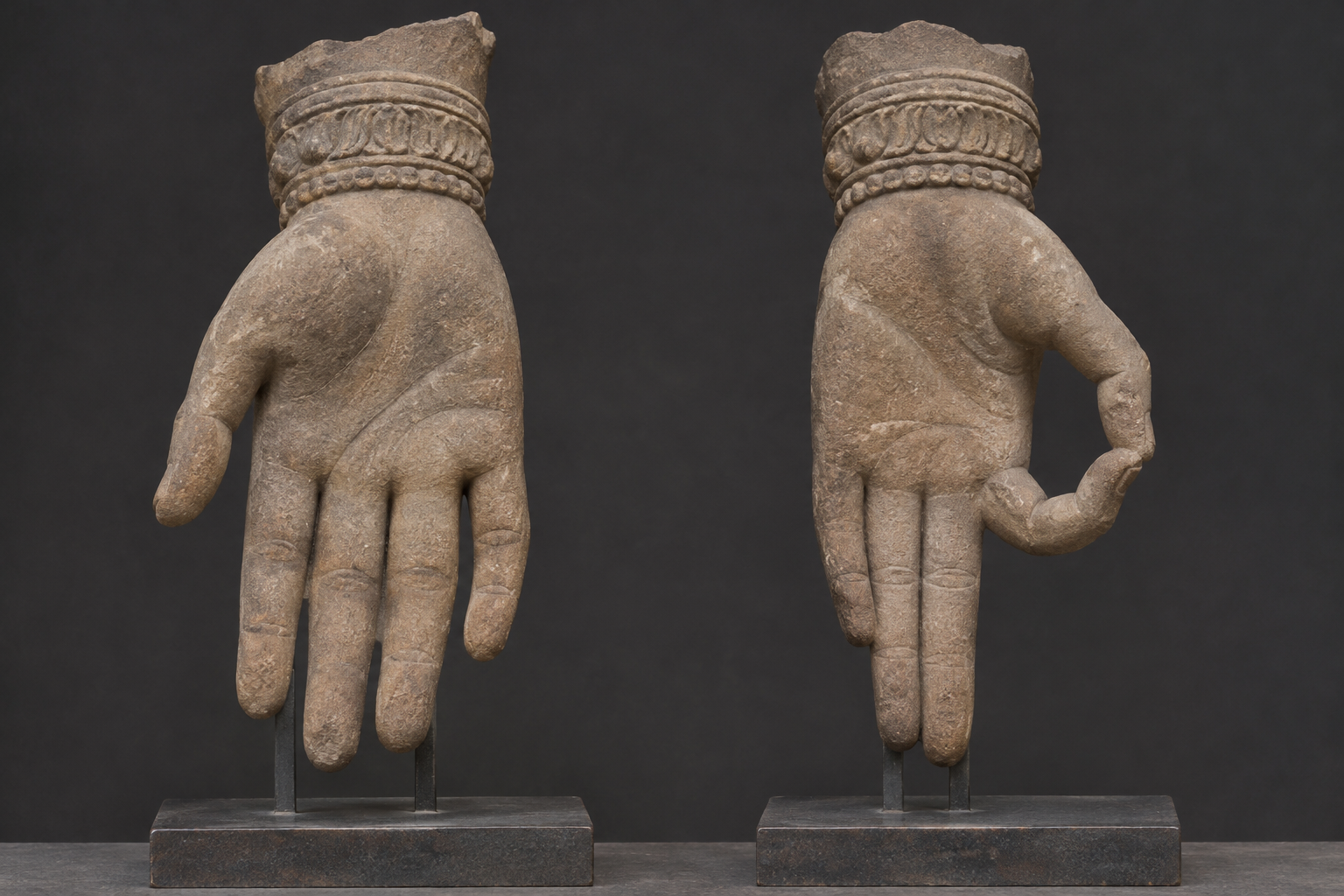
The most common mistake is to treat any visible palm as Abhaya Mudra. Abhaya carries a recognizable assurance of protection or freedom from fear, but a palm cannot be identified as abhaya merely because it is open. Its orientation, height, fingers, arm position, and iconographic setting must support that reading.
Prasarita and abhaya also answer different kinds of questions. Prasarita describes the hand’s extension through space. Abhaya identifies a more particular communicative function when the appropriate form is present. A hand can be spatially extended while also participating in a specific mudra; the broader description does not automatically establish the narrower identification.
Watch for a lost object
A damaged image can be deceptive. If the fingers curl as though they once enclosed something, or if the hand contains a break where an attribute might have joined it, consider the possibility that the hand was originally object-bearing. Do not turn physical absence into theological symbolism without checking the damage.
Distinguish iconic address from narrative action
In a stable devotional image, an extended hand may help establish a relationship between the deity and worshipper. In a narrative relief, the same visual movement may depict a particular action between characters. Identify the scene before importing a general devotional meaning into it.
Do not transfer a stage meaning mechanically
Hand language also appears in traditions of performance and abhinaya, where a gesture works with movement, expression, rhythm, and changing dramatic context. A sculpture freezes one moment and belongs to its own iconographic program. Resemblance to a performance gesture can be worth investigating, but resemblance alone does not prove identical meaning.
Read the relationship created by the extended hand
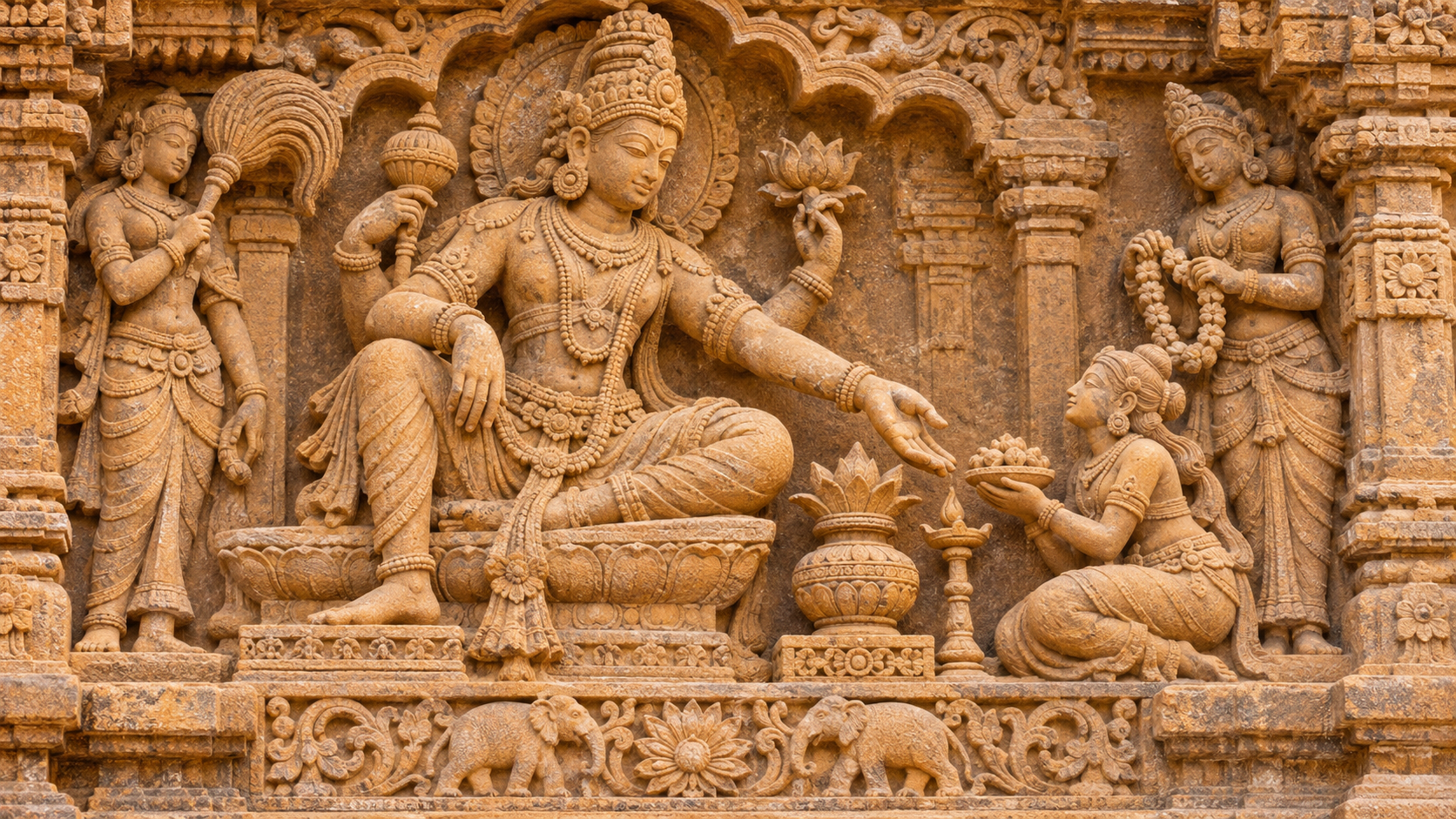
Extension makes space meaningful. It carries the figure’s presence beyond the torso and establishes a line between the sacred body and something outside it. Your strongest interpretation will usually come from identifying the other end of that line.
A hand directed toward the viewer may make the image feel outward-facing and relational. One aimed toward a companion may organize an exchange within the scene. One descending toward a foot, pedestal, attribute, or subordinate figure may guide the eye through a vertical hierarchy. These are starting hypotheses, not automatic translations; test each one against the figure’s gaze, posture, scale, and remaining hands.
Pay particular attention to asymmetry. If one hand remains close to the body while another reaches outward, the contrast may distinguish inward identity from outward action. If one hand carries an attribute and another is empty, the attribute may identify the form while the empty hand establishes a relationship. In a multi-figure panel, several arms may create a chain of attention that leads your eye to the scene’s central event.
Even apparently empty space can be active. Look along the direction of the arm rather than only at the fingertips. The sculptor may be opening the silhouette, balancing another limb, directing attention across the panel, or making the figure address the space occupied by the worshipper.
This is why an isolated photograph of a hand is rarely enough for secure identification. If you are documenting an image, take one photograph of the entire composition, one close view of the hand, and, where permitted, one view from the side. Record the hand’s condition and the location of nearby figures or attributes. Those details preserve the evidence that a tightly cropped image removes.
Key takeaways
- Prasarita Hasta identifies an extended or outstretched hand; it does not, by itself, supply one universal symbolic message.
- Read from shoulder to fingertips. Direction, palm orientation, finger shape, and the hand’s target matter more than a superficial resemblance.
- Interpret the hand with the deity’s identity, gaze, posture, attributes, other hands, and surrounding figures.
- Do not label every open palm as Abhaya Mudra, and do not assume that a damaged empty hand was always empty.
- Separate observation from interpretation by writing a neutral visual description before naming the gesture’s function.
On your next temple visit, pause before translating the outstretched hand. Follow its line through the full composition and name what you can see before deciding what it means. That small discipline turns a familiar-looking pose into a readable part of the image’s sacred language.
References

Leave a Reply
You must be logged in to post a comment.