
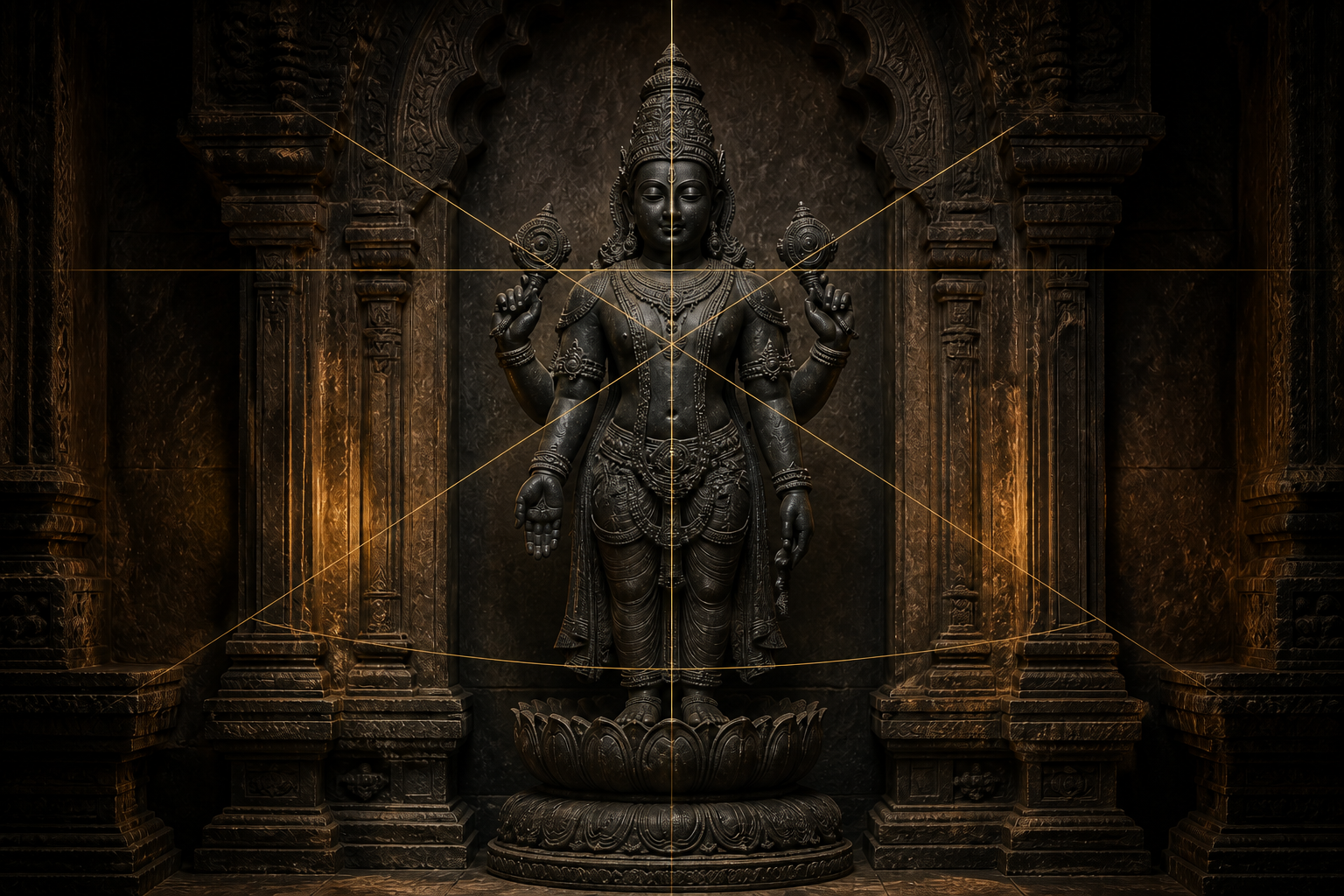
You can recognize a deity, a mudra, or an attribute and still miss what makes a Hindu murti feel composed. Before the ornament catches your eye, an underlying order has already brought the head, torso, limbs, pedestal, and surrounding space into relationship.
Pancha Sutram gives you a way to notice that order. It is valuable not only when you visit a temple or museum, but also when you evaluate a new commission, a replica, or a proposed restoration. The central question is simple: does every part belong to the same sacred whole?
Five axes change the question you ask of a murti
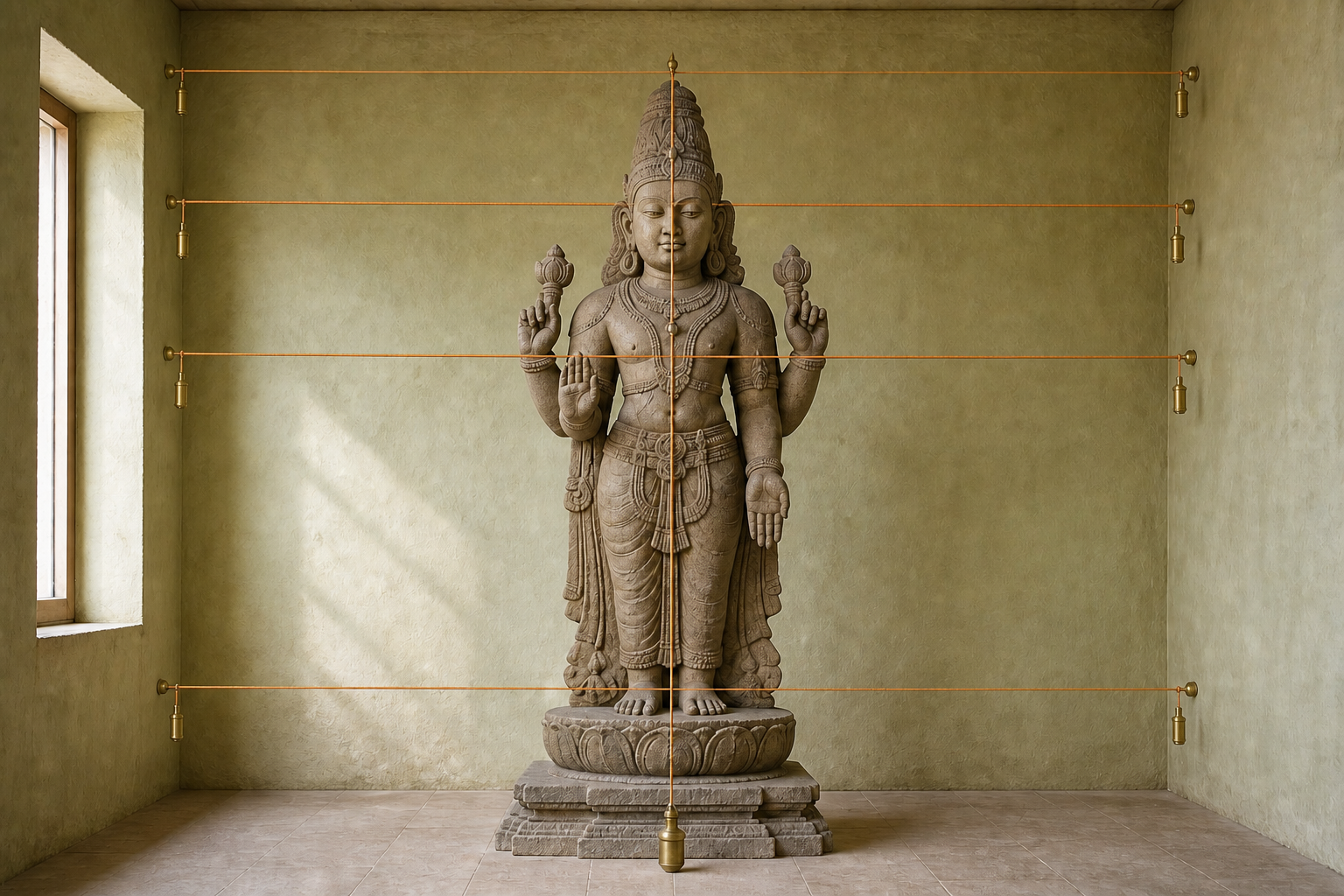
Pancha means five, while sutram carries the sense of a thread or guiding line. In this sculptural context, Pancha Sutram is a discipline of five axes used to organize measurement and spatial orientation. An axis is not part of the finished anatomy or ornament. It is a reference that helps the Shilpin decide where forms belong in relation to one another.
This matters because sacred image-making is not treated as unrestricted personal expression. Its premises are exacting: canonical rules, precise measurement, and knowledge transmitted through generations of Shilpins govern the making of the image. Creative skill remains essential, but it operates within a received discipline.
The practical shift is from examining isolated parts to examining relationships. Instead of asking only whether a face is beautiful, ask how the face sits over the torso. Instead of admiring one hand in isolation, notice how its gesture redirects the movement of the entire figure. Instead of treating the pedestal as a separate accessory, see whether it completes the image’s vertical and spatial order.
Pancha Sutram should therefore not be reduced to five detached labels memorized from a diagram. A list without its controlling canon, image form, and workshop discipline can create false confidence. Learn first to see what an axis-based system does: it turns separate anatomical and iconographic features into one intelligible form.
A five-pass method for seeing the underlying structure
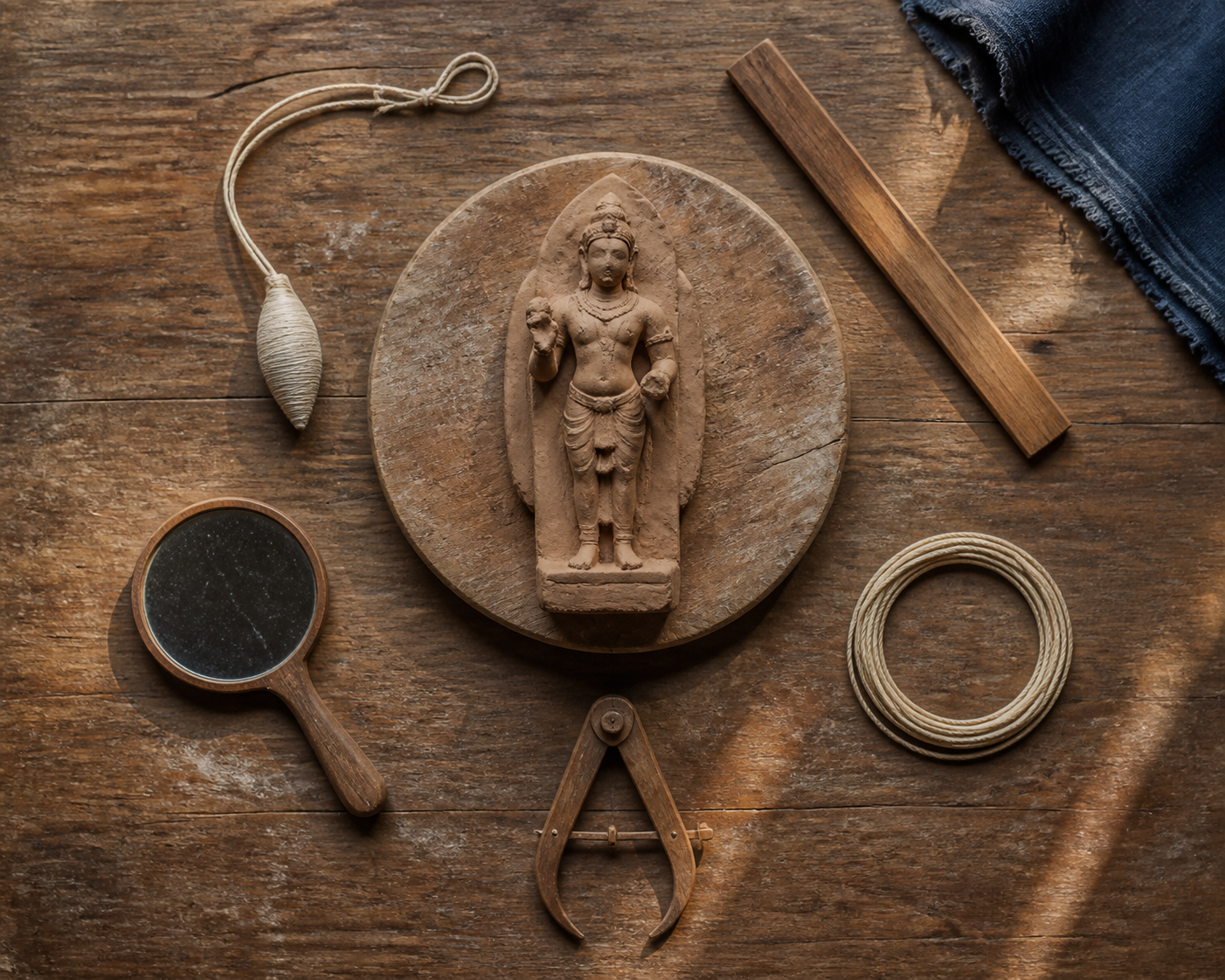
You do not need to be a trained Shilpin to look more carefully. The following five passes are a visitor’s method, not substitute names for the canonical five sutras. Use them to see the effects of disciplined measurement without pretending to reconstruct a technical system from appearance alone.
- Take in the whole silhouette. Stand as close to the frontal viewpoint as the setting respectfully permits. Look first at the outer boundary formed by the crown, shoulders, arms, legs, and pedestal. Ignore small ornament. Ask whether the figure reads as one organized mass or as a collection of locally attractive details.
- Locate the governing vertical. Imagine a line descending through the head, face, torso, and support. Do not insist that every feature sit directly on it; a dynamic pose may move around a reference line without losing it. Notice instead how the image establishes, departs from, and returns to its central order.
- Compare major landmarks. Look across the eyes, shoulders, elbows, hands, knees, and feet. You are not testing whether paired features are mirror copies. You are looking for deliberate relationships: repeated levels, controlled offsets, and correspondences that help the body remain coherent.
- Follow the directional movement. A turned head, raised hand, bent knee, weapon, flower, or other attribute may send the eye away from the center. Trace that movement and see how another part balances or completes it. This reveals the difference between meaningful asymmetry and a part that merely appears misplaced.
- Return the figure to its setting. Include the pedestal, back-slab, niche, or architectural frame in your view. Sacred sculpture occupies ordered space; it is not simply a freestanding body that happens to have been put inside a temple. Ask whether the support and frame reinforce the image’s orientation or visually compete with it.
If you are studying a photograph, use a straight-on image whenever possible. A camera placed above, below, or to one side can make aligned features look displaced and can exaggerate the nearer limbs. Make a simple two-layer sketch: draw the main vertical and a few cross-body relationships first, then add the visible contour. The difference between the two layers will show you how the finished form grows around its unseen scaffolding.
Precision does not mean mechanical symmetry
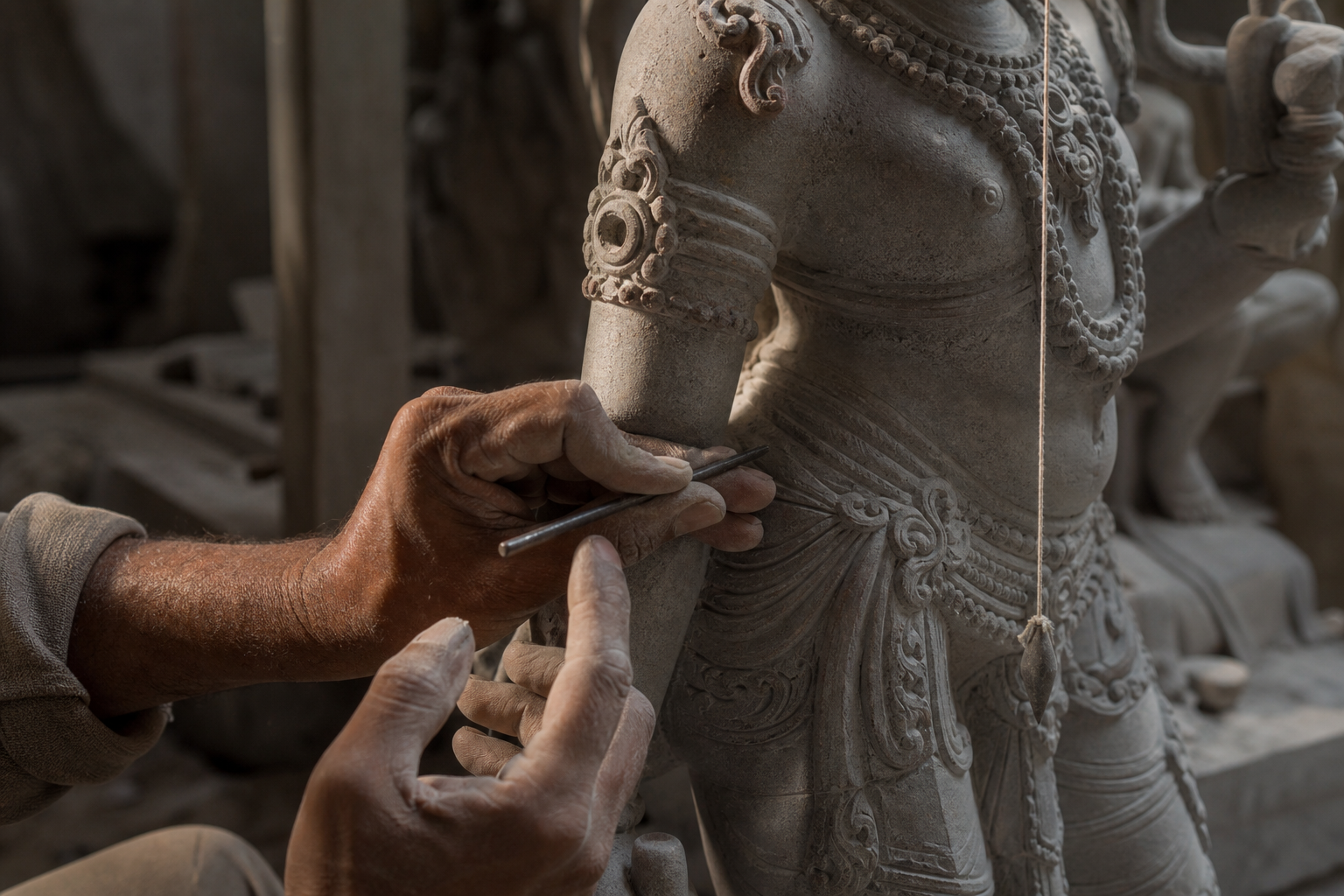
An axis is a reference, not an instruction to mirror one half of the murti onto the other. This distinction prevents one of the easiest mistakes in viewing or restoration: treating every visible asymmetry as damage, incompetence, or distortion.
A raised arm can cross or extend beyond a reference while the figure remains rigorously organized. A turn of the head can generate movement without making the body arbitrary. The test is not whether the left and right sides are identical. The test is whether their differences participate in the same measured composition.
When something appears irregular, check it in this order. First, see whether the head, torso, and base still establish a clear overall relationship. Second, ask whether the apparent departure belongs to a pose, gesture, or attribute. Third, examine whether another part of the composition answers that departure. Only after those checks should you suspect that the image has been altered, poorly copied, or inaccurately repaired.
Ornament can conceal structural weakness. A finely carved necklace, elaborate crown, or polished surface cannot correct a poorly organized body. Reverse your normal viewing order: silhouette first, axes and landmarks second, gesture third, ornament last. If the image remains convincing before you inspect its decoration, the underlying construction is doing real work.
The same principle clarifies why measurement is not opposed to sacred presence. Within this tradition, disciplined form is part of sacred making. Geometry does not replace iconography or devotion; it gives the visible image a stable order through which iconographic meaning can be expressed.
What to ask before commissioning or restoring sacred sculpture
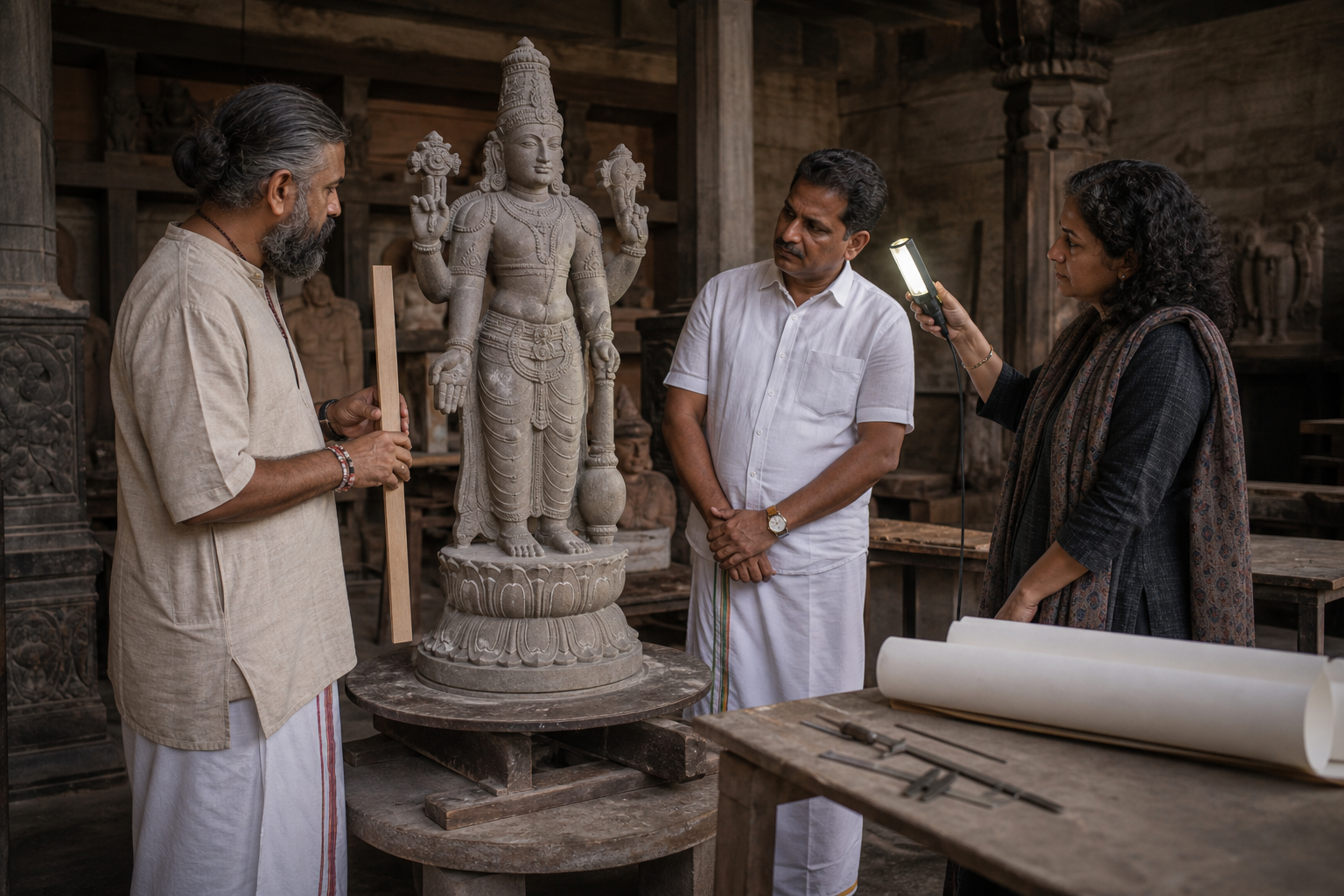
If a murti is intended for sacred use, approval should not begin with facial expression, ornament, or surface finish. Those features are easy to discuss because they are immediately visible, but late structural corrections can affect every part of the image. Settle the governing proportions and relationships before the work reaches fine detail.
- Define the intended use. State whether the object is a devotional murti, an architectural sculpture, a study, or a decorative reproduction. Do not assume that one set of visual expectations serves every purpose.
- Identify the governing authority. Ask which canonical or inherited workshop system controls the measurements. A vague promise to use traditional proportions is not enough. The maker should be able to explain what tradition governs the design and how it applies to the intended image.
- Request a frontal working drawing. Review the complete figure with its pedestal and frame, not merely a close view of the face. The drawing should make the principal alignments and dimensions understandable before carving or casting advances.
- Approve from large relationships to small details. Review the outer envelope first, then the principal axes and bodily landmarks, then the pose and attributes, and only then the ornament and surface. This sequence keeps decorative approval from hiding a structural problem.
- Do not correct asymmetry by instinct. Before mirroring, straightening, sanding, or recarving a feature, determine whether its displacement belongs to the intended pose. Material removed during restoration cannot simply be put back, so uncertainty should lead to documentation and qualified review, not immediate intervention.
- Preserve the record. Keep the approved drawing, dimensions, frontal and side photographs, and notes identifying the workshop discipline. That record gives future custodians something firmer than visual guesswork if repair becomes necessary.
Pancha Sutram alone cannot identify a deity, authenticate an antiquity, establish the ritual status of an image, or settle every question about regional style. It is a lens on measured construction. Keep those questions separate. For a sacred commission or consequential restoration, work with a qualified Shilpin and the relevant religious custodians rather than treating a visual checklist as sufficient authority.
Key takeaways
- Pancha Sutram is a five-axis discipline for organizing measurement and spatial orientation in Hindu sacred sculpture.
- The useful unit of observation is a relationship: face to torso, gesture to body, figure to pedestal, and image to architectural setting.
- An axis creates order without demanding mirror symmetry. Intentional movement can depart from a reference and still remain measured.
- Judge silhouette and major alignments before ornament, polish, or facial detail.
- For commissions and restorations, ask which canon or workshop discipline governs the design and require a complete frontal drawing before irreversible work proceeds.
- Use the framework to examine construction, not to make unsupported claims about antiquity, ritual status, or iconographic identity.
The next time you stand before a murti, give its ornament a minute to wait. Find the whole silhouette, the central order, and the relationships that carry the pose. Once you learn to see those quiet lines, sacred sculpture stops looking like assembled detail and begins to disclose the discipline that holds it together.
References
