
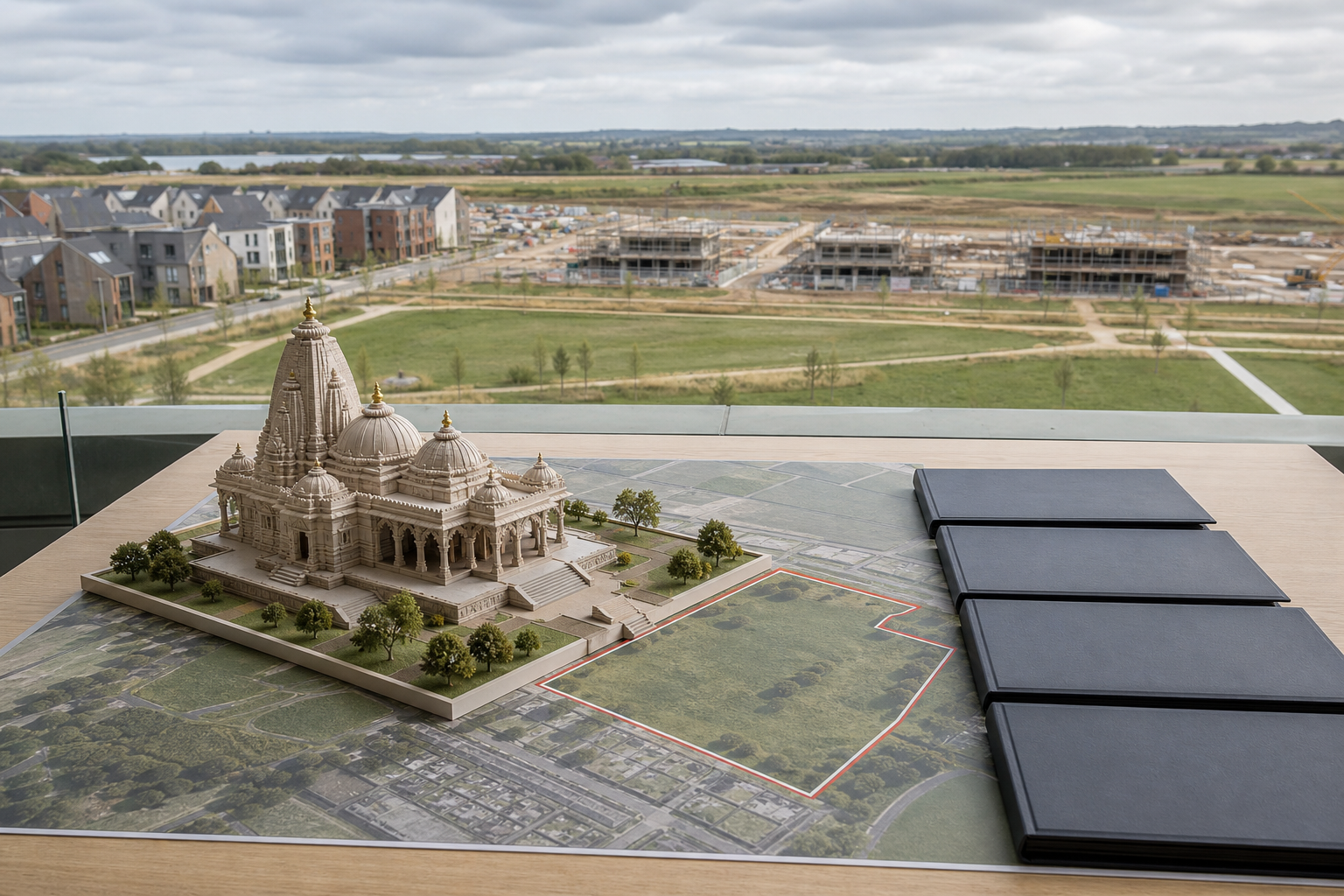
The Northstowe controversy is often described as a Hindu temple planning dispute, but the supplied article documents a more specific immediate decision: the allocation of a council-owned site through a competitive bidding process. It does not report the refusal of a planning application. That distinction matters because the central questions concern access to public land, bid evaluation and long-term religious infrastructure.
The available account raises substantial questions, but it is also the only source included in the supplied material. Its claims therefore should be treated as attributed reporting rather than a corroborated record. A careful assessment must separate the reported outcome from the unanswered questions surrounding the process.
What was actually decided in Northstowe
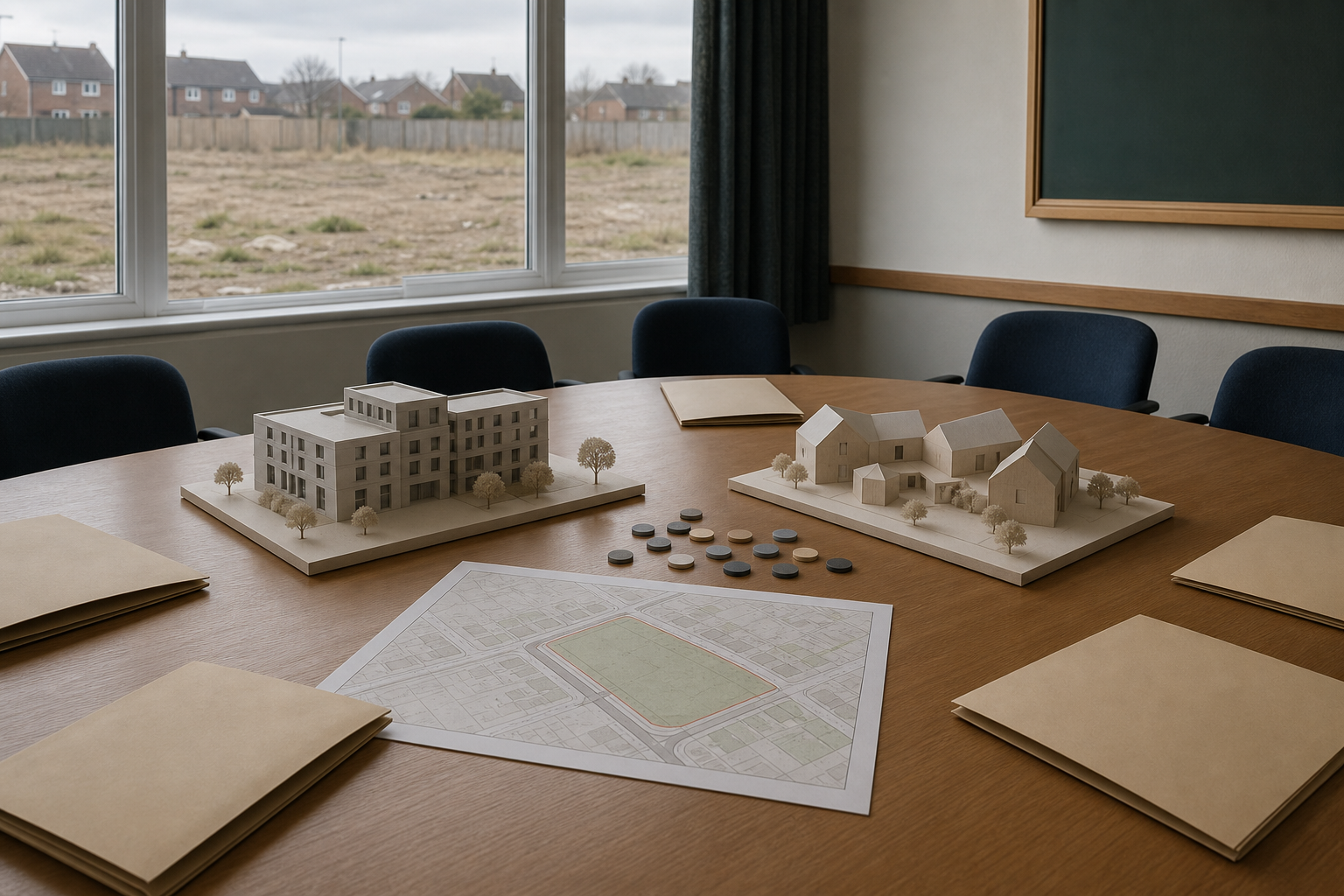
According to DharmaRenaissance Blog, South Cambridgeshire District Council awarded the Northstowe Church Network, also known as NCN, a 999-year lease on a 0.25-hectare plot. The article reports that the lease carries a peppercorn rent and that the selected project is expected to provide Christian worship facilities as well as space serving the local Muslim community.
Hindu Samaj Northstowe, described by the source as a charity formed by local residents, competed for the same site. Its proposal reportedly combined what would have been Cambridgeshire’s first Hindu temple with an interfaith and well-being centre. The article associates the project with approximately 150 Hindu families in and around the area.
The source reports that council officers scored the Hindu Samaj Northstowe bid at 65 per cent and the NCN proposal at 81 per cent. Those figures identify the reported ranking, but they do not by themselves reveal which criteria produced the difference, how individual considerations were weighted or whether assessors fully understood the religious functions proposed by each applicant.
This is consequently more precise than a simple story of permission granted to one religion and denied to another. On the information supplied, it was a competition between two proposals containing both faith-specific and wider community elements. The material does not establish that Hindu worship will be accommodated within the selected project, nor does it provide the council’s evaluation documents or the successful application.
Key takeaways
- The reported decision concerned a long lease for a designated site, not a documented refusal of Hindu planning permission.
- The sole supplied account says the church-led proposal scored 81 per cent, compared with 65 per cent for the Hindu-led proposal.
- Both bids reportedly extended beyond a single congregation: NCN included provision for Muslims, while the Hindu proposal included an interfaith and well-being centre.
- A score records an outcome but cannot demonstrate fairness without the underlying criteria, weightings and assessment reasons.
- Interfaith language does not automatically resolve whether a Hindu community has access to facilities suitable for autonomous Hindu worship.
Why lease duration and religious function matter

The reported 999-year term gives the allocation unusual civic significance. It is not merely a decision about which organisation runs a short programme. In a planned new town where institutions are still taking shape, control of a site on such a term can influence the religious landscape far beyond the tenure of current councillors, applicants and residents.
The source presents the Hindu proposal as a response to needs that extend beyond occasional access to a meeting room. It identifies worship, samskaras, festivals, religious education, cultural transmission and community support as important functions of a local temple. It also argues that travelling elsewhere for these activities creates a practical burden for families and can make religious participation feel distant from everyday life.
That argument should be evaluated on its merits rather than reduced to a demand for symbolic representation. A shared community venue and a dedicated place of worship are not necessarily interchangeable. As a general matter, religious communities may have requirements involving consecrated space, regular ritual activity, calendars, food preparation, clergy or religious teachers, and the storage or treatment of sacred objects. Whether a particular shared building can support those functions depends on its design, governance and operating rules.
The same principle applies across traditions. Substantive inclusion requires decision-makers to understand what a proposed space is meant to enable, not merely how many groups appear in its description. The relevant comparison in Northstowe is therefore not simply between a single-faith project and an interfaith project. Based on the supplied account, both applicants claimed a broader community purpose, but they organised that purpose around different institutional models.
The equality test lies in criteria and evidence

An unequal outcome is not, by itself, proof of unequal treatment. Competitive public processes normally produce one successful applicant and one or more unsuccessful applicants. The more useful question is whether the published criteria were relevant, applied consistently and capable of recognising the different ways in which communities organise religious and civic life.
For that question to be answered, the public record would need to explain the scoring categories, their relative weight, the evidence expected from bidders and the reasons points were gained or lost. Evaluator comments would help show whether factors such as governance, financial viability, community reach, deliverability, religious need and long-term use were assessed. The supplied article provides the two overall scores but none of this supporting material.
Transparency is especially important where institutional familiarity may affect judgement. The source argues that Hindu community activity can be organised through charities, families, volunteers, festival groups and local associations rather than structures resembling established church networks. This does not establish that the Northstowe assessment was biased. It identifies a legitimate issue for examination: whether the framework measured relevant capability or inadvertently rewarded one familiar organisational form.
Other matters also remain unresolved in the supplied record. It does not disclose how local demographic needs were evidenced, whether the duration of the lease affected the assessment, what Hindu provision exists in the selected design, whether alternative sites were considered, or what review mechanism was available to the unsuccessful applicant. These are questions for documents and reasoned explanations, not assumptions about the motives of religious communities.
A constructive route beyond zero-sum framing
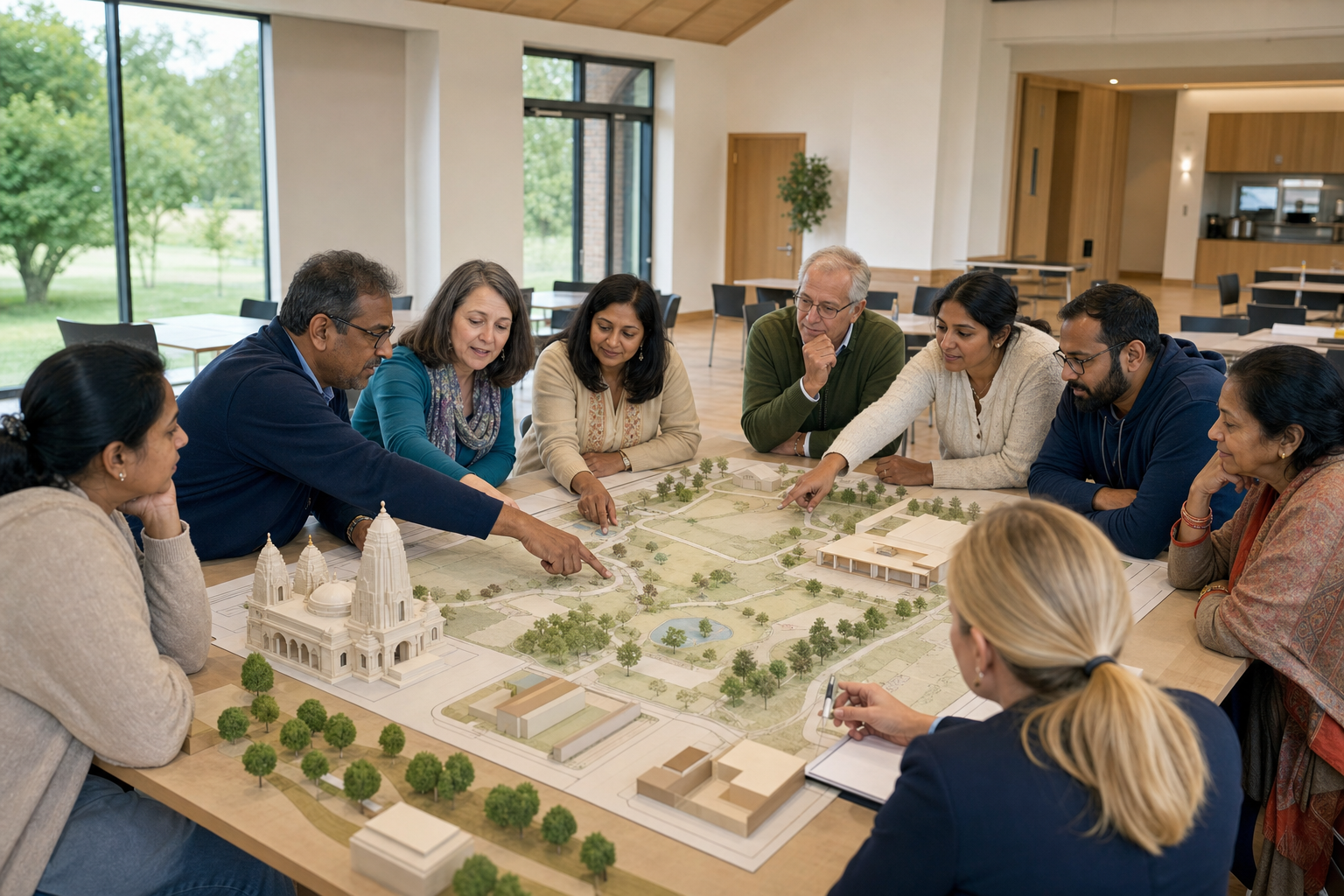
The dispute need not be framed as Hindus opposing Christian or Muslim residents. The selected scheme’s reported provision for two communities may have genuine local value, while Hindu residents can still reasonably maintain that their distinct needs remain unmet. Both propositions can be true, and neither settles whether the council chose fairly between the bids.
A credible institutional response would make the reasoning inspectable. Subject to legitimate confidentiality requirements, publication of the assessment framework, category-level scoring and a clear decision narrative would allow residents to distinguish disagreement over priorities from defects in procedure. Clarification of whether the winning project can support Hindu practice would also prevent the vague language of inclusion from carrying more weight than the building’s actual capabilities.
If the allocated site cannot meet those needs, constructive engagement should address realistic routes to a dedicated Hindu space rather than treating the unsuccessful bid as the end of the matter. That could involve identifying what evidence a future proposal would need, explaining how forthcoming community land opportunities will be handled, and ensuring that Hindu residents can describe their requirements directly to planners and decision-makers. These are possible approaches, not outcomes reported by the source.
Northstowe’s long-term civic landscape is still being formed, while the reported lease would endure for generations. The immediate test is whether the authorities and applicants can move from competing claims about inclusion to a documented account of how religious need, community benefit and institutional capacity were judged.