
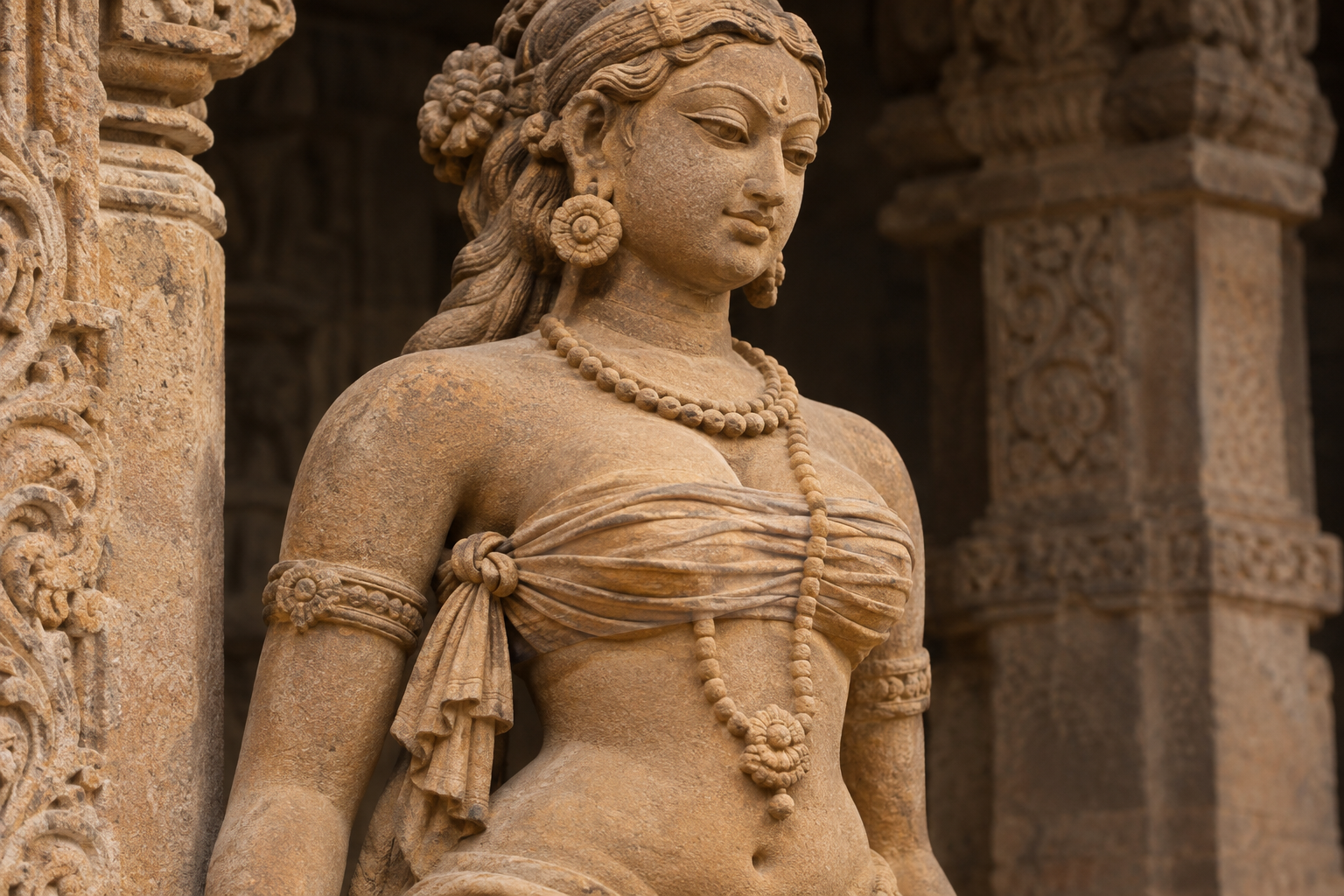
You are standing before a temple carving or studying a museum photograph when a narrow feature crosses a female figure’s chest. Is it clothing, jewellery, anatomy, or damage to the stone? If you answer too quickly, you can misread both the feature and the figure.
The kucha bandha gives that feature a precise place in Hindu visual culture. The term refers to a breast-band, an element of feminine attire represented within a sculptural language where garments, ornaments, and posture can carry meaning beyond decoration. Learning to recognise it helps you look at Hindu sculpture on its own terms rather than through modern assumptions about dress.
What you are actually looking for
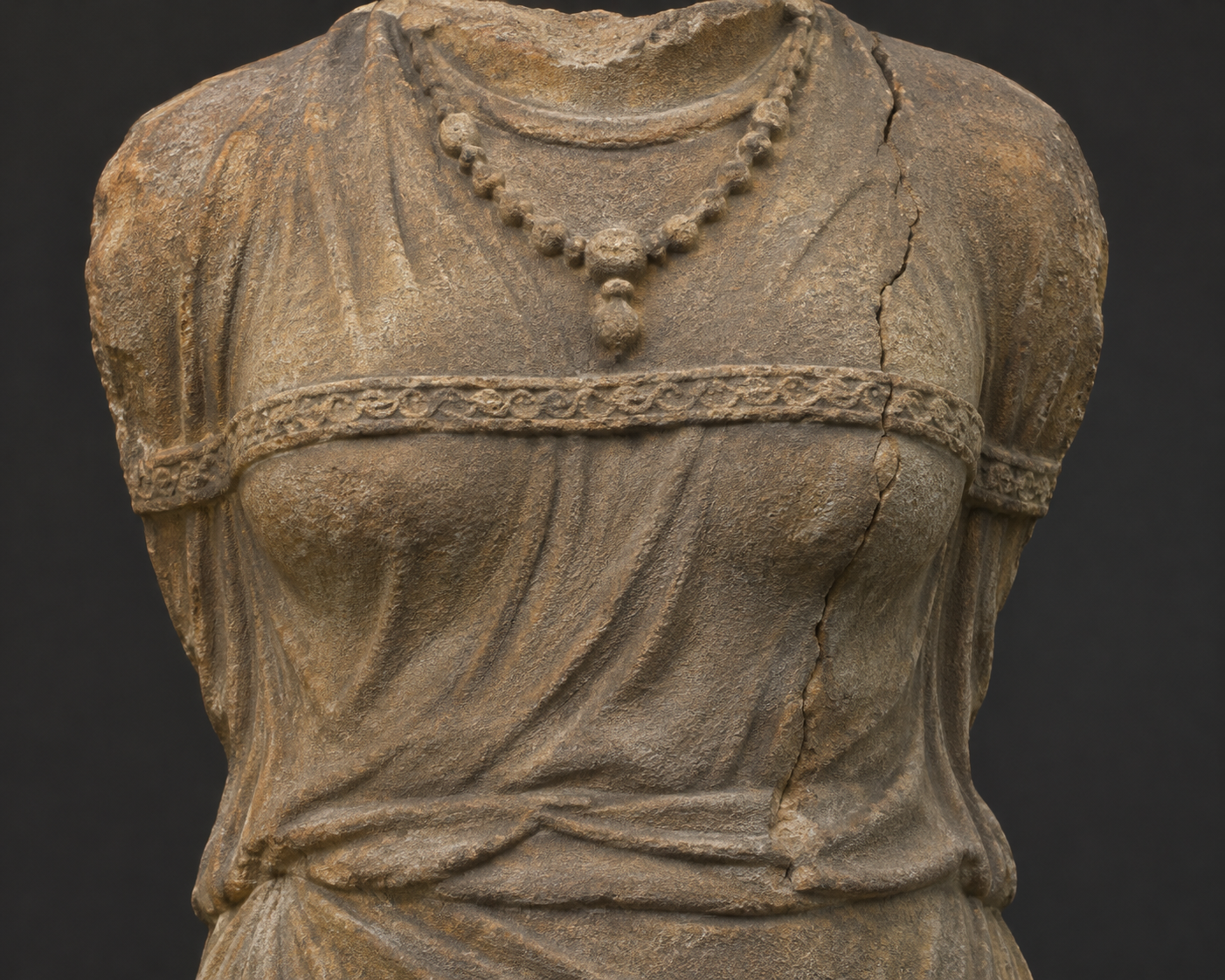
A kucha bandha is a breast-band depicted on a female figure. Its defining clue is not simply that a line appears somewhere on the torso. You are looking for a garment-like element whose position and form relate to the breasts.
Begin with location. A necklace originates visually at the neck and usually hangs downward. A waist ornament belongs lower on the body. A kucha bandha relates directly to the chest. On a worn carving, that positional relationship may be more reliable than surface decoration.
Then follow the form rather than staring at one isolated mark. Does the feature continue across the torso like a band? Does it appear to lie upon the body rather than emerge from its anatomy? Does the same type of feature appear more clearly on a neighbouring figure? These questions help separate intentional attire from a fracture, weathered contour, shadow, or photographic artefact.
The English expression “breast-band” is useful because it describes function without pretending to reproduce every historical nuance. “Bra” is less useful. It imports the construction, social meaning, and expectations of a modern garment into a different visual and cultural system. Use the modern comparison only as an initial recognition aid, never as the final interpretation.
Read it as part of a sculptural grammar
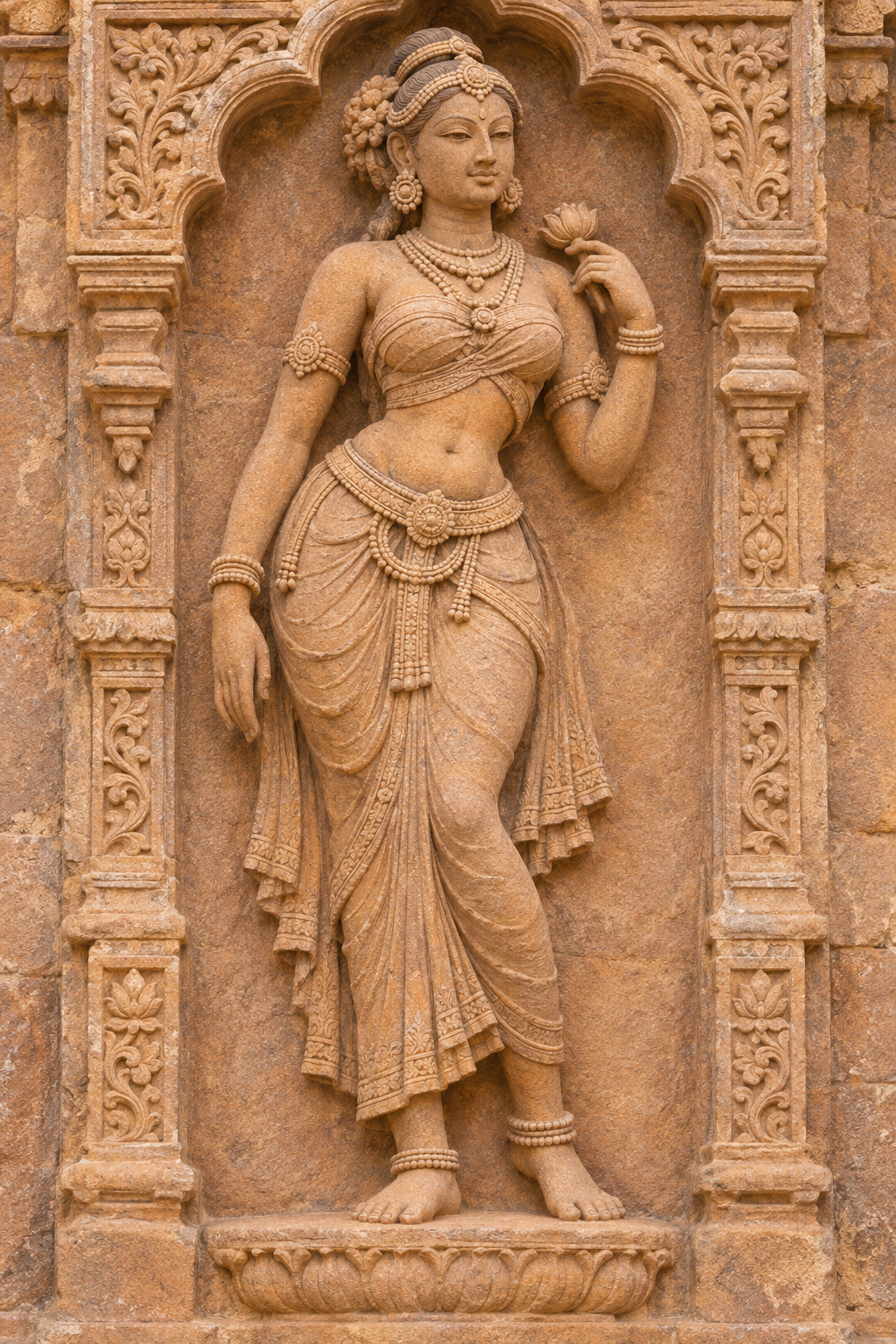
Hindu sculpture is not a random accumulation of attractive details. The kucha bandha belongs among elements of feminine attire treated within classical systems of iconometry and iconography. Iconometry concerns the ordered proportions and measured form of an image. Iconography concerns how form, attributes, attire, posture, and context help communicate identity and meaning.
That distinction changes how you look. Instead of asking only, “What did women wear?”, ask, “What is this sculptor communicating through the complete figure?” The band participates in the body’s visual organisation. It can articulate the chest, interact with jewellery, and contribute to the figure’s composed appearance. Its craft is therefore inseparable from the larger image.
This does not mean every carved line contains a hidden theological code. It means that attire should not be dismissed as filler. A garment may contribute to beauty, dignity, movement, social presentation, or sacred presence without functioning as a secret symbol with one fixed translation.
Keep interpretation proportional to the evidence. If you can identify the band but cannot establish a more particular meaning from the complete image, stop at the secure identification. “This appears to be a kucha bandha” is more responsible than attaching an unsupported doctrine to it.
A five-step method for examining a sculpture
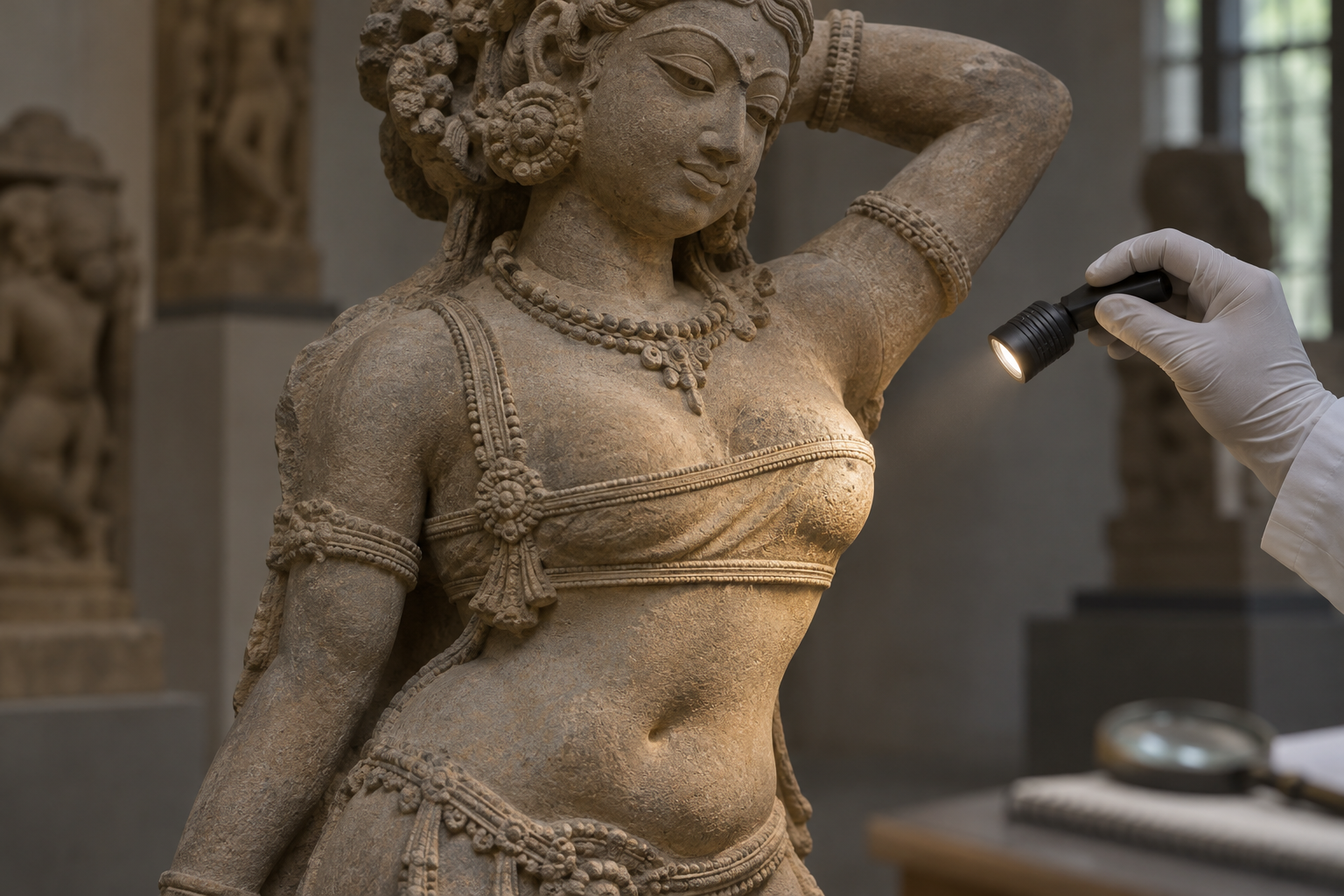
You do not need specialist equipment to make a careful first assessment. Use the following sequence at a temple, in a museum, or when examining a well-lit photograph.
- Locate the feature. Confirm that it crosses or encloses the breast area. A line merely near the chest is not enough.
- Trace its direction. Follow it from one side of the torso to the other. Look for the continuity expected of a band rather than judging a single surviving fragment.
- Separate it from nearby elements. Identify the neck, necklace, chest ornaments, garment edges, and anatomical contours. Overlapping details can make one object appear to be another.
- Compare nearby figures. A clearer figure in the same panel, doorway, wall, or sculptural group may reveal how the workshop represented clothing. Comparison within the same visual setting is safer than importing an example from a distant region or period without evidence.
- Record uncertainty. If erosion, breakage, restoration, lighting, or image quality prevents a secure reading, label the identification “possible” or “probable.” Return to it when you have another angle or a better image.
When working from a photograph, enlarge the torso but also keep a view of the complete figure. The close view shows the carving; the full view shows the relationship among attire, posture, ornaments, and setting. Either view alone can mislead you.
If you are documenting the object, write down what you can actually see before interpreting it: “horizontal band-like feature across the breasts” is an observation; “kucha bandha” is an identification; “symbol of a particular spiritual principle” is an interpretation. Keeping those levels separate makes your notes easier to correct and far more useful to another reader.
Four common misreadings to avoid
Do not reduce it to modesty. A breast-band may cover part of the body, but that fact alone does not prove that the sculptor was expressing a modern idea of modest dress. Read the entire figure and its cultural setting before assigning a moral purpose.
Do not reduce it to erotic display. The visibility of the breasts, the fit of a garment, or the sensuous treatment of the body does not make the detail merely sexual. Hindu sacred art can coordinate bodily beauty, ornament, auspicious presence, and spiritual significance without accepting the modern habit of placing “sensuous” and “sacred” in opposing boxes.
Do not identify a figure from this feature alone. The kucha bandha is an item of attire, not a unique name tag. If you are trying to identify a deity or attendant, examine attributes, hand gestures, posture, companions, placement, and the wider sculptural programme. One costume element cannot carry the whole identification.
Do not treat every difference as symbolic. A band can look different because of material, scale, carving technique, damage, or the sculptor’s chosen degree of detail. Establish the feature first. Interpret variation only when the surrounding evidence supports it.
Key takeaways
- Kucha bandha means a breast-band represented as an element of feminine attire in Hindu sculpture.
- Identify it through position, continuity, and its relationship to the torso, not through one line viewed in isolation.
- “Breast-band” is a useful description; treating it as simply a modern bra creates an anachronism.
- Read attire together with posture, ornaments, attributes, and architectural setting.
- Do not force the feature into a modern modest-versus-erotic binary.
- When erosion or poor photography leaves doubt, preserve that doubt instead of inventing certainty.
On your next temple or museum visit, take one extra minute with the figure. Look first at the whole composition, then trace the band across the torso, and finally compare it with adjacent carvings. That small discipline turns a nearly overlooked line into an entry point for reading Hindu sculpture with greater precision and cultural respect.
References

Leave a Reply
You must be logged in to post a comment.