

You may know Jogulamba only as a name on a Shakti Peetha list and still be unsure what to do with that knowledge. Should you memorise the list, search for a complete legend, or prepare for darshan at Alampur? Begin by holding together three things that online lists often separate: the Goddess, her sacred place, and the local katha.
The essential anchor is clear: Jogulamba is a form of the Hindu Goddess especially revered in Telangana, her Alampur shrine is counted among the 18 Maha Shakti Peethas, and her associated origin story begins with a sage named Yogeeswara. Understanding those claims properly will take you further than collecting unsupported details from several interchangeable temple summaries.
Hold together Mata, Peetham and Alampur
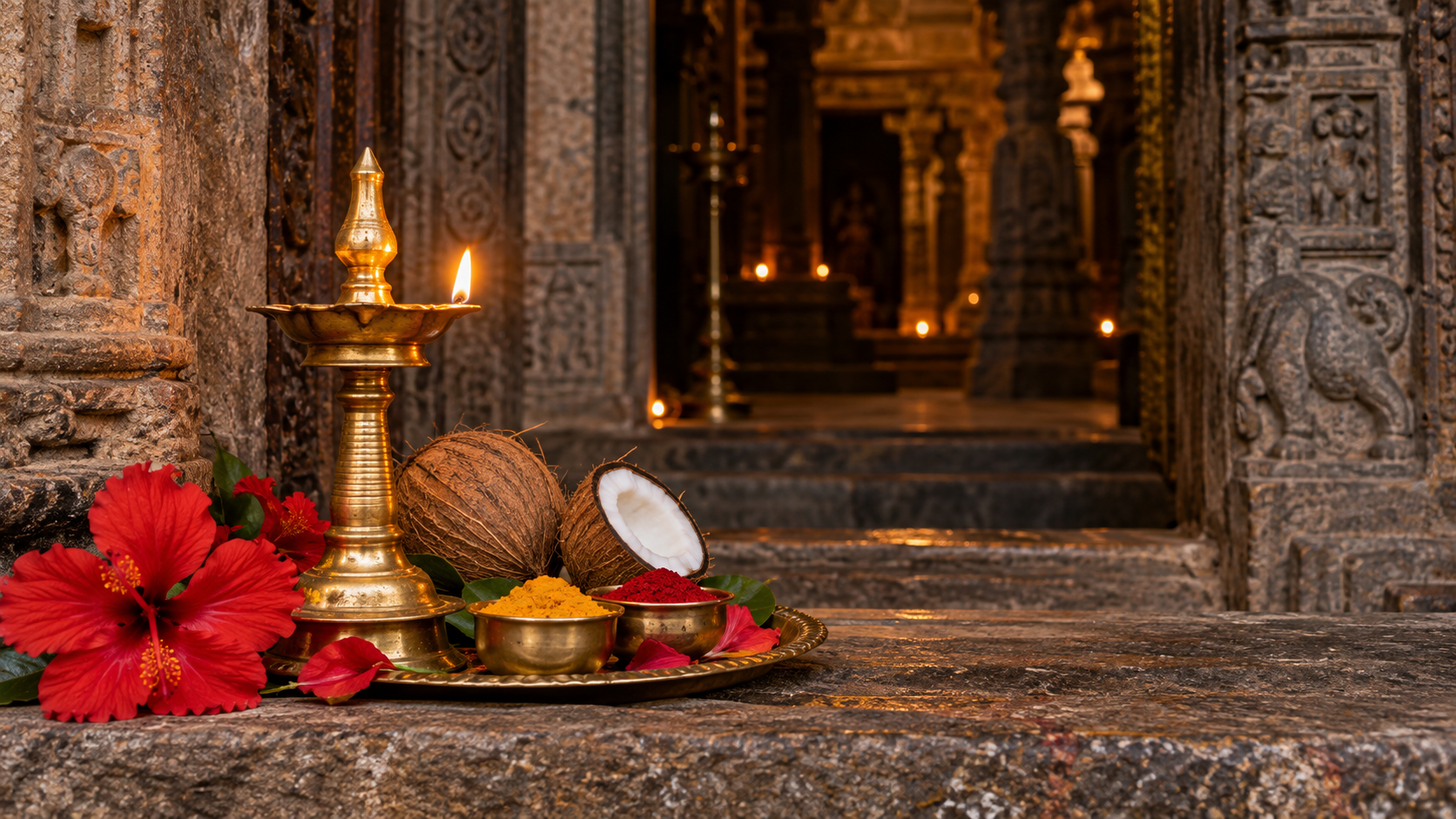
Begin with Mata. Jogulamba is approached as a form of the Goddess, not merely as a historical personality or a name attached to a building. That distinction changes how you read the tradition. A devotee is entering a relationship with Shakti; a student is learning how that relationship is expressed through a particular divine form.
Next comes Peetham. A peetham is understood as a seat of sacred presence. Calling Alampur one of the 18 Maha Shakti Peethas therefore places Jogulamba within a larger sacred geography of the Goddess. The classification connects the local shrine to a pan-Bharatiya field of Shakti worship, but it does not make local identity disposable.
Alampur and Telangana supply that indispensable local dimension. Jogulamba is not an abstract entry in a national catalogue. Her name, katha and worship belong to a living regional setting. If you discuss only the list of 18, you lose the local tradition. If you discuss only the locality, you miss the shrine’s place within the wider Shakti Peetha vision. Keep both scales in view.
Hear the Yogeeswara katha without inventing its missing parts
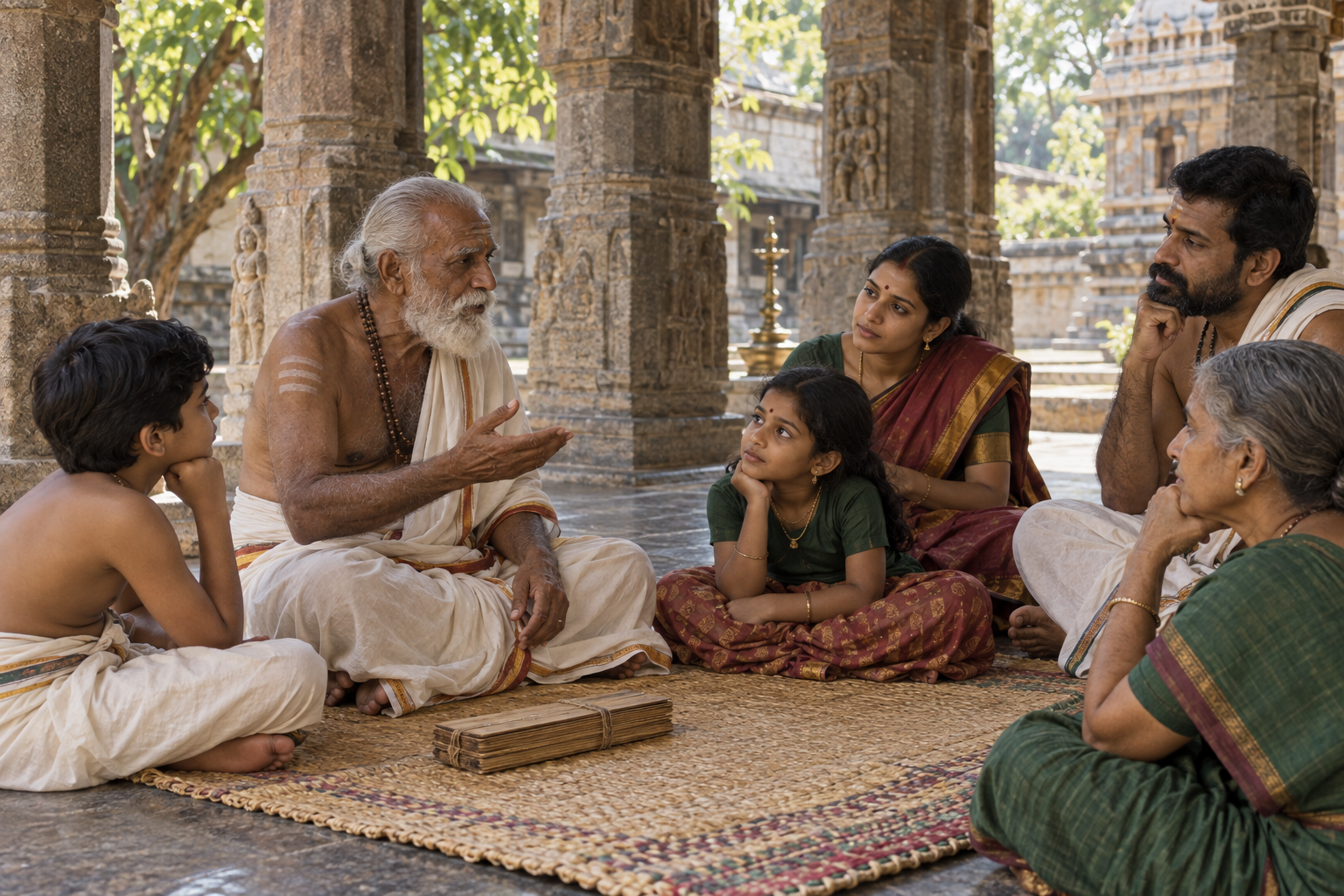
The name Yogeeswara is the firm narrative starting point available to you: the origin account begins with a sage of that name. It is not a licence to infer his biography, translate his name into a complete doctrine, or borrow episodes from another Goddess tradition. Similar-looking temple stories are not automatically interchangeable.
When you encounter a fuller telling, listen for four precise elements: what Yogeeswara does, how Jogulamba enters the account, what connection the story establishes with Alampur, and whether a present custom is explicitly linked to the narrative. These questions help you recognise the structure of the katha without forcing it into a preconceived template.
If you are teaching children, speaking at a community gathering or writing a temple note, state only the portion you can support. A careful formulation is: In the Alampur Jogulamba tradition, the origin narrative begins with the sage Yogeeswara; the complete local katha should be learned from a fuller traditional telling. That sentence preserves the known link while leaving room for the tradition-bearers who know the narrative in depth.
This restraint is not hesitation about Hindu tradition. It is respect for it. A katha carries names, relationships and sacred meanings that can be distorted when missing episodes are filled with whatever sounds plausible. Where your knowledge ends, turn that gap into a focused question rather than an invented answer.
Read the number 18 as a tradition, not a ranking

The description of Jogulamba as one of the 18 Maha Shakti Peethas is a specific traditional classification. It does not mean that the shrine occupies eighteenth place, that other Shakti temples are spiritually negligible, or that sacred importance can be reduced to a numerical league table.
Different Hindu lineages and regional tellings can preserve different enumerations of sacred places. When two lists do not match, first check whether both are actually claiming to list the 18 Maha Shakti Peethas. One may instead be using the broader expression Shakti Peethas. Then compare the divine form, the place and the tradition behind each enumeration. A spelling variation or a different scope should not be mistaken for a theological verdict.
The accurate statement is narrow and strong: Within the tradition of the 18 Maha Shakti Peethas, Jogulamba at Alampur is included. Use that wording when you need to explain the shrine to someone encountering it for the first time. It honours the claim without pretending that every Hindu enumeration must be identical.
You can then ask the more fruitful question: what does this sacred network invite a devotee to recognise? It invites you to see Shakti as locally present without being locally confined. Alampur matters in its own right, while participation in the wider Peetha tradition connects that place to a civilisational geography extending beyond one region.
Prepare for Alampur as a learner as well as a pilgrim

Before visiting, learn the three anchor facts well enough to say them plainly: the deity is Mata Jogulamba, the place is Alampur in the Telangana region, and the shrine belongs to the 18 Maha Shakti Peetha tradition. This small amount of preparation will help you recognise meaningful local explanations when you hear them.
Verify current opening times, access arrangements, permitted offerings and photography rules directly through current temple guidance or on-site authorities. These details can change, and a generic pilgrimage page may not reflect the practice in force when you arrive. Do not carry a ritual item merely because it is customary at some other Shakti shrine; ask what is appropriate at Jogulamba’s temple.
At the shrine, allow local practice to teach you. Read the signs, follow the queue, and take direction from authorised temple personnel. If you have an opportunity to ask about the tradition, use a precise question: How is Yogeeswara connected with Mata Jogulamba in the complete Alampur katha? That will usually produce a more useful explanation than asking for the entire history at once.
After darshan, write down the exact names and relationships you heard while they are fresh. Mark who explained them and distinguish a temple explanation from your own interpretation. If two tellings vary, preserve both with their contexts instead of silently merging them. That practice is especially important when passing the katha to younger family members or sharing it online.
Most importantly, do not leave with Jogulamba reduced once again to a number on a list. Notice how the local form of the Goddess, the Alampur setting and the wider Shakti Peetha identity illuminate one another. That threefold understanding is the real preparation for an informed darshan.
Key takeaways
- Jogulamba is a form of the Hindu Goddess with particular reverence in Telangana, and her shrine is at Alampur.
- The shrine is counted within the tradition of the 18 Maha Shakti Peethas; this is a sacred classification, not a ranking of temples.
- The associated origin katha begins with a sage named Yogeeswara. Do not supply further episodes unless you have a fuller traditional account.
- For a visit, verify changing practical rules locally and ask specifically how Yogeeswara is connected with Mata Jogulamba.
Your best next step is simple: learn the complete Yogeeswara katha from a trustworthy local telling, then approach Alampur with enough patience to see Jogulamba as both the Mata of a particular place and a presence within Bharat’s wider Shakti tradition.
References

Leave a Reply
You must be logged in to post a comment.