
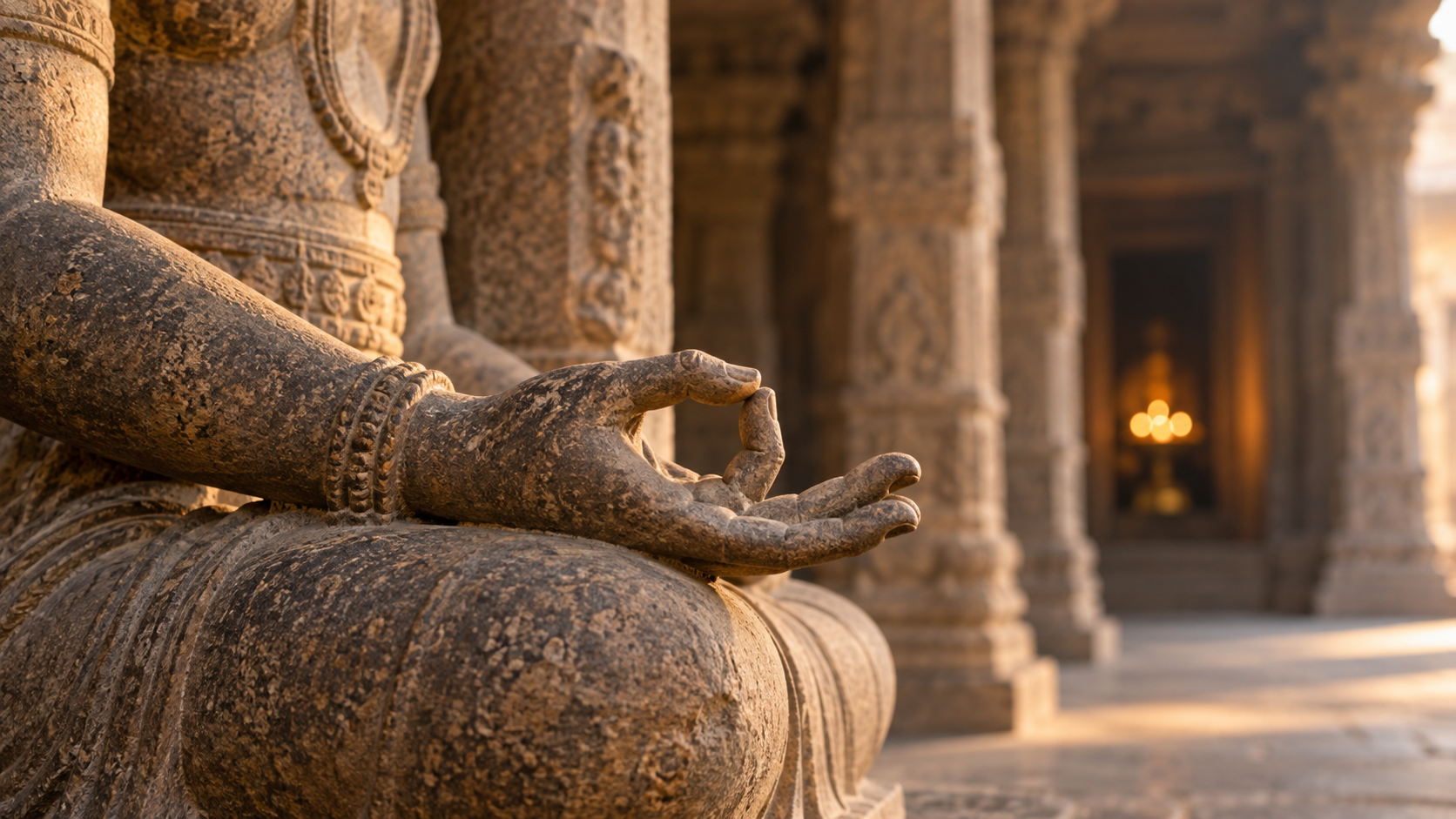
You are standing before a temple sculpture, studying a photograph of a murti, or trying to caption an old bronze. One hand catches your attention: the thumb and index finger meet while the other fingers extend. Is it Jnana Mudra, and what can you responsibly understand from it?
You can answer that question without forcing an elaborate story onto the image. Begin with what the hand visibly does, then read its meaning through the posture, setting, and larger iconographic composition.
Start with the hand, not with a grand interpretation
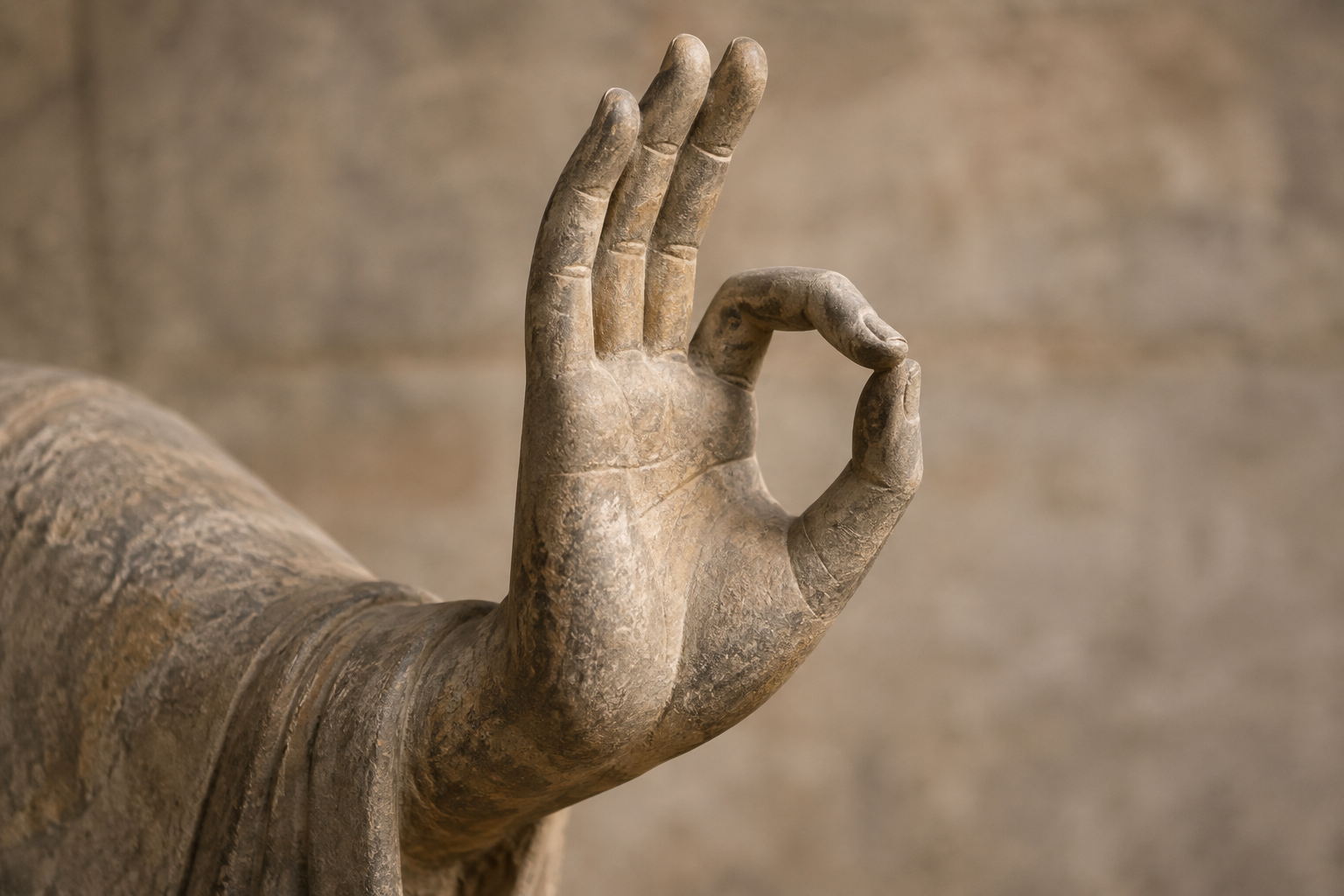
The basic form is precise: the tip of the index finger joins the thumb to make a circular shape, while the middle, ring, and little fingers extend outward in relaxed repose. Across centuries of Hindu stone and bronze imagery, this configuration has served as a visual sign of knowledge.
When you examine an image, use a simple visual sequence:
- Find the actual point of contact. The index finger should meet the thumb rather than merely bend in its direction.
- Check the remaining three fingers. They should extend separately or as a relaxed group, not close into a fist.
- Record which hand carries the gesture. Do not assume it is always the same hand.
- Note where the hand is placed: near the knee, in the lap, beside the torso, or raised toward the chest.
- Observe the palm’s direction and the angle at which the gesture is presented.
- Inspect the surface for breakage, erosion, repair, or a missing fingertip before making a firm identification.
A weathered circle will not always look geometrically complete. Stone loses fine edges, and photographs flatten depth. Compare several views when possible. If the thumb or index finger is missing, describe the surviving arrangement rather than silently reconstructing the hand.
Jnana names the knowledge being communicated
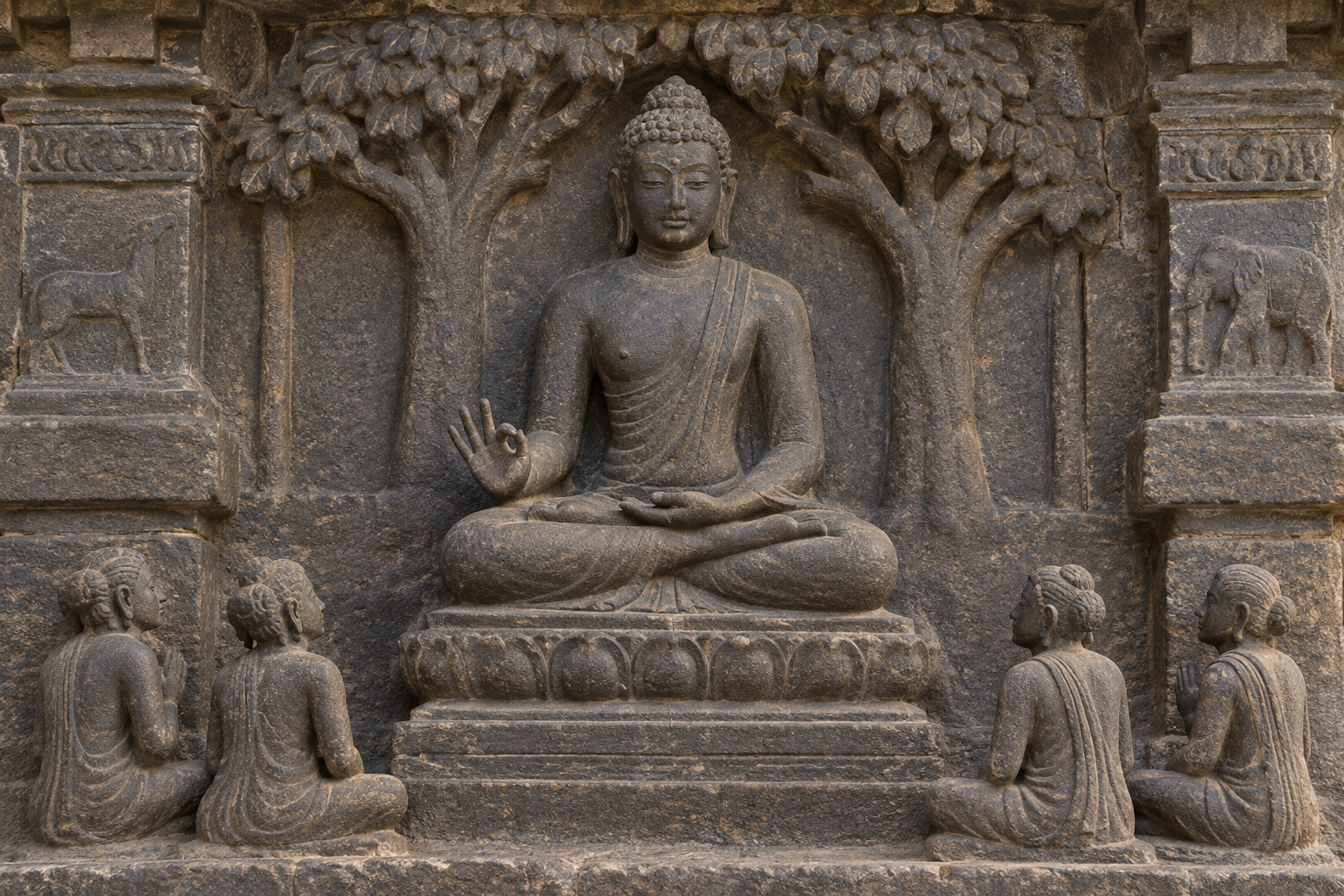
Jnana means knowledge. In a spiritual setting, it points beyond the accumulation of facts toward insight: the kind of understanding that changes how the self and reality are known. The mudra gives that otherwise invisible theme a visible form.
This is why the gesture should not be treated as decorative hand placement. Its controlled stillness belongs to the image’s meaning. Where a weapon, musical instrument, flower, or ritual object identifies an activity or attribute, Jnana Mudra communicates through the disciplined configuration of the hand itself.
The meeting of thumb and index finger is often read as a sign of unity, completeness, or the relation between individual consciousness and ultimate reality. Such readings can help you enter the theological world of an image, but they are interpretations of the form rather than labels engraved into every finger. Use them as a doorway, not as a rigid decoding chart.
Context decides how confidently you can name it
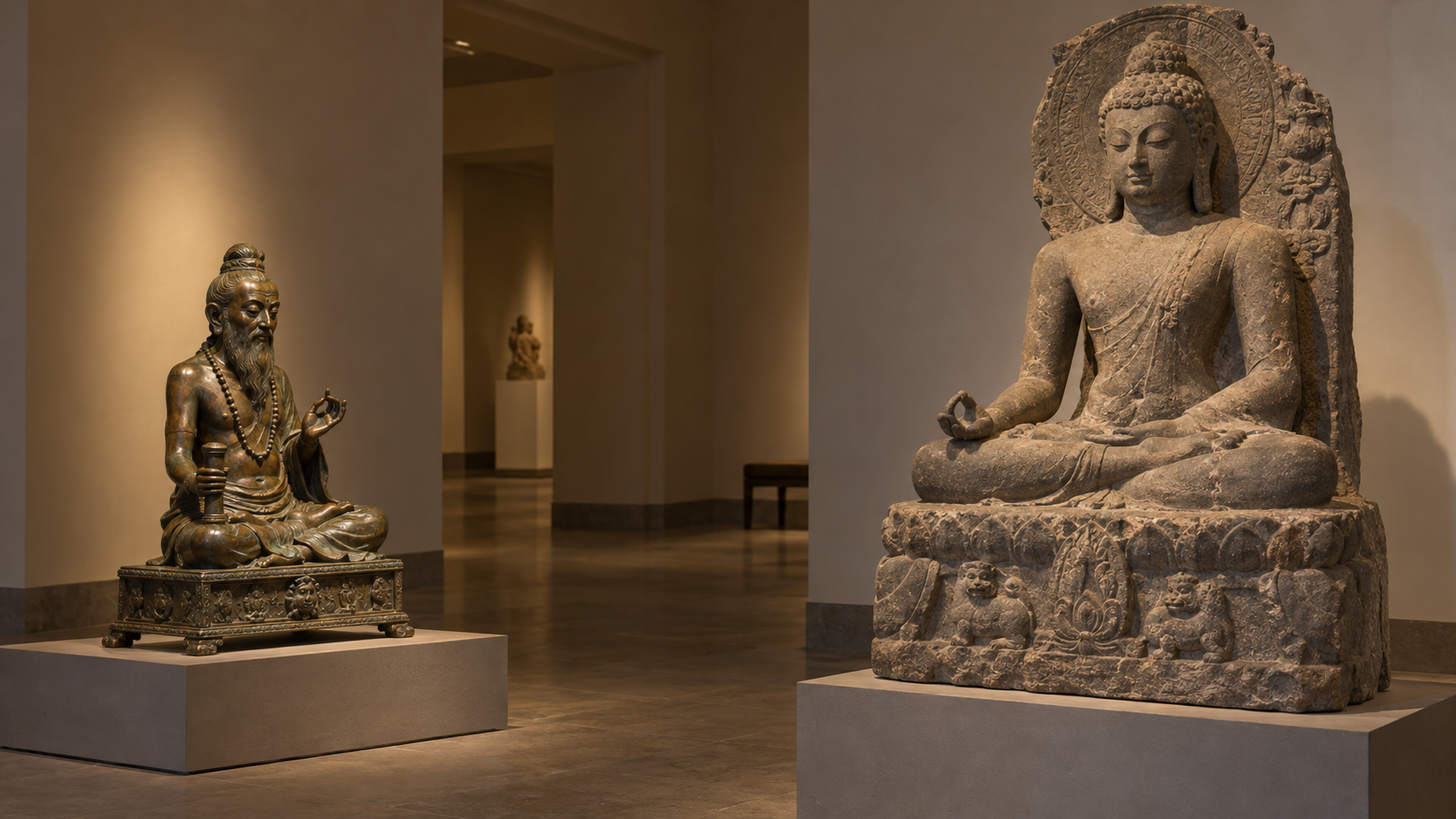
A thumb-and-index circle is your starting clue, not your entire conclusion. Closely related hand formations can acquire different names or emphases depending on the tradition, posture, position of the hand, and whether the figure is represented as contemplating, teaching, blessing, or performing another sacred act.
Read outward from the fingers in widening circles:
- The hand: Which digits touch, and which remain extended?
- The arm and body: Does the hand rest naturally with a meditative posture, or is it raised as part of an active address?
- The complete figure: What do the other hands, attributes, seat, ornaments, expression, and attendants communicate?
- The setting: Is the image part of a shrine, narrative panel, teaching scene, architectural programme, or later display?
- The local tradition: Does a temple inscription, catalogue, or established ritual identification preserve the image’s name and significance?
This method matters because iconography works like a grammar. A single sign carries meaning, but its role becomes clearer within the whole composition. The mudra may establish knowledge as a central quality without independently identifying the deity, teacher, philosophical school, or date of the image.
If you are writing a museum note, travel caption, or educational post, separate observation from identification. A careful caption might say: The right hand joins the thumb and index finger while the other three fingers extend; its form and contemplative placement are consistent with Jnana Mudra. That wording tells your reader what you actually saw and why the name fits.
Keep symbolism connected to the image before you
Popular explanations sometimes assign a separate metaphysical idea to every finger. You may encounter the three extended fingers linked to triads such as the three gunas, or to obstacles that obscure knowledge. These readings can be meaningful within a particular teaching context, but they should not automatically be presented as the single universal explanation of every sculpture.
A sound interpretation has three levels:
- Visible fact: Describe the fingers, palm, hand, and placement.
- Iconographic meaning: Identify Jnana Mudra as the gesture of knowledge when the form and context support it.
- Theological interpretation: Explain a deeper finger symbolism only when you can connect it to the relevant lineage, teacher, text, or local tradition.
Keeping those levels distinct does not weaken a Dharmic reading. It protects its integrity. Hindu sacred art can sustain many layers of meaning, but plurality is not permission to attach every available symbolism to every image.
The same discipline also prevents the opposite error: reducing a mudra to a neutral art-historical shape. A sacred gesture is part of how a murti makes a quality present to the devotee. Form, contemplation, and darshana belong to one encounter, even when a catalogue must describe them in separate sentences.
Key takeaways for reading Jnana Mudra
- Look first for contact between the thumb and index finger, with the remaining three fingers gently extended.
- Read the gesture’s central meaning as knowledge or spiritual insight.
- Use hand position, bodily posture, attributes, setting, and local identification to test your conclusion.
- Do not identify a deity, sect, historical period, or full doctrine from this hand shape alone.
- Present detailed finger symbolism as tradition-specific when its interpretive basis is not established.
- When damage creates doubt, describe what survives and qualify the identification.
The next time you meet this gesture, pause before reaching for an elaborate explanation. Observe the hand, read the complete murti, and state only as much as the image supports. That careful attention is itself appropriate to Jnana Mudra: knowledge begins by seeing clearly.
References

Leave a Reply
You must be logged in to post a comment.