
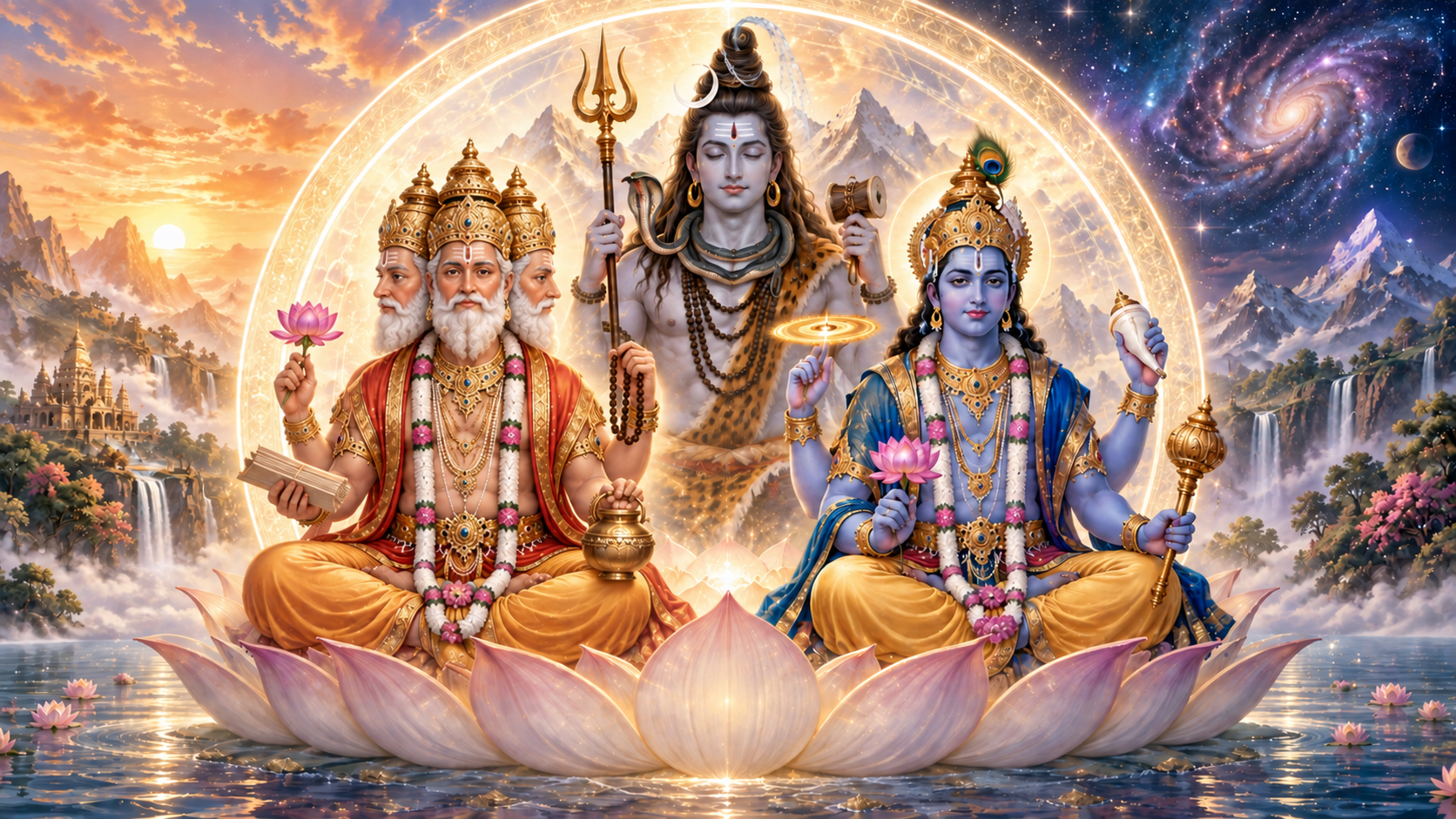
You may have met two opposite explanations of the Trimurti: Hinduism worships three supreme gods, or Brahma, Vishnu and Shiva are simply different names for the same thing. If you are trying to understand a temple image, explain Hindu thought to someone else, or place this teaching within your own practice, neither slogan is adequate.
The clearer answer holds unity and distinction together. The Trimurti presents Brahma, Vishnu and Maheshwara (Shiva) through creation, sustenance and transformation as three expressions of one supreme cosmic reality. The forms are distinct enough to carry meaning, yet they do not have to be imagined as rival ultimate powers.
Read the three forms through their cosmic functions
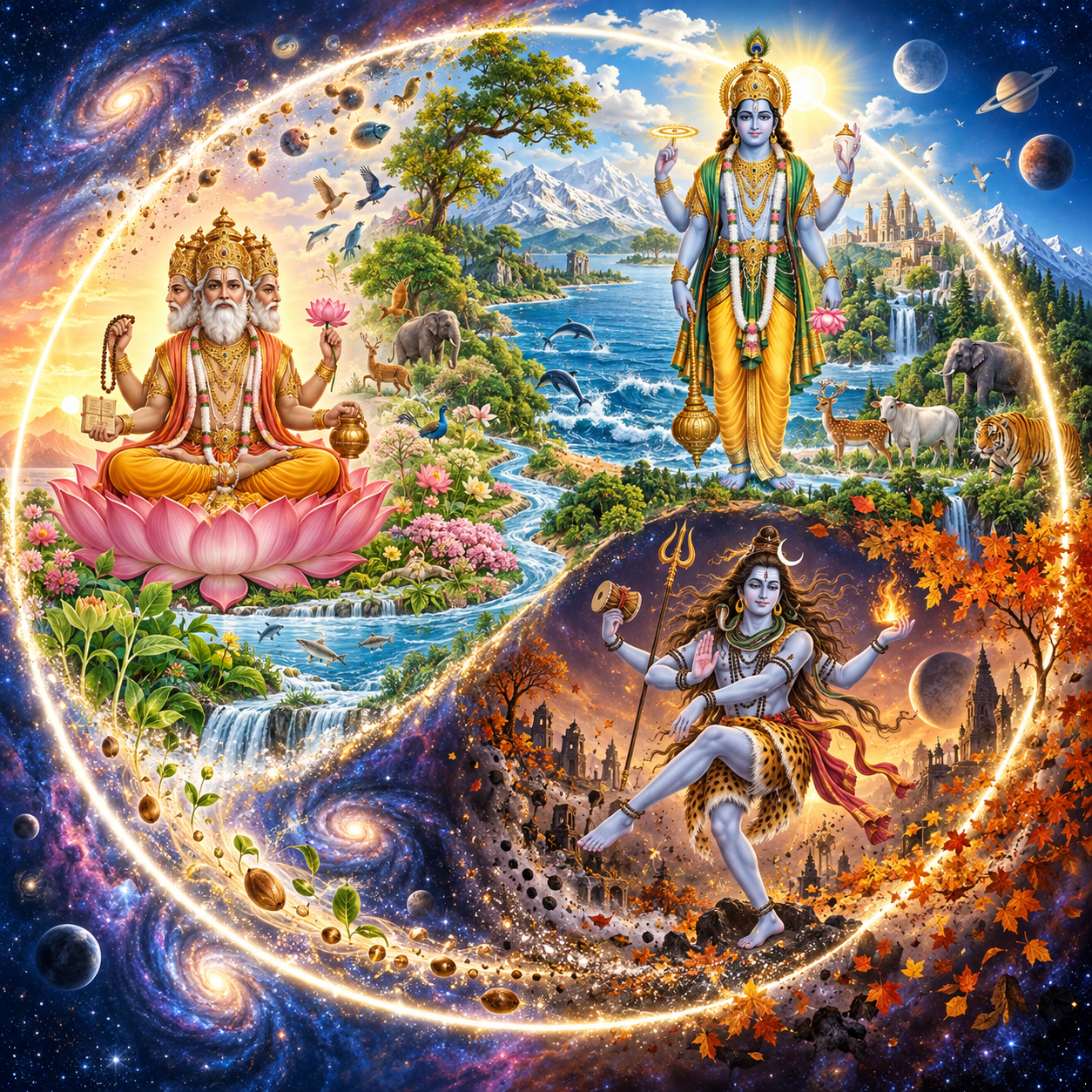
The most useful first question is not, “How many gods are there?” Ask instead, “What aspect of cosmic activity does each form reveal?” That shift takes you from counting images to understanding what the Trimurti is designed to communicate.
| Divine form | Cosmic function | A question it invites you to ask |
|---|---|---|
| Brahma | Creation | What is coming into form? |
| Vishnu | Sustenance | What must be preserved, nourished or kept in right relation? |
| Shiva (Maheshwara) | Transformation | What has completed its present form and must change? |
These functions depend on one another. What comes into being requires continuity if it is to endure. What endures eventually changes. Transformation clears the conditions in which another form can emerge. The three are therefore better understood as an integrated movement than as isolated departments of the universe.
Do not turn that movement into a rigid timeline. Creation, sustenance and transformation can be present together. A family begins a custom, preserves its meaning and adapts its outward form as circumstances change. A community establishes an institution, maintains its responsibilities and reforms what no longer serves its purpose. The functions are distinguishable even when they overlap.
This is why reducing Shiva to destruction misses the more useful idea. Destruction sounds like mere negation. Transformation recognizes that an ending can be a change of form and a condition for renewal. When you encounter an image or explanation of the Trimurti, look for this full cycle rather than treating its final movement as something alien to the first two.
Divine unity does not erase meaningful distinction
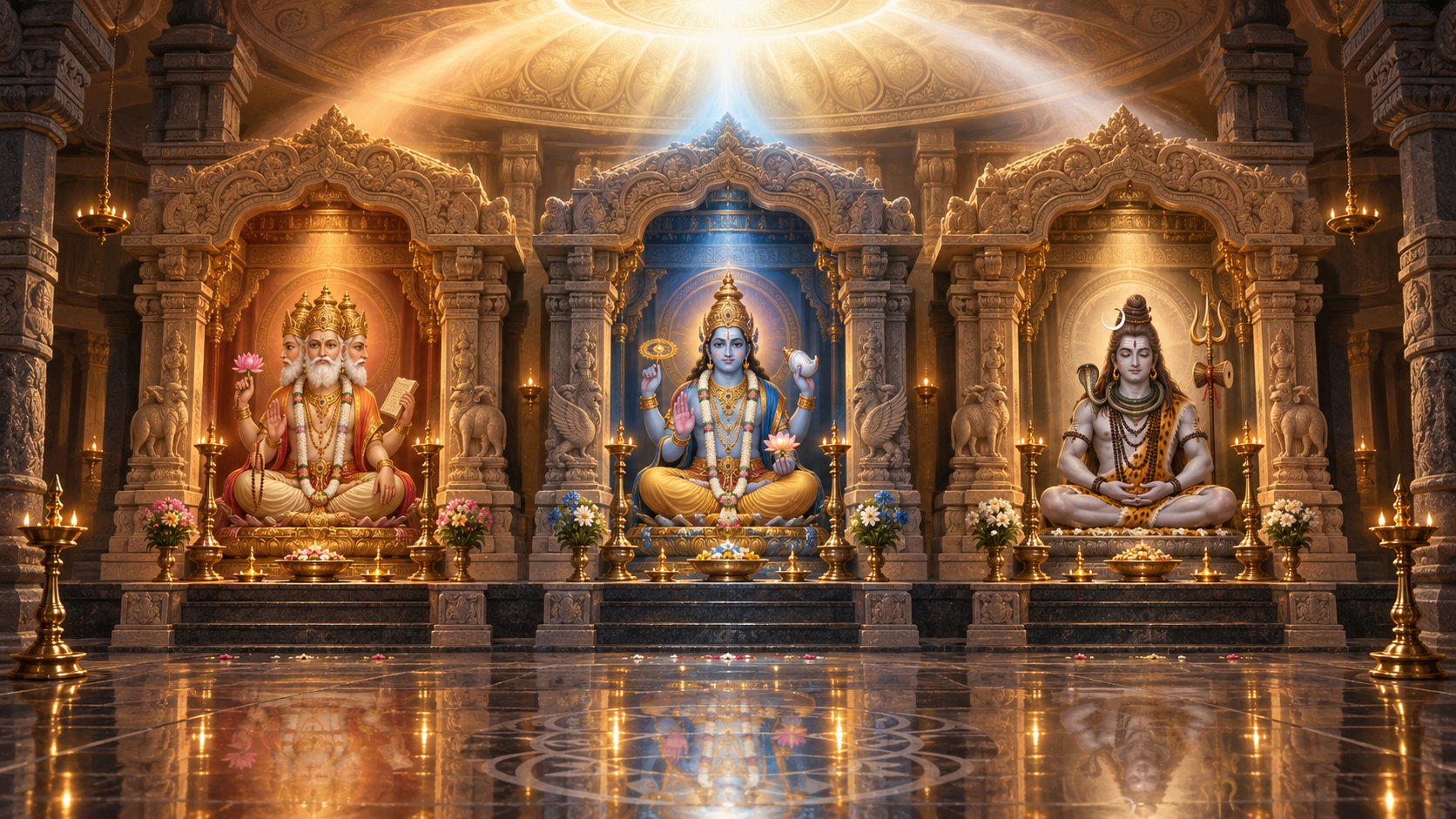
Unity here is a claim about the ground of the three functions, not a claim that every form is visually, relationally or devotionally interchangeable. Brahma signifies creation because creation matters. Vishnu signifies sustenance because continuity matters. Shiva signifies transformation because change matters. If the names meant nothing different, the threefold form would teach nothing.
At the same time, distinction need not become competition. The Trimurti does not require you to imagine three disconnected beings negotiating control of the cosmos. It directs attention to one divine principle disclosed through different but inseparable activities.
A simple analogy can help, provided you remember that it is only an analogy. The beginning, continuation and completion of a sentence are not identical, but they belong to one act of expression. Remove any one of them and the expression becomes incomplete. In the same way, the Trimurti lets you speak distinctly about cosmic functions without losing their underlying unity.
This also explains why the framework should not be used to police another person’s devotion. A devotee may approach one divine form as Supreme rather than treating all three as equal objects of worship. The Trimurti can illuminate the relationship between plurality and unity without forcing every Hindu tradition or devotee into identical language.
When a disagreement arises, identify the level of the claim before answering it. One person may be speaking about ultimate reality. Another may be describing cosmic function. A third may be expressing devotional commitment. Those statements answer different questions and are not automatically contradictions.
Four misunderstandings that obscure the teaching
Most confusion comes from dropping either distinction or unity. You can test an explanation of the Trimurti against four common errors.
- Error: treating the Trimurti as three rival absolutes. This makes creation, sustenance and transformation look like powers with unrelated sources. Read them instead as faces of one cosmic reality.
- Error: saying the forms are “all exactly the same.” Shared divinity does not make their functions meaningless. Preserve both the common ground and the particular role of each form.
- Error: reducing Shiva to a negative force. Transformation includes the ending of a present form, but the point is change within the cosmic movement, not evil opposed to creation.
- Error: using the Trimurti as a complete inventory of Hindu divinity. Treat it as a focused philosophical framework. Do not use it to dismiss forms of worship, divine relationships or theological emphases that are not contained in this trio.
A related mistake is to ask which member “wins.” The framework itself is explaining interdependence, not staging a contest. Creation without sustenance has no continuity. Sustenance without transformation becomes permanent fixation. Transformation without anything created or sustained would have nothing to transform.
If someone asks whether Hindus believe in one or many, the Trimurti gives you a careful answer: divine unity and divine plurality do not have to cancel each other. Say that plainly before adding further detail. It is more accurate than forcing Hindu thought into a choice the framework does not make.
A practical way to contemplate the Trimurti

You do not have to leave the Trimurti as an abstract diagram. Its three functions can sharpen how you examine a duty, relationship, institution or personal decision. The following is a contemporary reflection based on the framework, not a claim that Hindu tradition mandates a particular ritual.
- Creation: Name what genuinely needs to begin. Make it concrete enough that you can identify the next action, not merely a desirable idea.
- Sustenance: Name what already deserves faithful continuation. Ask what regular duty, discipline or care keeps it alive after the excitement of beginning has passed.
- Transformation: Name what must change form. It may be an outdated plan, an attachment to one method or a habit that prevents the work from serving its purpose.
Use all three questions before making a major commitment. If you can describe only the beginning, you have an aspiration rather than a durable plan. If you know what to preserve but cannot allow adaptation, preservation may harden into stagnation. If you want change without identifying what deserves continuity, transformation can become restless disruption.
The same lens helps when you stand before a murti or hear a divine name. Pause before asking only, “Which god is this?” Also ask, “Which relationship between the Divine and the cosmos is being brought forward here?” With Brahma, notice emergence. With Vishnu, notice continuity. With Shiva, notice the power by which a completed form gives way to change.
This does not replace devotion with analysis. It gives your attention somewhere precise to rest. The form remains personal and sacred, while the cosmic function helps you see why that form matters within a larger unity.
Key takeaways
- The Trimurti presents Brahma, Vishnu and Shiva as distinct expressions of one supreme cosmic reality.
- Brahma signifies creation, Vishnu sustenance and Shiva transformation.
- Divine unity does not make the three forms interchangeable; their distinct functions carry the teaching.
- Transformation is broader than mere destruction because it connects endings, change and renewed possibility.
- The framework explains a relationship between unity and plurality; it should not be treated as an exhaustive map of Hindu worship.
The next time you encounter the Trimurti, carry three questions with you: What is arising? What must be sustained? What is ready to change? If you can see those movements as distinct without imagining three rival ultimate realities, you have moved beyond memorizing divine names and begun to understand what their unity asks you to notice.
References

Leave a Reply
You must be logged in to post a comment.