
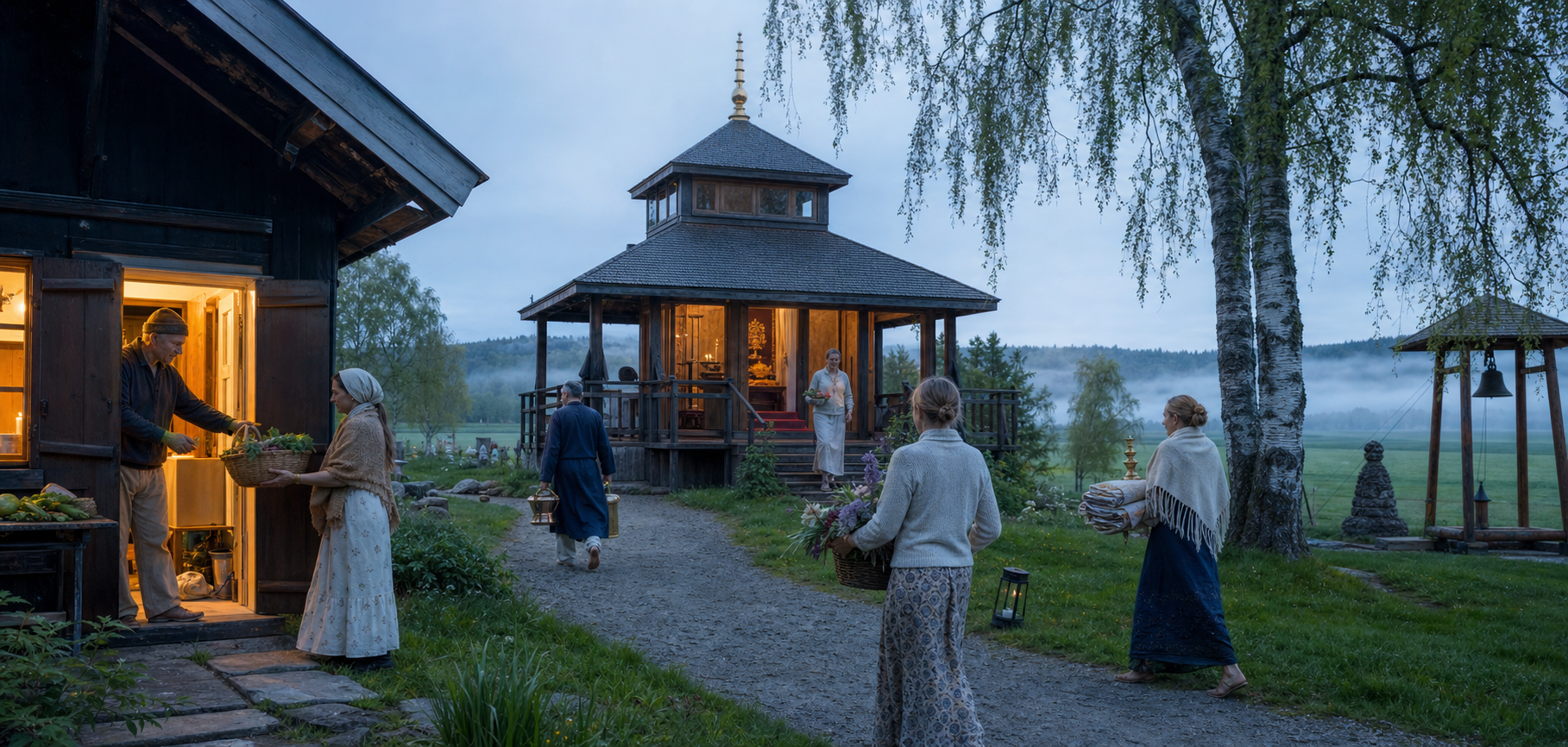
ISKCON Almvik’s forty-year milestone is most revealing when viewed through the work that makes worship possible. The available DharmaRenaissance Blog account reports that the Swedish community has maintained continuous service to Sri Sri Panca Tattva for four decades while renewing the practical spaces behind its devotional life.
The result is more than an anniversary story. Almvik offers a useful case study in how a spiritual tradition endures through kitchens, textiles, ritual preparation, volunteer labor, and architecture – systems that allow theology to become a repeated communal practice.
Key takeaways
- The source presents Almvik’s legacy primarily as forty years of sustained worship and service, rather than institutional longevity alone.
- The reported first phase of renovation has delivered a new Deity kitchen, pujari room, and sewing room.
- A larger community kitchen and a new altar for Sri Sri Panca Tattva are described as the next planned phase, not as completed work.
- The renewal illustrates how diaspora heritage is carried through functional spaces, learned skills, and recurring acts of seva.
Continuity is the first legacy
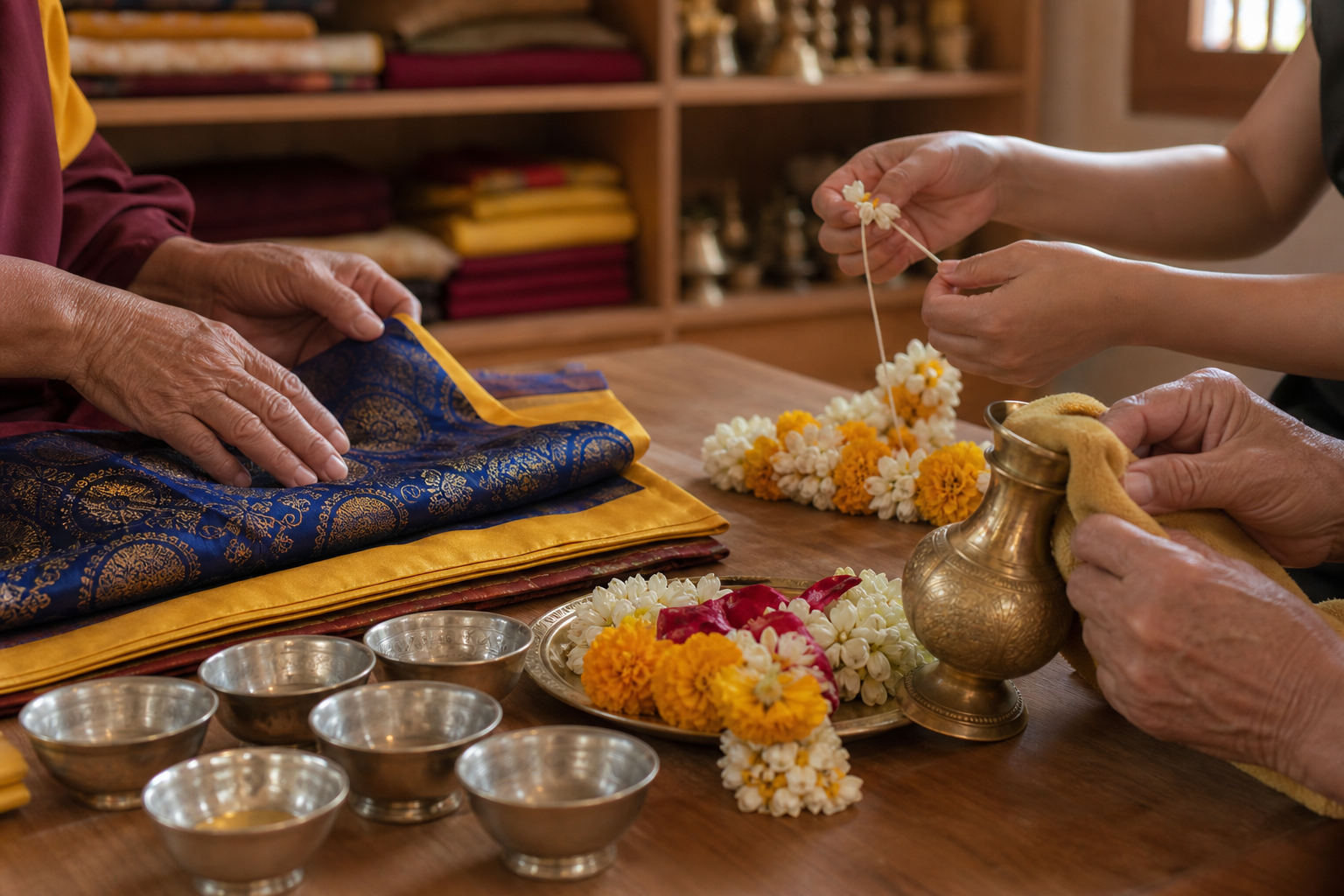
An anniversary can measure the age of an institution, but Almvik’s deeper measure is continuity. According to the source account, the community has served Sri Sri Panca Tattva for forty years. That claim points to thousands of ordinary cycles of preparation, worship, cleaning, cooking, sewing, singing, and welcoming – the repetitive work through which a temple remains spiritually and socially active.
This distinction matters because religious heritage is not preserved by buildings alone. A temple may possess an altar and sacred objects, yet its tradition remains living only when people retain the knowledge, discipline, and willingness needed to use them. Almvik’s reported milestone therefore represents accumulated capacity: devotees have continued to organize worship and transmit its habits within a Swedish setting over an extended period.
The focus on Sri Sri Panca Tattva also gives that continuity a distinct Gaudiya Vaishnava orientation. The source connects the altar with Lord Caitanya and His associates and with a devotional culture shaped by sankirtana, compassion, sacred sound, and the distribution of grace. Almvik’s longevity is thus not simply the survival of a local association; it is the persistence of a particular form of worship and community life.
The sacred work begins behind the visible altar
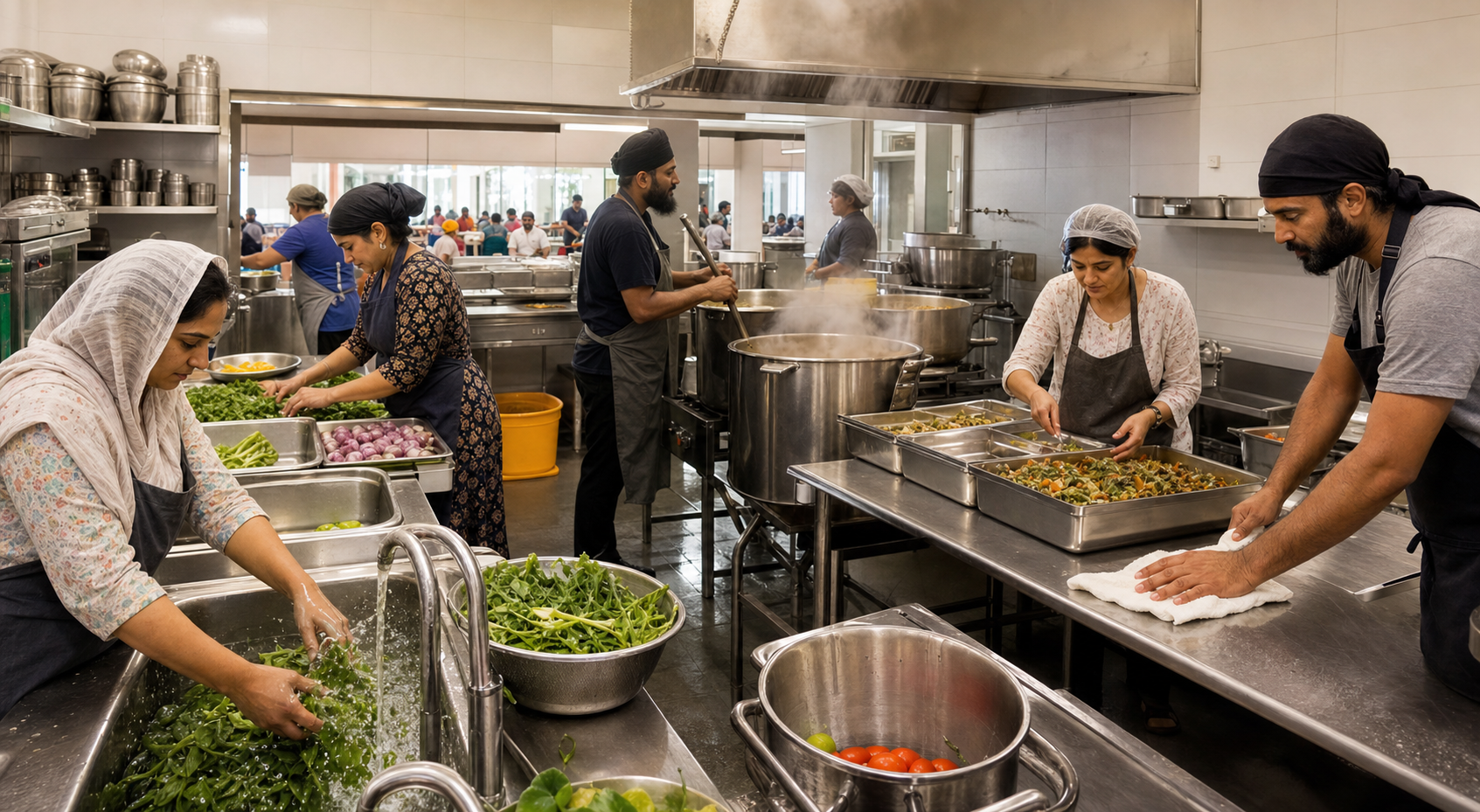
The three rooms reported as complete reveal the priorities of the first renovation phase. None is primarily a public ceremonial space. Instead, each supports the preparatory labor on which visible worship depends.
The new Deity kitchen is intended for food prepared as an offering before its distribution as prasadam. In Gaudiya Vaishnava practice, this is not equivalent to ordinary catering: cleanliness, order, intention, and a disciplined workflow are integral to the service. A purpose-built space can help devotees maintain those standards while keeping sacred preparation distinct from the larger-scale demands of community meals.
The new pujari room serves another form of careful preparation. The source describes the pujari’s responsibilities as including the dressing and decoration of the Deities, the presentation of offerings, the care of sacred articles, and the maintenance of daily worship. Organized storage and a quiet, clean workspace are therefore not peripheral conveniences. They protect attention, reduce avoidable disorder, and support consistent ritual practice.
The sewing room makes a different kind of devotion legible. Garments, altar cloths, and festival textiles unite craft with reverence. Their creation requires patience, aesthetic judgment, and technical skill, while their use allows beauty to function as an offering rather than as ornament for its own sake. By giving this work a dedicated setting, the renovation recognizes textile seva as part of the temple’s religious infrastructure.
Taken together, these rooms shift attention from ceremonial outcomes to the conditions that produce them. The completed phase invests in food preparation, ritual readiness, and sacred craft – three practices through which devotees learn that service is often quiet, exacting, and collaborative.
A larger kitchen and a new altar serve different needs
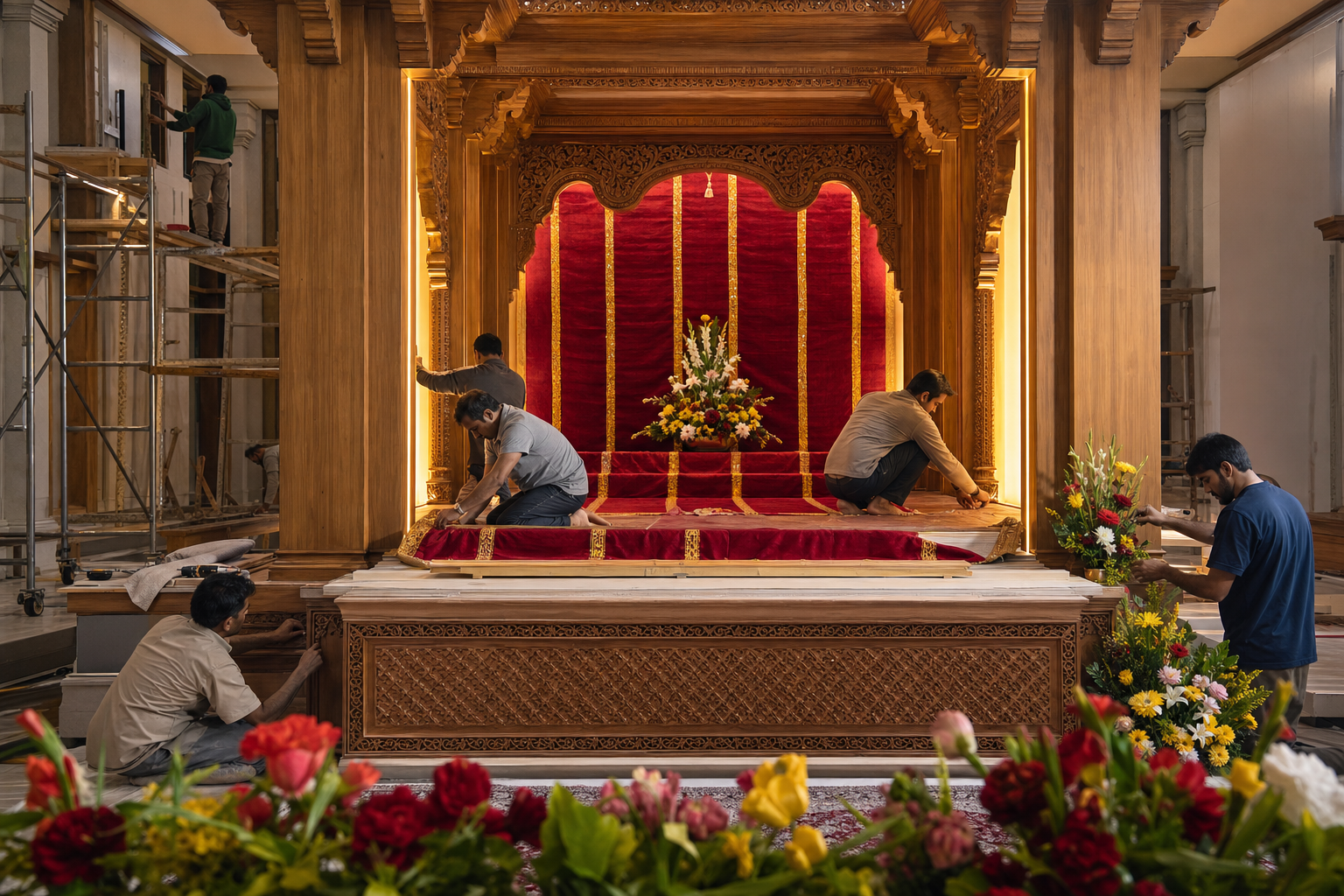
The source identifies renovation of the big kitchen and construction of a new altar for Sri Sri Panca Tattva as the next planned phase. These projects should not be described as finished: the supplied report gives no subsequent completion notice, timetable, budget, or design details.
Although kitchen and altar have different functions, they express complementary dimensions of temple life. A large kitchen supports hospitality, festival meals, volunteer participation, and prasadam distribution. Its effectiveness depends on practical matters such as safe movement, storage, preparation, serving, and cleaning. Better organization can reduce pressure on volunteers, particularly when attendance rises for communal occasions.
The altar, by contrast, provides the congregation’s principal visual and ritual orientation. Its form helps communicate whom the community worships and how worship is approached. Proportion, placement, color, textiles, and ceremonial use can all shape the experience of reverence, even though the source does not disclose the proposed altar’s design.
The pairing is significant: the altar gathers attention around the divine, while the kitchen enables care to circulate among worshippers and guests. One organizes sacred focus; the other helps turn devotional hospitality into a shared experience. Almvik’s plan consequently joins an inward-facing center of worship with an outward-facing capacity to nourish community.
Renewal turns inheritance into a future
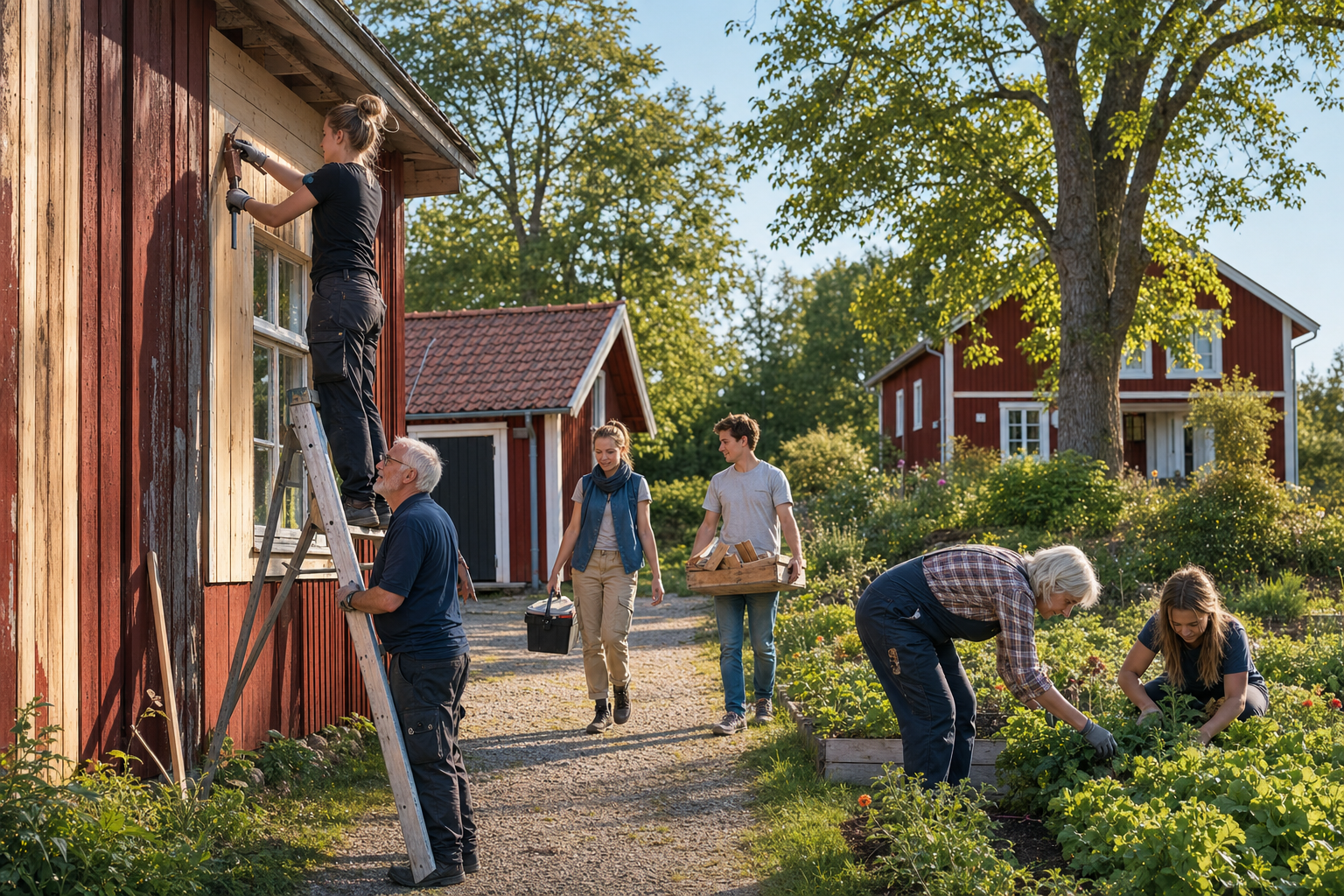
The source situates Almvik within the wider history of ISKCON, the movement established from the teachings of A.C. Bhaktivedanta Swami Prabhupada and developed through temples and devotional communities in varied cultural settings. In that context, Almvik’s forty years show how Gaudiya Vaishnava practice can take root outside India without depending on cultural memory alone.
For a diaspora temple, transmission is embodied. People encounter arati by attending it, learn kirtan by joining it, understand prasadam by preparing and receiving it, and acquire standards of service by working alongside experienced devotees. The source notes that such institutions can bridge generations, giving children and newcomers opportunities to meet a dharmic tradition through participation rather than abstraction.
Renovation can therefore be understood as adaptation in the service of continuity. Updating a kitchen or workroom does not necessarily alter the tradition’s theological center; it can strengthen the conditions under which established practices remain sustainable. The same principle applies to volunteer care. Spaces that are orderly, suitable, and dignified help prevent sacred work from depending indefinitely on inconvenience and improvisation.
Almvik’s next chapter will be shaped by whether renewed facilities can deepen participation and pass practical knowledge to another generation. If the planned work advances, its most meaningful result will not be novelty, but a stronger setting in which future acts of devotion can continue to accumulate.