
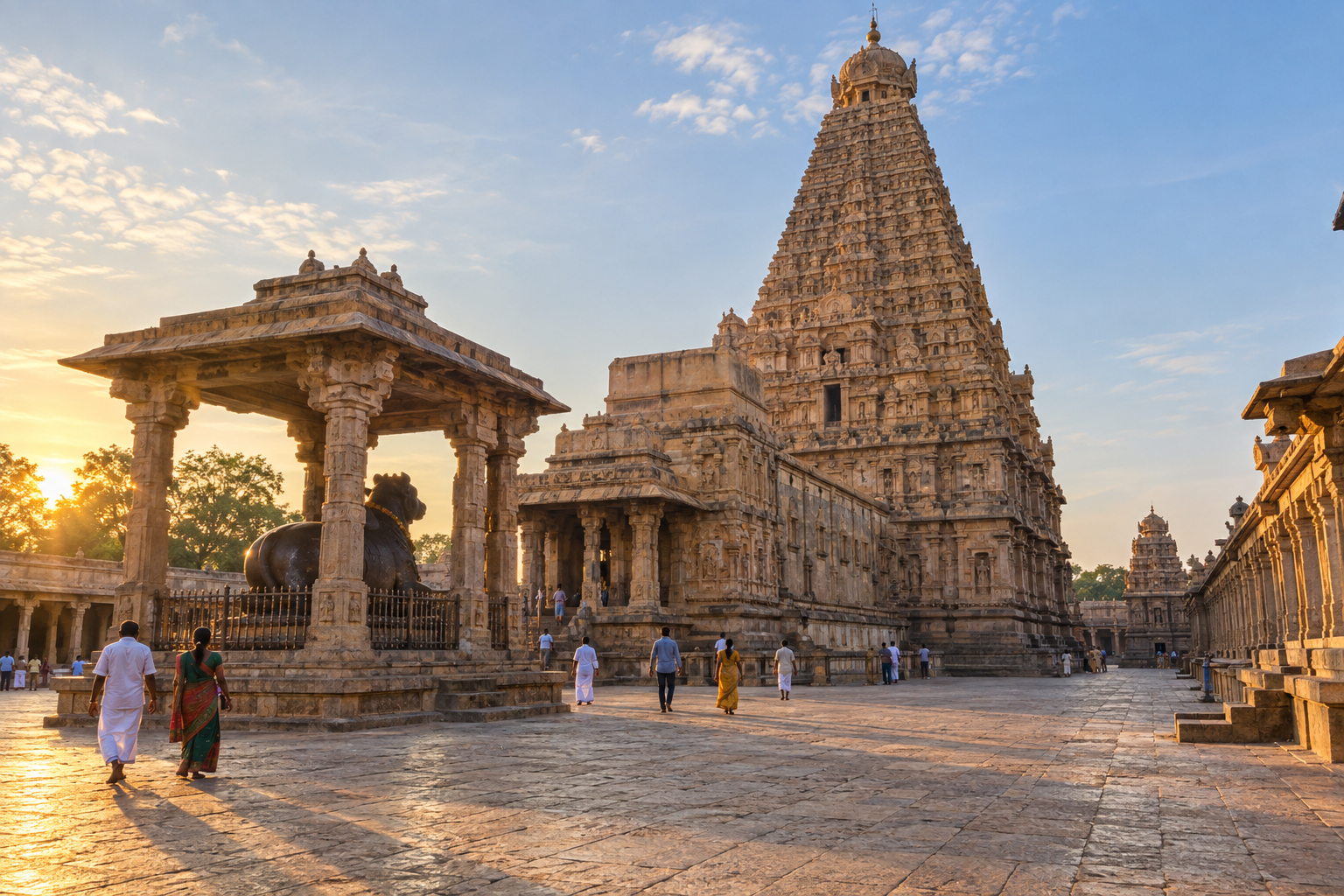
You can stand before an immense temple and still fail to see it. At Brihadeeswara, the usual mistake is to hunt for the familiar photograph, admire the scale and move on. A more rewarding visit has a sequence: orient yourself, notice how the sacred space is used, examine the architecture and only then reach for conclusions.
This approach works whether you are going for darshan, studying Bharatiya heritage or introducing your family to the temple. You do not need specialist vocabulary. You need a disciplined way to look, a willingness to distinguish fact from assumption and the courtesy to remember that a temple is more than a monument.
Decide what kind of visit you are making
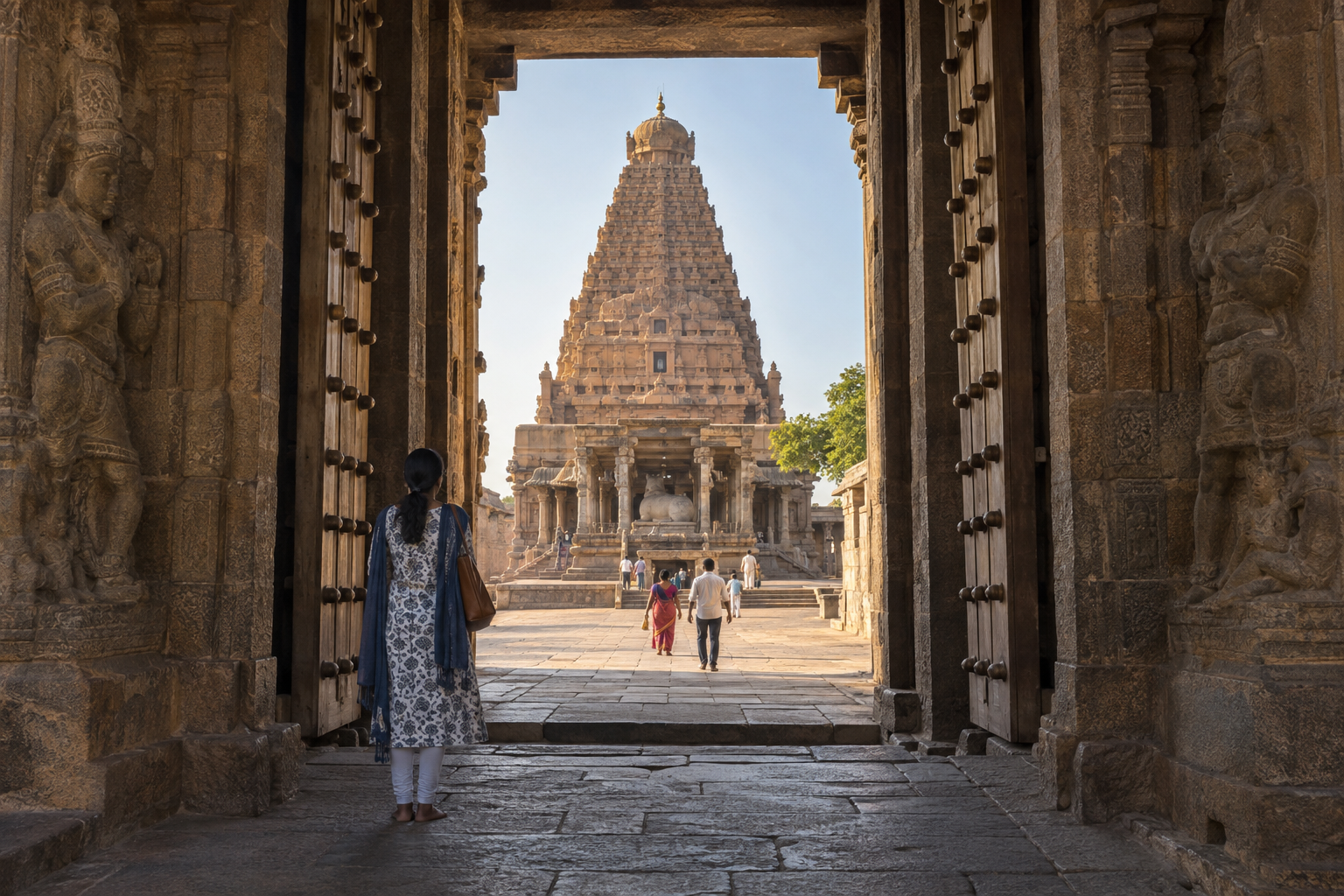
Begin by identifying the place correctly. Brihadeeswarar Temple is also written as Brihadeshwara Temple and commonly called the Big Temple; it is in Thanjavur, formerly Tanjore, in Tamil Nadu. Recognizing those names will help you interpret signs, maps and conversations that use different spellings for the same temple.
Then choose a primary purpose. You can combine devotion, architectural study and photography, but trying to do all three at once usually weakens each of them. If you have come for darshan, do not let your phone determine your pace. If you have come to study the building, do not begin with isolated decorative details before understanding the whole. If you have come with children, give them something concrete to notice rather than asking them merely to be patient.
- Check the current onsite instructions for access, footwear, queues and photography. Local directions take precedence over an old itinerary or online checklist.
- Spend your opening moments without taking photographs. Notice the dominant form, the direction of movement and where people naturally pause.
- If worship is underway, let its rhythm set your pace. Move around worshippers rather than treating them as obstacles between you and the architecture.
- After you have oriented yourself, record the questions that the building raises. A good question is more useful than a hurried caption.
This order protects your attention. A camera encourages you to isolate attractive fragments; orientation shows you how those fragments belong to a larger sacred composition.
Read the temple at four distances
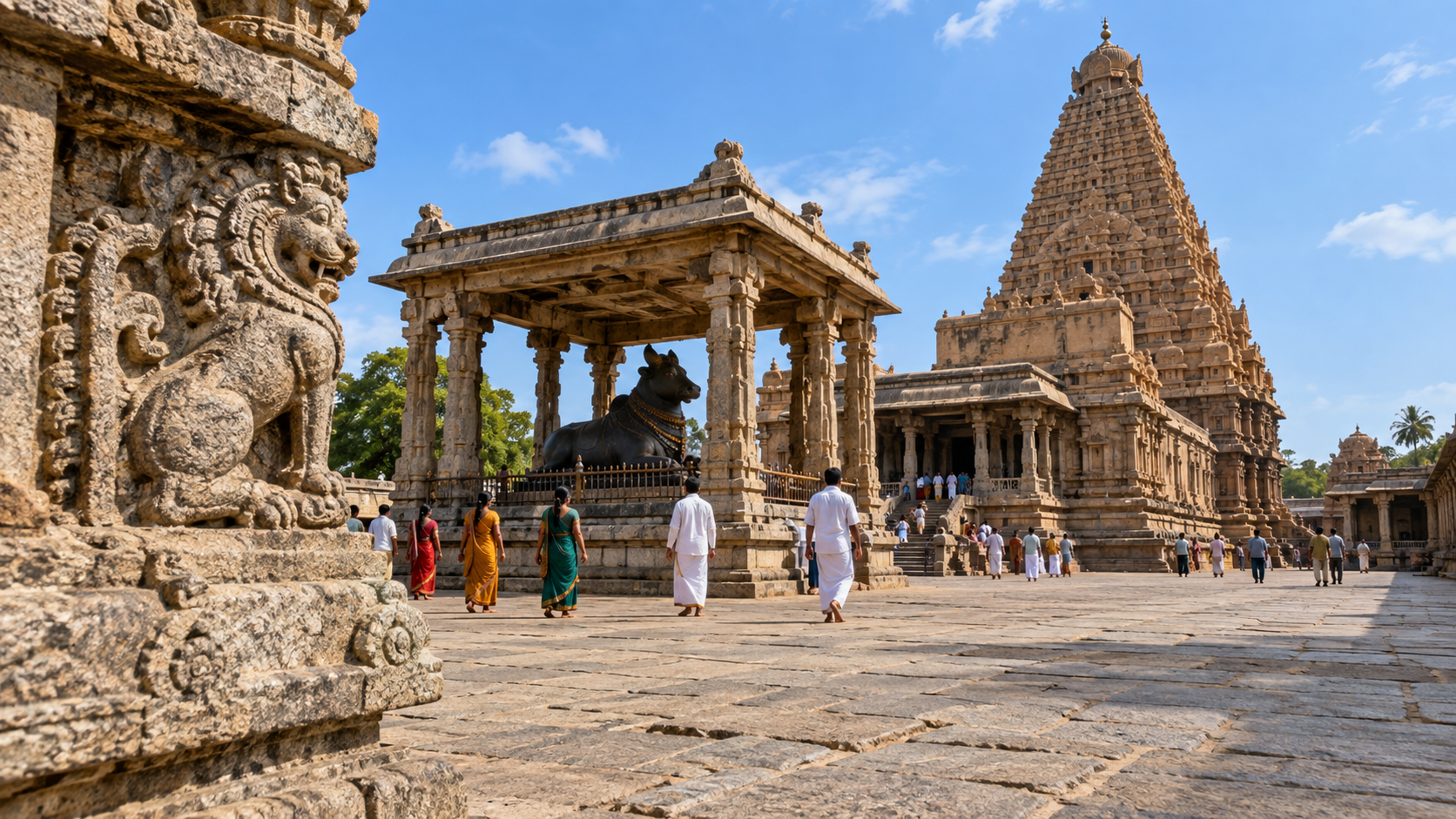
The nickname Big Temple can make size seem like the complete meaning of Brihadeeswara. Scale matters, but scale becomes intelligible only through relationships: building and sky, threshold and enclosure, open space and built mass, human movement and sacred focus. Read those relationships from four distances.
- From the surrounding city: Look for the first point at which the temple becomes visually legible. Does it appear gradually, or does a threshold reveal it? Notice how ordinary urban movement changes as you approach.
- At the entrance: Pause without blocking the way. Ask what the entrance frames, conceals or postpones. A threshold is not merely a gap in a wall; it changes your position from observer outside to participant inside.
- Across the open space: Let your eye compare height, width, mass and emptiness. Notice which form dominates, which routes appear intentional and where visitors gather. Stand at more than one side before deciding what the composition emphasizes.
- At close range: If access permits, examine surfaces, joints, carved elements, signs of use and visible repair. Do not touch. Close details become meaningful when you can relate them to the structure you have already seen as a whole.
If photography is allowed, make these distances your shot list. Take an image of the temple in its setting, one at the threshold, one showing spatial relationships and only then the close details. The resulting sequence will explain your visit better than a folder full of disconnected ornaments.
With family or a study group, ask each person to choose the feature that appears most important at every distance. Compare answers after leaving the central area. Differences reveal how scale, light, movement and prior knowledge direct attention.
Keep observation, history and devotion distinct
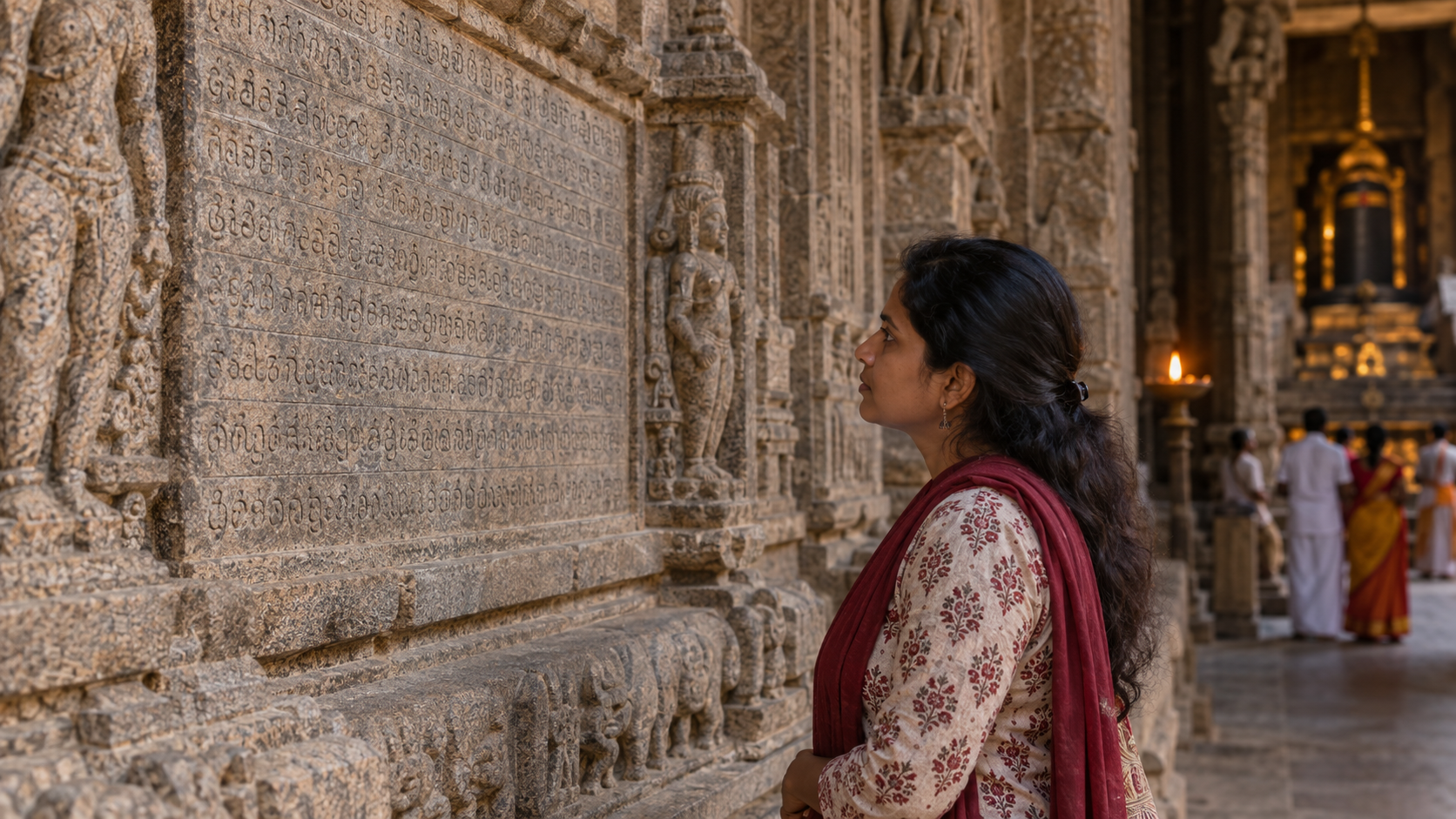
Brihadeeswara’s historical importance invites confident storytelling. Resist the urge to fill every gap from memory. Civilizational heritage is not defended by repeating an uncertain claim; it is honored by stating what is visible, what is documented and what remains to be verified.
| Kind of note | What to record | What to avoid |
|---|---|---|
| Observation | What you can directly see, hear or trace in the space | Turning an impression into a historical fact |
| Historical claim | The exact wording, date or attribution given on an onsite label or reliable reference | Replacing qualified language with a more dramatic assertion |
| Religious meaning | A name, practice or explanation in its devotional context | Treating living belief as decoration, or presenting interpretation as measurable architecture |
| Open question | What you need to verify after the visit | Guessing because a photograph needs an immediate caption |
This separation does not divide the temple into unrelated parts. It allows each kind of knowledge to retain its integrity. Architecture can direct the body and attention without every effect having a single provable explanation. Devotional meaning can be real to practitioners without functioning as a construction date. A historical label can establish a fact without exhausting the temple’s sacred significance.
Apply the same discipline when sharing your visit. Write “I noticed” for an observation, name the basis of a historical claim and identify a devotional interpretation as such. If you cannot verify a detail, leave it as a question. That is not timidity. It is responsible cultural memory.
Let etiquette sharpen rather than interrupt your attention
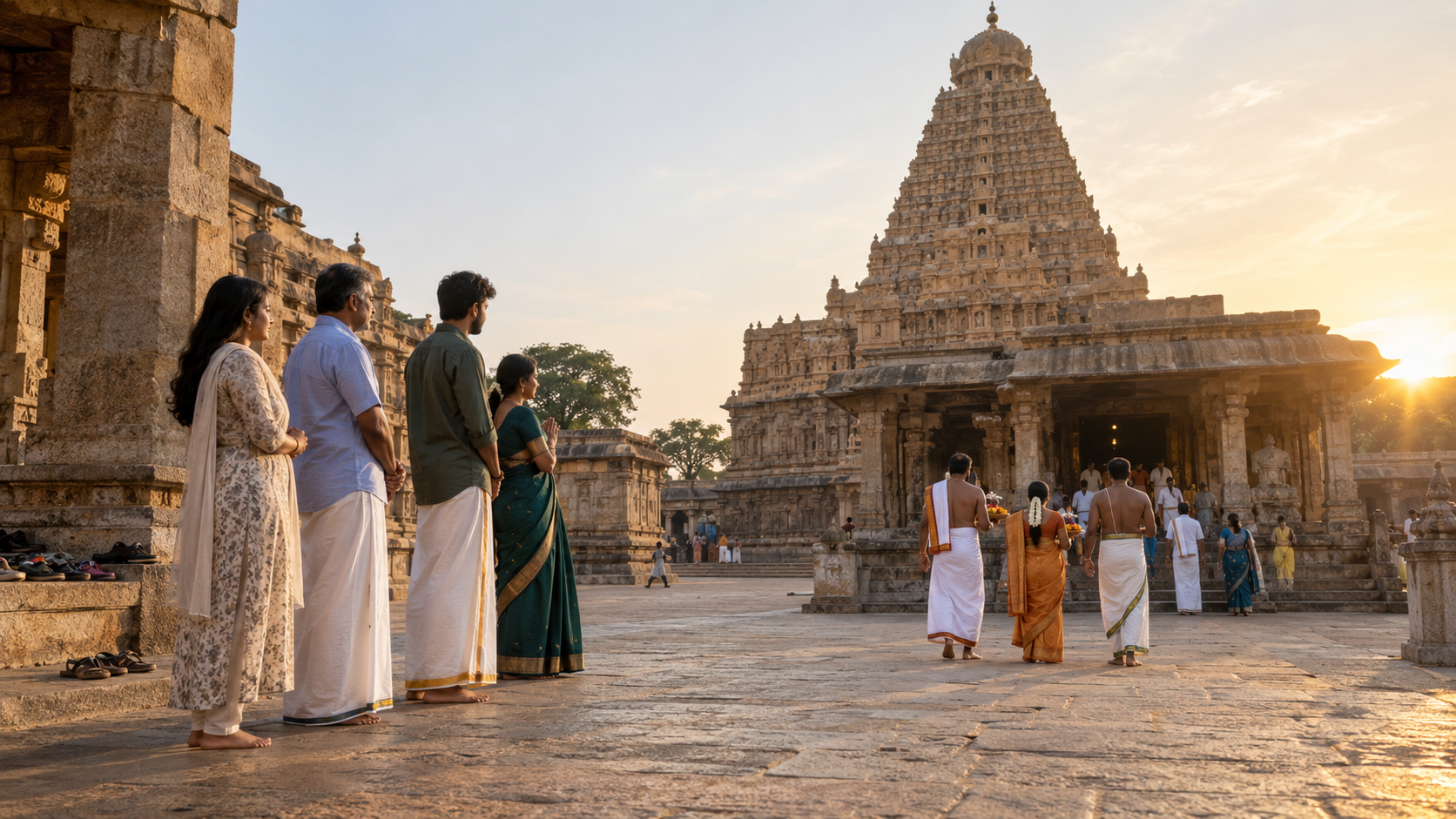
Temple etiquette is not an administrative inconvenience attached to the visit. It trains you to recognize that the place has purposes beyond your own. Your position, voice and camera can affect another person’s darshan, prayer or work.
- Read posted instructions before using a phone or camera. Permission in one area does not automatically imply permission everywhere.
- Keep entrances, queues and ritual routes clear. Move aside before stopping to study or photograph something.
- Do not make worshippers the subject of a recognizable photograph without their consent. Sacred practice is not a ready-made backdrop.
- Do not touch, lean on or climb architectural surfaces, even when no barrier is present.
- Keep alerts silent and conversations low. If you are explaining the site to others, step away from people engaged in worship.
- Follow directions from temple personnel promptly. A planned photograph or viewing angle is never more important than the functioning of the temple.
If you are bringing children, give them an active role: ask them to notice how their pace, voice and posture change after crossing the threshold. This turns etiquette from a list of prohibitions into an exercise in awareness.
Before leaving, review your notes somewhere that does not obstruct movement. Mark each entry as observation, verified fact, devotional meaning or open question. That small habit will prevent memory from blending categories later.
Key takeaways
- Recognize Brihadeeswarar, Brihadeshwara and Big Temple as names used for the temple in Thanjavur.
- Choose whether darshan, architectural study or photography is your primary purpose before you enter.
- Read the temple from the city, the threshold, the open space and close range instead of collecting isolated details.
- Keep direct observation, documented history, devotional meaning and unanswered questions separate in your notes.
- Let posted rules and the needs of worshippers determine how you move, speak and photograph.
When you visit, resist the urge to begin with the landmark image. Begin by becoming attentive. Leave with an accurate observation, a fact you have verified and a question worth pursuing. That is how a celebrated monument becomes legible as sacred heritage rather than merely recognizable scenery.
References

Leave a Reply
You must be logged in to post a comment.