
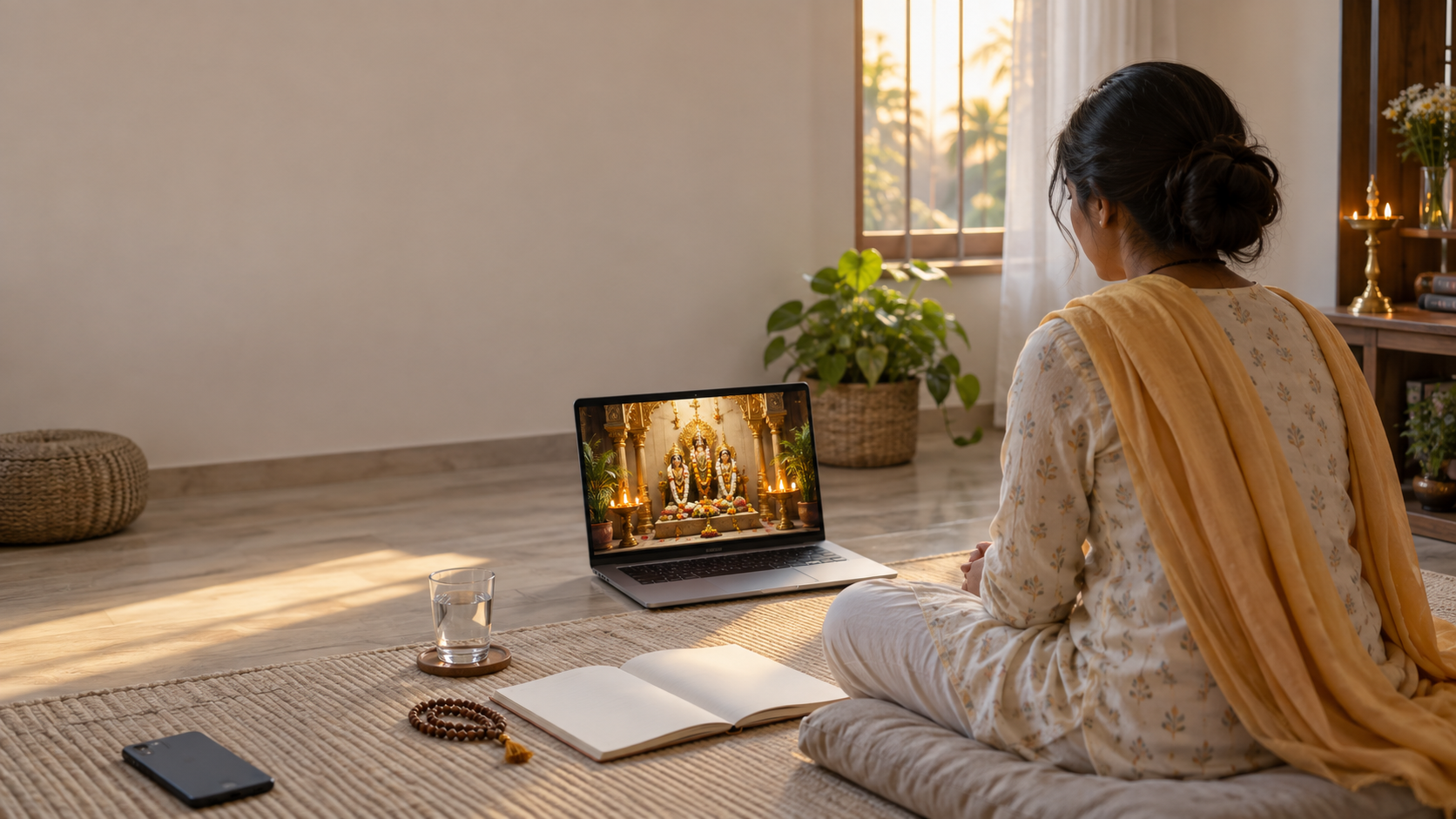
You may be unable to reach an ISKCON temple because of distance, health, travel, family duties, or an irregular workday. A broadcast can still bring temple worship, kirtan, and scriptural teaching within reach. Yet the same screen can quietly turn all three into background media.
The useful question is not whether you watched. It is whether you recognised what kind of devotional activity you had opened and responded accordingly. A temple stream calls for attentive viewing, kirtan invites participation, and a scripture class requires active study. Treating them differently is what turns convenient access into a sustainable part of your sadhana.
First identify what kind of broadcast you opened
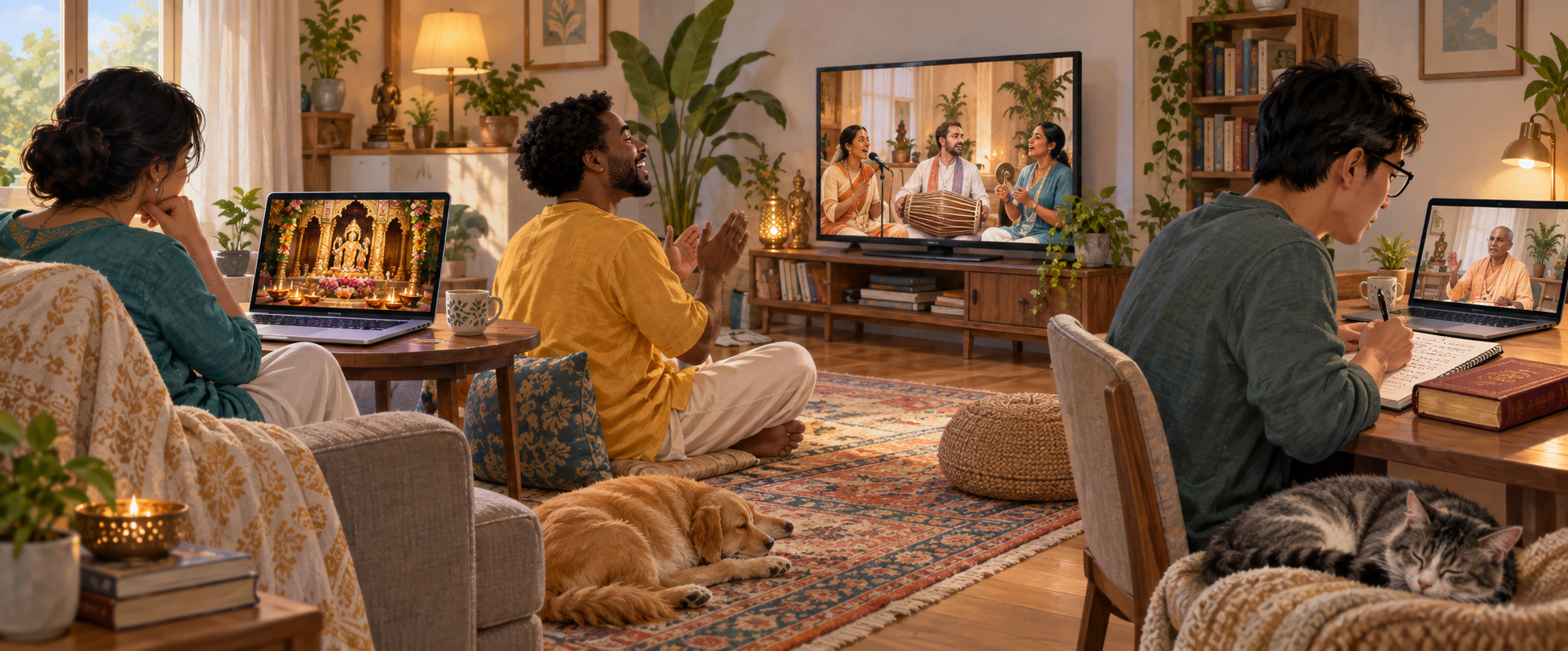
ISKCON broadcasts can look similar on a phone screen while asking very different things from you. Before pressing play, place the broadcast in one of three practical modes: worship, kirtan, or teaching.
- Temple worship: Settle your body, direct your eyes toward the altar or service, offer pranam according to your established practice, and remain present to what is happening.
- Kirtan: Follow the mantra, respond when appropriate, and listen to the lead without reducing the chanting to a musical performance.
- Teaching: Open the named text, keep notes, and listen for the relationship between the cited passage, its explanation, and its application.
The distinction becomes clear in actual programming. The Sri Sri Radha Kalachandji Temple livestream in Dallas is temple-centred. The Hare Krishna maha-mantra kirtan led by H.H. B.B. Govinda Maharaj at ISKCON Toronto is participatory chanting. The 20 September 2026 class by H.G. Vraj Bihari Prabhu at ISKCON Chowpatty is a focused teaching on Srimad-Bhagavatam 3.17.27.
Do not judge a temple stream for lacking a lecture, listen to kirtan as though it were a concert, or let a class run while you attend to unrelated work. Choose the mode first. Your posture of participation follows from that choice.
Prepare the room before asking the mind to settle
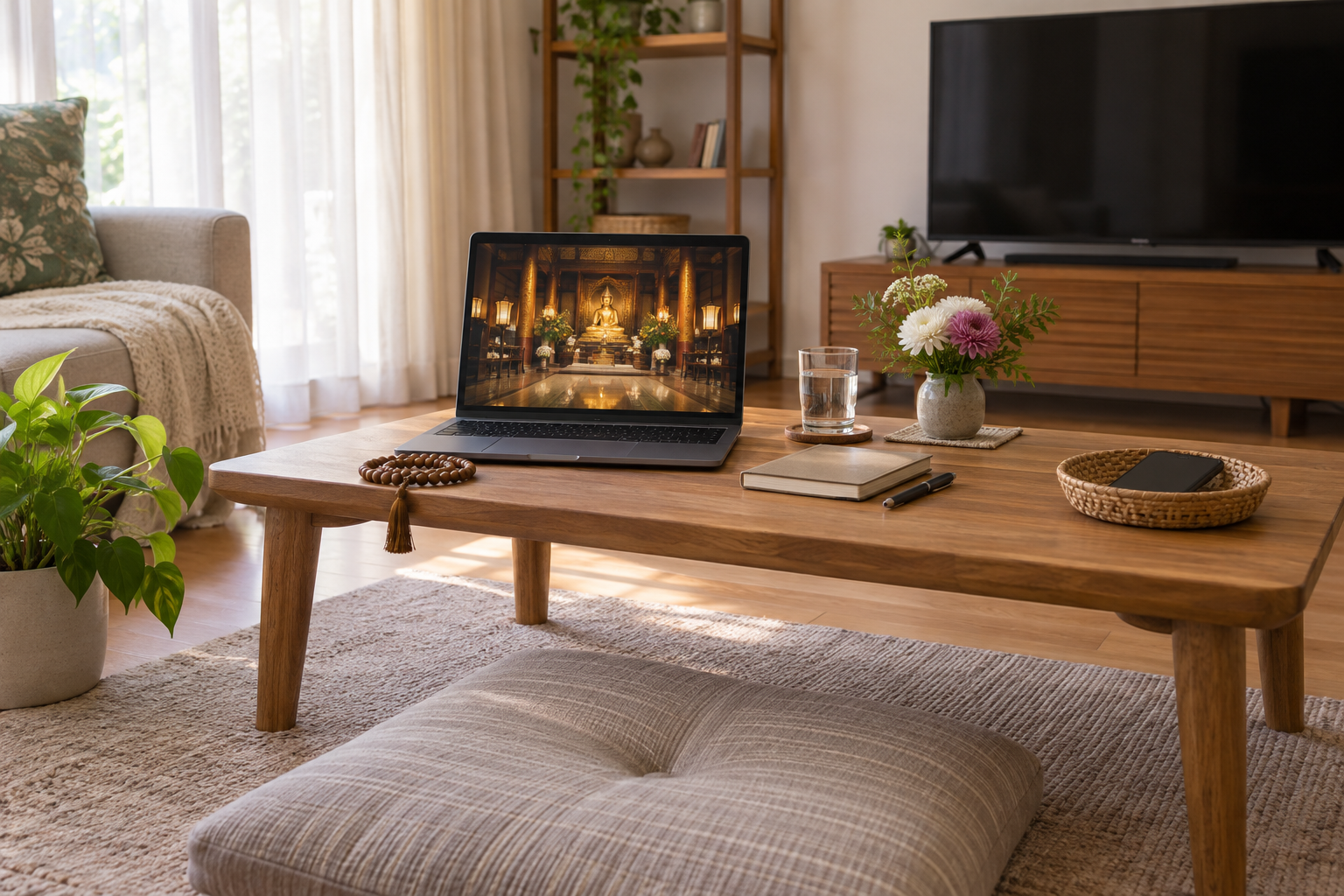
The decisive transition often happens before the broadcast begins. If you open a stream among messages, news, and browser tabs, the mind retains the habits of ordinary screen use. A small act of preparation marks the device as a temporary doorway to worship or study.
- Name your intention. Say plainly whether you are joining worship, chanting, or studying. This prevents aimless browsing between devotional videos.
- Stabilise the device. Place the screen where you can sit naturally instead of holding it, walking around with it, or repeatedly adjusting it.
- Remove competing signals. Silence notifications and close any chat, comment feed, or recommendation panel that draws your attention away.
- Prepare what the mode requires. Keep japa beads nearby only if they belong to the practice you intend to do. For a class, open the relevant scripture and have a simple way to take notes.
- Set a clean ending. When the worship, kirtan, or class finishes, resist the platform’s invitation to jump immediately to unrelated content. Complete your prayer, note the teaching, or sit quietly before changing activities.
Headphones can help when you share space with others, but isolation is not the goal. The aim is to remove avoidable friction while respecting the household around you. If family members want to participate, agree beforehand whether the session will be silent viewing, audible chanting, or study. Confusion about the mode is often more distracting than ordinary household sound.
Participate according to the devotional form
For temple worship, attend without pretending the camera shows everything
A temple camera gives you a framed view. It may not show every preparation, mantra, offering, or movement taking place beyond the frame. Receive what is visible with respect, but do not reconstruct unfamiliar ritual procedures from partial footage.
If you already maintain home worship, keep that responsibility primary. The broadcast can accompany your remembrance of Krishna and connect you with a temple service, but it should not become a reason to neglect the practice entrusted to you locally. Questions about ritual details belong with a qualified teacher or the temple community responsible for that worship.
For kirtan, enter the mantra instead of evaluating the performance
The screen naturally encourages spectatorship: you notice the lead singer, instruments, camera angle, sound quality, and energy of the gathering. Those observations are not the purpose of kirtan. Bring your attention back to the Hare Krishna maha-mantra each time it wanders toward performance assessment.
Chant audibly when your circumstances permit. If they do not, follow attentively in the mind rather than letting the kirtan become ambient sound. You need not reproduce the room’s outward intensity to participate sincerely. Clear attention to the mantra matters more than imitating visible emotion.
For a scripture class, separate text, explanation, and application
A class becomes much easier to retain when your notes distinguish three layers. First record what the named verse or passage is addressing. Then note how the speaker explains it. Finally write the practical application you understood. This prevents a memorable illustration from becoming confused with the wording of the scripture itself.
Precise programme details make this discipline possible. When a class is identified as Srimad-Bhagavatam 3.17.27, as in the Mumbai teaching, open that exact passage rather than relying only on the spoken commentary. After listening, try to state the central point without replaying the recording. If you cannot, return to the portion where the argument changed direction rather than passively starting the entire class again.
Build a rhythm that survives missed livestreams

Live participation can create a welcome sense of shared time, but live is not automatically more attentive. A stream joined at an inconvenient hour, with divided attention, may serve you less well than a recording approached deliberately. When a recording is available, pausing to find a verse or revisit an explanation can strengthen study.
Choose live viewing when the temple schedule fits your life and the shared occasion helps you remain present. Choose recorded viewing when you need control over pace, language, interruptions, or note-taking. Do not turn a missed livestream into guilt followed by abandonment. Move the practice to a workable place in your day.
Organisation also matters. Keep separate bookmarks for temple worship, kirtan, and teaching instead of placing every devotional video in an undifferentiated queue. For classes, record the date, temple, speaker, scripture passage, central teaching, and intended application. That small index allows you to return to a subject because you need it, not merely because an algorithm presents it again.
Online access is strongest when it leads back into embodied practice. A teaching should affect how you chant, serve, speak, or study. Kirtan should return your attention to the holy name. Temple viewing should deepen remembrance and, where feasible, support rather than replace your relationship with a local devotional community. A broadcast can carry sound, images, and instruction; it cannot notice your misunderstandings or offer personal guidance unless you also maintain contact with knowledgeable devotees.
Key takeaways for your next broadcast
- Identify the broadcast as temple worship, kirtan, or teaching before you begin.
- Prepare the room and device so that ordinary screen habits do not control the session.
- Watch worship attentively, participate in kirtan, and study a class with the named scripture open.
- Use exact programme details such as temple, speaker, and passage to organise later review.
- Choose live or recorded participation according to which setting supports greater attention.
- Carry something beyond the screen: prayer, chanting, study, service, or a question for a qualified teacher.
For the next broadcast, decide your mode before you click. Prepare what that mode requires, participate without multitasking, and leave with a concrete devotional response. That is how a stream stops being content you consumed and becomes time you consciously offered.
References
- Dandavats — ISKCON Dallas Live
- Dandavats108 — HH.BB GOVINDA MAHARAJ ISKCON TORONTO ROCKING HARE KRISHNA MAHAMANDRA KIRTAN
- Dandavats108 — 20th Sep. ’26 | H.G. Vraj bihari Prabhu | S.B. 3.17.27 | ISKCON Chowpatty Mumbai.

Leave a Reply
You must be logged in to post a comment.