

You do not encounter industrial pollution as an abstract debate. You encounter it when the air smells wrong, tap water becomes suspect, a river carries unfamiliar foam, or a convenient purchase leaves behind waste that nobody wants to claim. The question then becomes immediate: can something still be called progress when its benefits reach one group and its poison settles on another?
Halahala gives you a demanding way to answer that question. It neither condemns material achievement nor excuses its consequences. It asks you to examine the whole churning: the treasure being pursued, the danger being produced, the people made to bear it, and the discipline required to keep power from becoming adharma.
The churning produces poison before it yields nectar
In the familiar account of Samudra Manthan, devas and asuras churn the cosmic ocean in pursuit of amrita. Before the nectar can be secured, Halahala, a lethal poison, rises from the churning and threatens the wider order. The danger is not an unrelated intrusion. It comes out of the same process that is expected to deliver an extraordinary prize.
That sequence corrects two common mistakes. The first is the romantic belief that every increase in production is automatically good. The second is the opposite belief that the story demands withdrawal from enterprise, technology, or prosperity. The churning continues after the poison is confronted. The lesson is not that human beings must cease creating. It is that creation without responsibility is incomplete.
Industrial mastery can generate power, prosperity, useful goods, employment, mobility, and comfort. It can also produce contaminated water, dangerous air, damaged soil, hazardous residues, exhausted landscapes, and products that become somebody else’s disposal problem. A moral evaluation that records only the desired output is therefore as misleading as an account of Samudra Manthan that mentions amrita but omits Halahala.
When you evaluate a factory, infrastructure project, technology, or consumer product, put its nectar and poison on the same page. List the benefit being promised. Then list the extraction, emissions, worker exposure, waste, energy demand, end-of-life burden, and possible failure modes required to obtain it. If the second list is missing, the proposal has not yet described its real cost.
Pollution is often a transferred cost, not an absent one
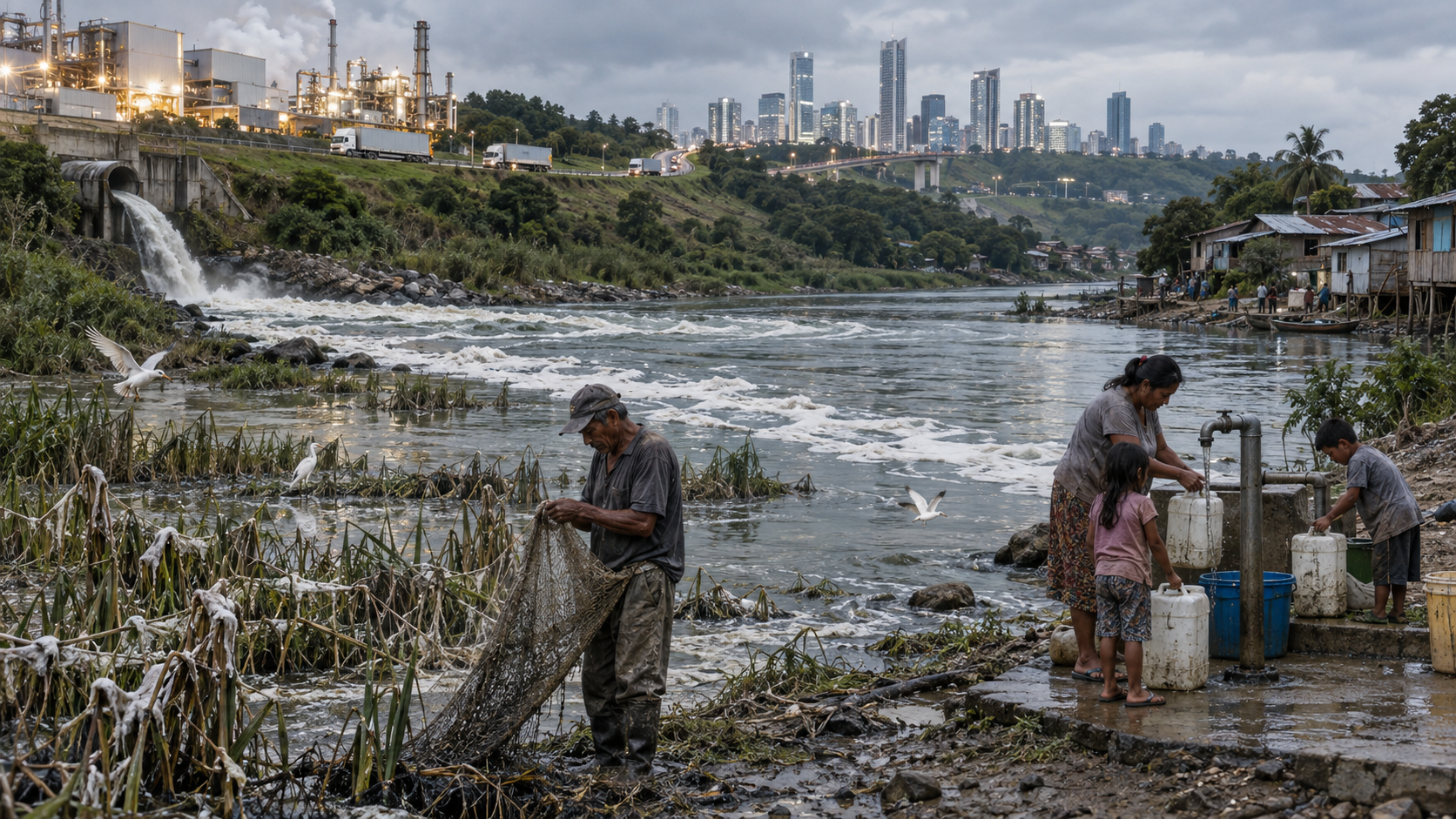
Material production transforms matter and energy. What does not remain in the desired product must go somewhere: into reusable material, controlled waste, heat, liquid discharge, gases, scrap, noise, or eventual disposal. Calling a process clean because the residue is no longer visible at the point of sale confuses distance with disappearance.
This is where industrial pollution becomes a moral problem rather than merely a technical inconvenience. The benefit may be private while the cleanup is public. The finished product may be enjoyed in a city while the extraction damage remains in a distant district. A company’s accounts may show profit while families, workers, municipalities, rivers, and future generations inherit costs that never appeared on its balance sheet.
You can expose this transfer by tracing a product or project across its full chain:
- Before production: What is extracted, from where, and what damage can extraction leave behind?
- At the workplace: Which substances, fumes, machines, or waste streams can affect workers, and who has authority to stop unsafe activity?
- Beyond the boundary: What enters the surrounding air, water, soil, roads, or neighbourhoods during normal operation, transport, and breakdowns?
- After use: Can the product be repaired, reused, recovered, or safely processed, or does its apparent convenience become another community’s burden?
- After closure: Who remains legally and financially responsible when the profitable activity ends but contamination, waste, or damaged land remains?
Do not accept a blank link in that chain as proof that no harm exists. Treat it as an unanswered liability. The practical response is to ask for the waste route, responsible party, monitoring method, failure plan, and repair obligation before approval or purchase, not after damage has become visible.
Shiva’s containment is responsibility, not permission
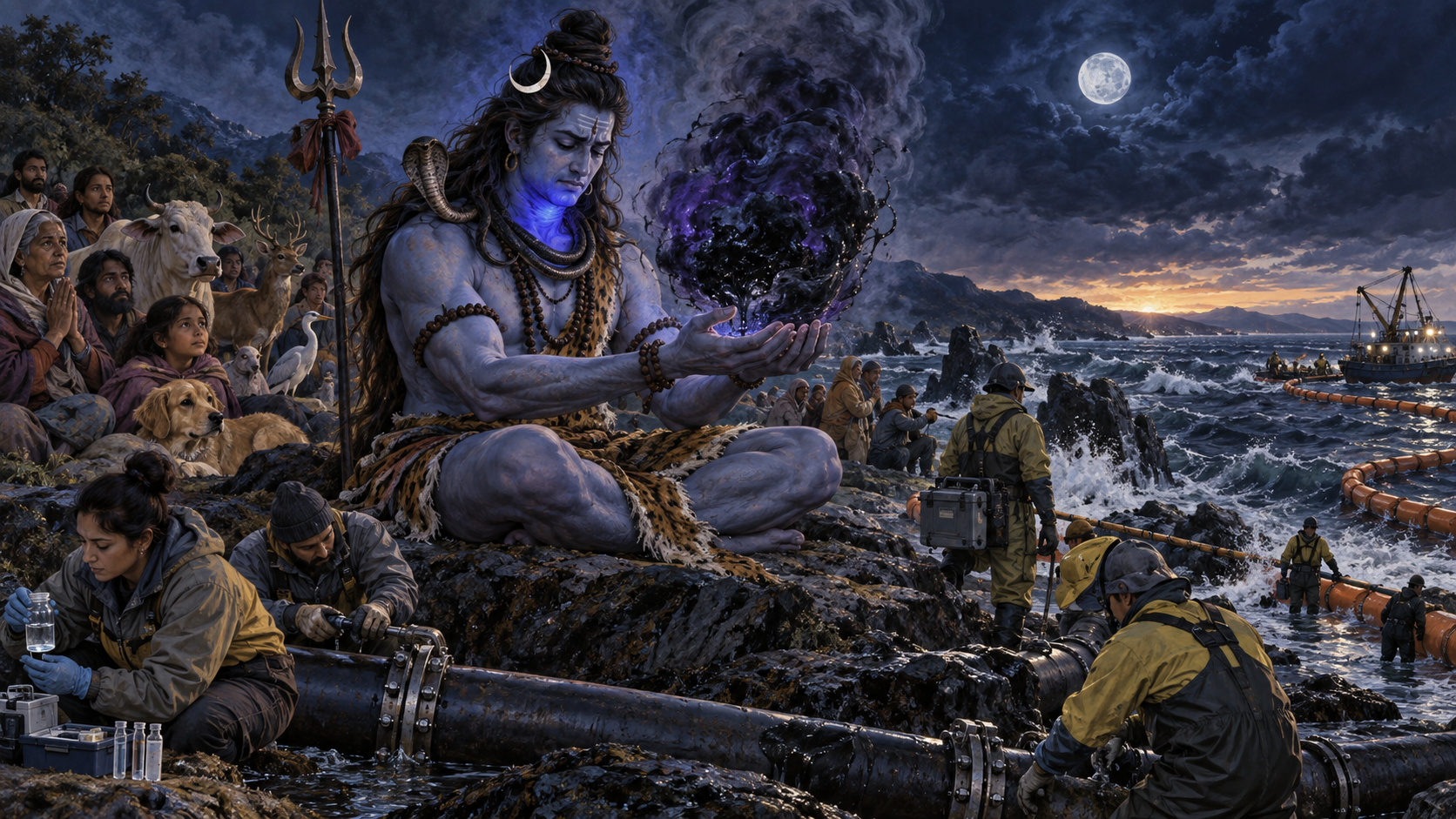
Shiva intervenes when Halahala threatens creation. In the best-known telling, he contains the poison in his throat and becomes Nilakantha, the blue-throated one. The image matters because the poison is neither denied nor casually dispersed. It is recognised, contained, and borne at visible cost by one capable of acting.
But this episode must not be twisted into a religious excuse for sacrifice zones. A worker compelled to inhale fumes, a village forced to accept polluted water, or a poor neighbourhood used as a dumping ground is not reenacting Shiva’s sacrifice. Shiva acts to protect others; the exposed community has usually had risk imposed upon it. One is responsibility freely assumed. The other is power shifting its danger onto those with less power.
Whenever an institution claims that a harmful residue is being managed, test the claim with concrete questions:
- Consent: Did the people facing the risk participate in the decision, or were they merely informed after it was made?
- Capacity: Is the containment system designed for routine operation, accidents, long-term storage, and eventual closure?
- Visibility: Are releases, failures, worker complaints, and monitoring results disclosed in a form affected people can understand?
- Authority: Can workers or residents trigger an independent inspection or halt when conditions become dangerous?
- Remedy: Is responsibility for cleanup assigned in advance, with resources available even if the operator closes or leaves?
Compensation after exposure is not equivalent to prevention. Nor is a promise of employment sufficient consent to unlimited harm. Jobs and production are real benefits, but they do not cancel the duty to prevent avoidable injury and repair damage that cannot be prevented.
If you encounter unknown fumes, suspicious discharge, or abandoned industrial material, do not touch, taste, collect, or closely approach it merely to document the problem. Move to a safe location and contact the appropriate local emergency, environmental, or public-health authority. Anyone with symptoms after a suspected exposure needs qualified medical assessment. Halahala is a moral metaphor; it is not a substitute for hazardous-material procedures.
A Dharmic test for deciding what deserves to be called progress
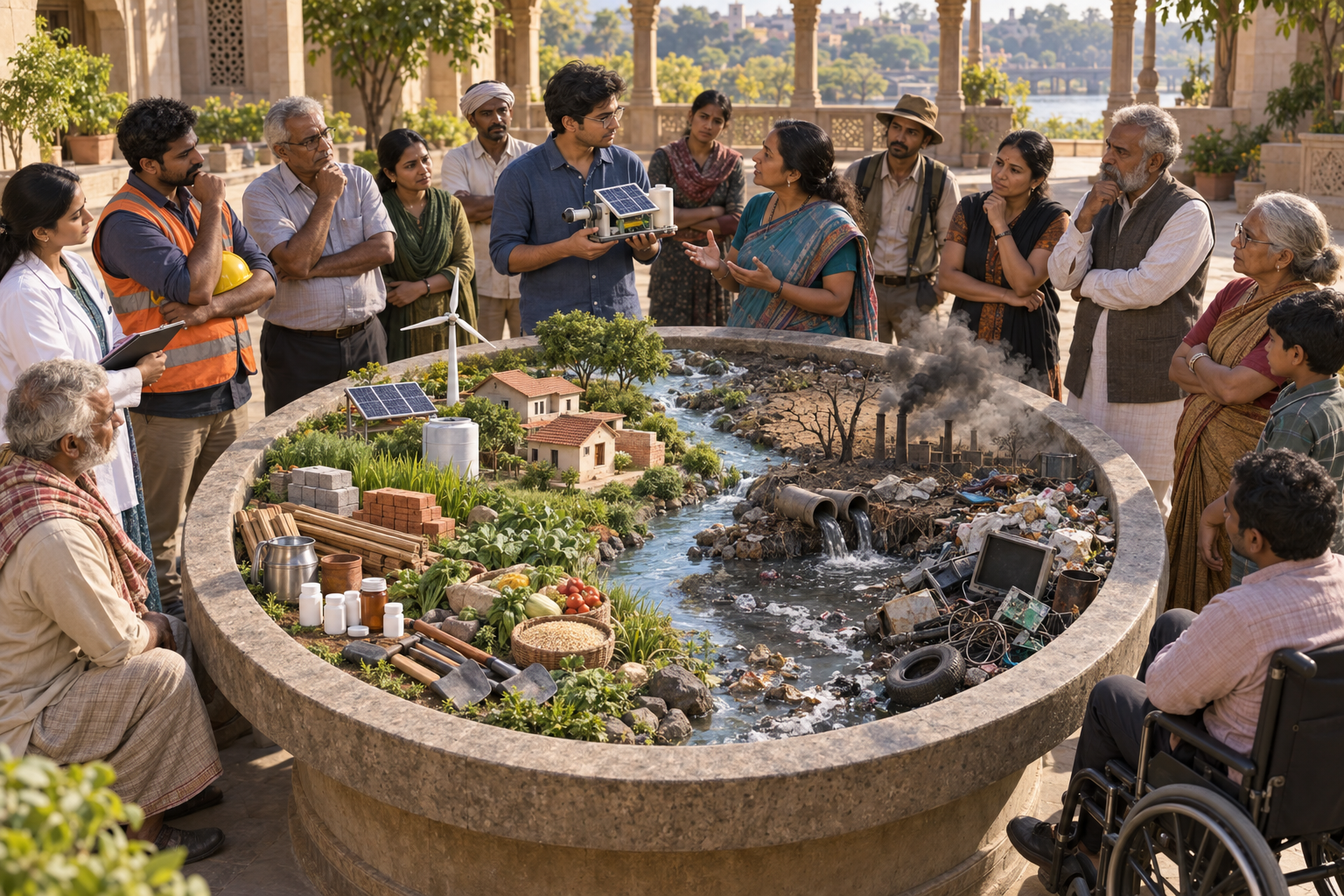
Dharma is not a single modern policy formula, and the Dharmic traditions should not be flattened into one environmental doctrine. Yet several of their disciplines place useful pressure on industrial decisions. Ahimsa asks whether avoidable harm is being reduced. Aparigraha challenges accumulation without limit. Right livelihood asks whether gain depends upon concealed injury. Seva turns attention toward those who bear burdens but receive few benefits.
These principles become useful when they are applied before a decision, not recited after it. Work through the following questions whenever someone presents a project as development:
- What genuine human need does this serve? Distinguish food, shelter, mobility, health, resilience, and dignified work from novelty, planned disposability, prestige, or consumption for its own sake.
- What Halahala does the process produce? Name the hazardous material, waste stream, ecological damage, worker risk, community disruption, or future cleanup burden instead of hiding everything under the word impact.
- Who receives the nectar, and who receives the poison? Compare the people receiving revenue, convenience, contracts, and employment with those facing exposure, displacement, noise, traffic, depleted resources, or long-term waste.
- Can the poison be prevented at its origin? Redesign, safer inputs, reduced throughput, repairability, reuse, and closed material loops should be considered before distant disposal or compensation.
- What limit will stop the churning? Define the condition that requires slowdown, suspension, redesign, or closure. A system with no stop condition treats growth as sacred and life as negotiable.
- Who is accountable for repair? Responsibility should remain attached to the decision-maker and beneficiary rather than dissolving among contractors, government departments, consumers, and future taxpayers.
A negative answer does not automatically settle every project. Some necessary activities carry risks that cannot be eliminated completely. It does, however, shift the burden of proof. If a proposal can quantify expected output but cannot name its waste stream, accountable owner, monitoring route, stop condition, and repair plan, it is not yet responsible progress.
This also guards against an easy misuse of Dharma. Ritual reverence for rivers, forests, animals, or Bhumi cannot compensate for operational practices that poison them. Sacred language raises the standard of conduct; it does not provide a ceremonial exemption from consequences.
Put the lesson to work where you have real control
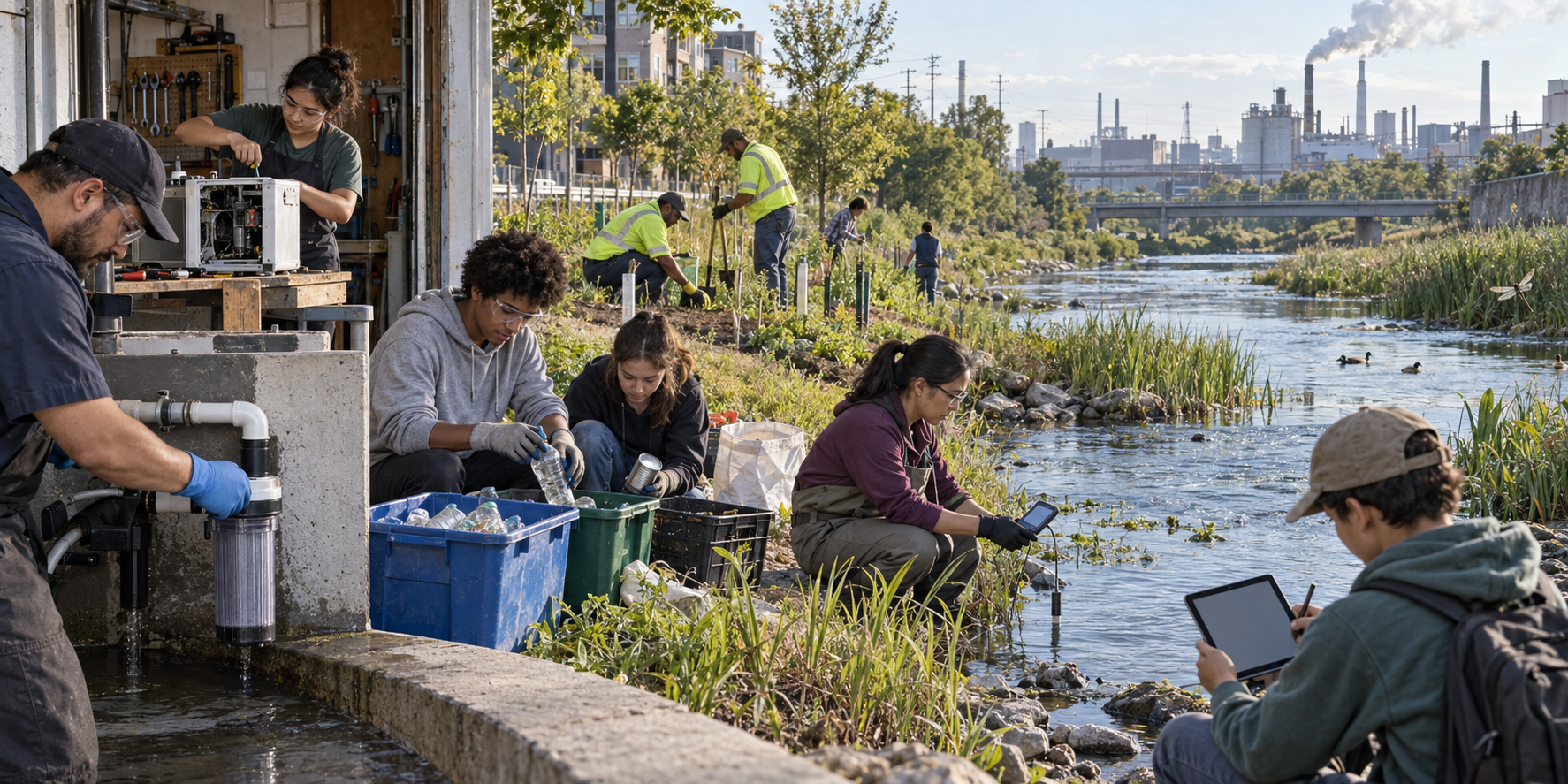
Moral responsibility should scale with power. A household choosing among imperfect products does not control an industrial system in the way a manufacturer, financier, regulator, or government does. Do not let institutions transfer their full duty onto consumers through appeals to personal purity. At the same time, use the influence you actually possess instead of waiting for a perfectly blameless choice.
Key takeaways
- As a buyer, question one recurring high-waste purchase. First ask whether you need it, then whether an existing item can be safely maintained, repaired, shared, refilled, or reused. Replacing a functioning object merely to buy a greener-looking one can create another waste stream.
- As a worker or manager, place waste, exposure, failures, complaints, and cleanup obligations beside output, cost, and delivery on the operating dashboard. What leadership reviews regularly becomes harder to hide.
- As a temple or community institution, examine procurement, disposable offerings and serving materials, water use, effluent, festival waste, and contractor practices. Environmental teaching becomes credible when the institution’s routine conduct reflects it.
- As a shareholder, lender, or donor, ask who pays if containment fails or the operator closes. A profitable activity that leaves cleanup to the public has not earned what it reports as profit; it has postponed part of its cost.
- As a citizen, ask representatives and project proponents for the named waste route, public monitoring, community participation, enforcement mechanism, closure plan, and responsible party. A promise of development is not a substitute for these answers.
- In every role, reject the idea that an unseen consequence is an acceptable consequence. Trace it until you can identify where it goes and who must live with it.
At the next material decision in front of you, write down four things: the benefit, the poison, the people carrying each, and the party responsible for containment and repair. If you cannot complete all four, pause the decision and find the missing answer. That small discipline is how Halahala stops being only a remembered symbol and becomes a boundary on the way we pursue prosperity.
References

Leave a Reply
You must be logged in to post a comment.