
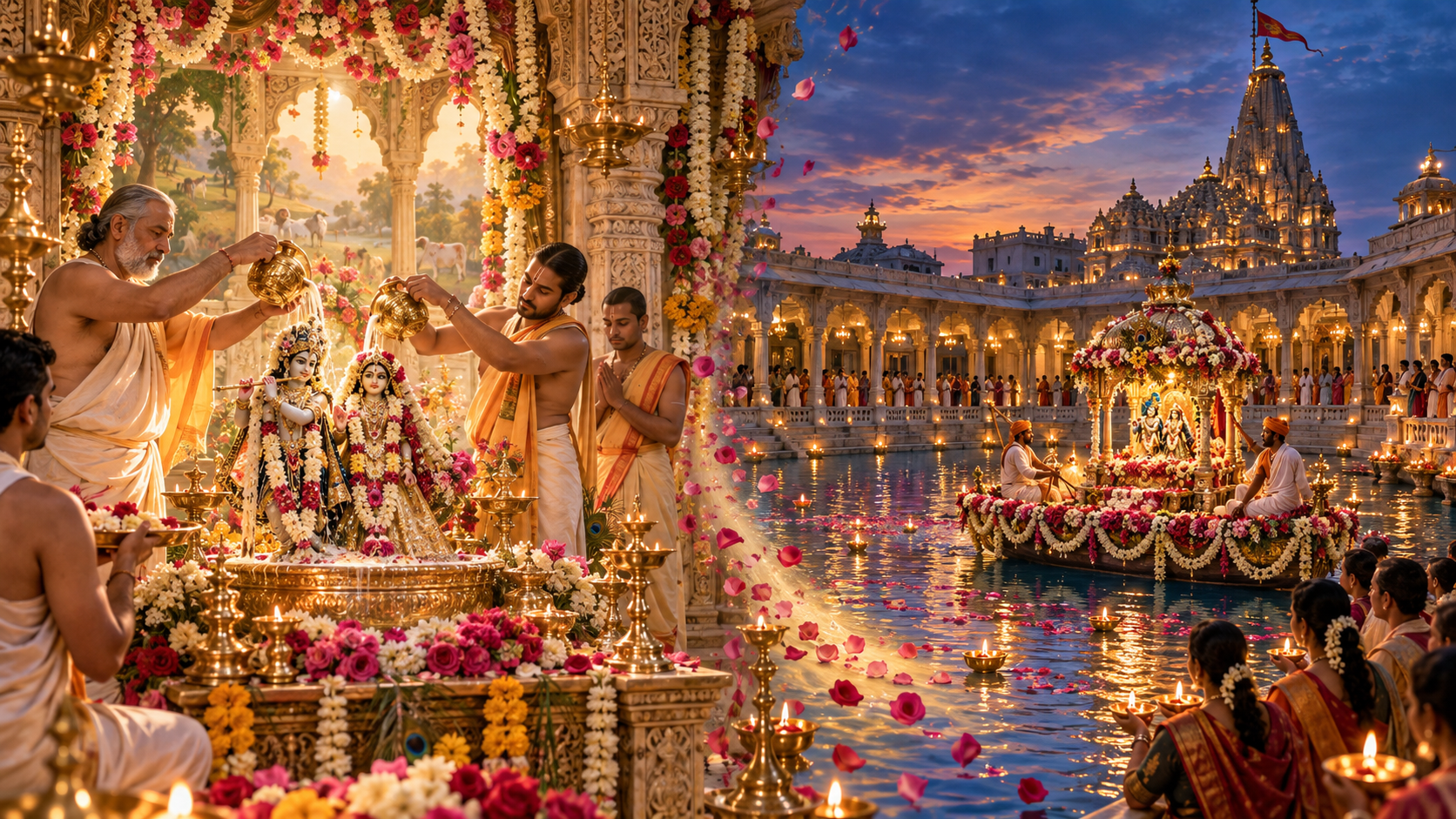
If you are deciding how to follow the Radha festival celebrations in Vrindavan and Dwarka, the names can make them sound like entirely different occasions. Vrindavan foregrounds a maha-abhishek. Dwarka presents Radhashtami through a boat festival. The useful question is not which form is more authentic, but what each form asks you to notice.
Once you understand the devotional grammar of each celebration, you can choose where to place your attention, prepare for a temple visit more intelligently, and avoid circulating photographs or videos with the wrong place, date, or ritual attached.
One festival can speak through two sacred geographies
Radhashtami places Sri Radha at the center of worship. Within Gaudiya Vaishnava practice, she is not treated as a decorative companion to Krishna. Radha represents the most concentrated form of loving devotion to him, and Krishna is approached in relationship with her.
Vrindavan and Dwarka bring different memories of Krishna into that worship. Vrindavan is inseparable from the Braj lila of Radha, Krishna, the gopis, and their intimate relationships. Dwarka recalls Krishna in the setting of his royal city. A Radha festival in Dwarka does not erase that distinction. It shows how Radha-bhakti can be carried into a temple community whose local sacred reference point is different.
This is one of the strengths of Bharat’s sacred geography. Places retain their own identities without becoming spiritually isolated from one another. Vrindavan does not need to become Dwarka, and Dwarka does not need to imitate Vrindavan in every outward detail. A shared object of devotion can be expressed through different forms of seva.
When you encounter either celebration, begin with three questions: Which deities are named? What form of seva gives the occasion its identity? Which temple and city are actually shown? Those questions reveal more than judging the festival by the size of its decorations or the spectacle of a short video clip.
Vrindavan centers the celebration on maha-abhishek
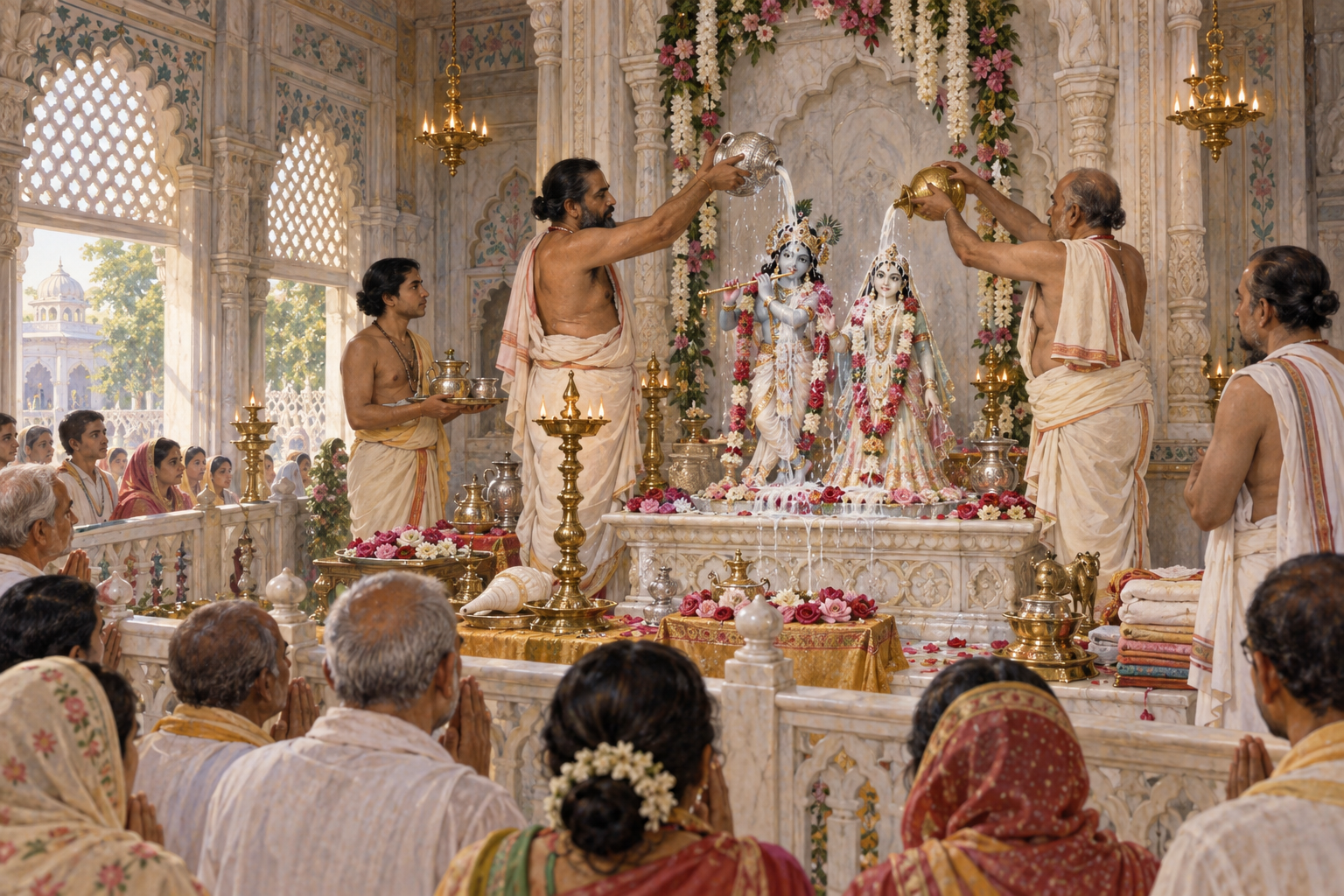
In Vrindavan, the celebration foregrounded a maha-abhishek of Sri Sri Radha-Shyamsundar with Lalita and Vishakha. Abhishek is the ceremonial bathing of the deity, while the word “maha” announces its major or especially festive character.
The full set of names matters. Radha-Shyamsundar identifies the divine couple, while Lalita and Vishakha place that worship within Radha’s circle of companions. The devotional scene is therefore relational. It is not simply an isolated image of Radha, nor a generic Krishna observance onto which Radha’s name has been added.
If you attend or watch this celebration, approach it in the following order:
- Identify the named deities before concentrating on the ceremony. Knowing whose seva you are witnessing prevents the images from becoming interchangeable temple footage.
- Attend to the act of service rather than trying to extract a universal ritual recipe. Abhishek materials, sequence, access, and accompanying worship can vary by temple and occasion.
- Retain the complete deity names when you label or share an image. Removing Lalita and Vishakha from the description removes part of the devotional context that the Vrindavan celebration explicitly preserves.
Maha-abhishek is visually compelling, but its meaning is not exhausted by what looks impressive on a screen. Bathing, dressing, and ornamenting the deity belong to seva. Darshan, the devotional act of beholding the deity, is therefore different from consuming a performance. If you are present, follow the temple’s rhythm instead of treating the most photographable moment as the whole celebration.
Before planning a journey around this particular observance, obtain a current calendar date and program directly from the temple. A relative label such as “today” should never be converted into a guessed date and then repeated as though it were permanent.
Dwarka gives Radhashtami the language of a boat festival
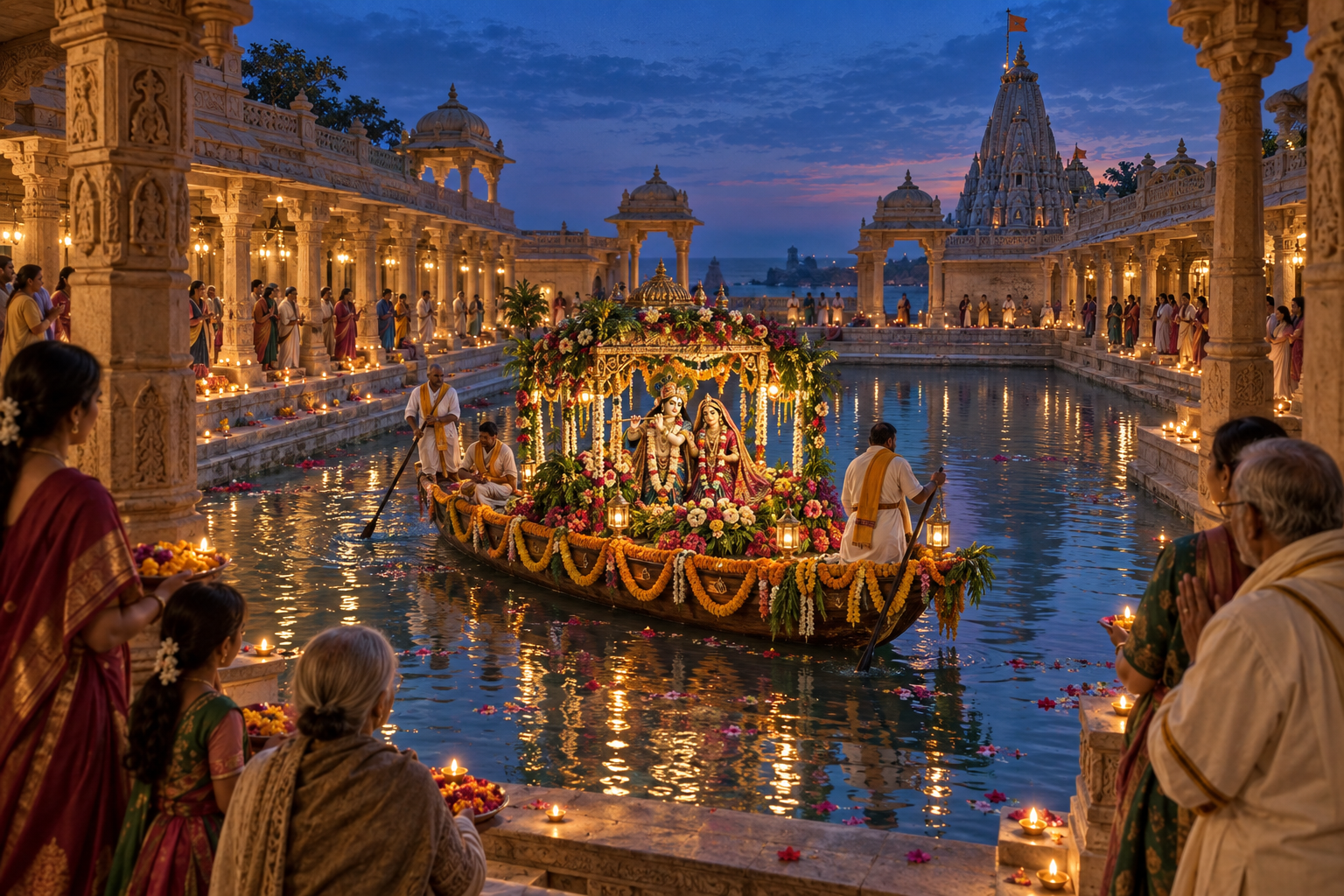
At ISKCON Dwarka, the named form was a Radhashtami Boat Festival Maha-Mahotsav on 19 September 2026. Here the governing festival image is a boat rather than maha-abhishek. The expression “Maha-Mahotsav” also signals that the program was presented as a major festive observance, not merely a minor decorative feature.
A boat festival changes the visual grammar of the occasion. The boat motif evokes movement, passage, and shared participation, giving the community a way to contemplate divine lila through a setting different from ceremonial bathing. That does not make the festival less centered on Radha. It means the same devotional center is being approached through another ritual imagination.
Keep the factual boundary clear, especially when sharing media. The confirmed identity is the Radhashtami Boat Festival Maha-Mahotsav at ISKCON Dwarka on the stated 2026 date. Its precise route, duration, sequence, access arrangements, and future recurrence cannot be inferred from the festival name alone. Those details require a current temple announcement.
The date needs the same care. Nineteen September 2026 identifies this Dwarka celebration; it is not a standing date for every future Radhashtami. Hindu festival dates follow the relevant calendar observance, so a dated 2026 program must not be reused as an evergreen travel schedule.
A fruitful way to read the Dwarka celebration is to notice continuity without demanding sameness. Radha-bhakti is at home in Vrindavan’s intimate sacred landscape, yet it can also animate a major temple festival in Dwarka. The connection is devotional rather than an attempt to collapse two cities into one story.
Choose and prepare according to your devotional intention

If you can attend only one form, decide by the kind of attention you want to cultivate. Use the distinction below as an orientation, not as a ranking.
| Question | Vrindavan | Dwarka |
|---|---|---|
| What gives the celebration its named form? | Maha-abhishek | Radhashtami Boat Festival Maha-Mahotsav |
| What is explicitly identified? | Sri Sri Radha-Shyamsundar, Lalita, and Vishakha | ISKCON Dwarka and 19 September 2026 |
| What should you notice? | Seva to the named deities and the relational setting around Radha | How the boat motif gives a communal festival form to Radha-bhakti |
| What should you not assume? | That one temple’s abhishek sequence is universal | That the 2026 date or exact program repeats unchanged every year |
| What must you verify before traveling? | Current date, start time, entry arrangements, and darshan access | Current-year date, program format, entry arrangements, and festival timing |
For an in-person visit, a little disciplined preparation protects both your time and the atmosphere of worship:
- Find the temple’s current-year announcement. A record from 2026 confirms that a celebration occurred; it is not a live schedule for another year.
- Confirm the exact start time, entry process, photography policy, permitted offerings, and whether special access rules apply during the main ceremony. Temple practice and crowd arrangements can change.
- Learn the full name of the celebration and the deities before you arrive. This gives you a devotional point of entry even if the crowd prevents a long darshan.
- Choose one intention for the visit: attending carefully to the abhishek, understanding the boat motif, hearing the divine names, or offering undistracted darshan. A festival is easier to receive when it is not treated as a checklist.
- When posting photographs or video, include the city, temple, ceremony, and verified date. That small habit prevents Dwarka imagery from being recirculated as Vrindavan, or a 2026 event from appearing to be current.
If you are participating from home, use the same discipline. Prefer an officially identified transmission or set of images when one is available. Read the deity names before watching, keep the city and ritual form attached to the material, and set aside a period of attention without scrolling between unrelated clips. Remote participation does not become more meaningful through the quantity of content consumed.
Most importantly, do not turn a difference in form into a contest between temples. Maha-abhishek and a boat festival direct attention in different ways. The first makes ceremonial service to the named deities especially visible. The second organizes the mahotsav around a moving devotional image. You can prefer one experience without declaring the other spiritually deficient.
Key takeaways
- Radhashtami can preserve one devotional center while taking different ritual forms in different temple communities.
- Vrindavan’s named celebration centers a maha-abhishek of Sri Sri Radha-Shyamsundar with Lalita and Vishakha.
- ISKCON Dwarka identified its celebration as a Radhashtami Boat Festival Maha-Mahotsav on 19 September 2026.
- The Dwarka date documents the 2026 occasion; it does not establish the date or format of a future annual program.
- Before attending, verify the current schedule and access rules. Before sharing, preserve the correct city, temple, ceremony, deity names, and date.
Your next step is simple. If you plan to travel, ask the relevant temple for its current program rather than building an itinerary from an older festival label. If you plan to observe from home, choose the celebration whose devotional form you want to understand and enter it through the names, place, and seva that give it meaning.
References
- Dandavats – Iskcon Vrindavan Maha Abhishek today Sri Sri Radha shyamsunder Lalita vishaka || Vrindavandham ||
- Dandavats – Radhashtami Boat Festival Maha-Mahotsav2026 || ISKCON Dwarka || 19th Sept 2026

Leave a Reply
You must be logged in to post a comment.