
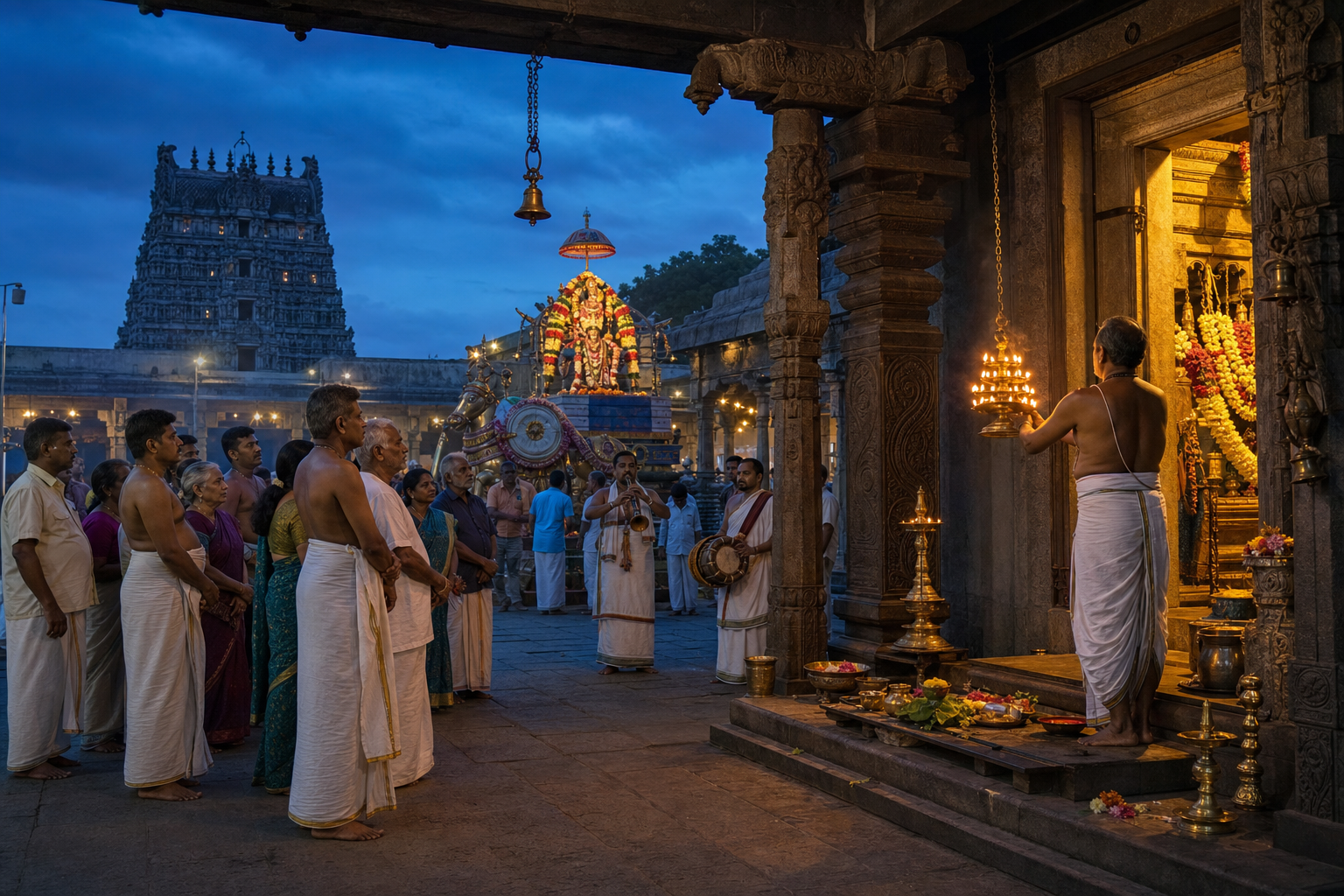
You may know whom you came to worship and still lose the thread once the ritual begins. A bell sounds, the sanctum closes, an abhishekam gives way to alankaram, and later the same deity appears outside on a vahana. If you treat these as unrelated ceremonies, you see the activity but miss the movement.
The useful approach is to read the temple as a ritual grammar. First identify the kind of observance underway. Then notice how space, sacred time, offerings, sound, and the deity’s public or private presence fit together. The pattern below is grounded in living Vaishnava and Shaiva traditions in Andhra Pradesh and Telangana. It is not a universal timetable for every South Indian temple; the local Agama, sampradaya, sthala-purana, and customary practice remain decisive.
First identify which ritual clock is running
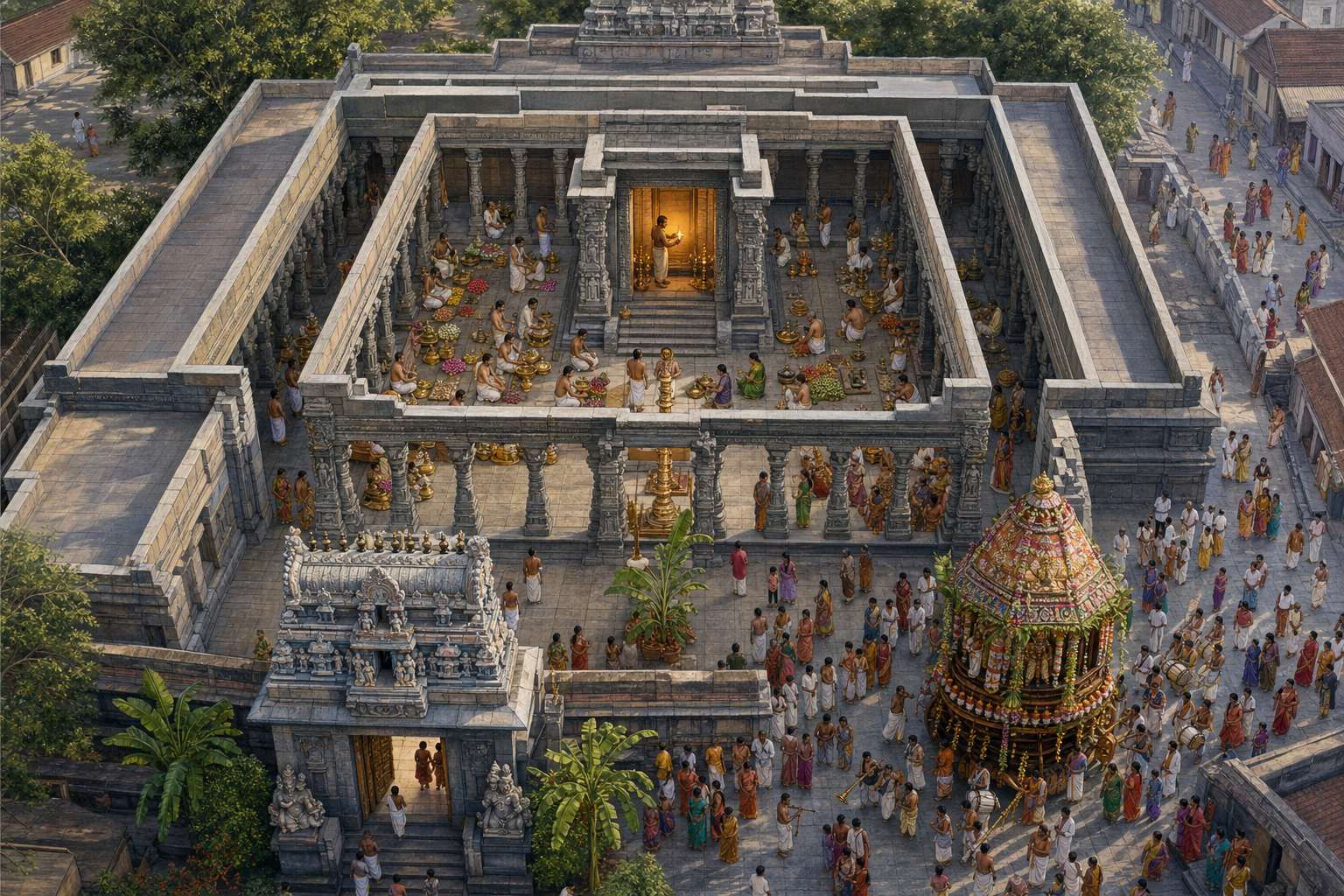
The first question to ask is not, “What does this gesture mean?” It is, “Which ritual clock am I watching?” Three clocks commonly overlap:
- Daily worship: The recurring cycle of awakening, purification, bathing or ceremonial preparation, adornment, mantra, food offering, lamp worship, darshan, and prasadam. This is the temple’s steady rhythm.
- A particular seva or vow: An archana, abhishekam, Rudrabhishekam, Kalyanotsavam, or another named observance may be performed within the daily cycle. It concentrates attention on a particular relationship with the deity without necessarily turning the entire day into a festival.
- Festival time: During an utsava, the whole temple changes scale. The utsava murti, processional route, music, vahanas, flagstaff, mandapas, streets, volunteers, and assembled community become parts of one extended act of worship.
The architecture helps you distinguish these clocks. A South Indian temple’s sacred axis may lead from the entrance and dhvajasthambha through the bali-pitha and mandapas toward the antarala and garbhagriha. In a Shaiva temple, Nandi’s alignment with the sanctum makes that orientation especially visible. The outer mandapa is therefore more than a waiting room. It can hold recitation, collective worship, festival preparation, and the movement between intimate sanctum worship and public celebration.
When you enter, pause before joining the quickest queue. Locate the sanctum, flagstaff, bali-pitha, processional path, and any subsidiary shrines. That thirty-second survey tells you where to stand, what not to obstruct, and whether the temple is in its ordinary rhythm or preparing for an utsava.
Read daily puja as a sequence, not a collection of objects
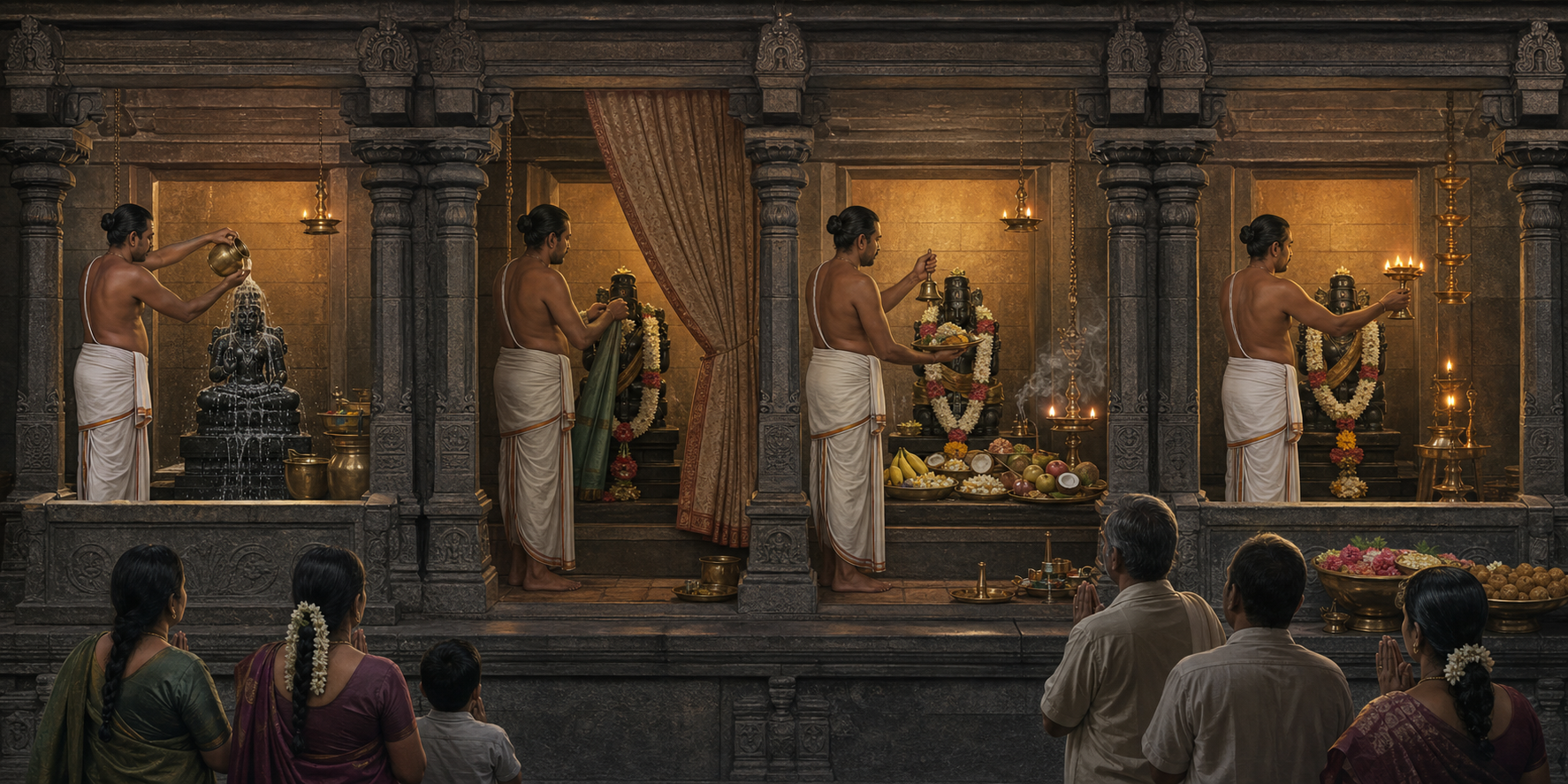
Temple worship engages water, fragrance, flowers, cloth, food, flame, mantra, music, and gesture, but the meaning does not reside in any one material by itself. It emerges from order. The exact sequence varies, yet five movements give you a dependable way to follow what is happening.
- Preparation and sankalpa establish purpose. Cleansing rites prepare the ritual field, while sankalpa gives the worship an intentional direction. Treat sankalpa as disciplined resolve, not merely a list of desired outcomes. It places your request within responsibility, place, time, and dharma.
- Abhishekam or snapana prepares the sacred form. In Shaiva worship, sacred bathing may include Panchamrita made from milk, curd, ghee, honey, and sugar. In Vaishnava festival practice, Snapana Tirumanjanam may be performed for the utsava murti with Vedic and stotra recitation. The bathing is not an isolated spectacle; it belongs to a movement of purification, honoring, and renewed manifestation.
- Alankaram discloses a particular aspect of the deity. Garlands, cloth, ornaments, marks, weapons, and color can emphasize protection, sovereignty, compassion, auspicious marriage, or another theological quality. Instead of asking whether the decoration is elaborate, ask which quality the alankaram is teaching you to contemplate.
- Mantra, archana, and naivedya turn attention into offering. Names and sacred recitations address the deity through sound; flowers and other approved materials accompany that address; naivedya offers food before it returns as grace-bearing prasadam. The devotee’s task here is attentive presence, not constant movement toward a better view.
- Deepa-aradhana and darshan complete an encounter. The offered flame reveals the adorned form, while darshan describes a reciprocal sacred seeing rather than ordinary observation. Receive the moment without blocking the line, and receive prasadam with the same attention you brought to the sanctum.
You may not be able to see every stage, especially where sanctum access is restricted. You can still follow the sequence by noticing transitions: the sound of recitation, the temporary closing and reopening of the sanctum, the change from bathing to adornment, the presentation of flame, and the distribution of prasadam. Choose one transition to observe carefully. That will teach you more than trying to record every visible detail.
A Brahmotsavam expands worship into sacred public time
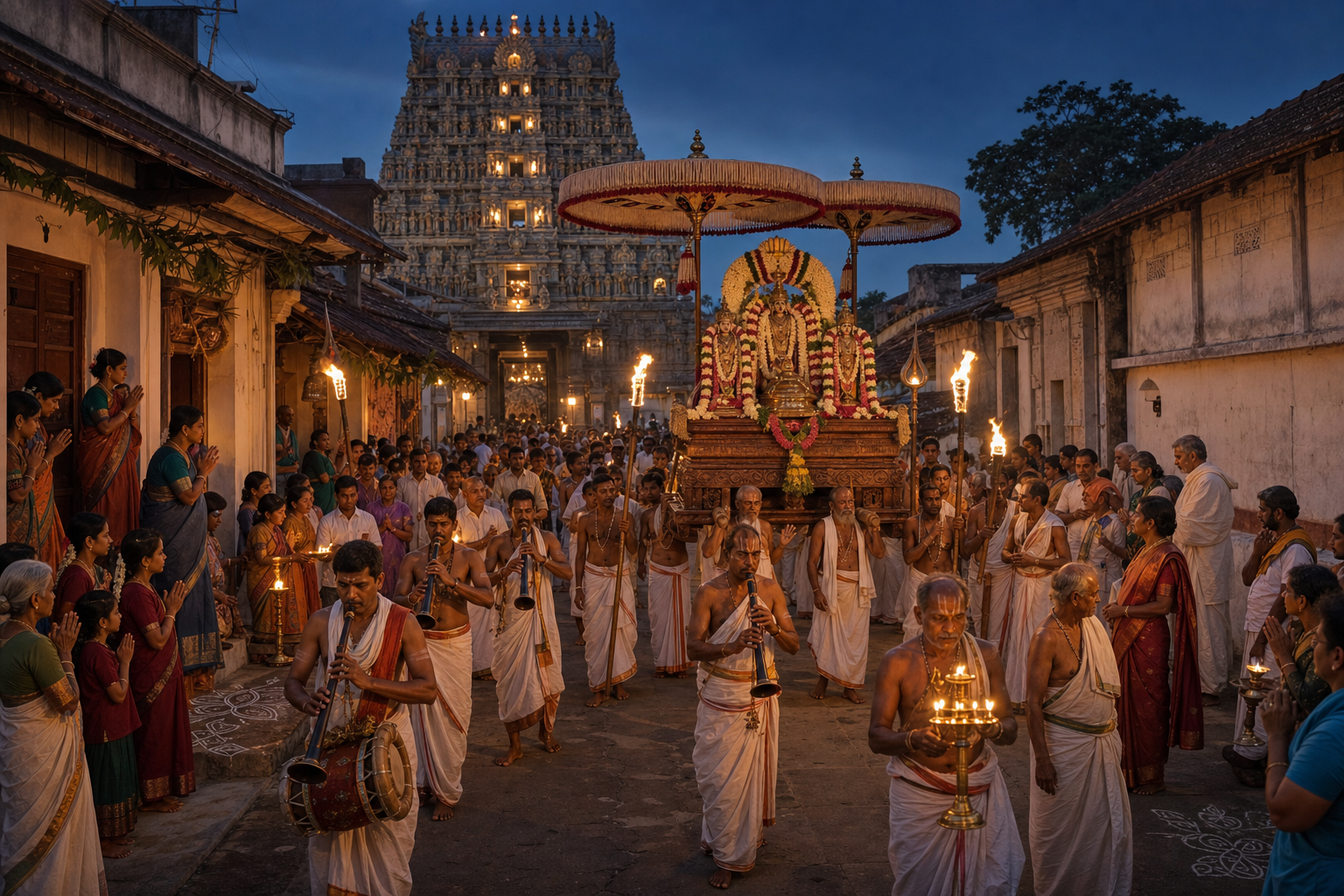
A Brahmotsavam is not simply a busier version of daily darshan. It creates a heightened period in which the deity’s sovereignty, protection, and accessibility are enacted across the temple and community. The opening and closing rites matter because they mark the boundaries of that sacred time.
Ankurarpanam commonly precedes the main festival. Auspicious seeds, traditionally navadhanyas, are ritually sown so that growth, purity, and wellbeing become part of the festival’s sankalpa. The act is easy to overlook because it occurs before the large processions, yet it establishes the field within which the later observances unfold. The following Dwajarohanam raises the Garuda flag in a Vaishnava Brahmotsavam and publicly marks the commencement of the festival.
The utsava murti then moves beyond the compact space of the garbhagriha. This is not a lesser substitute for the immovable principal deity. The processional form allows divine presence to be encountered along the ritual route, accompanied by mantra, Vedic recitation, nadaswaram, percussion, lamps, alankaram, and collective devotion. Vahana Sevas place the adorned utsava murti on emblematic mounts, and the mount supplies a theological lens for that particular darshan:
- Sesha: cosmic support and the ordered ground of creation.
- Hamsa: viveka, the discrimination that separates the enduring from the transient.
- Hanumanta: unwavering bhakti expressed through service.
- Simha: courage, protection, and righteous authority.
- Gaja: majesty, memory, abundance, and dignified strength.
- Surya Prabha and Chandra Prabha: the solar and lunar cadence of cosmic time.
- Garuda: devoted service, protection, and liberation.
Do not read these vahanas as decorative mascots. Ask what discipline each one places before you. Hamsa asks where your discrimination has weakened. Hanumanta asks whether your devotion has become service. Simha asks whether your courage is governed by dharma. The procession then becomes instruction rather than pageantry alone.
The concluding rites are equally important. Rathotsavam may draw the community into the deity’s public movement; Chakra Snanam ritually bathes the Sudarshana Chakra; and Dwaja Avarohanam lowers the festival flag. At Narasimha kshetras, these observances may form the closing movement of the Brahmotsavam. They do not mean that sacred presence has departed. They return the temple from exceptional festival time to its recurring cycle of worship.
The exact vahana order, the placement of Kalyanotsavam or Snapana Tirumanjanam, and the timing of closing rites are temple-specific. Use the announced local program, not a schedule remembered from another kshetra. Arriving early also lets you see the preparation and not merely the brief moment when the deity passes your position.
Vaishnava and Shaiva temples share a grammar, not one script
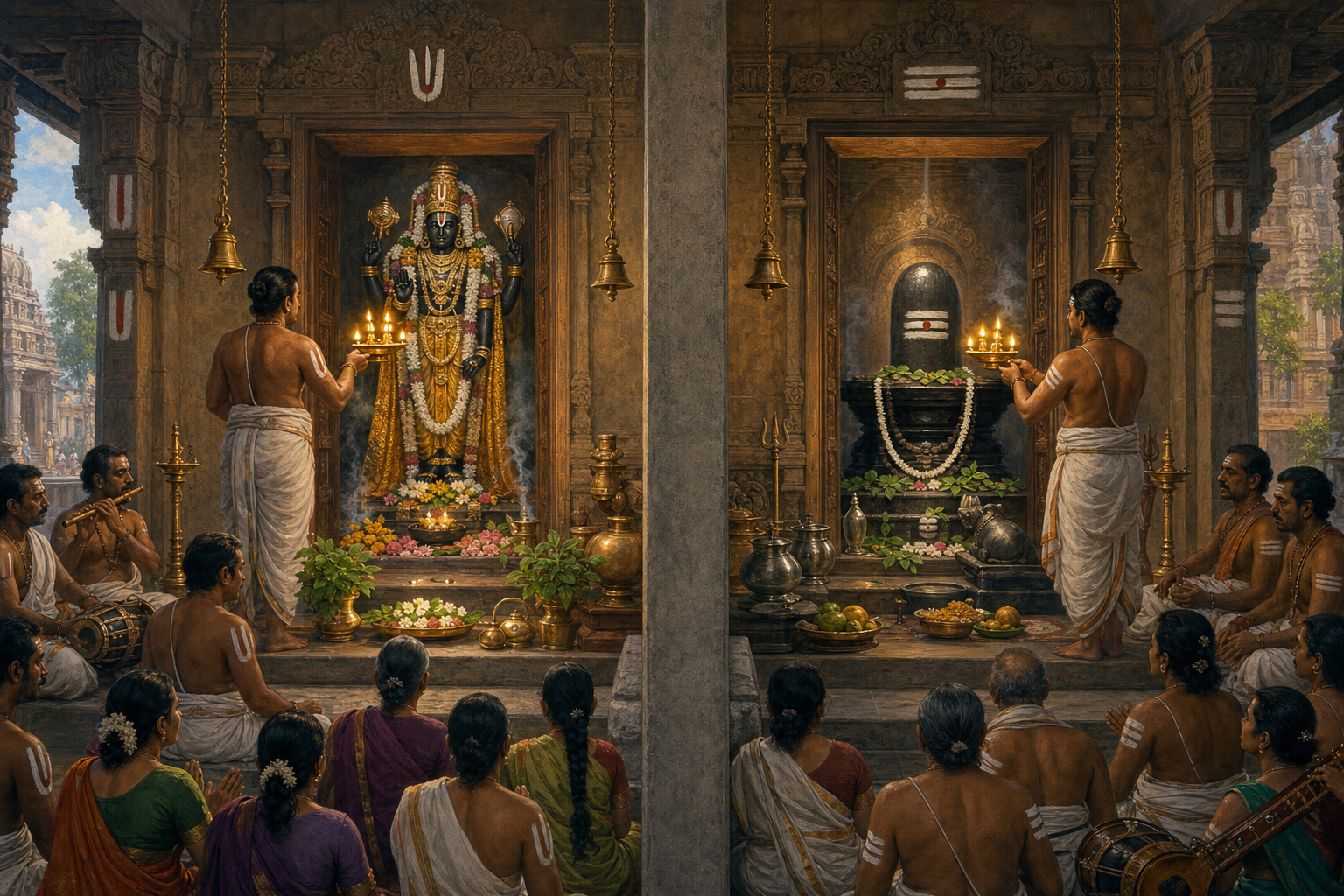
South Indian temples share forms such as abhishekam, alankaram, archana, naivedya, deepa, pradakshina, utsava, and prasadam. That common vocabulary should not tempt you to flatten distinct sampradayas into a single generic ritual system. The same ritual medium can serve a different theological emphasis in a different kshetra.
Vaishnava worship makes divine accessibility visible
In a Venkateshwara or Lakshmi Narasimha Brahmotsavam, processional worship makes protection, sovereignty, grace, and the deity’s relationship with the community publicly visible. The cycle may include Suprabhatam, aradhana, abhishekam or Snapana Tirumanjanam, alankaram, nivedana, and vahana processions. A Kalyanotsavam, where observed, presents divine marriage as an image of auspicious union, responsibility, household harmony, and communal wellbeing. At a Lakshmi Narasimha kshetra, fierce protection and the presence of Lakshmi belong within the same Vaishnava field of grace.
Shaiva worship can turn fierce form toward inner correction
At a Veerabhadra temple, an ugra form should not be mistaken for a celebration of uncontrolled anger. Veerabhadra’s fierceness signifies protective and restorative force: adharma is confronted so that truth, tapas, and harmony can be restored. The form’s weapons and alert posture therefore ask the devotee to recognize what must be cut away, restrained, or brought back into ethical alignment.
Abhishekam has particular prominence in this Shaiva setting. Vibhuti and bilva leaves are emblematic offerings, while Rudrabhishekam joins the bathing rite to the recitation of Sri Rudram and Chamakam. Maha Shivaratri brings nocturnal vigil, japa, and repeated abhishekams; Karthika observances emphasize lamps, pradakshina, and dana; Pradosham concentrates attention on purification and Shiva’s grace. These are not interchangeable labels for one ceremony. Each places the devotee in a different relationship with sacred time.
The practical rule is simple: learn the local name before interpreting the act. Ask which seva is being performed and which deity or utsava murti is receiving it. Do not transfer offerings or procedures mechanically from one temple to another. Local priests and posted temple instructions should settle what is appropriate in that kshetra.
Key takeaways for your next temple visit
A little planning protects the attention you came to offer. Festival participation can involve dense queues, moving processions, restrictions near the sanctum, and changing access routes. Travel light, use designated queue lines, carry water and necessary medication, and follow local photography rules. Modest clothing, patient movement, and special care around children and elders are not peripheral etiquette; they preserve a shared field of worship.
- Identify whether you are seeing daily puja, a particular seva, or festival worship before trying to interpret individual gestures.
- Read the temple’s axis from entrance to sanctum. Keep the dhvajasthambha, bali-pitha, Nandi where present, mandapas, and processional route clear.
- Follow the ritual movement from preparation and abhishekam through alankaram, offering, flame, darshan, and prasadam.
- During a vahana procession, contemplate the quality represented by the mount instead of treating the event only as visual spectacle.
- Use the temple’s current notices for timings and sequence. A Brahmotsavam program from another kshetra is not a substitute.
- Make your conduct part of the seva: keep the queue orderly, avoid litter and unnecessary noise, give elders safe passage, and respect restrictions around the deity.
- Let darshan produce one concrete sankalpa after you leave, such as annadanam, volunteer service, greater self-restraint, or patient care for someone in your household.
Before your next visit, choose one named rite you genuinely want to understand and verify its local time. Arrive early enough to witness the transition into it. Then leave with one action that expresses what the ritual asked of you. That movement from attention to conduct is where temple tradition stops being something you watched and becomes dharma you carry.
References
- DharmaRenaissance Blog — Punganur Kalyana Venkateshwara Brahmotsavams 2026: Dates, Rituals, Vahana Sevas & Full Visitor Guide
- DharmaRenaissance Blog — Kuravi Veerabhadra Swamy Temple: Fierce Shaivite Power, Kakatiya Heritage, Rituals & Guide
- DharmaRenaissance Blog — Tarigonda Lakshmi Narasimha Swamy Brahmotsavams 2026: Sacred Spectacle, Schedule & Visitor Guide
