
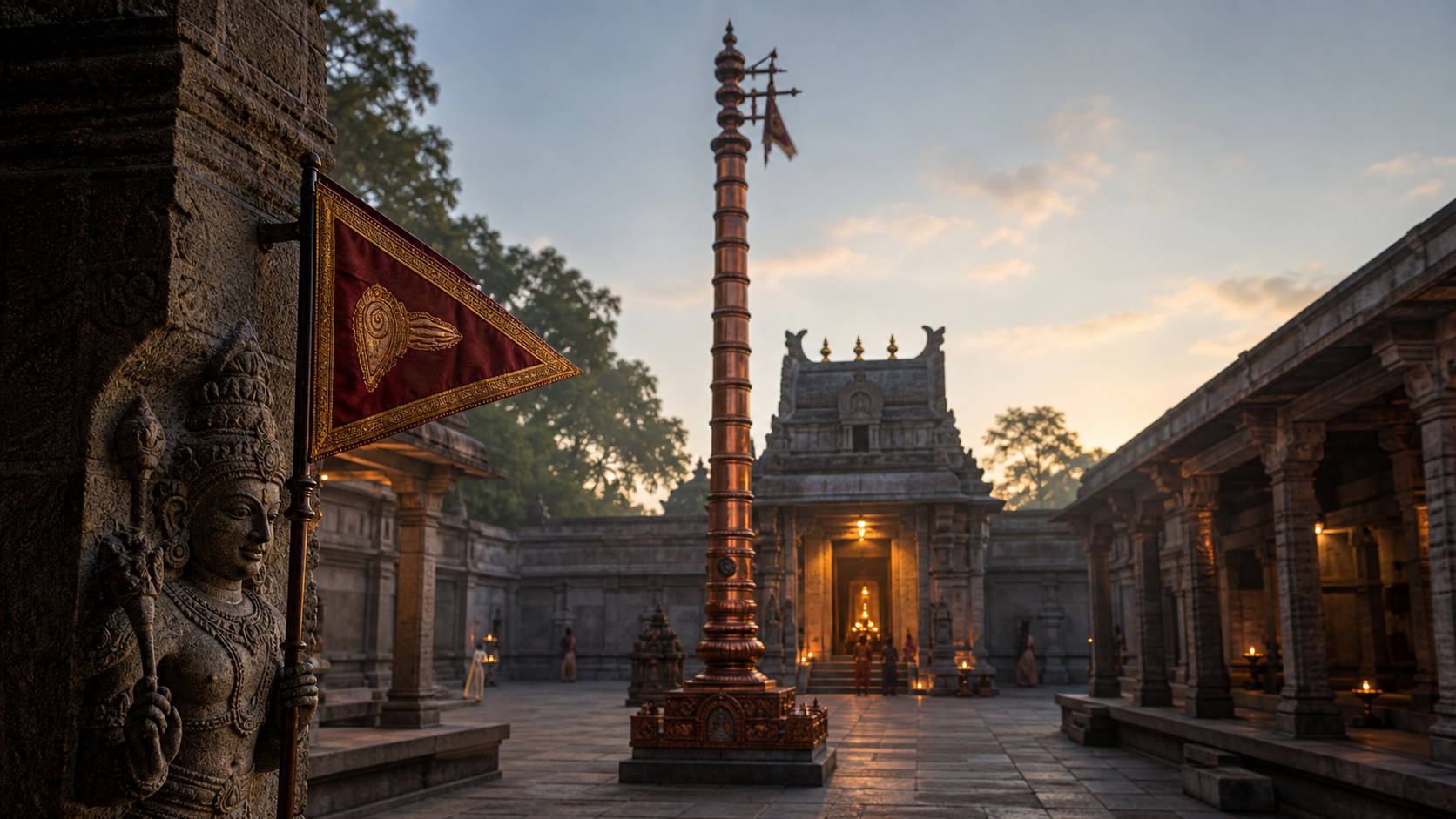
You have noticed a small pennon beside a deity, a standard rising from a chariot, or a metal-sheathed flagstaff on the approach to a sanctum. It is easy to treat the object as decoration or mistake it for another weapon. Either reading can hide one of the clearest signals in Hindu sacred art.
A patākā or dhvaja usually asks you to look for presence, rightful authority, ritual timing, and collective identity. Once you know where to look, the banner can help you identify the figure, understand the temple axis, and distinguish protective courage from uncontrolled aggression.
Begin with position, not with a guessed deity
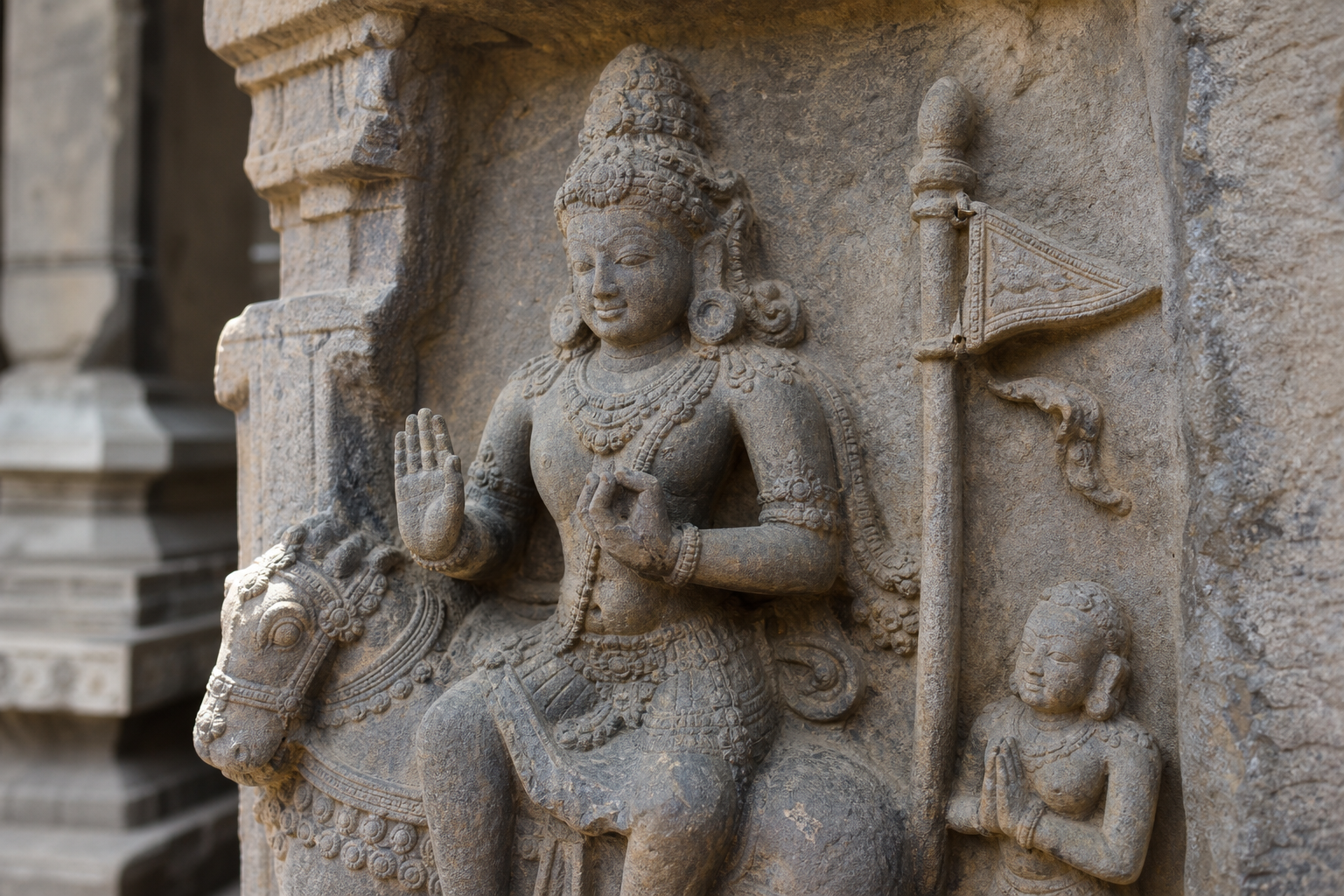
Start with a simple distinction. Patākā commonly means a flag or pennon, while dhvaja carries the sense of a standard, ensign, or banner. The terms can overlap in practice. Related words such as ketu, lāñchana, and chihna emphasize the object as a sign or identifying mark. You should therefore avoid forcing every example into a rigid vocabulary before you have examined its context.
The more important distinction is between an insignia and an āyudha. A sword, mace, trident, or spear can express the deity’s capacity to confront danger. A banner ordinarily proclaims whose authority is present, what vow governs that authority, and under which sacred identity people have assembled. Its message is closer to an emblematic pledge of dharma than to an act of attack.
Use this five-pass method when you encounter an uncertain object in a temple, sculpture gallery, manuscript image, or photograph:
- Determine its scale and form. Is it a compact hand-held pennon, a tall staff beside a figure or vehicle, or a monumental architectural flagstaff?
- Locate its bearer. A deity, attendant, charioteer, processional leader, or fixed temple axis gives the same banner a different immediate function.
- Inspect the device. A bird, bull, rooster, makara, monkey, lion, lotus, conch, or trident-shaped finial may provide the strongest identification clue.
- Look for corroborating attributes. Check the vāhana, weapons, mudrās, ornaments, attendants, and narrative action before naming the deity or episode.
- Notice how the cloth behaves. Curling edges, raised tassels, and diagonal pennons preserve the suggestion of wind even in stone or bronze. That implied vāyu makes an otherwise fixed sign feel active within sacred space.
The first pass prevents a common mistake: identifying an object by silhouette alone. A narrow staff can support a banner, weapon, parasol, or ceremonial object. The staff’s placement and finial matter more than its basic vertical shape. If damage has removed the cloth or emblem, record the identification as probable rather than certain.
Read the device as a clue, not a complete answer
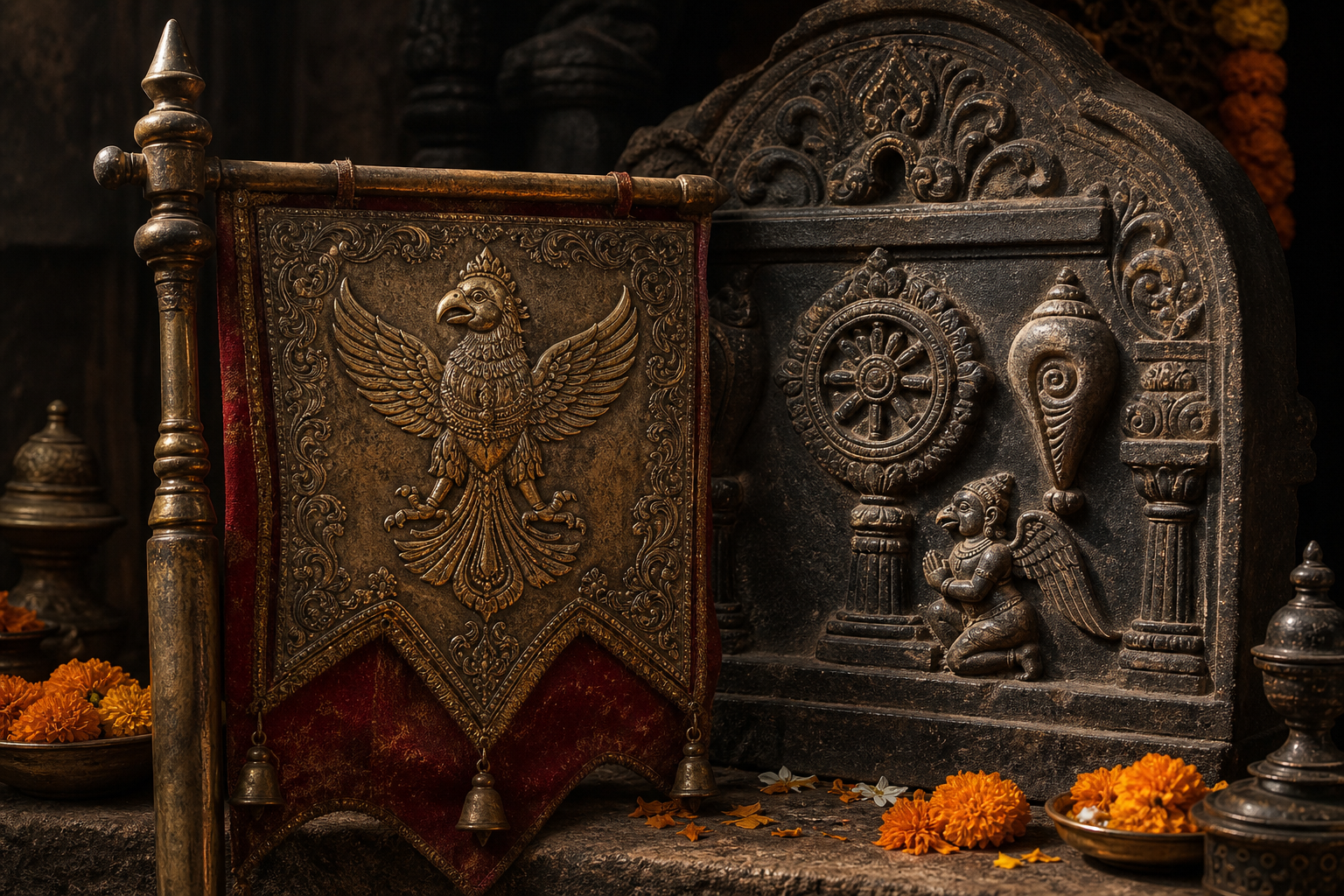
The emblem on a sacred banner can name a deity, sectarian lineage, narrative role, or sphere of protection. It is powerful evidence, but it is rarely safe to interpret in isolation. Lotus imagery, for example, can participate in more than one iconographic vocabulary. Regional practice and the surrounding sculptural program still control the final reading.
| Visible device | Strong first reading | What to check before concluding |
|---|---|---|
| Garuḍa | A Vaiṣṇava standard associated with Viṣṇu; Garuḍa-dhvaja also entered royal and dynastic imagery, including Gupta coins. | Look for Viṣṇu’s sanctum, Garuḍa facing the deity, or supporting signs such as the conch. Do not assume that every royal Garuḍa standard is a freestanding image of the deity. |
| Bull, Nandi, or a trident finial | A Śaiva affiliation in which protective force is ordered by divine authority. | Check for Nandi, Śiva’s attributes, and the standard’s relationship to the sanctum or procession. |
| Rooster | The seval kodi of Subrahmaṇya, Skanda, or Murugan, expressing vigilance and martial intelligence. | Look for the vel, the deity’s attendants, or a processional setting. The banner complements the spear; it is not simply a substitute for it. |
| Makara | The makara-dhvaja of Kāma or Kāmadeva, joining attraction with the need to govern desire. | Confirm the narrative and associated attributes before treating every aquatic hybrid as Kāma’s emblem. |
| Monkey on a chariot standard | Arjuna’s kapidhvaja in the Mahābhārata, sanctified by Hanuman’s presence and carrying protection, memory, and vow. | Verify the chariot scene and martial narrative. A simian device on a standard is more specific than a nearby, independent image of Hanuman. |
| Lion or lotus | A possible Śākta context, especially where the surrounding program confirms the Goddess. | Do not identify the tradition from the lotus alone. Examine the deity, vāhana, other attributes, and regional setting. |
Banner vocabularies are regionally inflected. The rooster is especially vivid in Tamil worship of Murugan, while a Garuḍa device may operate differently in a Viṣṇu temple, a narrative panel, and royal coinage. Treat the table as a disciplined starting point, not a replacement for the whole image.
When several standards appear in one relief, do not immediately diagnose confusion or rivalry. Ask whether the sculptor is distinguishing participants, bringing several powers into one narrative, or showing a procession composed of multiple groups. Hindu art can preserve distinct sectarian identities while placing them in visual conversation.
Ask what the banner proclaims without striking
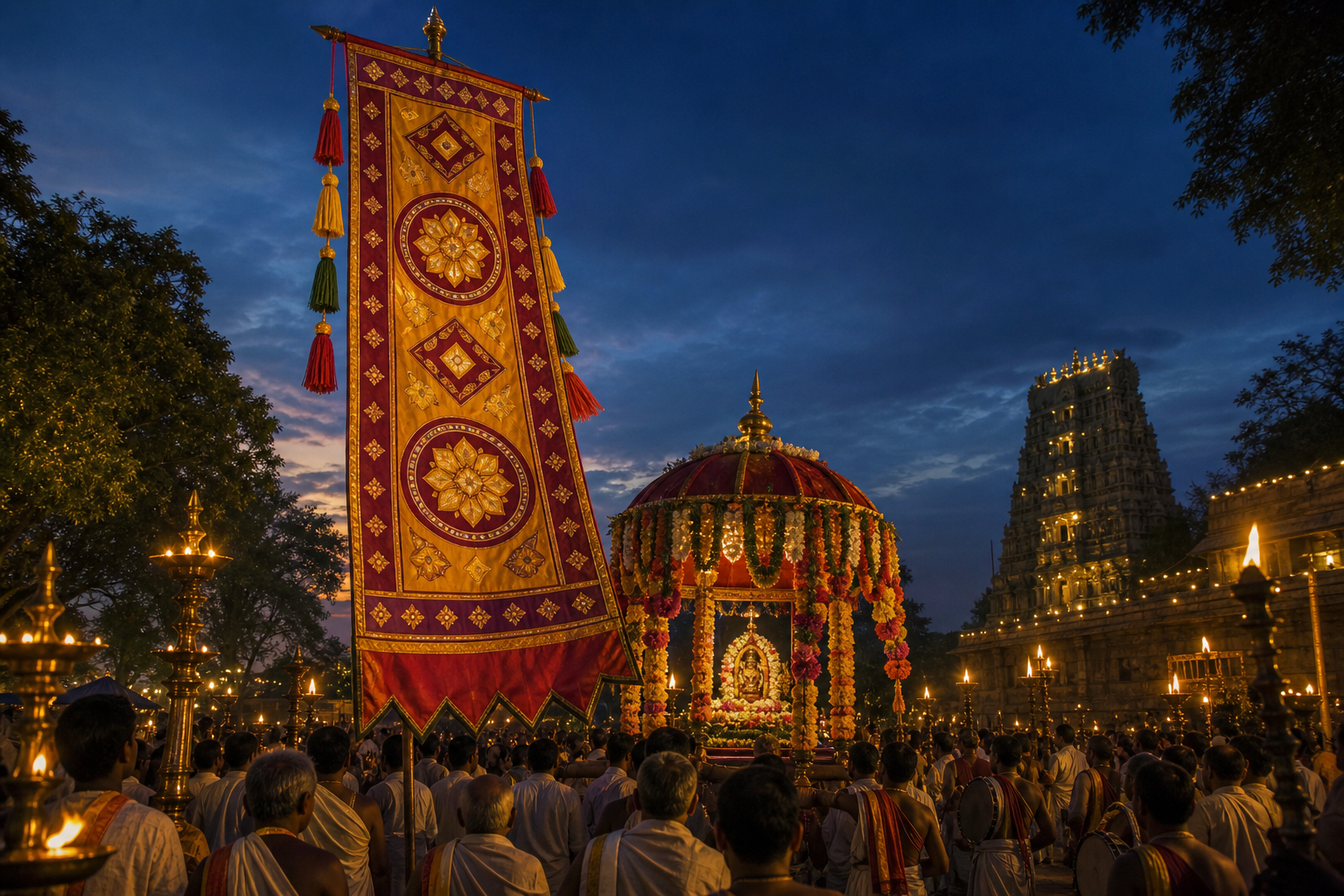
A sacred banner changes the ethical tone of an image. It can accompany a martial figure, but it does not perform the same work as a weapon. Its force lies in declaration: this presence has arrived, this authority has jurisdiction, this undertaking has begun, and this community stands within a shared commitment.
This is why the banner can move between royal, temple, and processional settings without losing its basic coherence. Royal insignia asserts sovereignty. Sacred insignia asks whether sovereignty is rightly directed toward protection and order. Victory is consequently framed as jaya through dharma, not merely the defeat of an opponent.
The same distinction helps you read a flag-bearing mūrti. The banner usually shifts emphasis toward oversight, proclamation, guardianship, or fidelity to a vow. It does not erase kṣatra, the courage required to protect. It places courage inside the disciplines of rājadharma and lokasaṃgraha: power must serve the social and cosmic order rather than its own appetite.
Arjuna’s monkey-emblazoned chariot standard makes this especially clear. Hanuman’s presence above the chariot binds martial action to memory, devotion, service, and restraint. If you read only the battlefield, you miss the vow. If you read only a decorative monkey, you miss the ethical government of strength.
Key takeaways
- Read a patākā or dhvaja first as an insignia, not as an offensive implement.
- Use position, bearer, device, and neighboring attributes together; no single clue should carry the entire identification.
- Sovereignty, divine presence, auspicious commencement, and communal belonging can operate at the same time.
- A martial context does not automatically make the banner militaristic. Its frequent work is to place protective force under a vow.
- Motion carved into the pennon matters. Suggested wind turns a static emblem into a sign of living sacred presence.
Let the dhvaja-stambha show you how the temple works
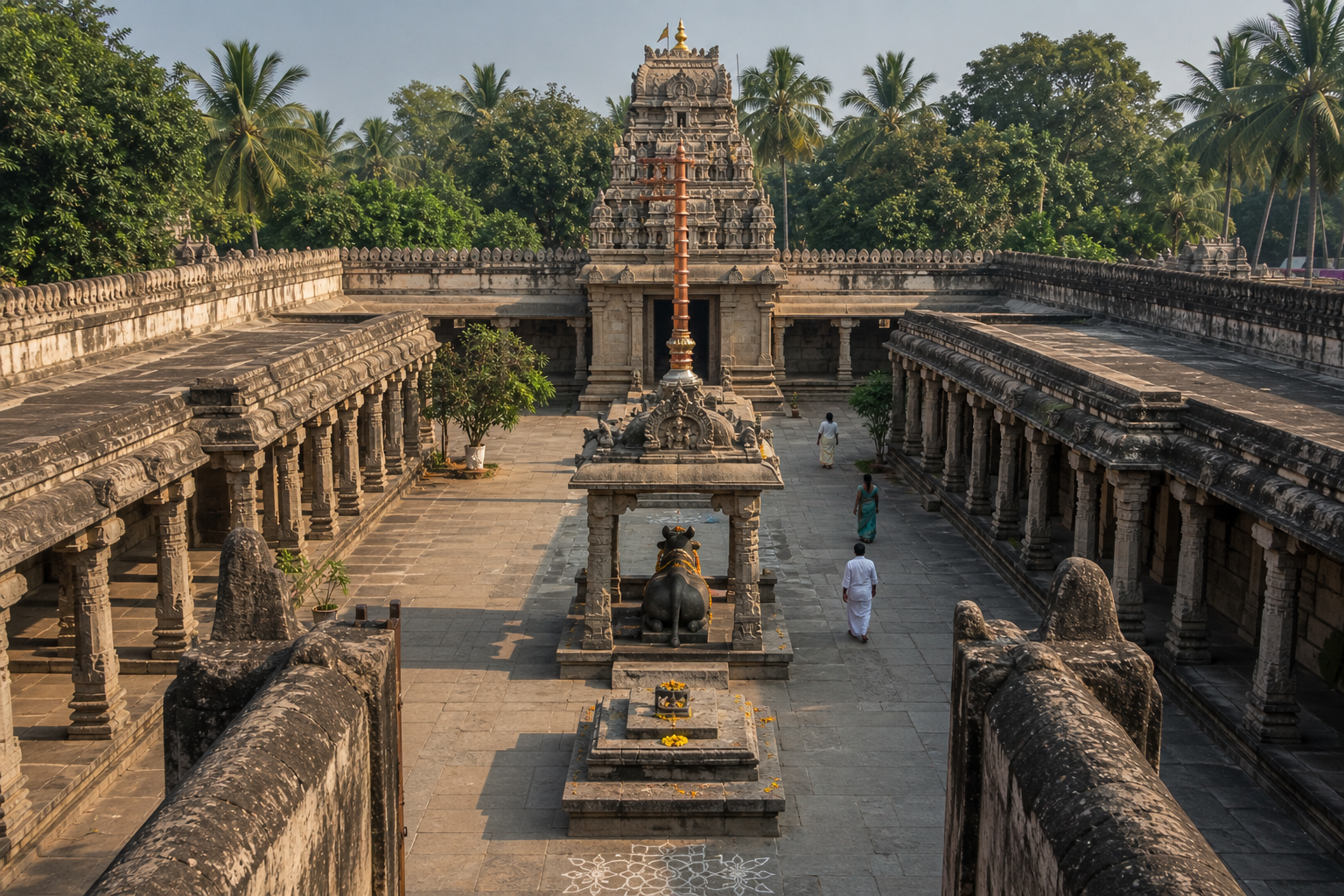
At a temple, do not look only upward at the flagstaff. Turn around and trace its line toward the sanctum. The dhvaja-stambha commonly participates in an eastern axial sequence involving the bali-pīṭha, the deity’s vāhana, and the sanctum. Its meaning therefore comes from alignment as much as height.
This changes how you should approach the structure. It is not an isolated pole placed in an open courtyard for convenience. Agamic temple manuals address its consecration, proportions, metal sheathing, and ritual care. Śilpa traditions also coordinate standards with pedestals and sightlines so that the vertical proclamation outside supports the inward movement toward darśana.
Follow the axis in a deliberate order:
- Stand where the flagstaff and sanctum can be read together rather than photographed as unrelated monuments.
- Identify the vāhana and bali-pīṭha, noting whether each element confirms the presiding deity.
- Examine the flagstaff’s finial and sheathing for sectarian signs that may be invisible from the entrance.
- Compare the permanent architectural standard with any textile banners, processional standards, or carved pennons elsewhere in the complex.
- If a festival is underway, note when the banner is raised, where the leading standard moves, and when it is lowered. These changes are part of the ritual, not incidental event decoration.
Dvajārohaṇa, the ceremonial raising of the flag, inaugurates major utsavas such as Brahmotsavam. The act converts ordinary calendar time into a marked liturgical interval. The banner’s descent closes that interval and returns its visibly mobilized authority to latency. A lowered or folded banner can therefore signify the proper phase of a ritual cycle rather than neglect.
The same logic explains why a standard often leads a procession. The deity’s authority is announced before the principal image reaches a street or gathering place. Temple space is thereby extended into civic space, and the community receives a visible cue to reorganize attention around the approaching sacred presence.
For a visitor, the useful question is not simply, “What festival is this?” Ask what changed when the banner rose, what follows behind the leading standard, and what the lowering of the flag concludes. Those three observations reveal the ritual structure more clearly than a collection of disconnected photographs.
Compare Dharmic banners carefully and leave a usable record
Compare functions without flattening traditions
The sacred banner belongs to a wider Dharmic language, but shared vocabulary does not mean identical theology. In Buddhist iconography, the victory banner belongs among the aṣṭamaṅgala and redirects the idea of conquest toward victory over inner afflictions. Jain temple flags proclaim the sanctity of the tīrtha and place ahiṃsā in public view. The Sikh Nishan Sahib marks the gurdwara as a place of presence, service, and sanctuary.
The responsible comparison is functional. Across these traditions, a raised standard can identify sacred presence, gather a community, make an ethical commitment visible, and redefine the space beneath or around it. The emblem, doctrine, ritual authority, and institutional setting remain particular to each path. You gain insight by noticing the civilizational grammar without dissolving real differences.
This comparison also corrects an overly narrow political reading of every flag. A sacred standard may certainly express sovereignty or protective courage, yet its horizon can be service, ahiṃsā, mastery of inner disorder, refuge, or fidelity to dharma. Decide what kind of victory is being claimed before assuming that the image celebrates domination.
Record the context that makes identification possible
A close-up of an emblem is rarely enough for later interpretation. If you are documenting a temple, museum object, family photograph, or heritage site, preserve the relationships that give the banner meaning. Where photography is permitted, capture a contextual view as well as the detail.
- Record whether the banner is hand-held, attached to a chariot or vāhana, borne by an attendant, or fixed architecturally.
- Note the bearer, the direction faced, and the relationship to the sanctum, procession, throne, or narrative action.
- Describe the device before interpreting it: rooster, bird, bull, monkey, makara, lotus, lion, conch, trident finial, or an uncertain form.
- Include neighboring mudrās, āyudhas, ornaments, vāhanas, and attendants that support or weaken the identification.
- Distinguish surviving cloth, carved cloth, a bare staff, a damaged finial, and a reconstructed element.
- Record visible condition problems in the metal sheathing, finial, staff, or sculpted pennon without touching or moving the sacred object.
- Preserve the local name supplied by the temple or object label, but keep it separate from your visual description so later readers can evaluate both.
Tagging banners alongside mudrās and āyudhas makes a digital inventory far more useful than filing every standard under miscellaneous ornament. Conservation has the same interpretive consequence. Repairing sheathing, preserving a sectarian finial, or documenting a worn pennon safeguards the legibility of the temple, not merely its surface appearance.
On your next temple visit, pause at the first banner before moving toward the mūrti. Find its bearer, name its device only if the evidence allows, trace its axis, and ask what vow its authority serves. That short discipline can turn an easily overlooked flag into a guide to the whole sacred space.
References
