
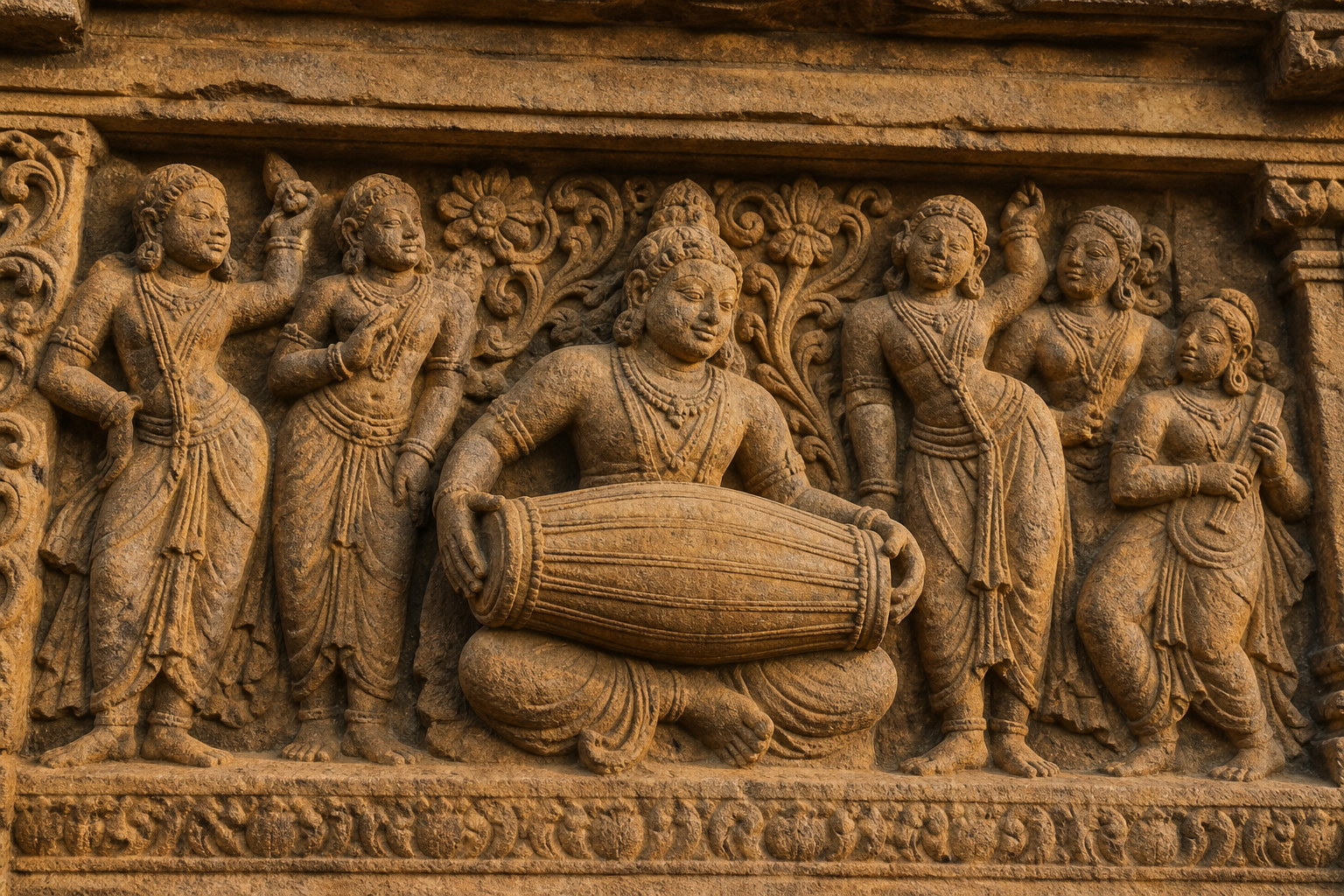
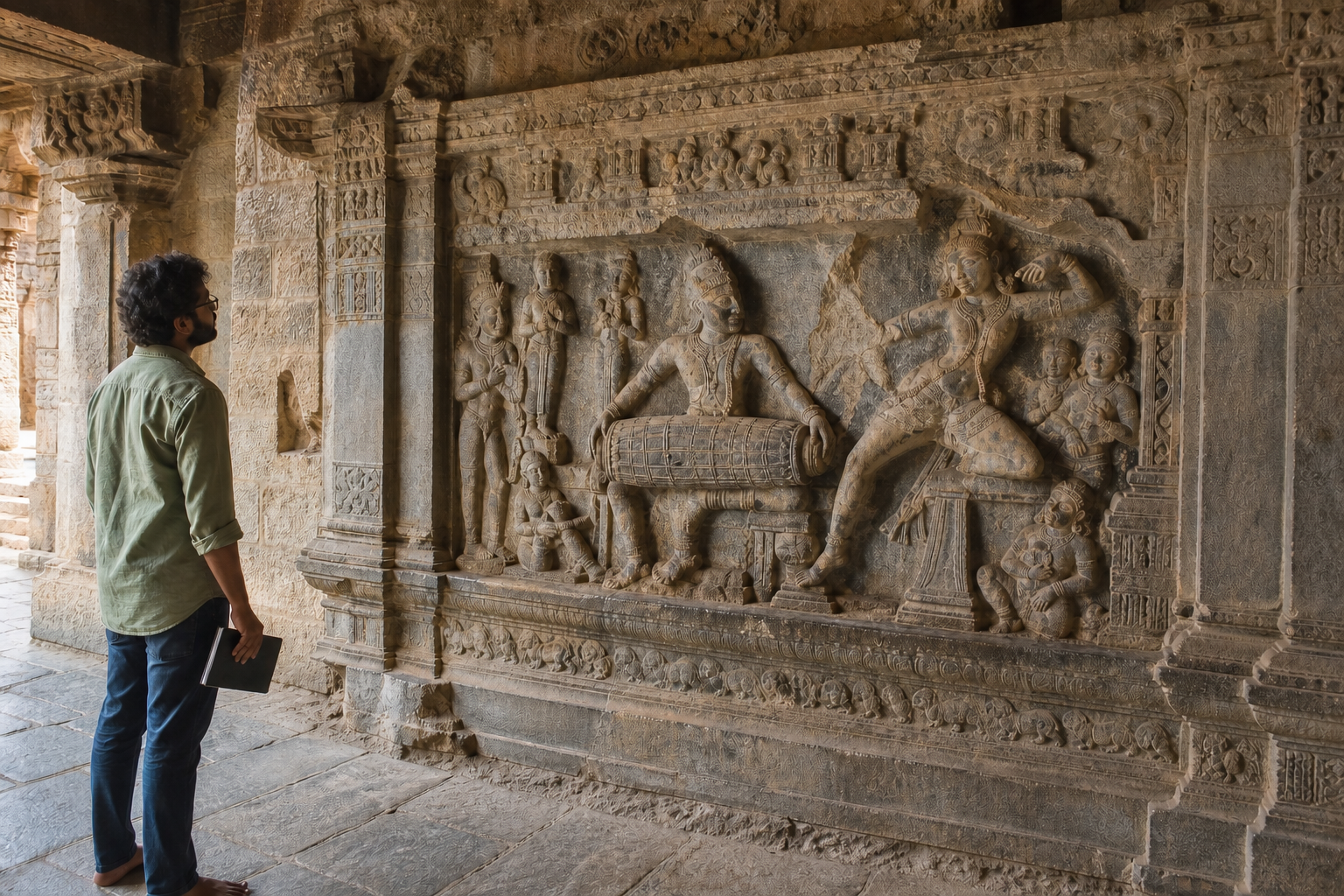
You are looking at a weathered temple carving. A figure holds a long drum with a rounded middle, but the surrounding details are crowded, damaged, or unfamiliar. Is the instrument merely part of a musical scene, or does it carry a deeper sacred meaning?
The most reliable answer avoids both extremes. A mridanga can depict an actual instrument and communicate rhythm, order, movement, devotion, and cosmic activity at the same time. To read it well, you need to begin with what the sculptor has shown before deciding what the image means.
First confirm that the drum is a mridanga
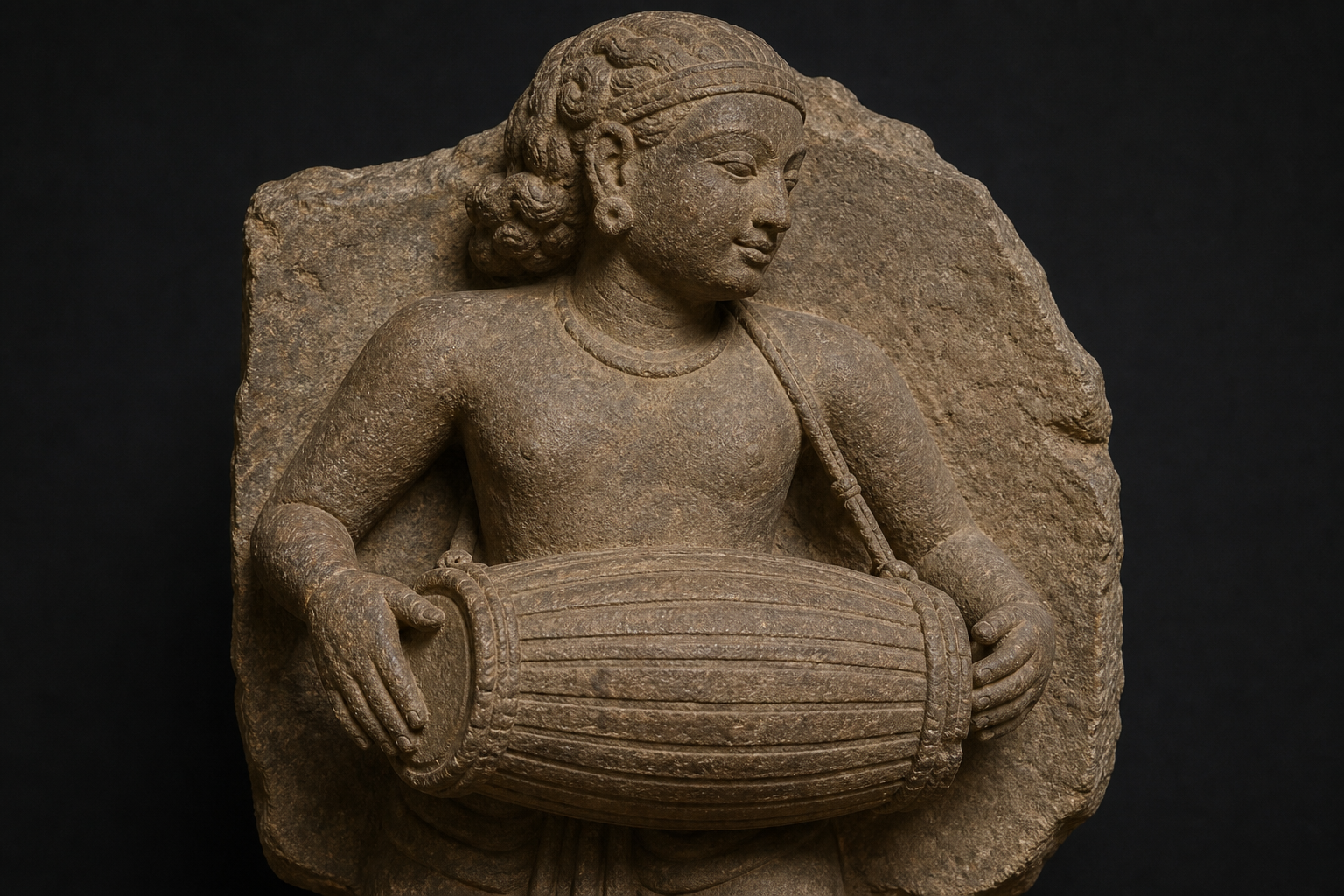
Identification matters because Hindu iconography contains more than one kind of drum. If you identify every sacred drum as a mridanga, you can build an elaborate interpretation on the wrong object.
Look first for the instrument’s characteristic structure: a double-headed, barrel-like body that swells near the centre and tapers toward both ends. The two striking faces lie at opposite ends of a single resonating body. From the side, the outline can appear biconical: two tapering sections meet around a fuller middle.
- Count the visible ends. Two opposed drumheads are the strongest initial clue.
- Trace the silhouette. A fuller centre with narrowing ends supports identification as a mridanga.
- Check whether the apparent symmetry belongs to the instrument or merely to the surrounding ornament.
- Follow the player’s hands. Hands directed toward opposite ends can clarify an outline that erosion has made uncertain.
- Keep the identification provisional if one end is hidden, broken, or merged into another figure.
Do not confuse this profile with the damaru. A damaru is an hourglass-shaped drum that narrows at its middle; the mridanga has a fuller central body and striking surfaces at its outer ends. That distinction is especially important when a sacred dance scene tempts you to treat every drum as the same emblem.
Stone does not preserve every practical detail of an instrument. Scale may be compressed, perspective may distort one end, and damage may remove a hand or drumhead. Use several clues together. If only the general outline survives, describe the object as a probable mridanga rather than turning a possibility into a certainty.
Read outward from the instrument to the whole composition
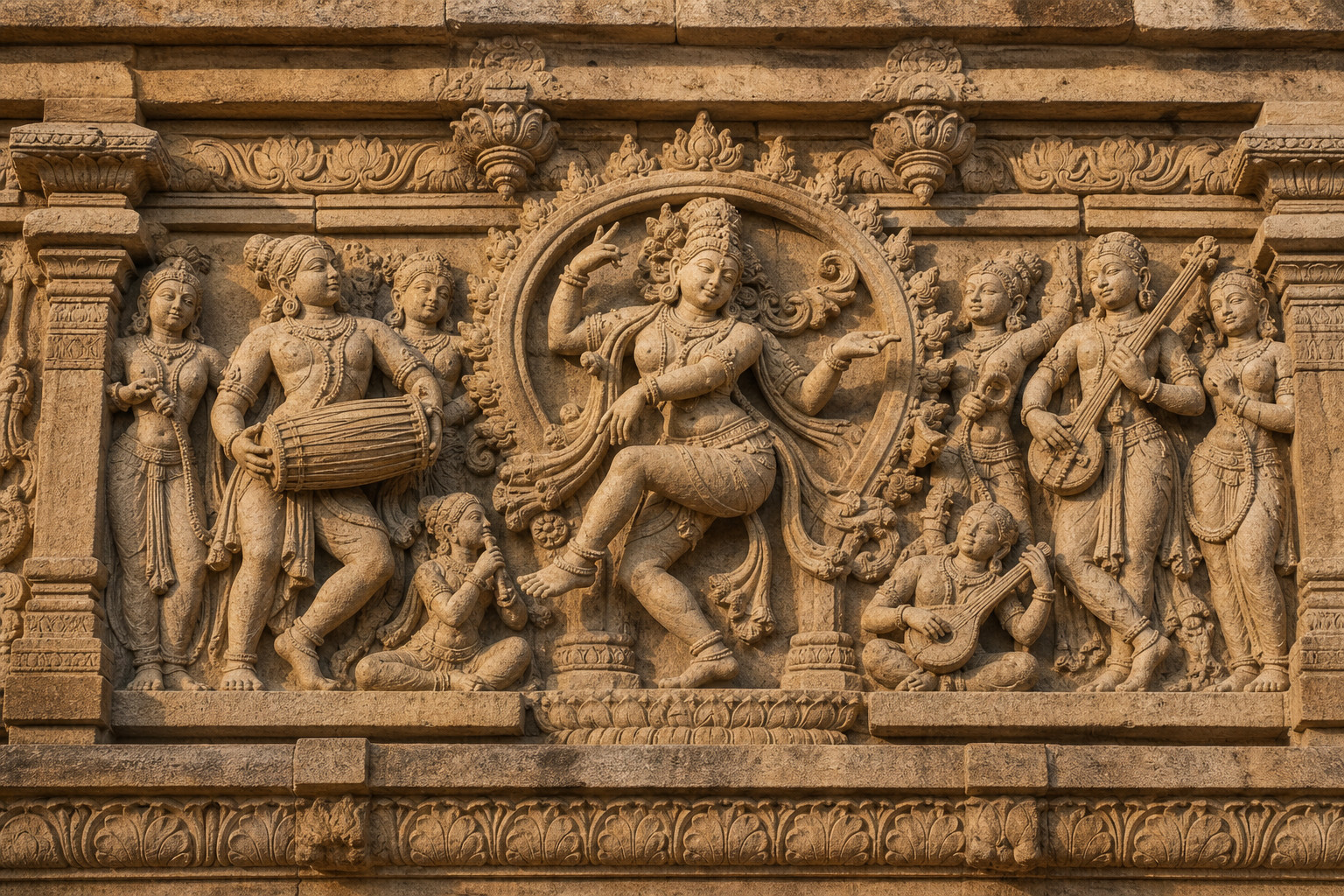
A symbol in temple sculpture does not function like an isolated word in a dictionary. Its meaning develops through relationships: who plays the drum, who responds to it, how bodies move, and where the scene appears within the temple’s visual programme.
- Describe the object without interpreting it. Note its outline, two ends, orientation, condition, and contact with the player’s hands.
- Study the player. Ask whether the posture suggests concentrated performance, vigorous movement, accompaniment, procession, or still attendance.
- Follow the implied beat. Look for bent knees, turned torsos, lifted arms, repeated poses, or flowing garments that make nearby bodies seem responsive to rhythm.
- Identify the company. A dancer, divine figure, attendant, or group of musicians changes the range of plausible meanings.
- Examine the architectural location. A drum in a narrative panel, a band of performers, or a prominent sacred composition should not automatically receive the same interpretation.
Keep observation and interpretation separate in your notes. Write, for example, “a double-headed drum beside a turning figure” before writing “rhythm animates the dance.” The first statement records visible evidence. The second explains it. This simple discipline makes your reading clearer and prevents an attractive idea from disguising a weak identification.
Context also controls how far you can go. The presence of a mridanga supports a reading involving music, measured rhythm, or animated performance. A claim about a particular deity, episode, doctrine, or ritual requires additional evidence from attributes, gestures, adjacent figures, inscriptions, or the temple’s established tradition. The instrument alone cannot carry all of that weight.
What the mridanga can communicate in sacred stone
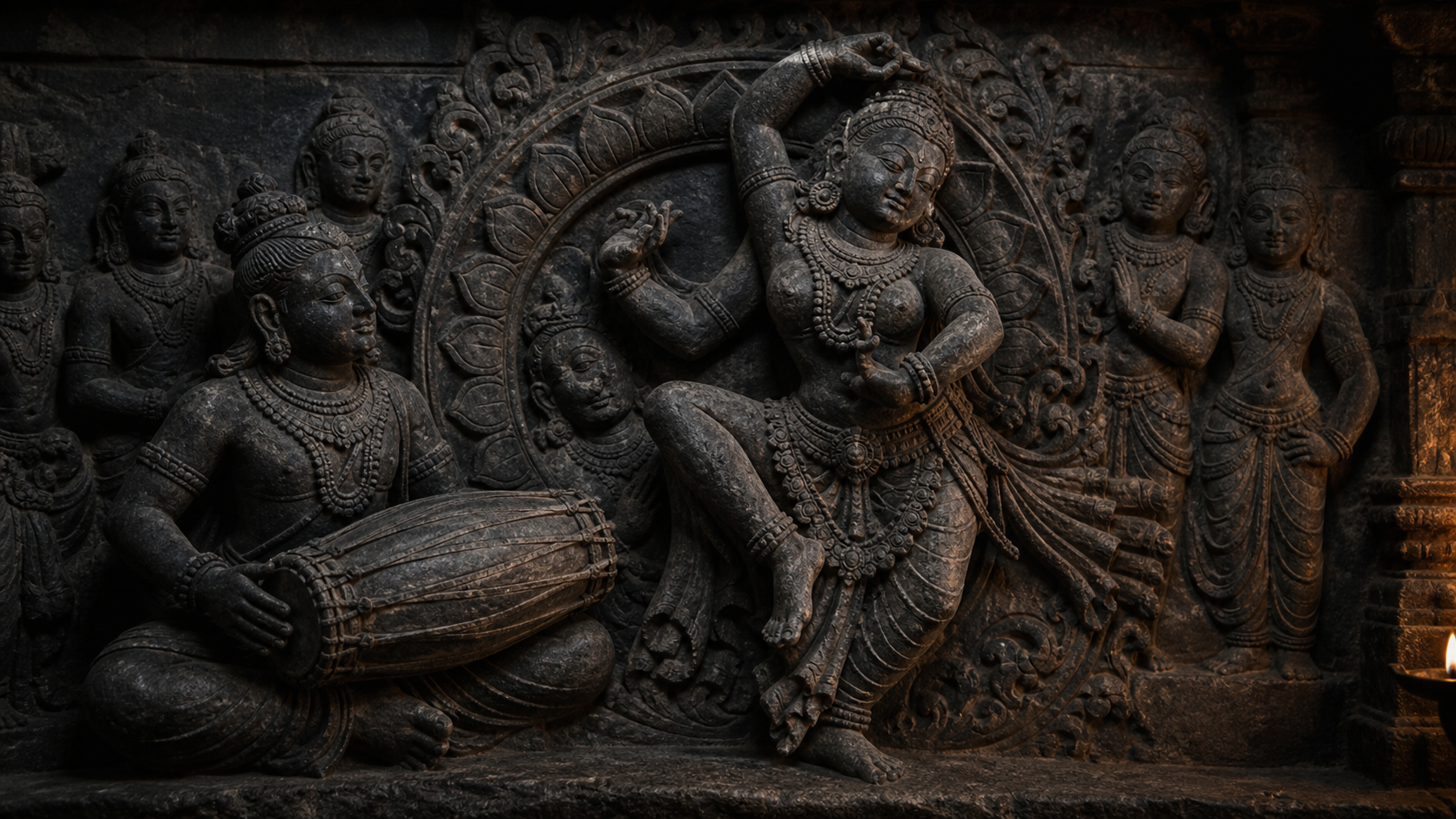
The mridanga’s symbolism begins in its actual function. A drum produces patterned sound through repeated strikes. Sculpture translates that function into visible form. The resulting meanings are connected, but they are not interchangeable; the composition tells you which layer deserves emphasis.
Rhythm turns movement into order
A beat does more than make noise. It measures movement, coordinates performers, and gives repeated action a recognisable pattern. In sculpture, the mridanga can therefore signify ordered energy rather than motion without direction. When surrounding bodies appear to dance or respond, the drum helps you understand their movement as structured and purposeful.
This is the strongest route from musical rhythm to cosmic meaning. The instrument can evoke the pulse within a sacred dance: activity is abundant, yet not chaotic. Read that layer when the larger composition supports it. A solitary musician in an ordinary ensemble does not automatically require a cosmic explanation.
The silent carving asks you to imagine sound
A stone drum cannot be heard, but its carved shape activates your memory of sound. The image reaches beyond what the material can physically produce. You do not merely see an object; you mentally supply the beat, and that imagined beat makes static figures feel present and alive.
Notice how this changes your viewing. Instead of treating the panel as a collection of frozen bodies, ask where the next beat would fall and which figure seems ready to answer it. That question can reveal visual relationships that remain invisible when you examine attributes one by one.
Two sounding ends belong to one body
The double-headed construction offers a natural image of relation: two distinct sounding surfaces are held within one instrument. In an appropriate composition, this can suggest complementarity, alternating forces, balance, or multiplicity sustained by an underlying unity.
Treat this as an interpretive possibility, not a universal code. Two drumheads do not by themselves prove that the sculptor intended a particular pair of philosophical opposites. Look for reinforcement in paired figures, bilateral organisation, alternating gestures, or another visible pattern. Without such support, the safest meaning remains the practical one: the instrument generates rhythm through two ends of one resonating form.
Performance can become participation in the sacred
A musician inside a temple composition need not be dismissed as background entertainment. The player contributes bodily discipline, attention, and sound to the sacred scene. Music becomes an action performed in relation to the divine, while the musician becomes a participant rather than a passive spectator.
This layer is especially useful when the carving includes an ensemble, attendants, dancers, or a central sacred presence. Ask what the musician is doing for the composition. The mridanga may establish tempo, gather separate bodies into one event, or mark performance itself as a mode of devotion. The answer should come from the arrangement you can see, not from a predetermined claim that every musician represents the same idea.
Avoid the shortcuts that produce weak interpretations
Mridanga symbolism is rich enough without assigning every possible doctrine to every carving. Four common shortcuts cause most misreadings.
- Do not call every drum a mridanga. Confirm the double-headed form and fuller central body first.
- Do not call every sacred drum a damaru. The damaru’s narrow waist and the mridanga’s swelling centre point to different instrument forms.
- Do not assume that a mridanga identifies one deity or one narrative. The neighbouring figures and their attributes must establish that connection.
- Do not force the two heads into a fixed formula of opposites. A symbolic reading needs compositional support beyond the instrument’s construction.
- Do not reduce the musician to decorative filler. Even when no theological meaning can be proved, the figure may organise movement, direct attention, and make the scene intelligible as performance.
The better approach is layered. Begin with the literal object, move to its musical function, then consider its role in the composition, and only after that ask about philosophical or cosmic resonance. Each layer should rest on the one beneath it. If the evidence stops at musical accompaniment, let the interpretation stop there.
This restraint does not make the image less sacred. It respects the intelligence of Hindu temple art, where ordinary forms can carry several meanings without ceasing to be recognisable parts of lived culture. The drum can be an instrument, a maker of rhythm, a source of visual movement, and an emblem of ordered sacred energy all at once.
Questions to ask when you encounter a carved mridanga
What does a mridanga usually symbolize in temple sculpture?
Its most defensible symbolic field includes rhythm, measured movement, animated sacred performance, and the ordering of energy. In a dance-centred composition, those meanings may widen into the pulse of cosmic activity. The surrounding scene determines how strongly you should make that final connection.
Does every mridanga represent cosmic dance?
No. Some depictions may primarily show musicianship, accompaniment, celebration, or participation in a sacred event. Cosmic significance becomes persuasive when the drum works with dancing figures, a central divine presence, repeated movement, or other evidence of a deliberately ordered universe.
How can you distinguish a mridanga from a damaru?
Compare the middle of the instrument. A mridanga has a substantial barrel-like body that is fuller around the centre and tapers toward two outer heads. A damaru has an hourglass form that contracts into a narrow central waist. When damage obscures that distinction, use the hands, scale, and surrounding composition as secondary clues and keep your conclusion provisional.
What should you record when photographing one?
Take one image of the entire panel, one of the instrument and player’s hands, and one that shows the panel’s architectural location. A close-up alone may prove the drum’s shape but erase the context needed to interpret it. Record visible damage as well; a missing hand or broken end can explain why an identification remains uncertain.
At the next temple carving you examine, give yourself half a minute before naming its meaning. Trace the drum’s outline, follow the player’s hands, scan the neighbouring bodies, and note the panel’s location. Once those observations agree, you can read the mridanga not as a detachable symbol but as the beat that helps the whole composition move.
References
