
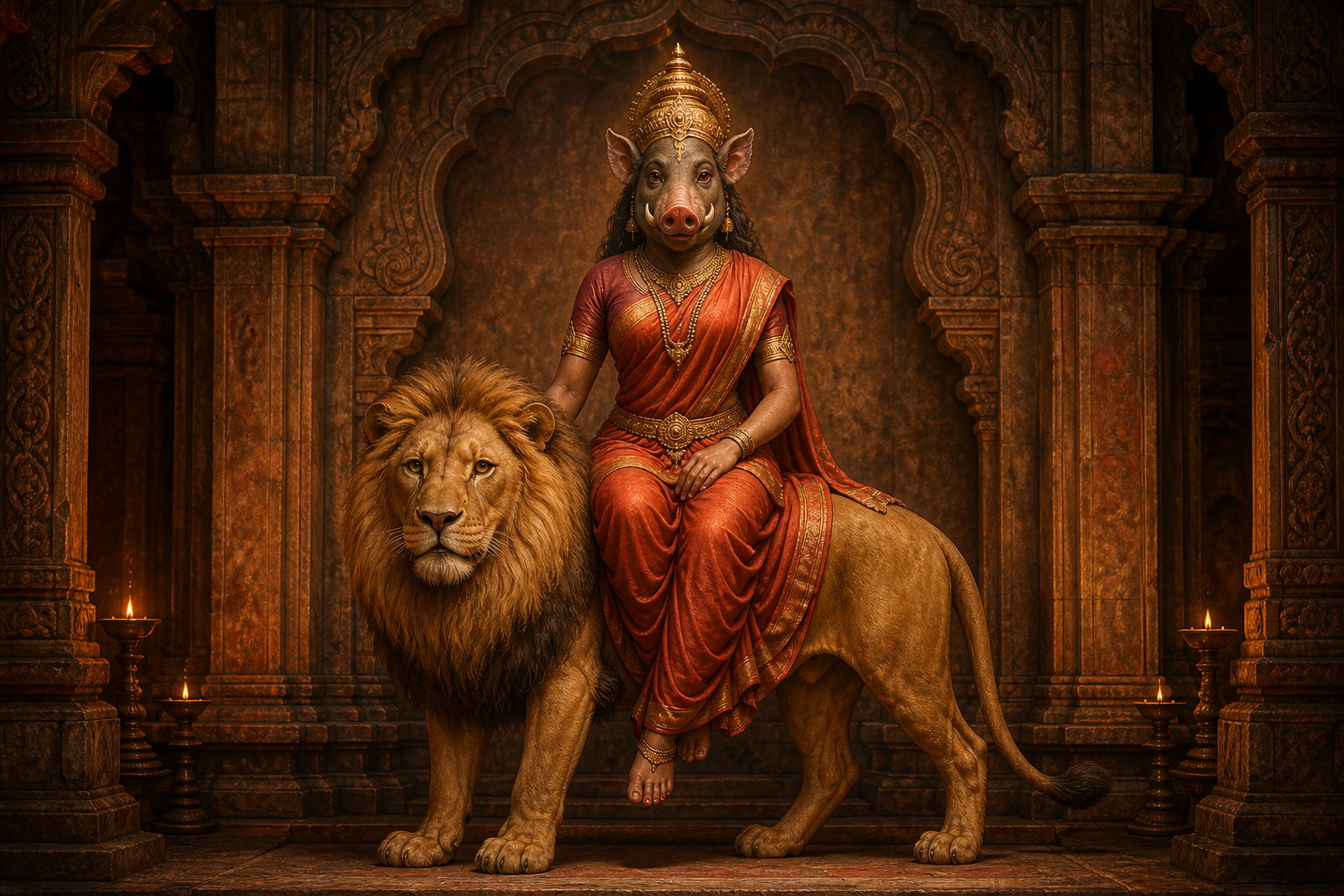
You have found a boar-faced goddess seated on a lion, perhaps in a shrine photograph, sculpture, or devotional print. You want to know whether she is Simha Varahi and what the unusual image means. Begin with the conjunction of features, not the most dramatic feature by itself.
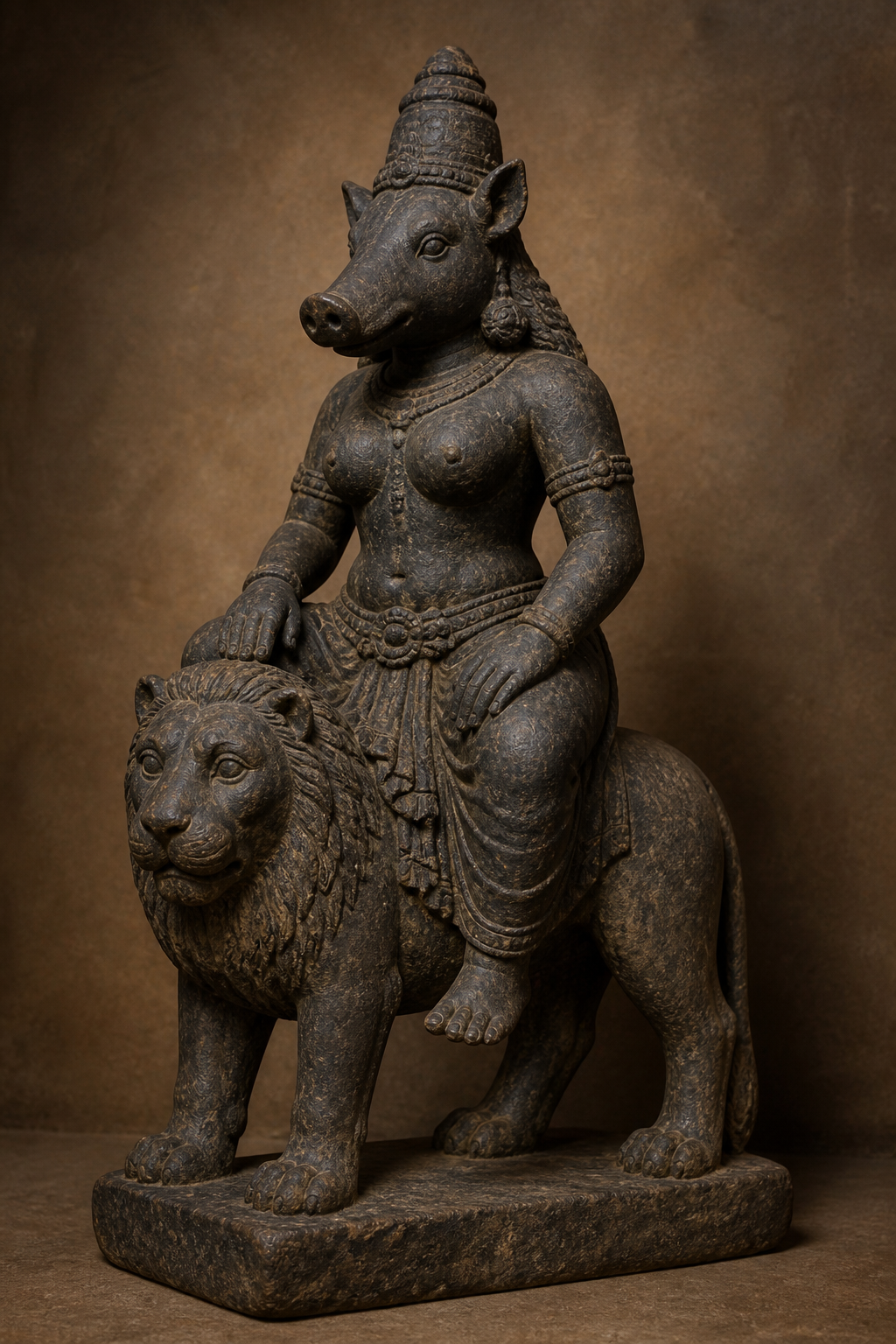
The sound identification is this: Simha Varahi is a rare form of Varahi in which the boar-faced Divine Mother is seated upon a lion. Recognizing her correctly requires you to distinguish the deity’s face, her theological identity, and her vehicle. That approach prevents you from mistaking every lion-mounted goddess for Varahi or rejecting a genuine Varahi image simply because you expected a different mount.
Read the image in three layers
Hindu iconography works through combinations. A face, vehicle, posture, surrounding group, and local name can each contribute to an identification. No isolated feature should carry more weight than it can bear.
- Identify the face. Look first for the distinctly boar-like face or snout associated with Varahi. A lion below the figure cannot establish her identity if this defining feature is absent or impossible to see.
- Identify the vehicle. Determine whether the lion is actually supporting the goddess as her seat or mount. A nearby lion might instead be a decorative, narrative, or attendant element.
- Check the context. A label, temple tradition, surrounding Matrika group, or documented provenance can confirm what the visible attributes suggest. Preserve the local name rather than replacing it with a more familiar one.
The crucial distinction is between rider and vehicle. Simha Varahi remains boar-faced; she is not a lion-faced goddess. The lion belongs beneath her as the identifying vehicle of this particular form. If the face is unclear, use a cautious label rather than a confident declaration.
A concise working description is therefore: a boar-faced form of Varahi seated on a lion. Details such as the number of arms, weapons, colours, ornaments, or hand gestures should not be supplied from memory when the individual image does not display them clearly.
What the lion changes, and what it does not
Varahi is more commonly represented with a buffalo or serpent, whereas Simha Varahi is the rare form seated upon a lion. The vehicle is therefore not an incidental flourish. It is the visual feature that marks this uncommon variation once the goddess has already been identified as Varahi.
The lion intensifies the image’s language of fierceness, command, and active power. That is a responsible iconographic reading, not a claim that every community gives the lion one fixed doctrinal meaning. A temple lineage or regional tradition may preserve a more specific explanation, and that explanation should govern how you describe the image in its own setting.
Just as important, the new vehicle does not erase Varahi’s identity. The boar face continues to connect the goddess with Varaha. You should therefore read the composition as two ideas held together: the Varaha-derived identity carried by the face and the forceful mode signalled by the lion.
This also gives you a useful rule when viewing modern artwork. If the artist has enlarged the lion, softened the boar features, or placed the goddess in a crowded scene, do not let visual prominence decide the name. Ask which element identifies the deity and which element qualifies her form.
Varahi’s place among the Seven Divine Mothers
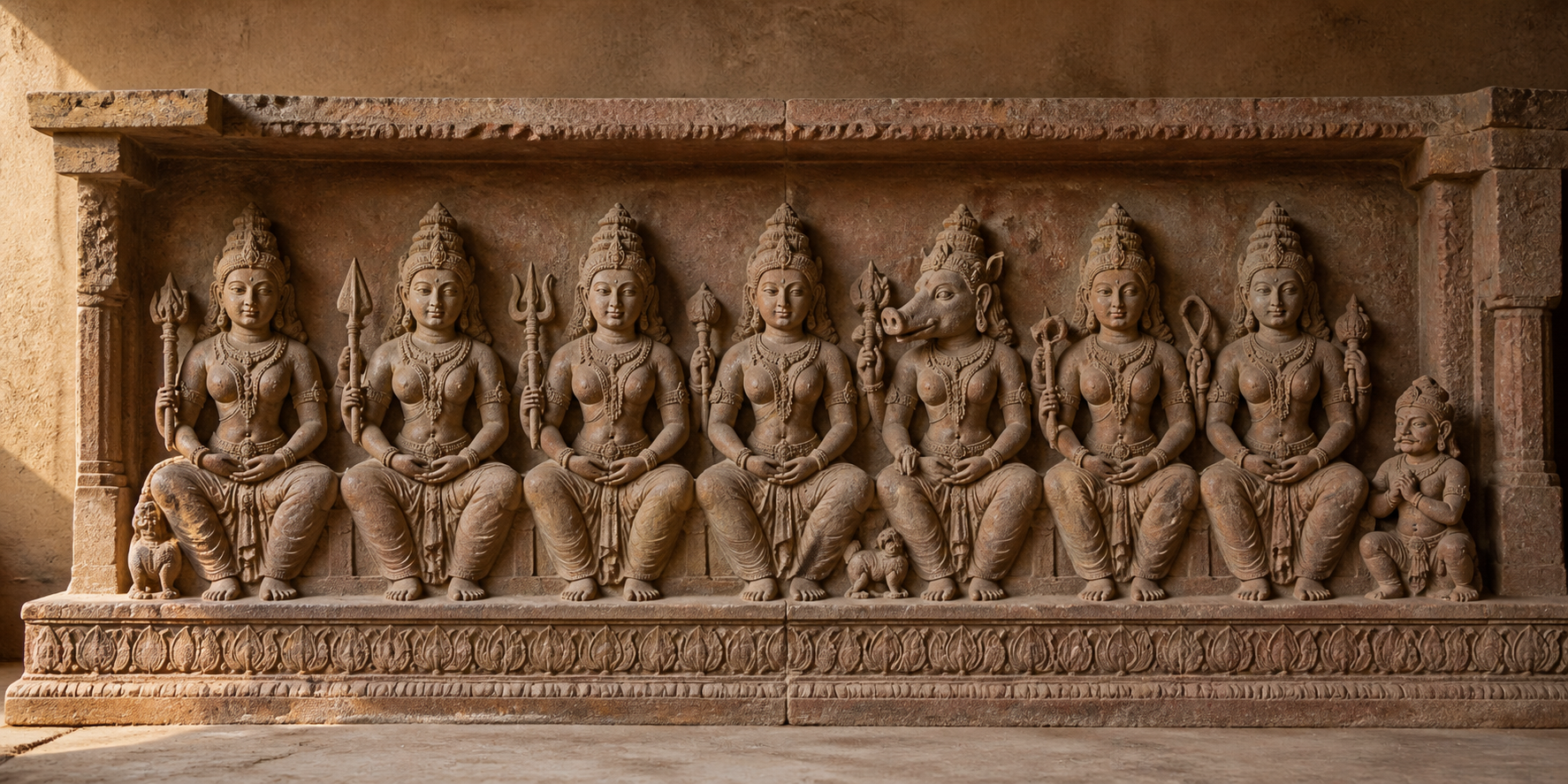
Varahi is one of the Sapta Matrikas, the Seven Divine Mothers. She is understood as the shakti, or feminine energy, of Varaha, the boar incarnation of Bhagavan Vishnu. These two relationships explain more than the lion alone can explain.
- The Sapta Matrika relationship places Varahi within a collective manifestation of divine maternal powers.
- The Varaha relationship explains why her boar face is essential rather than merely animal ornamentation.
- The Simha variation tells you how this particular image presents Varahi: not through her more usual vehicle, but upon a lion.
Here, shakti should be read as an active feminine manifestation of divine power. Calling Varahi merely a decorative female version of Varaha misses her identity as a Divine Mother. At the other extreme, treating the lion-mounted form as unrelated to Varaha also discards the theological meaning of the boar face.
Keep all three names in view when explaining the image to someone else: Varahi identifies the goddess, Sapta Matrika identifies her wider divine company, and Simha identifies the special lion-mounted form. This vocabulary is more precise than describing her vaguely as a lion goddess or boar goddess.
How to verify, caption, and approach an unfamiliar image
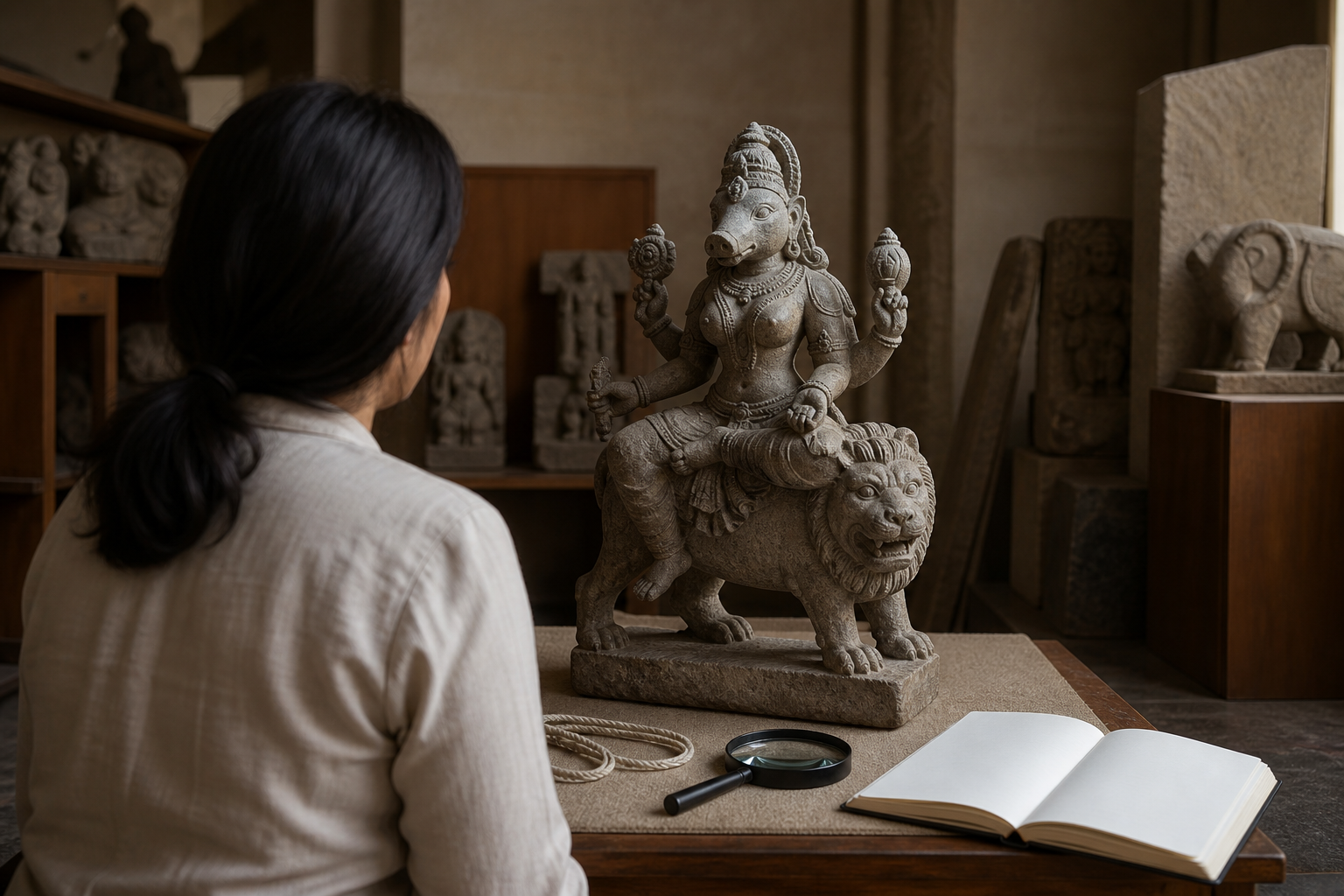
Because Simha Varahi is rare and lesser known, an online caption should be treated as a lead rather than conclusive proof. You can make a careful identification without pretending that the visible image answers every ritual or historical question.
- Record where the image came from. Note the temple, collection, publication, original webpage, or artist. A cropped repost can remove the context needed for a reliable identification.
- Inspect the face before the mount. Confirm that the facial form is boar-like. If the photograph is too small or damaged, state that limitation.
- Confirm the lion’s role. Look for the goddess seated directly upon it rather than merely standing near a lion motif.
- Look for Matrika context. If the image belongs to a group of Divine Mothers, that setting strengthens the Varahi identification. Record the group without assuming that every individual figure follows one universal design.
- Ask for the local name. In a living temple, the name used by the custodians and worshipping community matters more than a generic internet checklist.
- Separate recognition from ritual instruction. A visible boar face and lion may support an iconographic identification, but they do not reveal a mantra, initiation, festival observance, or complete worship procedure.
If provenance is secure, a clear caption would be: Simha Varahi, the rare lion-mounted form of Varahi, one of the Sapta Matrikas and the shakti of Varaha.
If provenance is uncertain, change the opening to: Likely Simha Varahi, identified by the combination of a boar-faced goddess and a lion vehicle. The word “likely” is useful honesty, especially when a modern artist has altered conventional details or the original label has been lost.
For worship in a temple, follow that temple’s established practice. For a home image, do not manufacture specialised rites from iconography alone. The respectful next step is to seek guidance from the tradition that supplied the image, particularly before adopting a specific mantra or formal practice.
Key takeaways
- Simha Varahi is identified by a combination: Varahi’s boar face and a lion serving as her seat or vehicle.
- The lion marks a rare form because Varahi is more commonly associated with a buffalo or serpent.
- Varahi belongs to the Sapta Matrikas and is understood as the feminine energy of Varaha, Bhagavan Vishnu’s boar incarnation.
- The lion modifies the presentation of Varahi; it does not replace her Varaha-derived identity.
- An image can support a name, but it cannot by itself supply a complete ritual tradition. Use local provenance for ritual and temple-specific claims.
If you are examining an image now, establish the face, vehicle, and context in that order. Give it a cautious caption when evidence is incomplete, preserve the name used by its living tradition, and take ritual questions to that tradition’s custodians. That is the simplest way to combine accuracy with reverence.
References
