
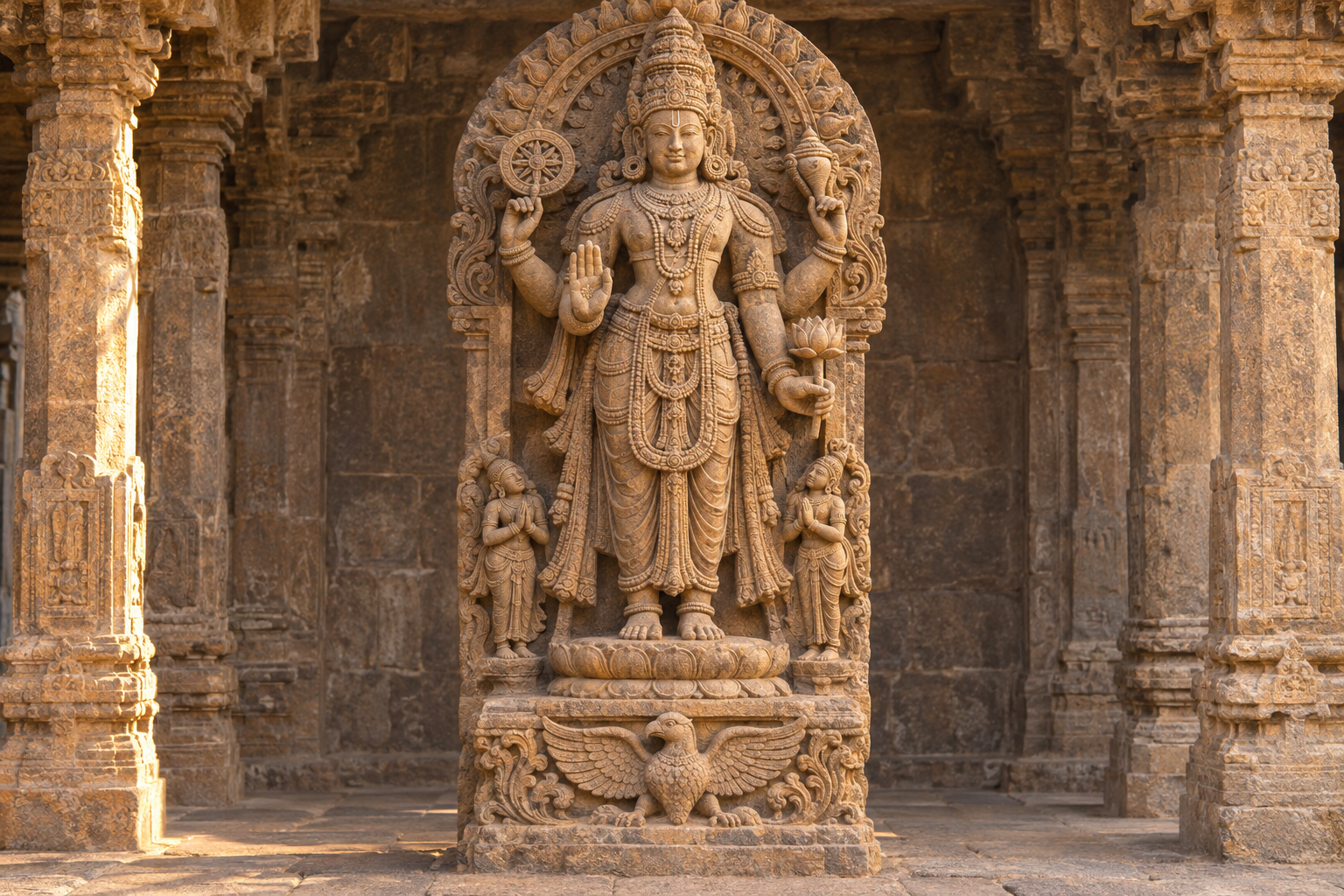
You may recognize a sacred figure yet still hesitate over what you are seeing. Is the tall headpiece a crown or arranged hair? Does a lotus identify the deity, specify a particular form, or simply belong to the larger composition? That hesitation is useful. A confident identification built on one conspicuous feature is often weaker than a careful reading of the entire image.
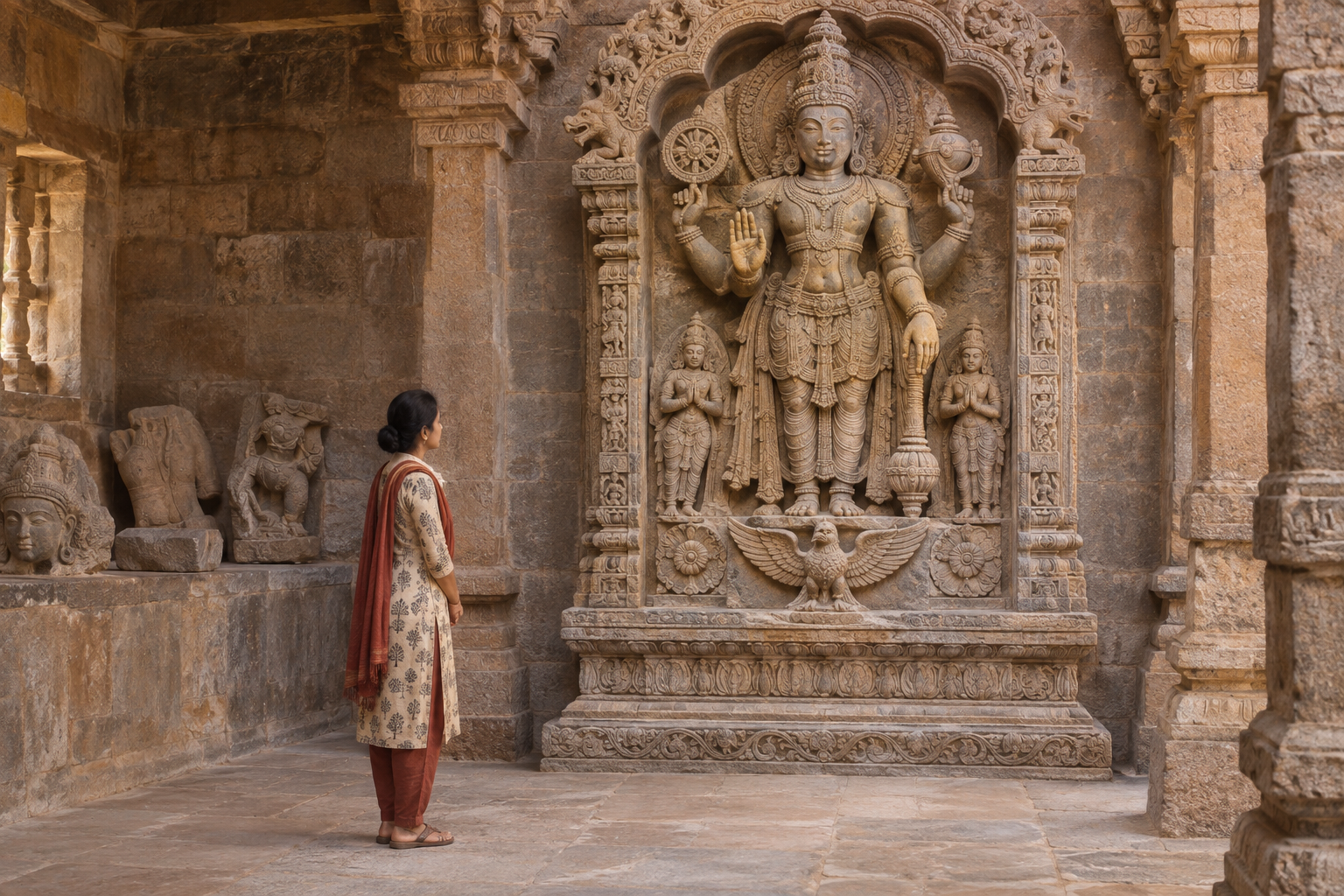
If you are visiting a temple, captioning a photograph, or cataloguing a sculpture, use the same sequence each time: describe the figure, classify the regalia, test the attributes, check the setting, and state how certain you are. This turns iconography from guesswork into disciplined observation.
Begin with the whole figure, not its finest ornament
Iconography is a visual language. Regalia is part of that language, but it does not speak alone. A crown may convey sovereignty or celestial dignity without uniquely naming its wearer. A lotus may carry a theological association without proving an exact manifestation. Begin by recording the complete cluster of evidence.
- Setting: Note the temple, shrine, niche, sanctum, museum gallery, or architectural position. Record the local name separately from your visual interpretation.
- Form: Count visible faces and arms. Record whether the figure stands, sits, or reclines, and whether damage makes any feature uncertain.
- Hands and attributes: Examine every hand individually. Distinguish a held object from a hand gesture, and distinguish both from decoration behind the figure.
- Head and hair: Trace the silhouette from its base to its summit. Ask whether you see a crown constructed as regalia or a form constructed from hair.
- Adornments: Record necklaces, girdles, sacred threads, garments, and other ornaments without assuming that every decorative element identifies the deity.
- Surrounding figures: Note attendants, consorts, vehicles, pedestal forms, and neighboring images. Their relationship to the central figure can be more informative than an isolated jewel.
Description should come before identification. Write tall, cylindrical headpiece with nearly parallel sides before writing Kirita Makuta. Write lotus held in the upper hand before assigning a theological meaning. This order preserves what you actually saw and makes it easier to revise an interpretation without revising the evidence.
At a living temple, the community’s name for the murti deserves to be recorded as living tradition, not treated as an obstacle to classification. Keep that name and your formal description in separate fields until you know how they relate. In a museum, copy the label exactly, but do not let a label prevent you from inspecting the sculpture for yourself.
Read the crown by silhouette before reading its decoration
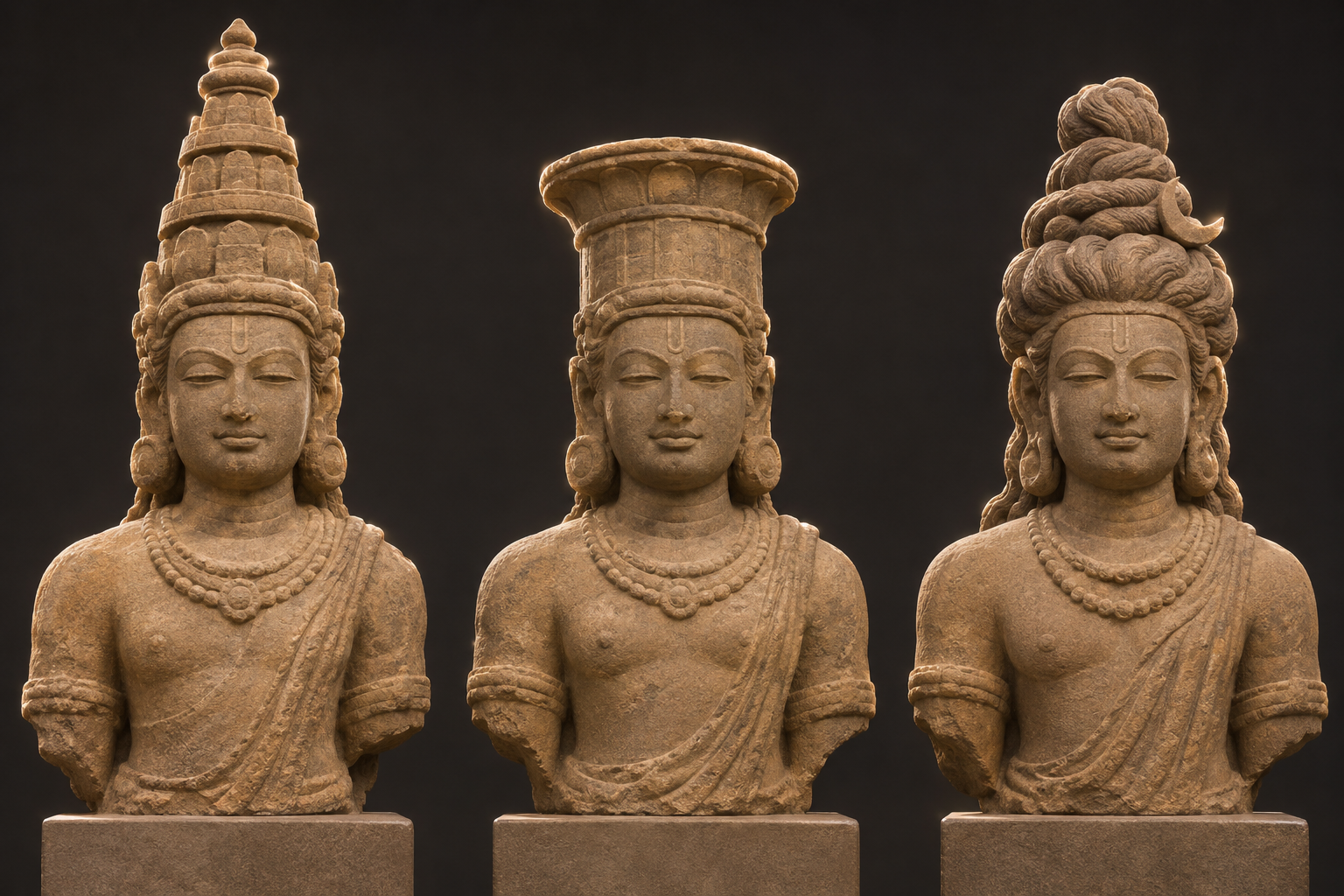
Jewels, bands, and carved patterns can vary, become worn, or disappear under later adornment. The overall construction is therefore the better place to begin. A Kirita Makuta rises in a predominantly vertical, cylindrical form with little taper. Its upright profile distinguishes it from a narrowing, tiered Karanda Makuta and from a Jata Makuta formed through an arrangement of hair.
| Crown form | First visual cue | Question to ask |
|---|---|---|
| Kirita Makuta | Tall cylindrical body; sides rise with minimal taper | Do the sides remain substantially upright rather than narrowing through stacked levels? |
| Karanda Makuta | Tiered, conical construction | Can you see successive levels becoming narrower toward the summit? |
| Jata Makuta | Head form built from hair rather than a conventional crown body | Does the surface behave like arranged hair, and does an ascetic or Shaiva context support that reading? |
Work from the base upward. Locate the point where the headpiece begins, follow both outer edges, note any visible tiers, and then inspect the summit. If the sides stay almost parallel, Kirita Makuta is a reasonable candidate. If they narrow through distinct stages, test Karanda Makuta. If the mass is visibly hair-based, test Jata Makuta and then look for supporting ascetic or Shaiva context.
Use the word candidate until the entire sculpture supports the classification. A frontal photograph can flatten tiers, while erosion can make a conical crown look cylindrical. If access permits, examine the figure from more than one angle. When that is impossible, state the limitation instead of filling the missing view with certainty.
Once you have classified the form, ask a second question: what is the regalia doing within this particular composition? The Kirita Makuta carries an idiom of celestial sovereignty and dignity, but that meaning is not the same as personal identity. Record crown type under form and sovereign character under interpretation. Keeping those two levels separate prevents a general symbol of rank from becoming a false name tag.
Padma Lakshmi shows why one attribute is never enough
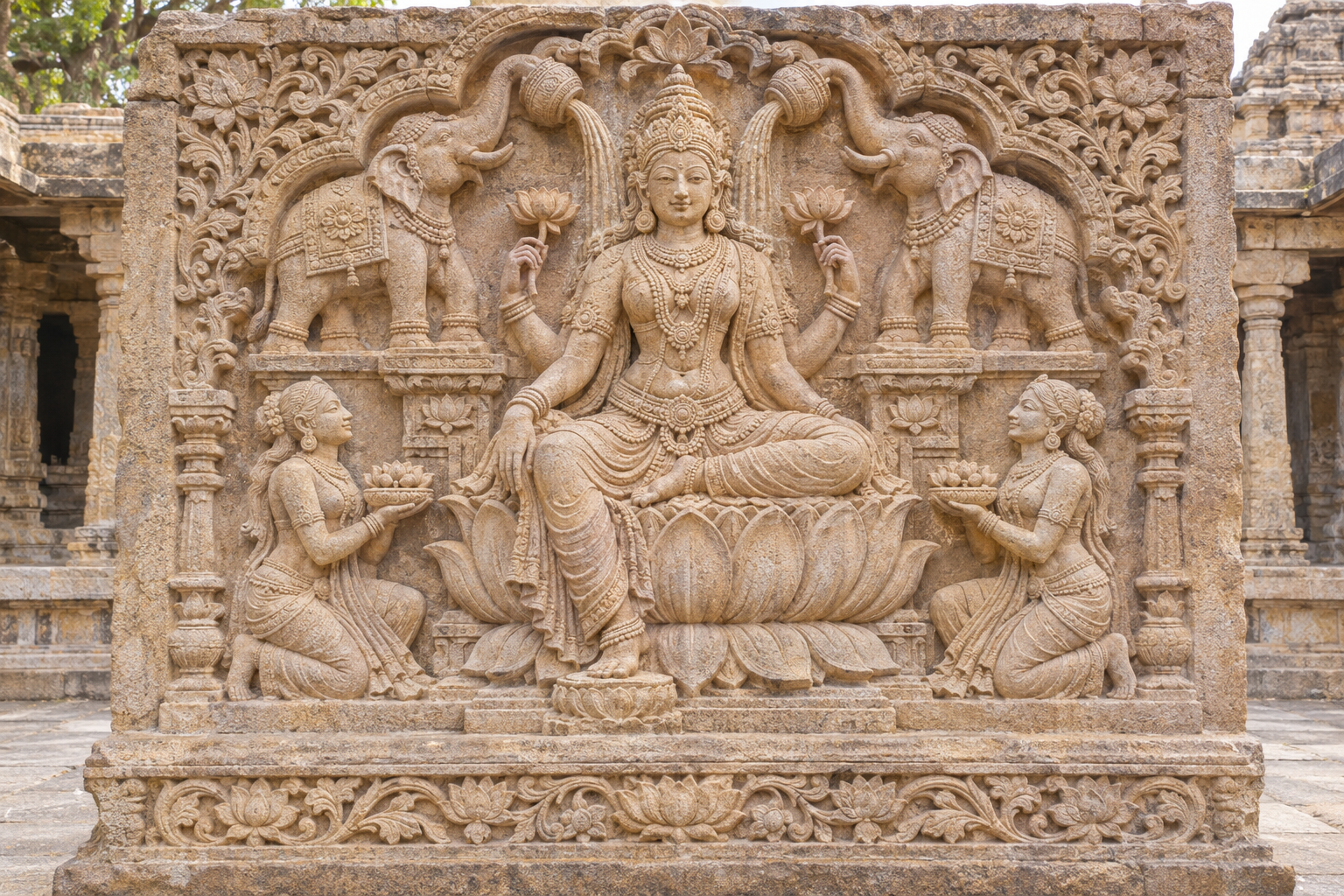
Padma Lakshmi is a gracious and benevolent manifestation of Lakshmi associated with prosperity, abundance, and auspiciousness. The lotus association directs your attention, but it does not remove the need to identify Lakshmi or establish the particular form through the rest of the image.
This case requires special care because references to Padma Lakshmi in Shilpa Shastra and Agamic materials are comparatively brief. The surviving picture depends on limited textual descriptions read alongside temple manifestations. A short textual profile is not permission to supply missing details from imagination.
- Establish the broad identity first. Look for independent evidence that the figure is Lakshmi: the shrine’s received identification, an inscription, a reliable catalogue entry, or a coherent cluster of iconographic features.
- Locate the lotus precisely. Record whether it is held, used as a support, placed nearby, or incorporated into decoration. These are not interchangeable observations.
- Separate identity from emphasis. A lotus can strengthen a Padma association without, by itself, establishing Padma Lakshmi as the exact form.
- Record regalia independently. Classify the crown and ornaments on their own visual evidence. Do not assume that a Kirita Makuta is an exclusive badge of Padma Lakshmi.
- Match your wording to your evidence. Use a firm identification only when context and visible features converge; use qualified language when they do not.
Your caption can make the level of certainty transparent. Write locally worshipped as Padma Lakshmi when you are reporting a living identification. Write consistent with Padma Lakshmi when the image fits but lacks decisive confirmation. Write Lakshmi, possibly in a Padma form when damage or incomplete context leaves the specific manifestation unresolved. These phrases preserve useful information instead of disguising uncertainty.
A crown and lotus do not produce an identity by arithmetic. The crown may support a reading of sovereign divinity; the lotus may support a Padma association. The exact name still depends on the whole figure, its setting, and any reliable identification attached to it.
Use a field checklist that survives damage and incomplete views
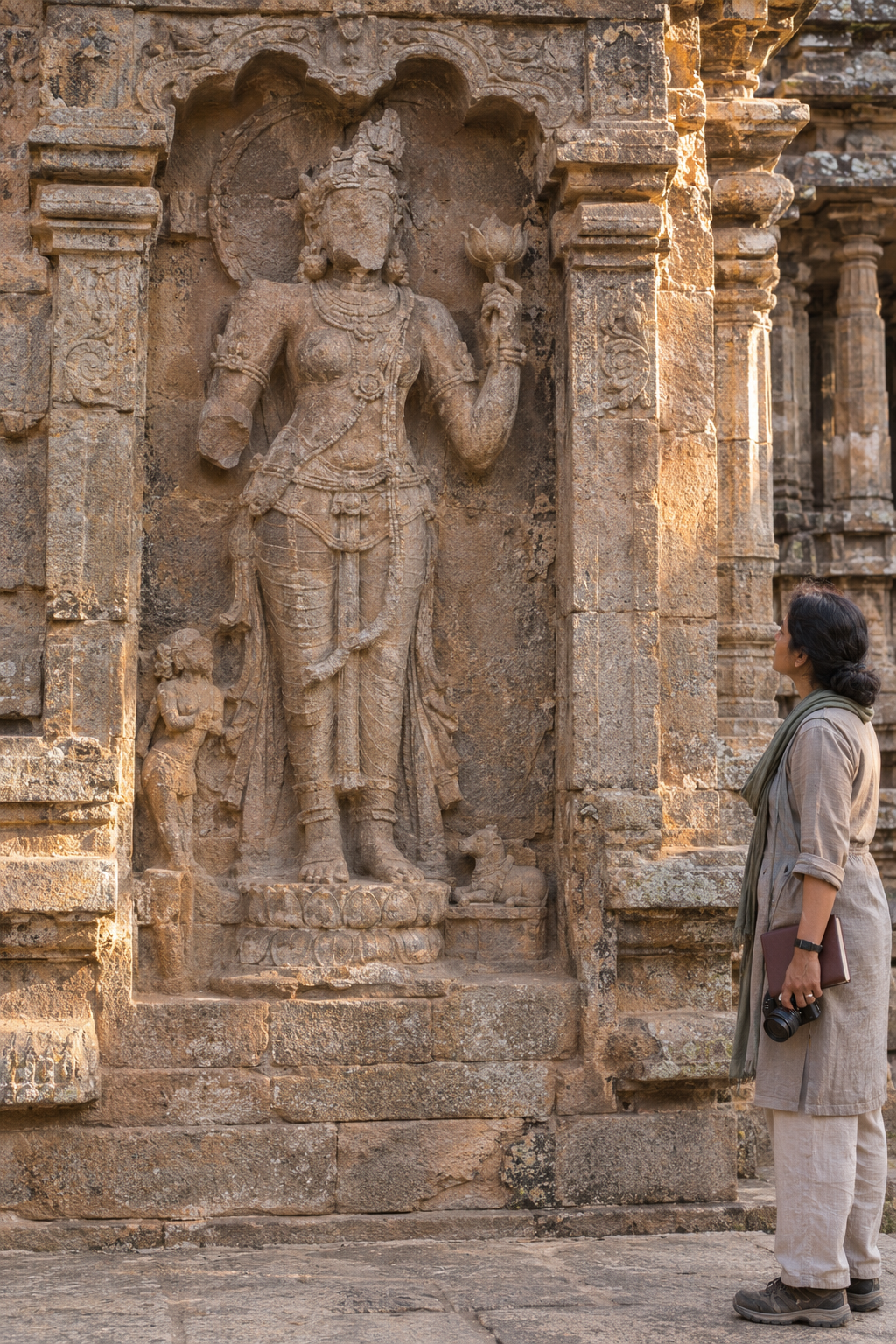
Temple sculptures are not always available under ideal viewing conditions. A hand may be broken, a crown partially covered, or the pedestal hidden. Your method should show which evidence is absent and which is merely inaccessible.
- Respect the site first. Follow the temple’s rules on access and photography. If photography is prohibited, make written observations rather than attempting a concealed image.
- Record the exact location. Include the temple or collection, the specific shrine or architectural position, and the direction the figure faces if you can determine it.
- Make a neutral inventory. Record posture, visible arms and faces, hand positions, objects, headgear, ornaments, pedestal, attendants, and surrounding figures.
- Mark damaged or obscured areas. Do not treat a broken hand as evidence that an attribute was never present. Do not classify an obscured crown summit as flat.
- Classify the headgear by construction. Test cylindrical and minimally tapering Kirita, tiered and conical Karanda, and hair-based Jata as distinct possibilities.
- Test the proposed identity against every visible feature. If your conclusion depends entirely on one lotus, one crown, or one museum label, keep looking.
- Attach a confidence level. Use confirmed, probable, possible, or unidentified, and write one sentence explaining what additional evidence would change the result.
A useful note can be compact: location; local identification; posture; visible arms and attributes; crown construction; lotus position; damage; associated figures; proposed identification; confidence; evidence still needed. This format gives another reader enough information to evaluate your conclusion instead of merely accepting it.
When comparing photographs, compare like with like. A frontal view should not be used to deny tiers visible only from the side, and a heavily restored image should not silently supply features missing from an older sculpture. Treat restoration, lighting, garlands, metal coverings, and photographic angle as conditions of observation, not as features of the original iconography.
Key takeaways for your next temple visit
- Describe visible form before assigning a traditional name.
- Read iconographic identity from a cluster of attributes, posture, setting, and associated figures rather than from one object.
- Distinguish the upright, minimally tapering Kirita Makuta from the tiered Karanda Makuta and the hair-based Jata Makuta.
- Treat a lotus as meaningful evidence, but not as automatic proof of Padma Lakshmi.
- Record local identification, formal classification, symbolic interpretation, and confidence as separate pieces of information.
- State what damage or restricted access prevents you from knowing.
On your next visit, choose one murti and spend five minutes describing it without naming it. Then test one identification against every detail you recorded. That small discipline will teach you more than memorizing a list of isolated symbols, and it will let you speak about sacred sculpture with both precision and humility.
References

Leave a Reply
You must be logged in to post a comment.