
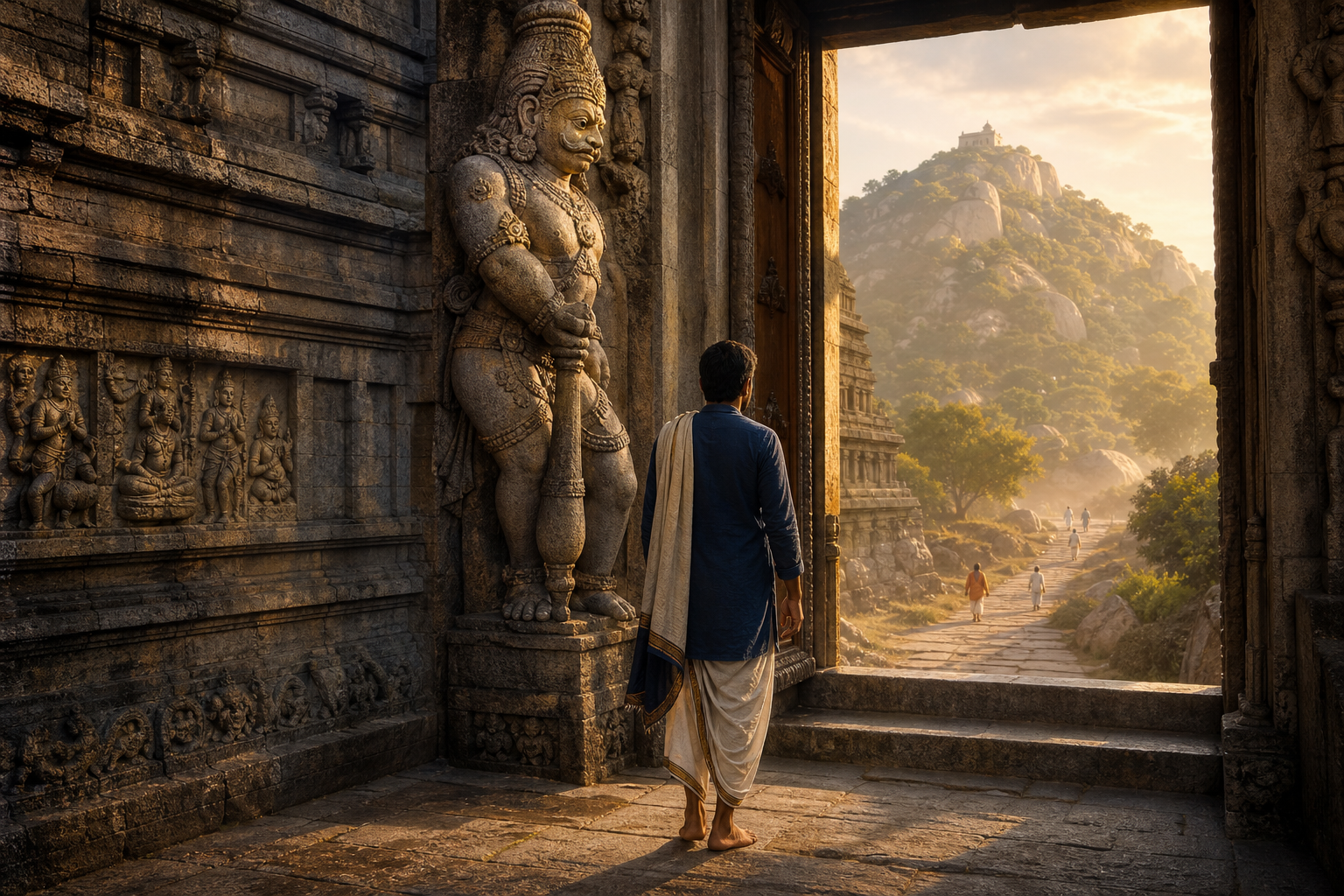
You can walk through a Hindu temple, see a fierce face above the entrance, hear a many-layered myth, climb a sacred hill, and still leave unsure what you were meant to understand. The problem is usually not a lack of facts. It is treating each image, story, and ritual act as an isolated object.
If you are preparing for a temple visit, or trying to make sense of one afterward, use three connected lenses. A symbol marks a place in your journey. A myth dramatizes a conflict within consciousness and conduct. A pilgrimage turns the teaching into something your body must enact. Reading all three together changes a temple from a collection of unfamiliar forms into a disciplined path of attention.
Begin with placement, conflict, and response
In a Hindu temple, meaning is rarely carried by shape alone. Placement matters. A fierce face over a gateway is doing different work from a deity established in the sanctum. A carving along a procession route prepares movement, while an image above a doorway governs a crossing. Before asking, “Who is this?” ask, “Why is this here?”
The same discipline applies to myth. Do not begin by deciding whether every event must be read as literal history or whether every character is merely an abstract psychological symbol. First locate the tension. What power is present? Where does that power lose balance? What restores dharma? What response is expected from the listener?
Pilgrimage adds a third question: what must you actually do? A hill must be approached, a threshold crossed, a burden carried, a vow remembered, or a distraction relinquished. Physical movement does not automatically produce transformation, but it gives the teaching a form that thought alone cannot supply.
This yields a dependable reading method. Observe where the form appears. Identify the conflict expressed through its associated narrative. Then choose the mental, ethical, or devotional response appropriate to that place. Symbol, myth, and practice become one movement rather than three unrelated subjects.
Read the guardian before you cross the threshold
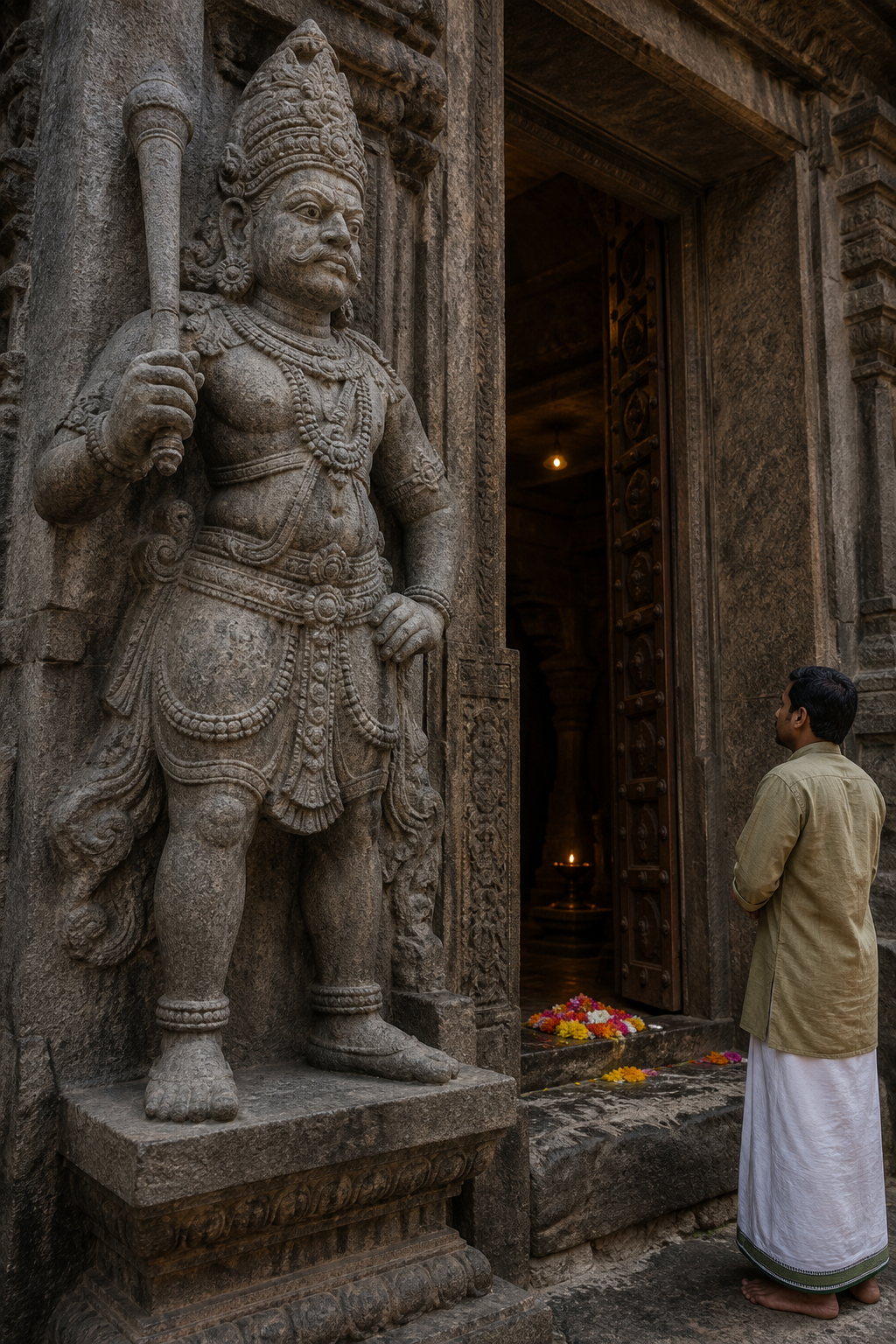
One of the clearest demonstrations of this method is the fierce guardian face found on temple entrances and architectural bands. It may have prominent eyes, an open mouth, and a protruding tongue. Vajramukha is one name used for forms in this guardian family, and it is frequently identified with the more widely attested Kirtimukha. Local terminology and iconographic details can vary, so resemblance should not be mistaken for complete identity in every region.
The associated Shaiva narrative explains why the face belongs at a threshold. Shiva manifests a ravenous being in response to a boastful challenger. After the challenger submits, the still-hungry creature is commanded to consume its own body. It obeys until only its head remains. Shiva then blesses the surviving head and establishes it as Kirtimukha, a guardian placed above sacred entrances.
The frightening appearance therefore does not make the figure an embodiment of evil. Its function is protective and purifying. The wide eyes suggest unbroken vigilance. The devouring mouth recalls the consumption of pride, disorder, and negativity. The tongue intensifies its liminal character: this is a power stationed where one kind of space ends and another begins.
Its location turns the myth into an instruction. You are about to seek darshana, but you should not carry every ordinary impulse into the sanctified space. Arrogance, agitation, fear, gossip, and restless distraction have to be noticed before they can be set down. The guardian does not merely keep hostile forces outside. It asks whether you are prepared to govern what is already within you.
Use that moment deliberately. Stop before passing beneath the lintel or arch. Notice the direction of the eyes and the force of the mouth. Name one condition that should not accompany you farther. Then make the decision visible in your conduct: silence the phone, end the side conversation, slow your pace, or release the need to be seen performing devotion. This is not a replacement for the temple’s ritual customs. It is the inward preparation that allows those customs to work on you.
You may encounter related faces on toranas, cornices, Dravidian gopuram tiers, Nagara shikhara bands, and sanctum doorways. Stone, stucco, and metal versions can be surrounded by foliage, makara forms, or celestial attendants. Do not let stylistic variety distract you from the first interpretive question: what transition is this guardian marking here?
Read myth as disciplined attention, not divine gossip
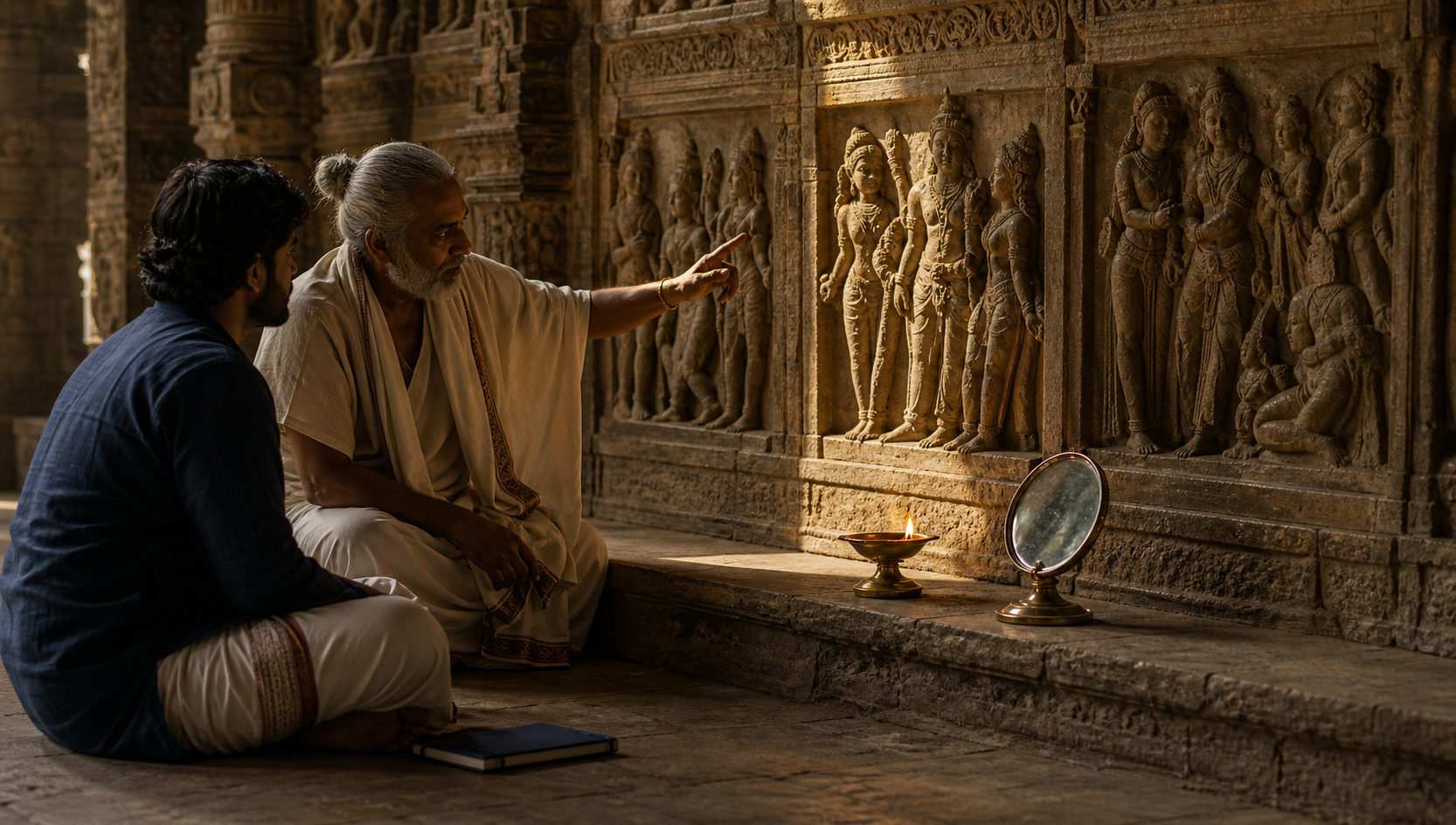
A sacred narrative loses much of its force when it is reduced to gossip about divine personalities. It also loses discipline when every detail is treated as a free-floating metaphor that can mean anything. A sound symbolic reading stays anchored in the actual relationships, directions, powers, and consequences within the story.
Consider the account of Brahma’s fifth head and Shatarupa. Brahma’s four heads face the cardinal directions and are associated with comprehensive awareness, cosmic order, and the four Vedas. Shatarupa, whose name evokes “a hundred forms,” represents the diversity and generative abundance of life. As Brahma’s gaze continues to follow her, a fifth head appears, directed upward.
Different Puranic and oral tellings do not always place the emphasis in exactly the same location. In some, Shiva removes the fifth head to restore balance. In others, the central concern is the mastery and redirection of attention. The variation should be preserved rather than forced into one rigid retelling. The common ethical movement is clearer: creative power must remain governed by restraint, dignity, and dharma.
A responsible interpretation does not turn Shatarupa into the cause of Brahma’s failure of restraint. She signifies the manifold beauty and vitality of creation. The problem arises in the movement of the gaze. Attention expands beyond its proper order and becomes compulsion. Shiva’s intervention can therefore be contemplated as tapas: the inward severity that cuts through an ego-driven momentum before it causes further disorder.
The story is not asking you to condemn beauty, desire, or creative energy. It asks whether desire remains aligned with purpose and whether another being’s dignity survives your attention. That distinction matters in relationships, ambition, leadership, artistic work, and spiritual life. Energy becomes constructive when discernment determines its direction.
When you hear a myth of this kind, test your interpretation with four questions. What legitimate power begins the action? At what point does it become unregulated? Who or what restores the boundary? What practice would prevent the same imbalance in your own conduct? Applied here, the movement is from creative intelligence, through possessive attention, to restraint and realignment.
This gives you a practical examination for moments of attraction, obsession, or ambition. Ask what has captured your attention, whose dignity might be reduced, which boundary has become inconvenient, and where the same energy could serve a worthy creation. The myth then becomes a mirror for agency. It does not remain an accusation directed at someone else.
Let sacred geography turn meaning into practice

A pilgrimage differs from viewing an isolated image because your body enters the symbolic pattern. Distance, ascent, repetition, fatigue, offering, and community make an inward intention concrete. Yet effort by itself is not the goal. Without a vow or ethical direction, a difficult climb can become little more than an achievement.
Palani Hill’s sacred names offer an unusually clear way to connect geography with practice. Sivagiri, Saktigiri, Idumban Malai, and Siddhan Vaazhvu are not merely alternate labels for the same hill. Each name draws attention to a distinct dimension of the pilgrim’s work.
| Sacred name | Symbolic emphasis | Practice for the pilgrim |
|---|---|---|
| Sivagiri | The hill of Shiva; stillness, contemplation, and jnana | Clarify why you have come and reduce the mental noise competing with that intention. |
| Saktigiri | The hill of Shakti; dynamic energy held in balance with consciousness | Decide where your energy should serve, create, or protect rather than merely react. |
| Idumban Malai | The memory of Idumban and the kavadi vow; perseverance, humility, and offering | Carry a commitment as gratitude and service, not as a display of endurance. |
| Siddhan Vaazhvu | The life of the Siddhas; tapas, medicine, yoga, and knowledge tested through experience | Choose a repeatable discipline that will continue after the pilgrimage ends. |
Read in sequence, the names form a practical map. Sivagiri asks for clarity. Saktigiri asks how clarified intention will become right action. Idumban Malai asks whether that action can be sustained as a humble vow. Siddhan Vaazhvu asks whether the vow will mature into a way of life. This sequence is an interpretive aid, not a replacement for the temple’s inherited ritual order.
The sensory life of the pilgrimage can reinforce the same movement. Steps interrupt your normal pace. Bells gather scattered attention. Lamps orient the gaze. The movement of other pilgrims reminds you that sacred effort is not a private performance. Instead of treating these conditions as background scenery, use them as prompts to return to your intention.
The kavadi tradition associated with Idumban makes the relationship between burden and devotion especially visible. A burden becomes sacred not because suffering is valuable in itself, but because it is carried as vow, humility, gratitude, and service. If a demanding climb or observance exceeds your physical capacity, do not turn illness or injury into proof of faith. Preserve the discipline through an appropriate form of prayer, restraint, service, or sustained practice, guided by the temple community and your actual circumstances.
Before beginning a pilgrimage, choose which of Palani’s four emphases you most need. Do you need clarity, rightly directed energy, fidelity to a vow, or consistency in practice? Keep that one intention close during the journey. Soon after returning, give it an observable form. A vow that produces no change in conduct has not yet crossed the final threshold.
Compare traditions without flattening their differences
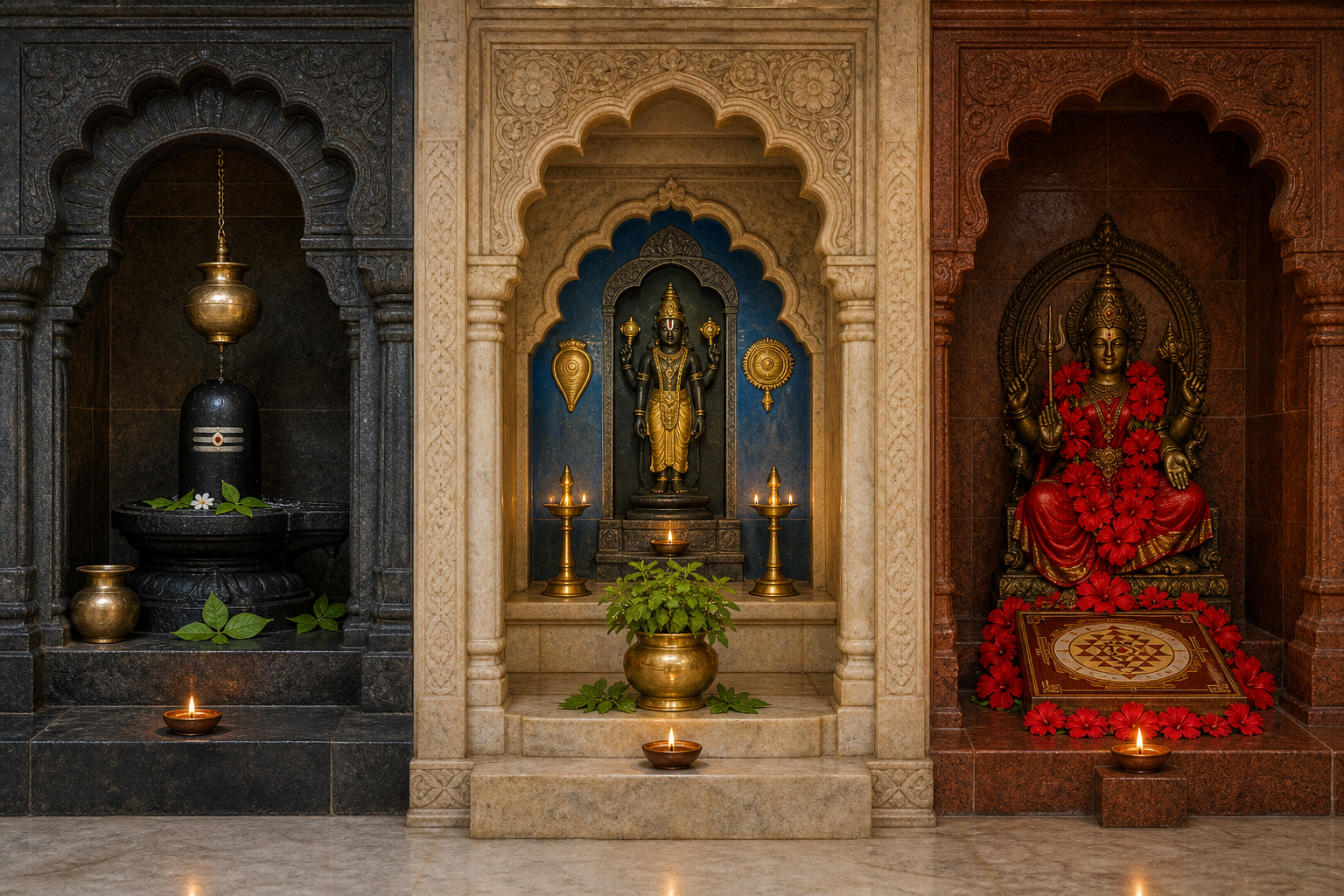
Hindu sacred forms belong to a wider Dharmic and civilizational landscape, but comparison requires care. Closely related guardian masks appear in Buddhist and Jain sacred art as well as Hindu temples. Comparable visages also traveled with architectural ideas and craft traditions into Khmer and Javanese settings. This continuity supports a history of shared sacred vocabulary; it does not prove that every community uses the same name, story, or theology.
The same distinction applies to ethical parallels. The regulation of attention in the Brahma and Shatarupa narrative can be placed in conversation with Buddhist mindfulness, Jain restraint and aparigraha, and Sikh teaching on overcoming haumai. These connections reveal a shared concern with self-mastery. They should not be used to erase the doctrines, disciplines, and devotional worlds that make each path distinct.
When local explanations differ, begin with the local form rather than forcing a universal answer. Record the name actually used at the site. Note whether the image appears above a sanctum, on a gateway, along a procession path, or on a tower. Observe its material and companion motifs. Learn the narrative attached to it in that temple tradition. Only then compare its function with similar forms elsewhere.
This is especially important when studying regional architecture. A guardian on a Dravidian gopuram tier and one on a Nagara shikhara band may perform comparable work while preserving different artisan lineages and visual conventions. Similarity of function does not require uniformity of style. Civilizational continuity is stronger, not weaker, when regional memory is allowed to remain specific.
Key takeaways for your next temple visit
- Look at placement before trying to identify a form. A threshold image is usually telling you how to cross, not merely what to call it.
- In a myth, find the legitimate power, the point of imbalance, the corrective act, and the discipline expected from you.
- On pilgrimage, attach bodily effort to a clear vow. Decide what will continue after you return.
- Preserve local names and explanations before making comparisons across regions or Dharmic traditions.
- Leave with one observable commitment involving restraint, service, clarity, or sustained practice.
On your next visit, resist the urge to decode the entire temple at once. Choose one gateway, one associated story, and one movement of your own body. Pause at the gateway. Ask what it is warning you not to carry farther. Hold that answer as you approach darshana, and give it a concrete expression when you return to ordinary life.
A sacred symbol has not completed its work when you can name it. Its work is completed when seeing becomes discernment, discernment governs action, and the pilgrimage continues in the way you live.
References
- DharmaRenaissance Blog — Vajramukha: The Fearless Guardian of Hindu Temples and Shiva’s Ego-Devouring Grace
- DharmaRenaissance Blog — Brahma’s Fifth Head and Goddess Shatarupa: A Timeless Purana Lesson on Desire and Dharma
- DharmaRenaissance Blog — Palani Hill’s Sacred Names: Unveiling Murugan’s Timeless Symbolism and Living Devotion
