
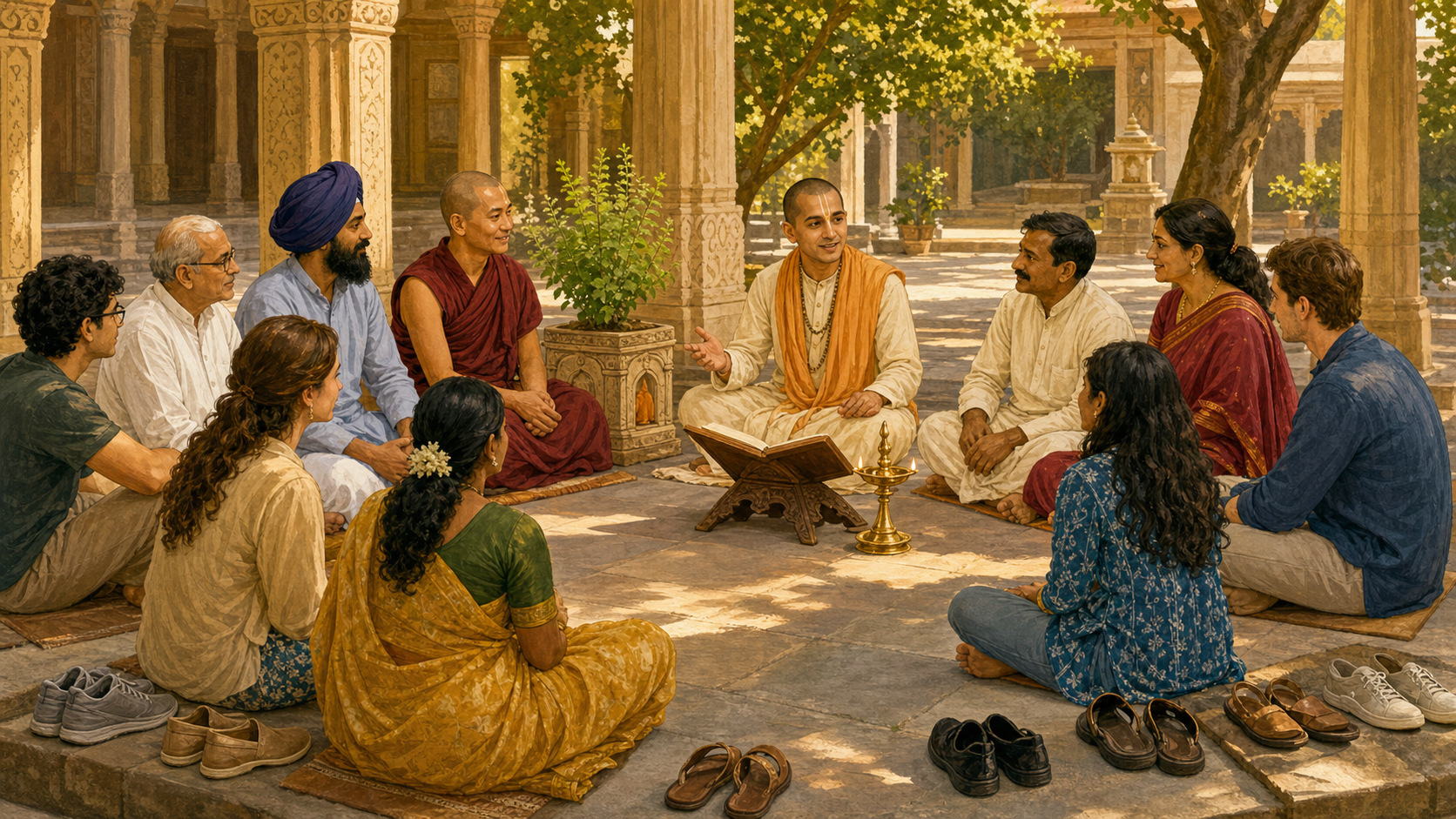
You may be preparing a temple program, campus gathering, festival, reading circle, or service project and facing a real tension: how do you welcome Buddhist, Jain, Sikh, Hindu, and spiritually curious participants without turning Sanatana Dharma into a vague message that says every path is identical?
The answer is not to choose between conviction and cooperation. Effective Vedic outreach states its own commitments clearly, lets other traditions represent themselves, and gives shared values a practical form. You can preserve the integrity of Krishna-conscious teaching while building relationships across the wider Dharmic family.
Key takeaways
- Begin with shared ethical ground, but do not treat that ground as proof that every tradition teaches the same doctrine.
- Name your Vedic or Krishna-conscious identity before presenting a practice, text, or theological claim.
- Explain Sanskrit terms in plain language while retaining the original terms and their tradition-specific meanings.
- Build unity around conduct such as non-harm, service, education, care for vulnerable people, and environmental responsibility.
- Let Buddhist, Jain, Sikh, and other Hindu participants describe their own reasons for similar practices.
- Measure outreach by accurate understanding, continued practice, trusted relationships, and useful service—not attendance alone.
Unity requires clarity about what is shared

Inter-Dharmic unity works when it makes cooperation possible without asking anyone to surrender a distinct self-understanding. Hindu, Buddhist, Jain, and Sikh communities can meet around non-harm, compassion, loving-kindness, service, wisdom, and responsibility. They do not need to be redescribed as different versions of one theology.
Two shortcuts usually weaken outreach. Sectarian isolation treats every difference as a danger. Indiscriminate universalism treats every difference as an inconvenience. The more durable position is simple: we are not all the same, and we are not strangers.
Before announcing a gathering, write four statements for the organizing team:
- Purpose: What should a participant understand, practise, or contribute by the end?
- Identity: Which community is hosting, and from which lineage or philosophical position will it speak?
- Shared ground: Which ethical commitment makes cooperation meaningful?
- Boundary: Which theological or ritual differences will be acknowledged rather than blended?
If the team cannot answer these plainly, the public invitation will probably confuse people. A useful invitation might say: This Krishna-conscious gathering explores how Hindu, Buddhist, Jain, and Sikh communities cultivate compassion and service. Each participant will speak from within their own tradition; no claim of theological sameness is implied.
That wording does three jobs. It identifies the host, gives guests a reason to participate, and protects them from being used as decorative confirmation of someone else’s conclusion. It also allows the host to teach bhakti without disguising devotion to Krishna as generic well-being.
The outreach principle associated with Srila Prabhupada joins fidelity to Krishna consciousness with social uplift and welcome across backgrounds. The welcome is not a demand to erase Krishna, the Bhagavad-Gita, or bhakti. It is a commitment to communicate them in a way that increases understanding rather than defensiveness.
Teach Vedic ideas in three connected layers

A newcomer should not have to choose between an oversimplified slogan and an unexplained Sanskrit vocabulary. Structure each teaching in three layers:
- Begin with a recognizable concern. Name the human or social problem: avoidable harm, isolation, self-centred consumption, loss of purpose, neglect of vulnerable beings, or separation between spiritual aspiration and daily conduct.
- Present the Vedic principle in its own language. Introduce ahimsa, dharma, bhakti, dana, seva, japa, or another relevant term. Explain that your description is a working introduction, not an exhaustive translation.
- Offer a practice that embodies the teaching. Let participants encounter the principle through chanting, meditation, study, giving, service, mindful consumption, animal protection, or ecological care.
For ahimsa, you might begin with the question of preventable suffering, explain non-harm as disciplined moral restraint, and then examine food choices or animal welfare. For bhakti, you might begin with the fragmentation of modern life, explain loving devotion to Krishna, and invite people to hear kirtan or learn how japa functions within Krishna-conscious practice.
This sequence prevents two common mistakes. Beginning and ending with familiar social language can hide the spiritual roots of the practice. Beginning with specialized terminology and assuming prior knowledge can make Vedic teaching feel closed to anyone who did not grow up with it.
A faithful translation pattern
When introducing a Dharmic term, use a repeatable pattern:
- Say and display the original term.
- Give a concise working description.
- Name the tradition or lineage shaping your explanation.
- Show how the principle changes conduct.
- State where other Dharmic traditions may understand or ground it differently.
For example: In this Krishna-conscious setting, bhakti means devotional relationship and service directed toward Krishna. Compassionate conduct follows from that relationship, but bhakti is not merely another word for kindness. That sentence is accessible without stripping the concept of its object, context, or theological force.
Use the same care when discussing other communities. Do not turn Jain ahimsa, Buddhist karuna or maitri, and Sikh seva into interchangeable labels. Say instead that these ideas can support ethical cooperation while arising within distinct accounts of reality, liberation, discipline, and authority.
Accessible presentation also needs depth behind it. Stephen Knapp, known as Sri Nandanandana Dasa, offers a useful methodological example: disciplined spiritual practice is joined to engagement with Sanskrit texts, temple and pilgrimage traditions, historical context, comparative inquiry, and clear writing for a global readership. If you teach publicly, imitate that combination. Learn from texts and living communities before reducing a tradition to material for a slide or social-media caption.
Make shared values visible through service
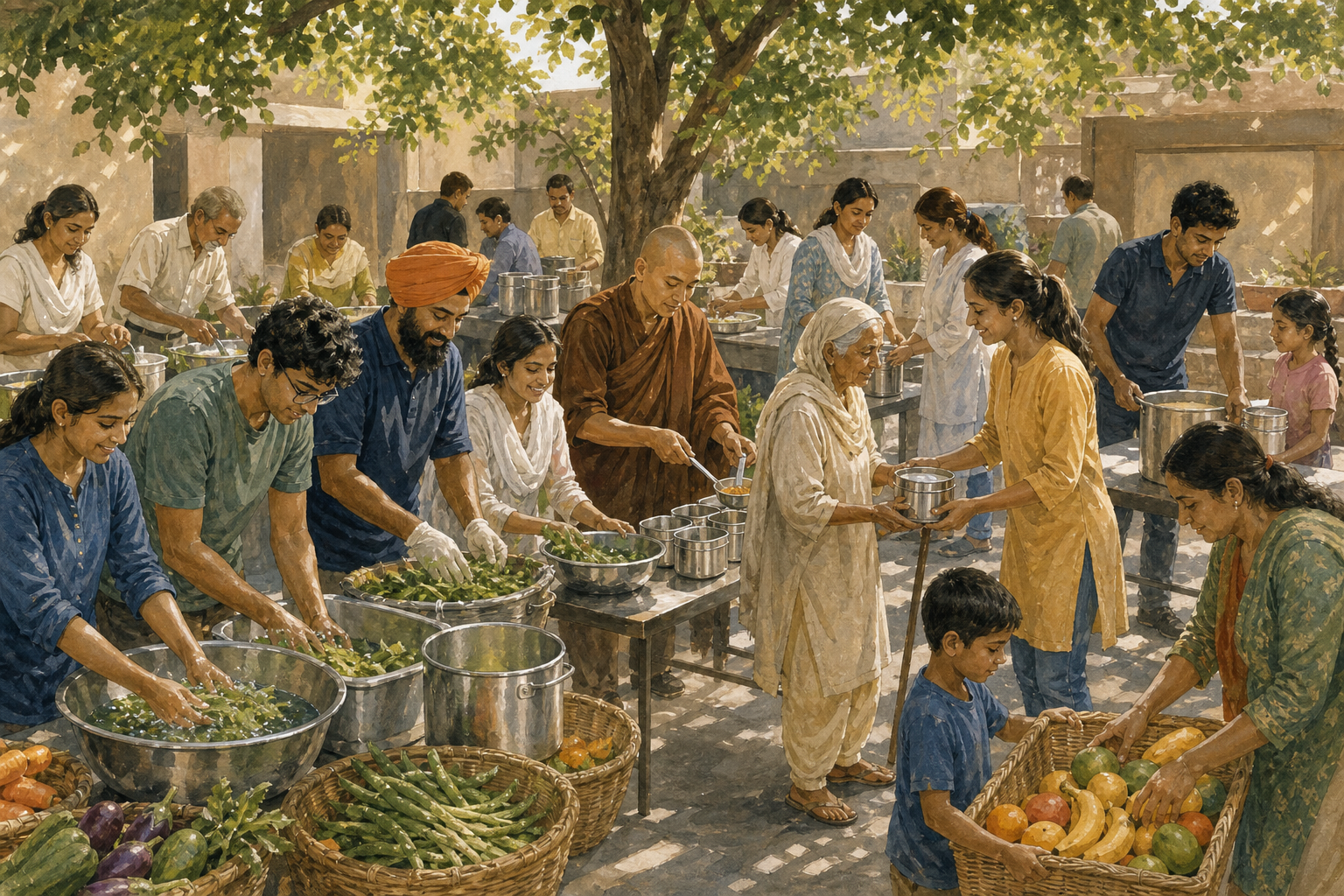
Terms such as unity and compassion become credible when participants can see what they require. Ahimsa, karuna, maitri, and seva become lived commitments through choices about consumption, protection of life, care for vulnerable people, education, and environmental stewardship. A collaborative program should therefore move from discussion to conduct.
A practical gathering can follow this sequence:
- Name a concrete concern. Choose an issue the participating communities can address honestly, such as animal welfare, food support, ecological care, or educational access.
- Invite rooted explanations. Ask each community to explain why that concern matters within its own teachings. Do not hand speakers a conclusion they are expected to endorse.
- Include an appropriately identified practice. A Krishna-conscious host may offer kirtan or japa as Krishna-conscious practices. Another community may contribute reflection or prayer in its own form. Participation should be invited, never presumed.
- Complete a useful act. Connect the gathering to giving, service, care, or education rather than leaving compassion on the stage.
- Provide distinct paths for follow-up. Participants should know where to study Vedic teachings with the host and how to continue the shared service without confusing the two commitments.
This approach is especially useful for festivals. A festival can celebrate Dharmic kinship through hospitality, music, food, learning, and service, while its program notes clearly identify which community offers each ritual or teaching. Public warmth and doctrinal precision can occupy the same space.
Service must not become covert recruitment. Tell volunteers who is organizing the activity, how spiritual elements will be included, and what participation involves. Do not treat people receiving assistance as conversion targets, publicity scenery, or evidence of the organizers’ virtue. Seva loses moral force when another person’s vulnerability becomes an instrument.
Co-ownership matters as well. If a Jain, Buddhist, or Sikh community appears on the invitation, its representatives should help shape the theme, language, practices, and follow-up. Asking for approval after every important decision has already been made is endorsement-seeking, not collaboration.
Protect trust before measuring reach
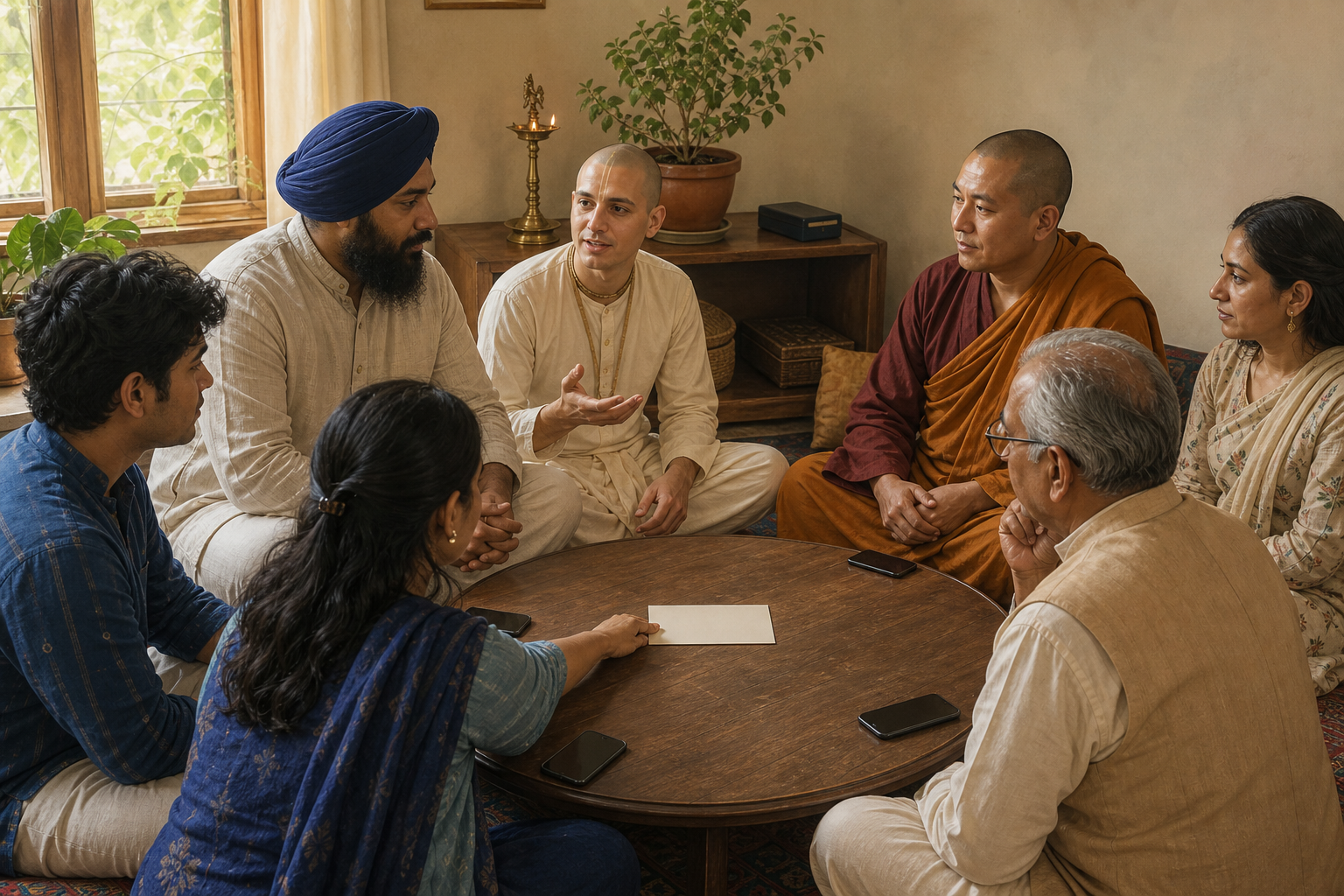
Trust is usually won or lost before anyone approaches the microphone. Circulate the invitation, speaker descriptions, discussion prompts, and explanation of practices among the participating communities. Ask each representative to correct the description of their own tradition.
Before publishing the program, check the following:
- Is the host’s Vedic, Hindu, or Krishna-conscious identity explicit?
- Can every participating community recognize itself in the description?
- Are similarities framed as areas of cooperation rather than proof of sameness?
- Are genuine differences acknowledged without polemic or caricature?
- Will newcomers know what is optional, what is devotional, and what is expected of them?
- Is there a clear next step for study, practice, service, or further dialogue?
When disagreement appears, do not rush to resolve it with a universal slogan. Distinguish ethical cooperation from metaphysical agreement. Use phrases such as within Krishna-conscious teaching, from this Jain perspective, or on this point the traditions differ. Precision lowers the emotional temperature because nobody has to fight to recover a position that the moderator erased.
Attendance alone measures reach. It does not tell you whether outreach produced understanding or merely assembled an audience. After the gathering, ask better questions:
- Can a newcomer explain a Vedic concept without reducing it to a motivational slogan?
- Can participants name both a shared commitment and a genuine difference?
- Did anyone continue with japa, kirtan, study, dana, seva, or another clearly identified practice?
- Did the service activity help the intended people or cause in a concrete way?
- Do the co-hosting communities trust one another enough to work together again?
- Did younger or diaspora participants gain language for their heritage rather than being asked to choose between inherited identity and modern public life?
Culturally sensitive explanation can help younger generations and diaspora communities approach Vedic heritage with greater confidence. That outcome requires more than reassurance. Give them accurate terms, historical and philosophical context, contact with living practice, and permission to ask difficult questions without being treated as disloyal.
For your next gathering, rewrite the invitation around purpose, identity, shared ground, and boundary. Send it to the participating communities before publication. Then connect the conversation to a service or practice people can continue. If the language survives honest review and the service remains worthwhile even when nobody changes religious labels, you have a sound foundation for Vedic outreach and Dharmic unity.
References
- Dandavats — Enlightenment Meets Dharma: Uniting Dharmic Paths with Krishna-Conscious Compassion
- Dandavats — Stephen Knapp (Sri Nandanandana): Inspiring Bridges to Vedic Wisdom and Dharmic Unity
