
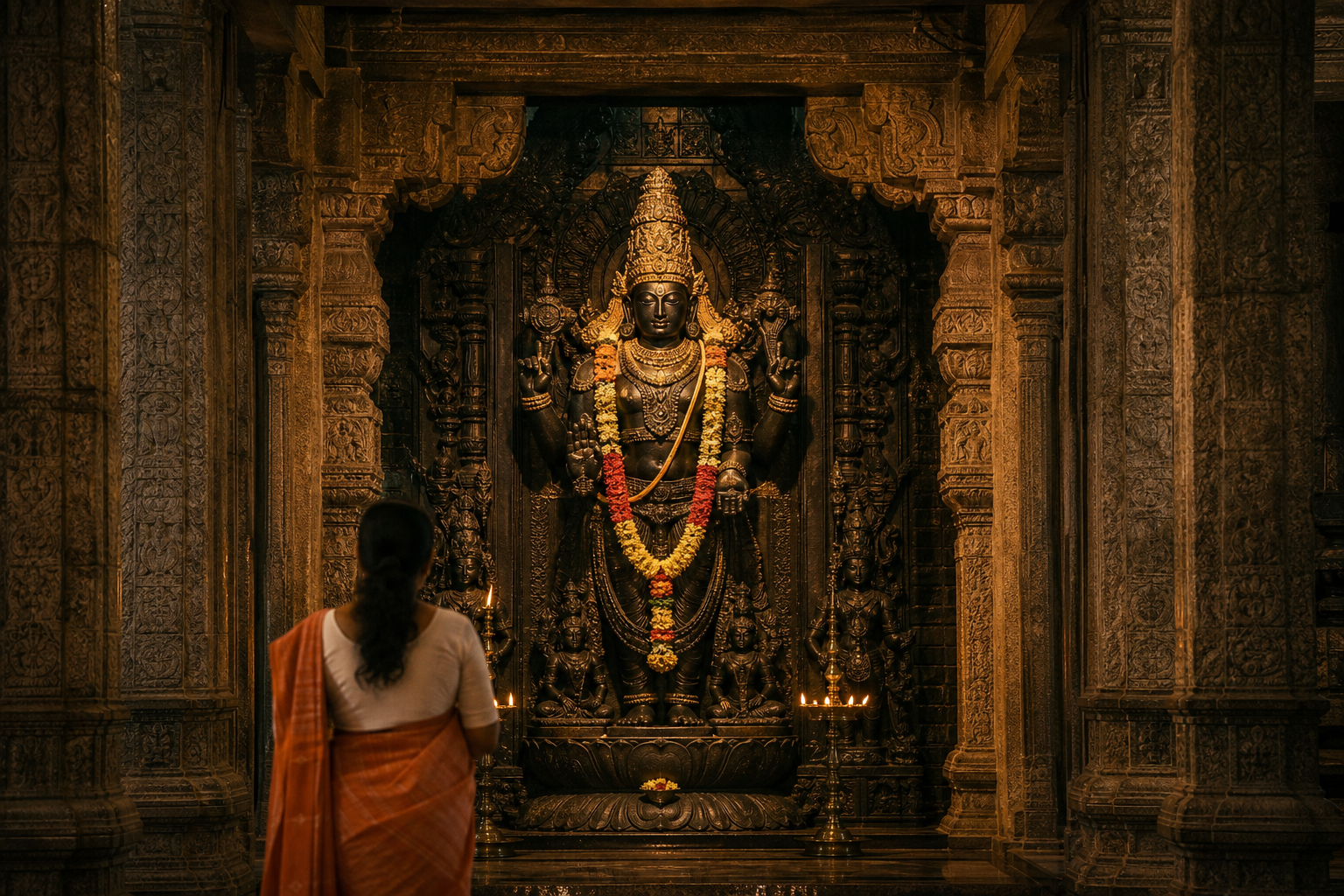
You stand before a murti and recognize a chakra, a crown or a raised palm. Then the details begin to compete: four arms, several necklaces, a long garland, a diagonal cord, a lotus pedestal and figures at the base. If you seize on the most dramatic feature and guess, you can miss the visual order that makes the image intelligible.
Use a fixed sequence instead. Read the whole form before its objects, the objects before their symbolism, and the figure before the wider temple setting. That method lets you distinguish what you can actually see from what you may reasonably infer—and it keeps sacred art from being reduced either to decoration or to a catalogue of disconnected symbols.
Read the visual order before interpreting a symbol
A sacred image does not give equal emphasis to every detail. Its posture, central axis, gestures, attributes and ornaments form a hierarchy. Begin far enough away to see that hierarchy. Is the figure frontally composed and serenely balanced, or does the body turn through a dance-inflected curve? Do the arms create a stable enclosure, radiate into the surrounding space or cross the body? Does a long garland reinforce the vertical axis while a necklace closes it horizontally at the throat?
This first look prevents a common error: allowing one recognizable object to determine the entire identification. A chakra strongly supports a Vaishnava reading, but the figure’s other attributes, chest marks, crown, vehicle, pedestal and location should agree. In the same way, a single strand at the neck may be an Ekavali, but its position and construction must be checked before a symbolic meaning is attached to it.
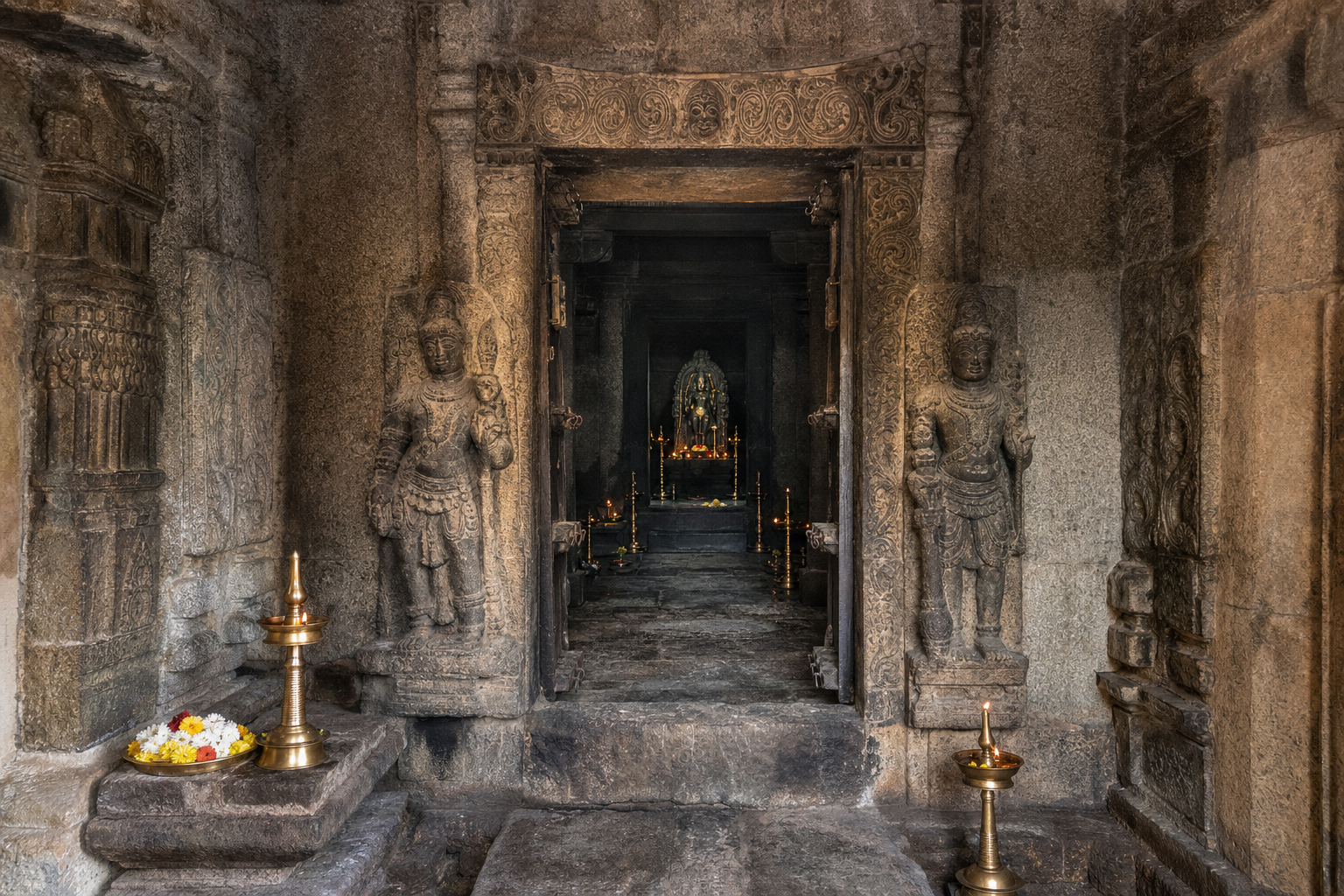
Temple placement is part of the evidence. A figure in the sanctum, a directional niche, a prākāra wall or a gopura does not perform exactly the same visual function. The cardinal organization of a temple may bring a deity into dialogue with the guardians of the directions, while a museum display can separate that figure from the architecture that once clarified its role. This is especially important when considering Vishnu as Lokapāla or guardian of the worlds: it is a theological and spatial reading, not a single rigid image type that can be identified from one object alone.
Make two lines in your notes before assigning a name. Under Seen, record only visible facts: four arms, a discus-like object, a conch, a high crown, a long garland and a lotus base. Under Inferred, record your interpretation: a regal Vaishnava form expressing preservation or guardianship. Keeping those lines separate makes uncertainty useful instead of embarrassing. It also gives you a reading that another viewer can check.
Use this seven-pass method on any temple image
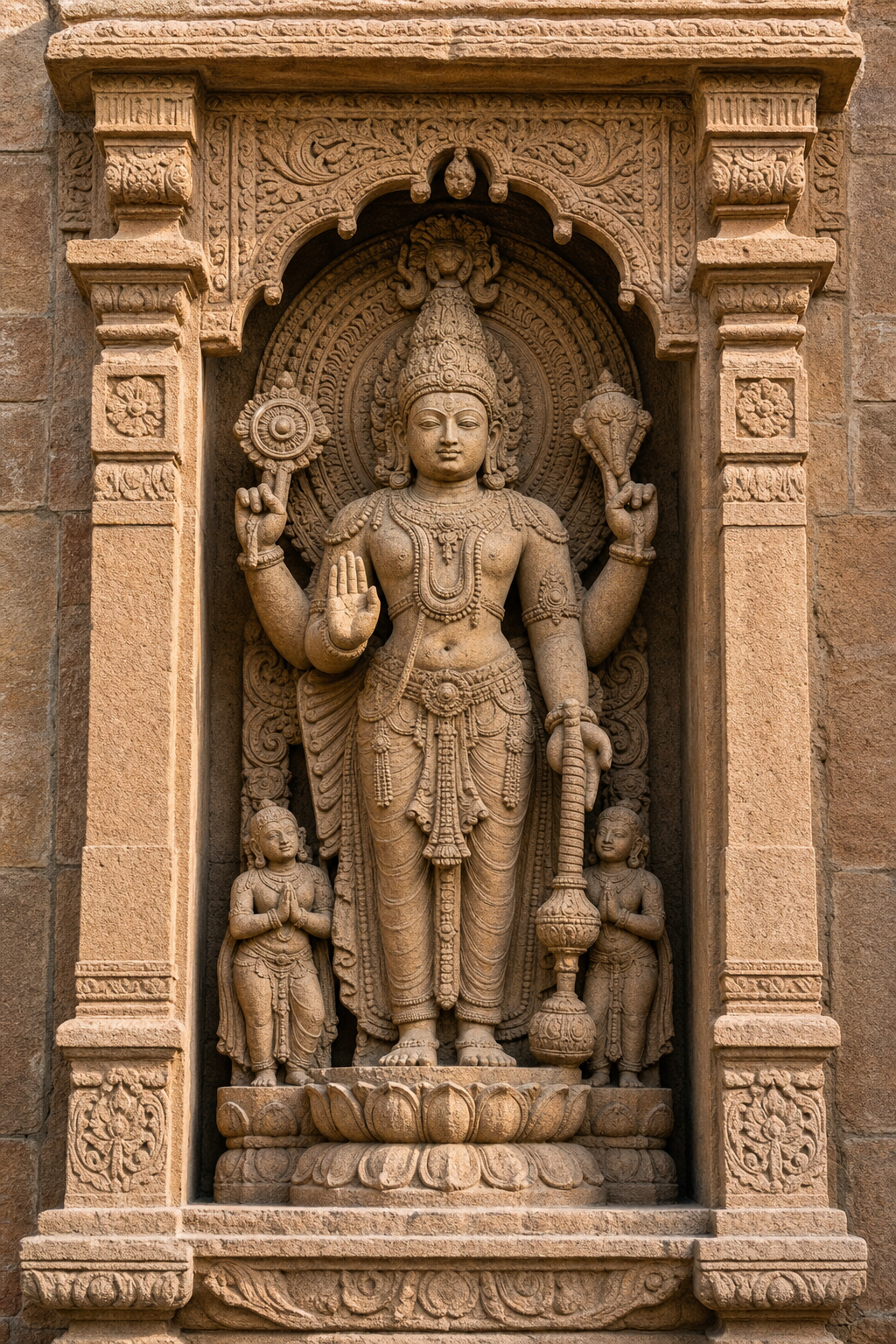
You do not need to identify every small object at once. Move through the image in the same order each time, and stop when the evidence no longer supports a precise conclusion.
- Record the setting. Note whether the image is in a sanctum, exterior niche, gateway, enclosure wall, processional setting or museum case. Look for a stated direction, nearby deities and repeated figures around the building. If the original location is unknown, carry that limitation into your interpretation.
- Read the silhouette. Identify standing, seated, reclining or dancing posture before studying jewelry. Notice frontal stillness, bodily curves, the number and spread of arms, and whether the composition projects repose, movement or alertness. A broken limb should be recorded as damage, not interpreted as intentional absence.
- Identify held attributes. Work hand by hand. Describe an object’s visible form before naming it: wheel or discus, conch, mace, lotus, sword or bow. Hand arrangements can vary, so do not reject an otherwise coherent identification merely because an object is not in the position you expected.
- Separate gestures from objects. An open palm raised in assurance can be read as abhaya, while a bestowing gesture expresses varada. These gestures communicate the deity’s relation to the devotee and should not be treated as empty hands waiting for lost attributes.
- Move from head to chest. Record the crown, earrings, halo or aureole, chest marks, jewels, necklaces, sacred thread and garlands in descending order. Their relative positions often matter more than their apparent richness.
- Inspect the support system. Look beneath and behind the main figure. A lotus pedestal, vāhana, attendant, serpent canopy or aureole can settle an identification that the central body leaves uncertain. Garuḍa and Śeṣa, for example, reinforce a Vaishnava reading in different ways.
- Test a minimal conclusion. Name the deity or type only as precisely as the combined evidence allows. Then add the function that the posture, gestures, attributes and location support. A defensible conclusion might identify Vishnu securely while treating a directional guardianship reading as probable rather than certain.
Avoid the four shortcuts that cause most misreadings
- Do not identify the whole image from one weapon, ornament or hand gesture.
- Do not interpret an eroded or ritually polished detail as though it had never existed.
- Do not assign a directional role when the image’s original architectural location is unknown.
- Do not begin with abstract symbolism. Establish the visible form first, then ask what that form means within its iconographic and ritual setting.
The neckline teaches you how precise iconography can be
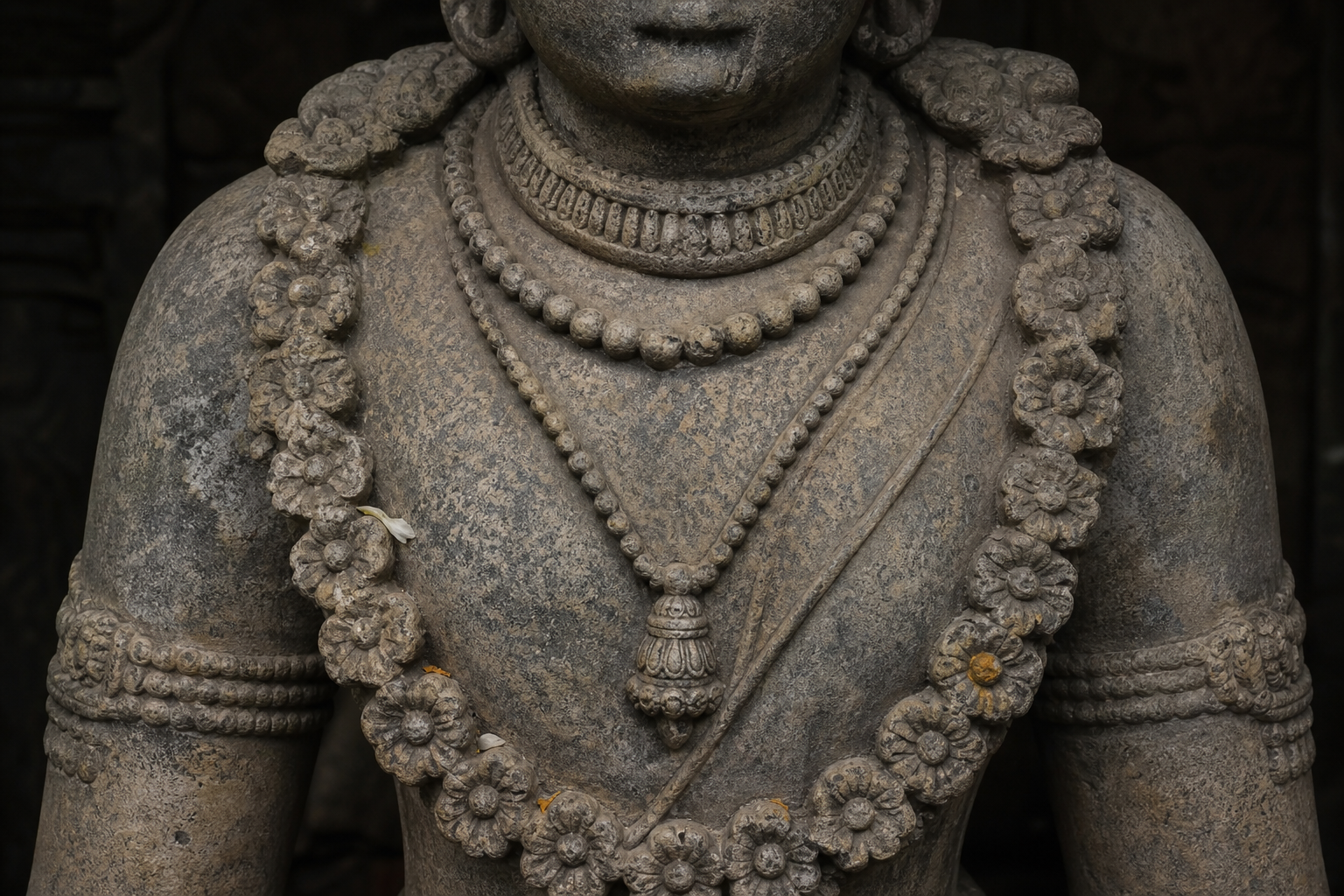
Neck ornaments are an excellent test of disciplined looking because several distinct forms can occupy a small area. Their names are not interchangeable. The Ekavali is a single, uninterrupted strand set near the throat or high on the chest. Its name joins eka, meaning one, with āvali or āvalī, a row or string. Simplicity is therefore part of its structure, not evidence that the sculptor omitted detail.
| Form | What to look for | Common confusion to avoid |
|---|---|---|
| Kaṇṭhī | A short choker hugging the neck | Do not automatically call every short necklace an Ekavali |
| Ekavali | One continuous row near the throat or clavicles, usually without a pendant break and with little change in thickness | Do not mistake it for a longer necklace simply because weathering has blurred its edges |
| Hāra | A longer necklace descending over the sternum | Do not merge it visually with the shorter throat strand above it |
| Vana-mālā | A long floral garland descending much farther down the torso | Do not classify it as metal jewelry merely because stone or bronze makes every material look similar |
| Yajñopavīta | A sacred thread crossing the torso diagonally | It is categorically different from necklaces encircling the neck |
Use three tests when the carving is faint. First, check proximity: an Ekavali belongs near the throat, not at mid-chest. Second, follow the line from side to side: it should remain a complete, even strand rather than terminate in a pendant or divide into loops. Third, compare its gauge across the chest: strong tapering or a large central element points away from the elemental single-row form.
The usual layering is legible from near to far: a kaṇṭhī at the neck, an Ekavali just below it, longer hāras over the sternum and a garland descending farther down the body. The diagonal yajñopavīta cuts across this horizontal and vertical arrangement. Once you see those directions, an apparently crowded torso becomes organized.
Only after formal identification should symbolism enter. Because the Ekavali is one continuous line placed around the seat of voice, it can evoke oneness, integrity, disciplined speech and mantra. These meanings gain force from the ornament’s exact construction. If the visible form is actually a multi-row hāra or a diagonal sacred thread, importing the Ekavali’s symbolism would be a category error.
Deity-specific combinations refine the reading. A Vishnu image may balance a restrained throat strand against the long vana-mālā. A Shaiva image can place a smooth single strand beside rudrākṣa textures, bringing auspicious adornment and ascetic discipline into the same visual field. Śākta images may use the strand to clarify the collarbone beneath richer necklaces and armlets. In Chola Somaskanda bronzes, the unbroken arc also helps stabilize the compositional center. The same ornament retains its basic identity while doing different visual work.
Apply the method to Vishnu’s protective iconography
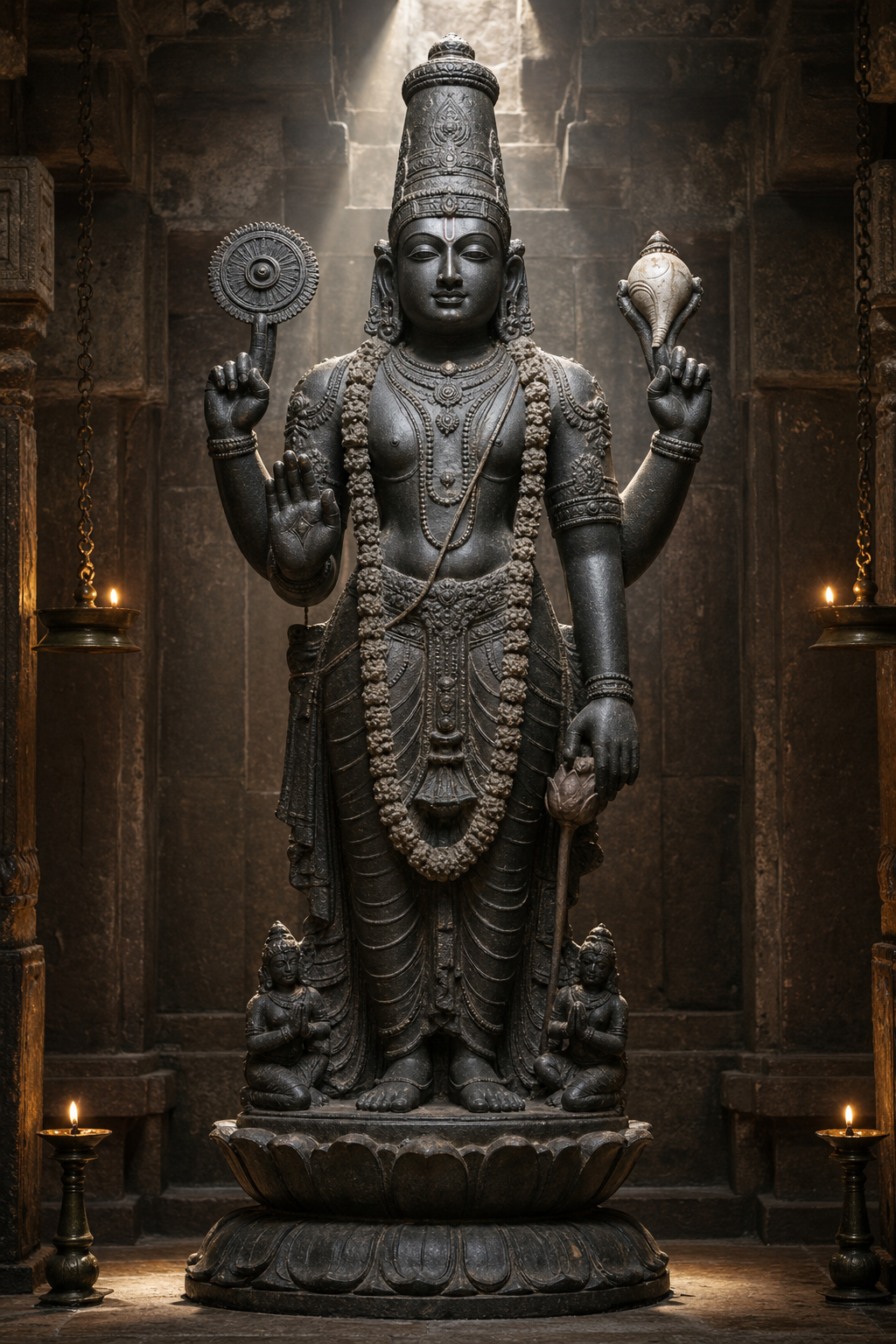
Begin a Vishnu reading with a cluster, not a single emblem. A characteristic form is four-armed, crowned with the tall kīrīṭa-mukuṭa and organized around the śaṅkha, chakra, gadā and padma. The Śrīvatsa mark, Kaustubha jewel, long vana-mālā and aureole strengthen the identification. Pītāmbara describes the yellow garment of Vishnu’s iconographic form, but an unpainted stone image cannot establish color by shape alone.
Each principal attribute contributes a different dimension of protection:
- Sudarśana Chakra: time, order and the decisive governance of dharma. Read it as disciplined sovereignty, not merely as a weapon.
- Pāñcajanya Śaṅkha: primordial sound and the summons toward righteous order. Its meaning complements the chakra: sound announces what order enacts.
- Kaumodakī Gadā: grounded strength and the capacity to restrain disorder.
- Padma: purity, sovereignty and auspicious renewal within the world being protected.
Nandaka, the sword associated with discriminative knowledge, and Śārṅga, the bow of cosmic readiness, can appear in variants. Their presence should expand the reading rather than force the image into the four-object formula. Likewise, abhaya and varada make protection relational: the first offers freedom from fear, while the second turns divine sovereignty toward grace and welfare.
The ornaments complete this theology. Śrīvatsa connects Vishnu with Śrī or Lakṣmī and the auspicious order she embodies. Kaustubha marks the cosmic heart. The vana-mālā creates a living vertical continuum, while the crown presents kingship as stewardship rather than arbitrary power. Garuḍa contributes speed, clarity and the overcoming of poison; Śeṣa or Ananta places guardianship against the background of eternity.
A Lokapāla reading becomes stronger when the temple’s directional program supports it. The classical protective grid assigns Indra to the east, Agni to the southeast, Yama to the south, Nirṛti to the southwest, Varuṇa to the west, Vāyu to the northwest, Kubera to the north and Īśāna to the northeast. Vishnu understood as Jagatpāla does not make these guardians irrelevant. His sustaining sovereignty embraces the ordered space within which they hold their respective stations.
Use three checks before describing a figure as Lokapāla Vishnu. First, secure the Vaishnava identification from multiple features. Second, determine whether the location participates in a cardinal or protective architectural scheme. Third, look for a coherent language of guardianship in the chakra, assuring gesture, regal marks, vāhana and surrounding figures. If only the first check is possible, identify Vishnu and leave the more specific function open.
Protective forms can sharpen different aspects of the same vocation. Narasiṁha expresses fierce intervention at a threatened boundary. Varāha makes the rescue of the earth visible. Trivikrama measures the worlds and re-establishes cosmic limits. The multi-faced Vaikuṇṭha Caturmūrti of Kashmir presents sovereignty able to survey more than one quarter. These forms are not interchangeable, but each helps you notice that preservation in Hindu iconography is active, ordered and morally directed.
Let style, ritual and location correct your first reading
Use regional style as supporting evidence, not a date stamp
The same iconographic element changes surface character across time and region. Gupta–Sarnath sculpture of the 5th–6th century often renders the Ekavali as a sleek, nearly abstract band, while Mathura work can give it more tactile beading. Pāla–Sena production in Bengal and Bihar from the 8th–12th century may thicken the strand or alternate bead sizes. Pallava and Chola artists integrated it into carefully tiered South Indian ornament systems; the Chola bronzes of the 11th–12th century made a polished strand catch ritual lamplight without interrupting the movement of the body.
Later Hoysala carving can preserve the single-row logic through minute granulation even when the surrounding surface is extremely intricate. Kakatiya and Vijayanagara idioms multiply detail without abandoning the foundational line. Medieval Odisha often uses a crisp throat band to mediate between the neck and the longer necklaces below it.
Do not date an image from that necklace alone. Require agreement among at least three kinds of evidence: bodily modeling and posture; ornaments and drapery; and material, technique or known provenance. A smooth strand may indicate a stylistic preference, but it may also be the result of weathering or repeated ritual cleaning.
Distinguish carved form from living adornment
A temple murti participates in ritual life. In an Agamic sequence, abhiṣeka and unction are followed by vesting and then ābharaṇa or ornamentation. A single strand commonly establishes the throat layer before longer necklaces and festival garlands are added. On a richly adorned day, removable jewelry can conceal the sculpted necklace beneath it; after bathing, the underlying form may become more visible.
Ask what kind of evidence you are viewing: a form permanently carved or cast into the murti, a removable piece of alankāra, or a surface altered by worship and care. On stone, an Ekavali may survive only as a low ridge above the sternum. On bronze, long-term cleaning can soften separate beads into what appears to be a smooth rib. Ritual history is therefore not damage to be mentally erased; it is part of the object’s life, even when it complicates formal identification.
Recognize Dharmic kinship without erasing differences
Closely related visual principles occur across Dharmic traditions, but they do not create one undifferentiated iconographic system. Buddhist bodhisattvas at Ajanta and in later Pāla settings can wear a high single strand that anchors longer necklaces. Jain Tirthankaras are characteristically presented through austerity, while Yakṣa and Yakṣi attendants may carry ordered jewelry with a single row near the throat. Sikh simran gives continuity and concentration to the mālā, but Sikh tradition does not employ murti-pūjā. The responsible comparison lies in the shared discipline of continuity, attention and ordered form—not in pretending that the theology or ritual use is identical.
Key takeaways
- Read setting, silhouette, hands, ornaments and supports in that order before assigning a precise name.
- Separate visible description from interpretation so that a plausible inference is never mistaken for an observed fact.
- Identify an Ekavali by its high placement, uninterrupted single row and consistent gauge—not merely by its apparent simplicity.
- Treat Lokapāla Vishnu as a guardianship reading strengthened by attributes and temple space, not as a universally fixed type.
- Use regional style, material condition and ritual adornment to test an identification; none should decide it alone.
On your next temple visit, resist naming the figure for the first few moments. Record where it stands, trace its bodily axis, follow each hand, separate the throat strand from the longer hāra and garland, and inspect the base. Then make the narrowest interpretation that all those features support. One observation you can defend, paired with one uncertainty you can name, is a more faithful reading than an elaborate symbolism built on a hurried guess.
References
- DharmaRenaissance Blog — Ekavali: Sacred Elegance of the Single Strand in Hindu Iconography and Temple Art
- DharmaRenaissance Blog — Decoding Lokapala Vishnu: Powerful Iconography, Sacred Symbols, and Cosmic Guardianship
