
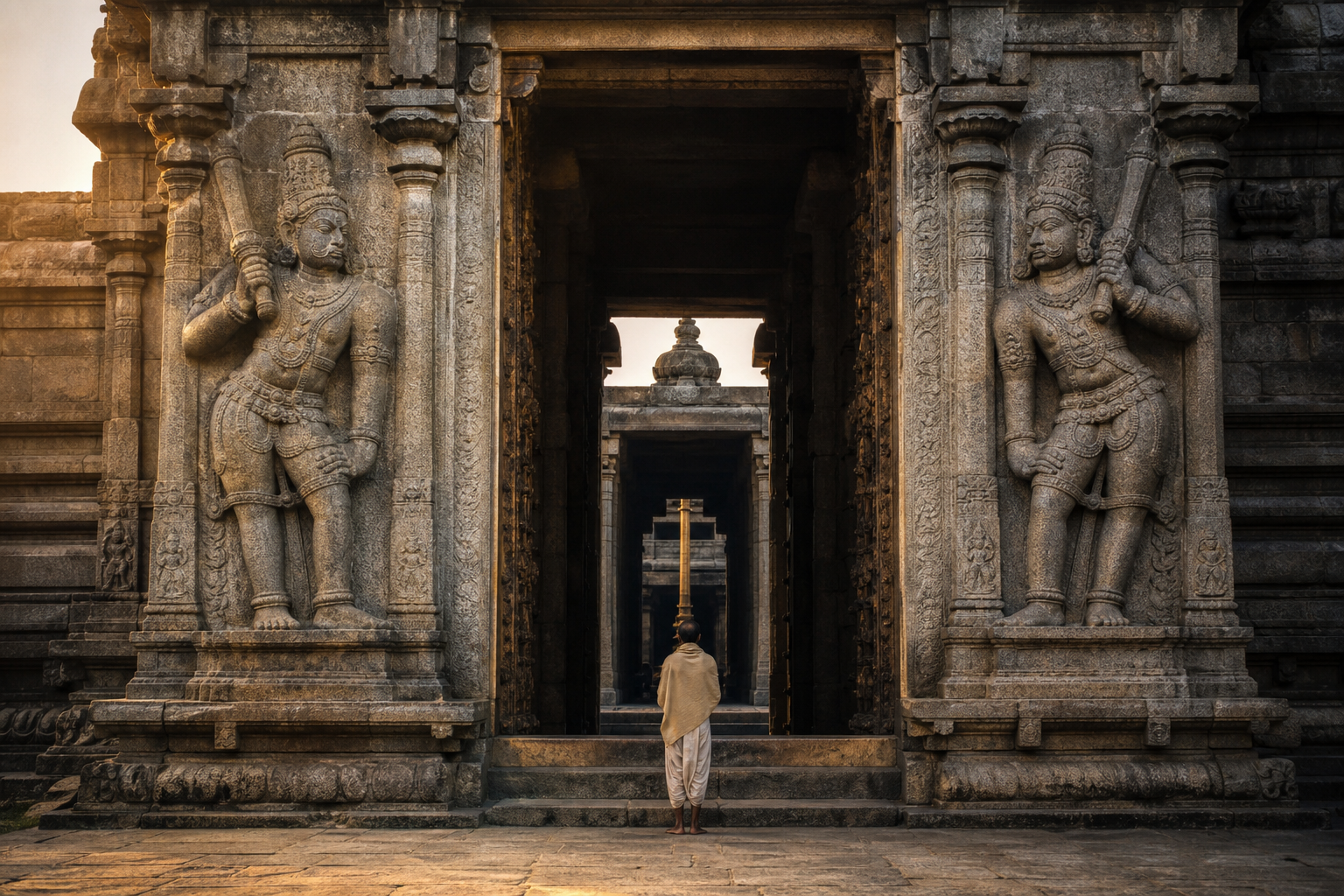
You stop at a temple doorway because the figure beside it looks alarming: fangs, a skull cup, a weapon, perhaps a dog. A few steps away, a round-bellied attendant holds a conch. Calling one a demon and the other decoration would miss what the temple is teaching you.
Start with placement, not appearance. Then examine attributes, posture, companions and orientation. That sequence will help you distinguish a doorway guardian from a Bhairava who protects the sacred precinct, an auspicious treasure figure, or a deity governing one of the directions. More importantly, it will help you approach each image as part of the temple’s ritual intelligence rather than as an isolated sculpture.
Read the threshold before you read the face
Guardian iconography is architectural. A figure’s position often tells you its job before its hands tell you its name. The doorway marks a change of condition: you are leaving ordinary circulation and entering progressively consecrated space. Images placed there regulate that passage visually, ritually and ethically.
Begin by locating the figure within the whole building. Do not crop it mentally from its doorway, wall or subsidiary shrine. A carving at the bottom of a jamb is performing a different task from a large figure flanking the opening. A shrine near the perimeter is not functioning exactly like a deity placed according to a directional plan.
- At the sides of an entrance: first consider a doorway-protection role. Scale, pairing and a direct relationship to the passage matter more than whether the face looks fierce.
- At the base of a doorframe: look for smaller auspicious attendants, especially a matched conch-and-lotus pair. Śaṅkha Nidhi and Padma Nidhi commonly occupy these lower threshold registers.
- Near a gate or along the perimeter: consider a kṣetrapāla, a guardian of the sacred field. Bhairava frequently serves this function in Śaiva settings.
- On a wall or in a planned directional position: ask whether the image belongs to a cosmic arrangement. Kubera, for example, governs the north within the eight-direction scheme.
This gives you the first practical rule: identify the architectural role before attempting a personal name. If you reverse the order, a weapon can tempt you into a confident but false identification.
Distinguish four kinds of guardianship

Dvārapālas control the passage
A dvārapāla belongs to the doorway as a doorway. These guardians are usually read in relation to the opening they flank, often as a pair. Their scale and commanding stance announce that entry is consequential. They are not merely security figures in stone; they mark the point at which your conduct, attention and intention should change.
When the image lacks a uniquely identifying emblem, stop at the functional identification: “a dvārapāla” may be more accurate than an unsupported divine name. Look for a matching figure on the other side, compare their gestures, and notice whether both bodies turn toward the doorway, toward you, or in complementary directions.
Kṣetrapālas guard the sacred field
A kṣetrapāla protects more than one door. The “field” may be the temple precinct, a ritual territory or, in an expanded civic understanding, an entire sacred city. Bhairava’s presence near gateways and perimeters expresses this wider jurisdiction. Kāla Bhairava’s traditional standing as the kotwāl, or chief guardian, of Kāśī preserves that territorial meaning in especially vivid form.
For a possible Bhairava, search for a cluster: a fierce Śaiva appearance, three eyes, moving or windblown matted hair, a dynamic stance, skull or serpent imagery, and especially the dog. The dog functions as Bhairava’s vigilant, threshold-crossing vāhana. Fangs alone are not enough; the companion animal and Śaiva attributes make the identification stronger.
The nidhis guard entry through auspicious abundance
Not every guardian threatens disorder with force. Śaṅkha Nidhi and Padma Nidhi usually appear as smaller yakṣa-like figures associated with Kubera’s treasures. One holds or supports a conch; the other corresponds to the lotus. Their rounded bodies convey plenitude, while their subordinate scale distinguishes them from the principal deity and the larger doorway guardians.
The pair teaches you how to understand prosperity at the threshold. The conch evokes generative sound, ritual commencement and the proclamation of dharma. The lotus carries purity, generative power and composed abundance. Together they present resources not as private accumulation but as wealth redirected toward worship, learning, generosity and communal continuity.
In the architectural grammar associated with Mānasāra, Mayamata, Śilparatna and Odisha’s Śilpa Prakāśa, the twin treasures belong at or near significant thresholds. In some Odishan arrangements they appear low on the jambs beneath a lintel image of Gajalakṣmī. If you see a small figure with a large conch at the base of a doorway, therefore, do not dismiss it as a comic dwarf or mistake it for the presiding deity. Look across the opening for the lotus-bearing partner.
Directional guardians make the temple a cosmic map
The dikpāla principle assigns divine governance to the directions, allowing architecture to mirror an ordered cosmos. Kubera’s guardianship of the north places wealth within this larger system: prosperity has a direction, a duty and a place within dharma.
Orientation matters here. Before identifying a directional figure, establish which way the shrine faces and where you are standing. A wealth-associated image does not become Kubera merely because it appears on what seems to be your left. Your bodily left changes when you turn; geographic north does not. If you cannot establish orientation, keep the directional identification provisional.
Decode a cluster of signs, not one dramatic object
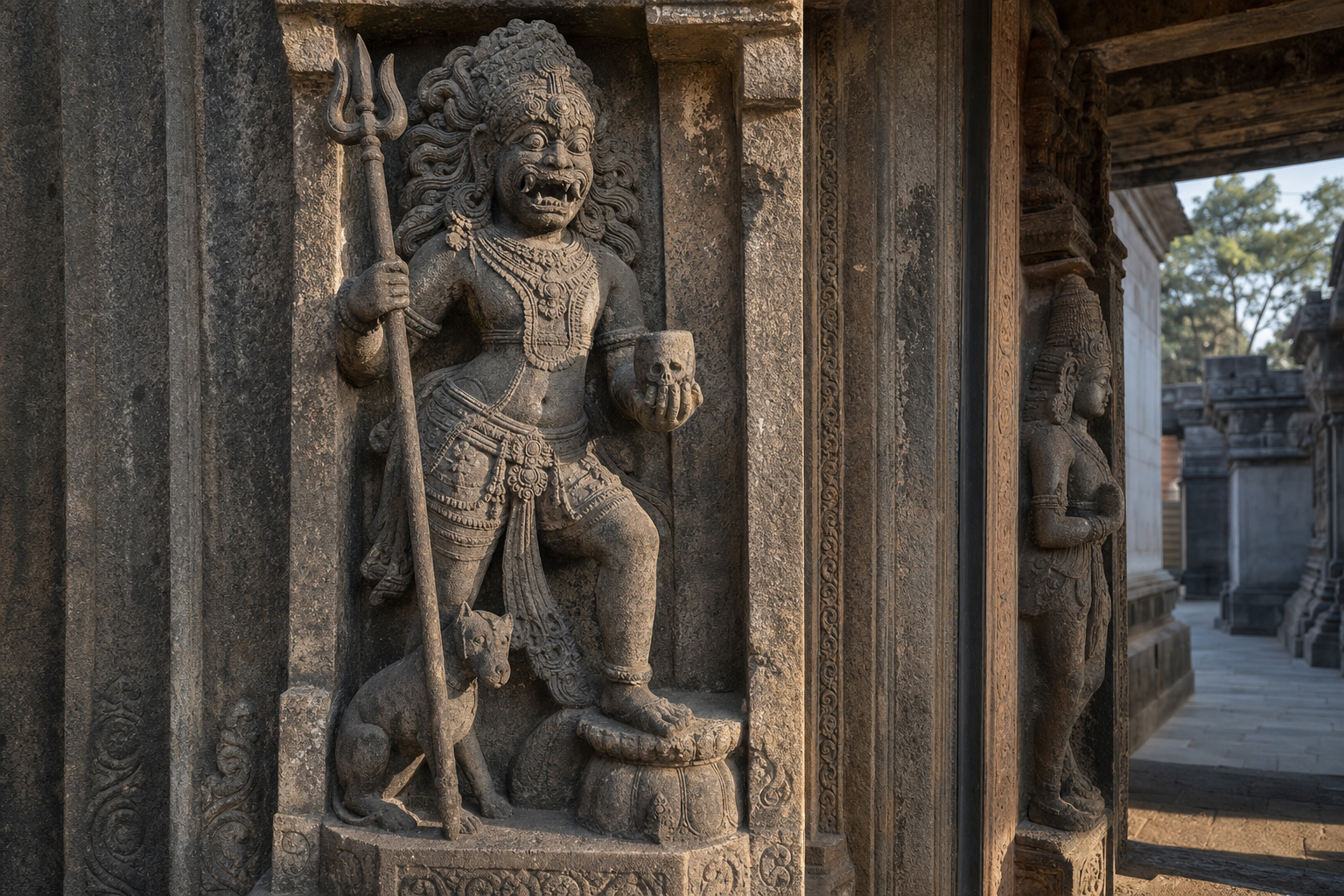
Temple images work like compressed sentences. Location supplies the setting, posture supplies the verb, attributes qualify the action, and companions help identify the subject. One sign may be shared by several deities; a coherent cluster is much harder to misread.
| What you notice | What it may indicate | What to check next |
|---|---|---|
| A dog beside a fierce Śaiva figure | Bhairava in a protective or kṣetrapāla role | Look for three eyes, matted hair, trident, skull imagery and a perimeter or gateway setting. |
| A conch held by a small, rounded yakṣa at the jamb base | Śaṅkha Nidhi, the conch treasure | Look across the doorway for a comparable lotus-bearing figure. |
| A lotus held by the matched threshold attendant | Padma Nidhi | Check whether the pair is smaller than the principal guardians and integrated into the doorframe. |
| Skull cup, skull garland, khaṭvāṅga, serpents or bone ornaments | A fierce Tantric and cremation-ground vocabulary | Do not assign a name yet. Combine these signs with the face, vāhana, Śaiva markers and placement. |
| A wide, forceful ālīḍha or pratyālīḍha stance | Poised movement and active protection | Examine which leg advances and whether the hands reinforce a cutting, restraining or guarding action. |
| A wealth-bearing figure in a confirmed northern position | Possible participation in Kubera’s directional scheme | Verify the temple’s orientation and the presence of other directional deities. |
Use the three-evidence rule
Before attaching a precise name, require three kinds of evidence:
- Place: doorway, jamb base, perimeter shrine, wall register or confirmed direction.
- Form: posture, facial character, number and arrangement of limbs, hairstyle, dress and bodily scale.
- Relationship: paired figure, vāhana, retinue, presiding deity or surrounding directional program.
Attributes then refine the result. Samhāra Bhairava may appear with four, six or eight arms, so arm count by itself is weak evidence. His hands can carry combinations of triśūla, ḍamaru, kapāla, khaṭvāṅga, sword or knife, noose and bell. Regional forms may add other weapons. The configuration changes across lineages and artistic traditions, while the combined language of fierceness, transformation and guardianship remains recognisable.
Material and regional style can change the silhouette as well. South Indian metal images may emphasize taut movement and gesture; Deccan and Himalayan stone can appear denser; Odishan carving can give minute attention to skull garlands and serpent ornaments; Newar copper-alloy traditions can translate Bhairava’s force into masks and festival images. Treat those differences as local articulation, not as mistakes measured against one universal template.
Why a terrifying guardian is not an image of evil

A fierce face is the most common point of misreading. In Bhairava iconography, ugra or raudra form does not celebrate uncontrolled violence. It gives visible shape to protection that will not negotiate with delusion, fear or disorder. Samhāra means dissolution here: the removal of impediments and bondage so that dharma can stand unobstructed.
That changes how you read the weapons. A trident can express discernment piercing the three guṇas. A sword or curved knife severs ignorance. A noose restrains unruly impulses. The skull cup receives what must be transformed, while the ḍamaru and bell turn attention toward sacred sound and alert awareness. These meanings form a theological vocabulary; they are not licence to reduce every object to a rigid one-word code.
The body extends the message. Ash recalls impermanence. Matted locks, serpents and flames convey concentrated power. A skull garland brings mortality and language into the field of transformation. A dynamic stance says that protection is active rather than passive. Bhairava’s terrifying form is directed against misapprehension, not against the sincere devotee approaching the shrine.
Compare that function with the nidhis. Bhairava confronts what must not cross the sacred boundary unchecked. Śaṅkha Nidhi and Padma Nidhi welcome what may cross when it has been aligned with dharma: resources, vitality, generosity and auspicious intention. One threshold can therefore contain both severity and hospitality. The apparent contrast is deliberate. Sacred order needs the power to exclude corruption and the capacity to sustain what is good.
This is also why “guardian” should not be translated mentally as “minor deity.” A figure may be smaller in scale or positioned outside the sanctum while carrying an indispensable ritual responsibility. Architectural rank, devotional independence and theological importance are different questions. Do not use one as a shortcut for the others.
A five-minute method for your next temple visit
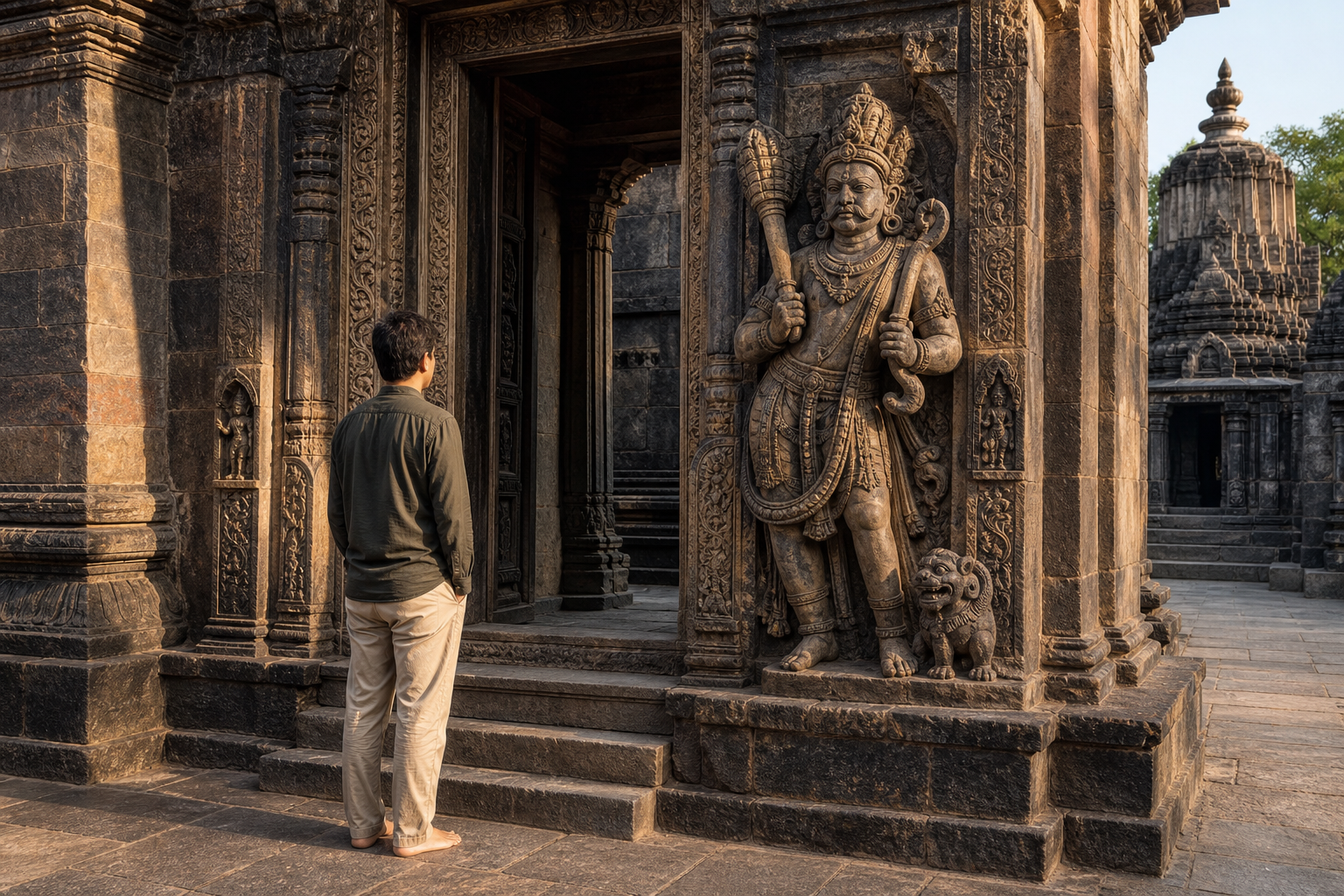
You do not need to memorise an iconographic catalogue before entering a temple. Use this sequence on one figure at a time:
- Step back far enough to see the architecture. Include the full doorway, neighbouring wall, base mouldings and any matching figure in your view.
- Name the position without interpreting it. Say “left jamb base,” “outside the gateway,” “perimeter shrine” or “northern wall” before saying “Bhairava,” “Kubera” or “nidhi.” This separates observation from inference.
- Find the relationship. Search for a partner, vāhana, retinue or principal deity. A conch becomes far more diagnostic when a lotus-bearing counterpart answers it from the opposite side.
- Record the stable attributes. Note the objects actually visible. If weathering has erased a hand or emblem, mark it as unreadable rather than supplying what you expected to see.
- Read the body’s action. Is the figure standing at ease, advancing, dancing, restraining, blessing or guarding? Posture often clarifies what an ambiguous object cannot.
- Check direction with the building, not your body. Establish the temple’s orientation before invoking the dikpālas.
- Confirm the local identity. Read an inscription or temple notice where available, or ask a knowledgeable priest or guide. Local sampradāya and sthapati traditions can preserve a valid identification that a generic checklist would miss.
Use tentative language until the cluster is complete: “probably a Bhairava because of the dog, skull cup and perimeter placement” is stronger than “that weapon proves it is Bhairava.” This is not indecision. It is disciplined seeing.
Remember that you are examining living ritual architecture. Keep out of restricted areas, avoid obstructing worship, and follow the temple’s rules for photography. A better view is not worth turning another devotee’s darśana into your field exercise.
Key takeaways
- Read placement before expression: doorway, jamb base, perimeter and direction indicate different kinds of guardianship.
- Identify the role before forcing a personal name. “Dvārapāla” or “kṣetrapāla” may be the most accurate first answer.
- Require a cluster of place, form and relationship; no single weapon or facial feature is decisive.
- A dog strongly supports a Bhairava identification when fierce Śaiva attributes and a protective location are also present.
- A conch-and-lotus pair of small yakṣa figures points toward Śaṅkha Nidhi and Padma Nidhi, guardians of auspicious, dharma-directed prosperity.
- Fierceness expresses active protection and the dissolution of obstruction, not moral evil.
At your next temple, pause at one threshold for a minute before moving inward. Find the guardian’s place, object and companion, then state its role in one careful sentence. That small practice turns the carvings around you from background ornament into a readable grammar of sacred order.
References
- DharmaRenaissance Blog — Samhara Bhairava Iconography Unveiled: Fear-dissolving Tantric symbols, weapons, and temple role
- DharmaRenaissance Blog — Shankha Nidhi Unveiled: Kubera’s Conch Treasure and Guardian of Auspicious Wealth
