
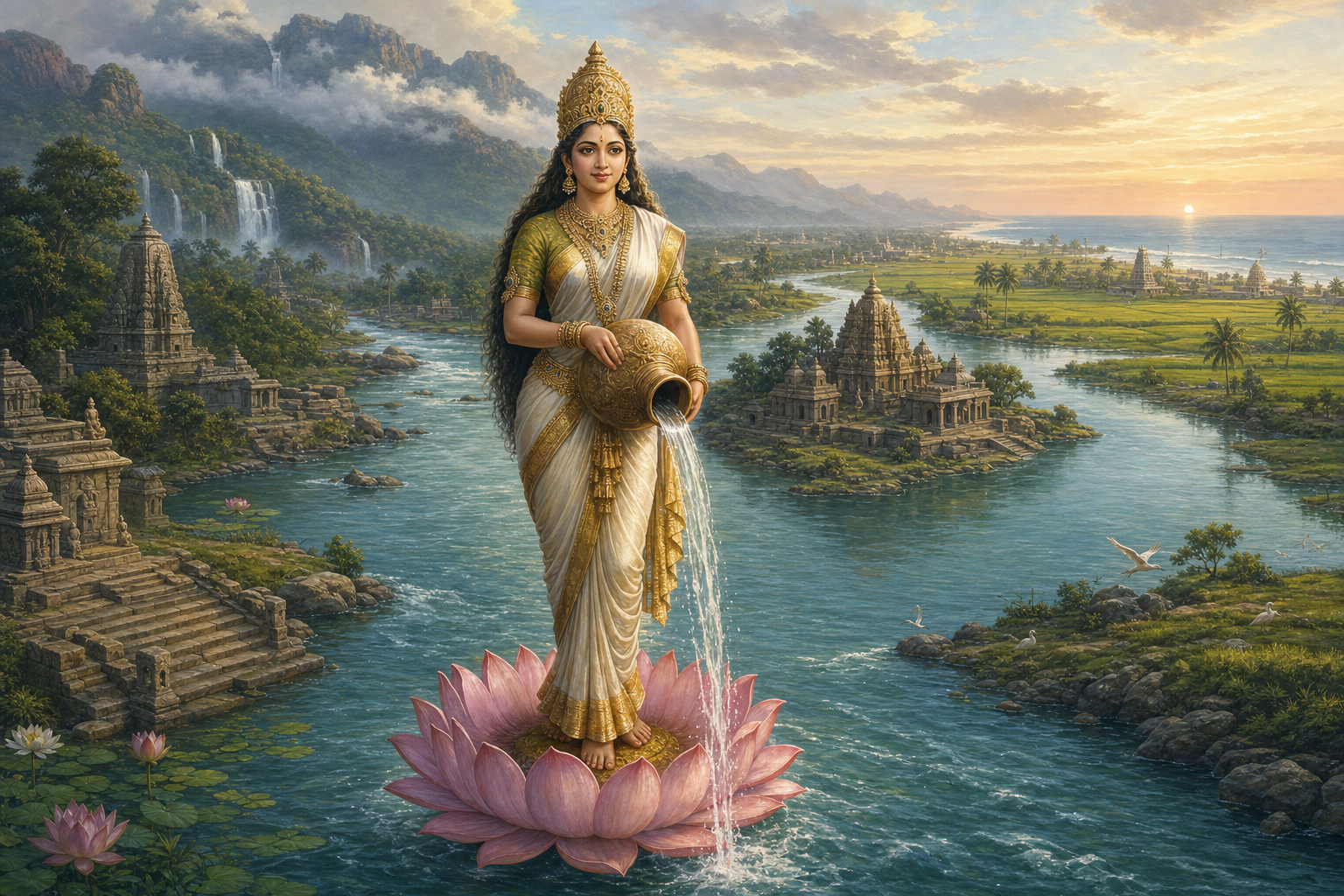
You are standing before a crowned female figure holding a water vessel. A lotus rests near her feet, aquatic forms curl around the niche, and the temple itself stands within the Kaveri basin. Is this Goddess Kaveri, another river goddess, or a local Amman represented in a similar visual language?
The honest answer rarely comes from one attribute. To identify Kaveri with confidence, you have to read three things together: the image, its architectural position, and the sacred life of the place. That method turns a beautiful but anonymous sculpture into an intelligible presence within the river’s journey from Talakaveri to the sea.
Identification requires three kinds of evidence
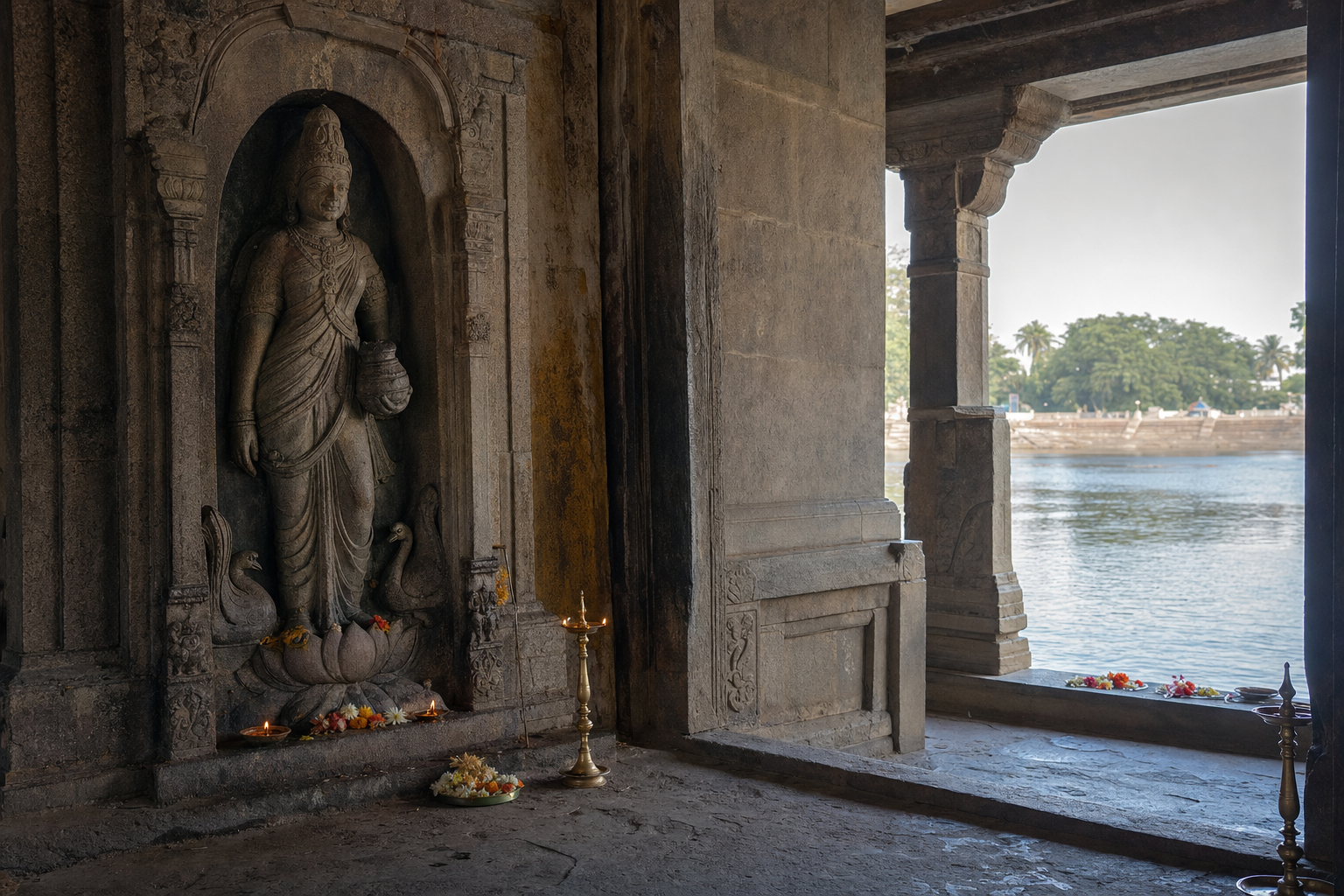
Begin by resisting the quickest conclusion. A pot does not automatically make a figure Kaveri. A lotus does not settle the question either. River goddesses share attributes, and temple artists work within related conventions. The name becomes persuasive when form, placement, and local context point in the same direction.
- Read the form. Look for a kumbha or water pot, lotus imagery, a gentle expression, a tall crown, aquatic creatures, and ornament that preserves a flowing bodily line.
- Read the placement. Determine whether the figure guards a doorway, occupies a side niche, stands near a circumambulatory path, or belongs to an independent Kaveri Amman shrine.
- Read the context. Check the name used in worship, nearby inscriptions or labels, local narratives, processional customs, river festivals, and the temple’s relationship to a source, island, confluence, ghat, delta, or coast.
The third pass is often decisive. Ganga and Yamuna commonly flank sacred thresholds across Indian temple traditions, including in the South. A river figure beside a door therefore may express purification without representing Kaveri specifically. In the Kaveri basin, however, a locally named Kaveri Amman, a rite directed toward the adjacent river, or a narrative connection to Agastya gives the same visual features a much sharper identity.
If you are documenting a sculpture, photograph more than its face. Record the full body, each hand, the pedestal, the arch above it, adjacent figures, and the wall or doorway containing the niche. Then note the locally spoken name. A close-up may preserve the artistry while removing the very evidence needed for identification.
This three-part test also prevents a common mistake: treating iconography as a code in which every symbol has one fixed answer. Kaveri’s images belong to a visual and ritual grammar shaped by river, temple, and region. You identify her through convergence, not through a single visual password.
Read the visual grammar without forcing a name
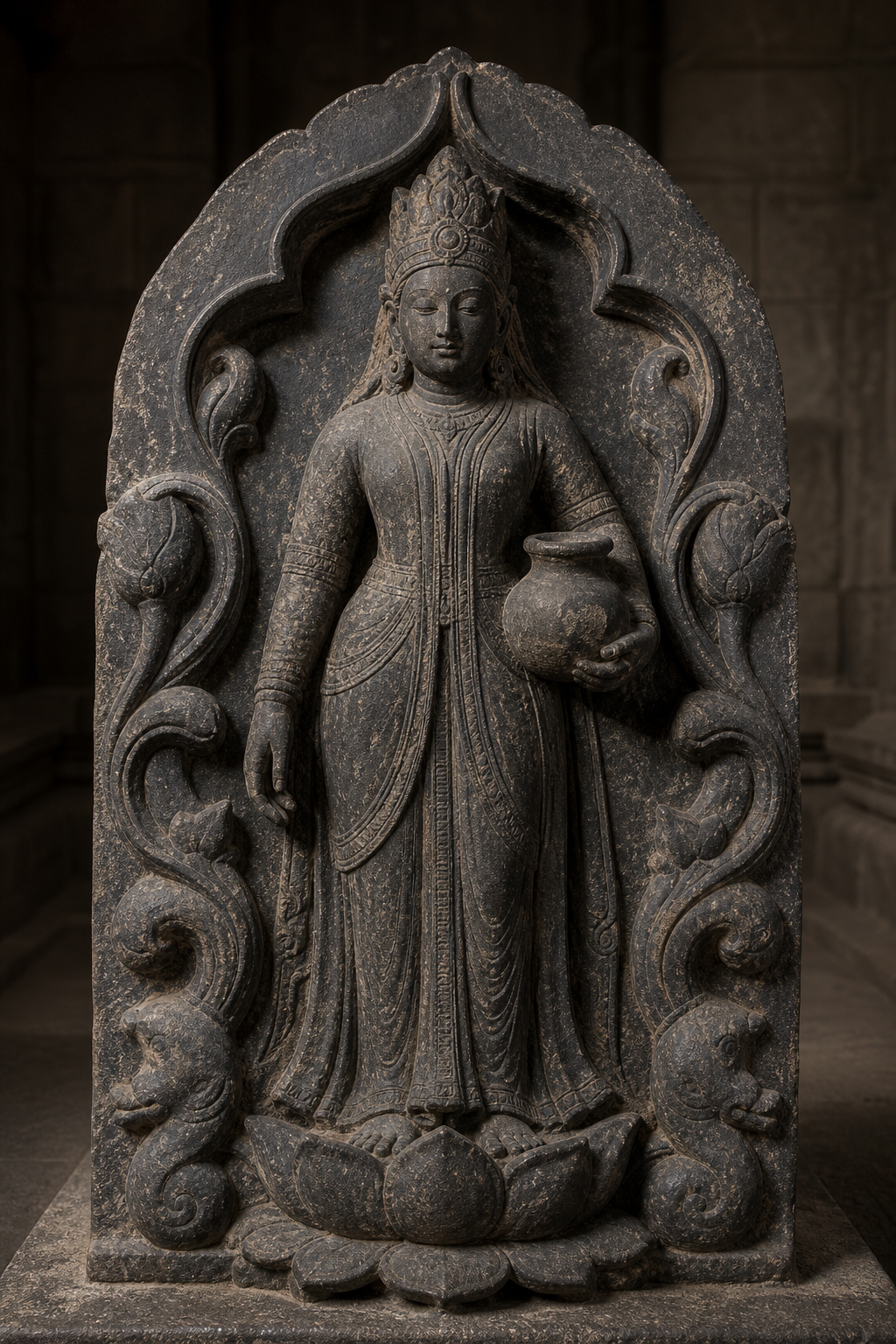
The kumbha is the first attribute to examine. At its broadest level, the filled vessel signifies water, abundance, and a source that continues to give. In Kaveri’s case it carries an additional narrative charge: she is remembered as dwelling in the water vessel of Sage Agastya before being released for the welfare of the land. Where the local tradition invokes that episode, the vessel is not merely decorative. It compresses the river’s restrained potential and generous descent into one object.
Lotuses may appear in her hands, beneath her feet, or as pendant forms in the surrounding architecture. They reinforce an aquatic setting while also conveying auspicious emergence. Fish, curling foliage, and the makara, a mythic aquatic hybrid, can extend that watery identity beyond the body of the goddess. A makara may appear below the figure or within an arch, while a kirtimukha and vegetal forms can organize the frame above her.
Next, look at movement. River goddesses may be composed in balanced samabhanga or in the gently bending tribhanga. Soft modeling, slight torsion, and drapery that follows rather than arrests the body help the figure imply flow without literally depicting moving water. The face normally carries saumya bhava: calm, gracious, and protective rather than fierce. A karanda-mukuta may crown the head, and the jewelry can be rich without making the figure visually rigid.
These features tell you that the sculptor wanted the body to behave like water: composed yet mobile, nourishing rather than threatening, ornamented yet unobstructed. They establish a river-goddess reading. They do not, on their own, distinguish Kaveri from every other personified river.
Regional style provides another layer of evidence. Chola-period work in the Kaveri delta, especially from the tenth through twelfth centuries, favors poised bodies, controlled torsion, refined surfaces, and drapery cut in fine ridges. Temple programs at Thanjavur, Darasuram, and Gangaikondacholapuram also preserve aquatic imagery and references to river-fed abundance. Those surroundings reveal how deeply the river informed the civilization’s artistic world, but an aquatic motif in a Chola temple is still not an automatic label reading “Kaveri.”
Hoysala carving in Karnataka produces a different effect. Chloritic schist permits exceptionally intricate bead chains, pendant lotuses, foliage, and makara arches. The denser surface can make water visible through ornamental rhythm: one form pours into the next like a carved cascade. When local worship also identifies the deity with Kaveri, this elaborate frame supports rather than replaces the contextual evidence.
Metal changes the encounter again. A panchaloha Kaveri Amman can leave a fixed shrine during a procession and approach the riverbank, an embankment, or a gathered community. Lamplight moving over polished metal gives the image a watery gleam, but the more important change is ritual: the goddess becomes mobile. The procession connects the personified river inside the temple with the flowing river outside it.
Follow Kaveri’s geography from source to sea
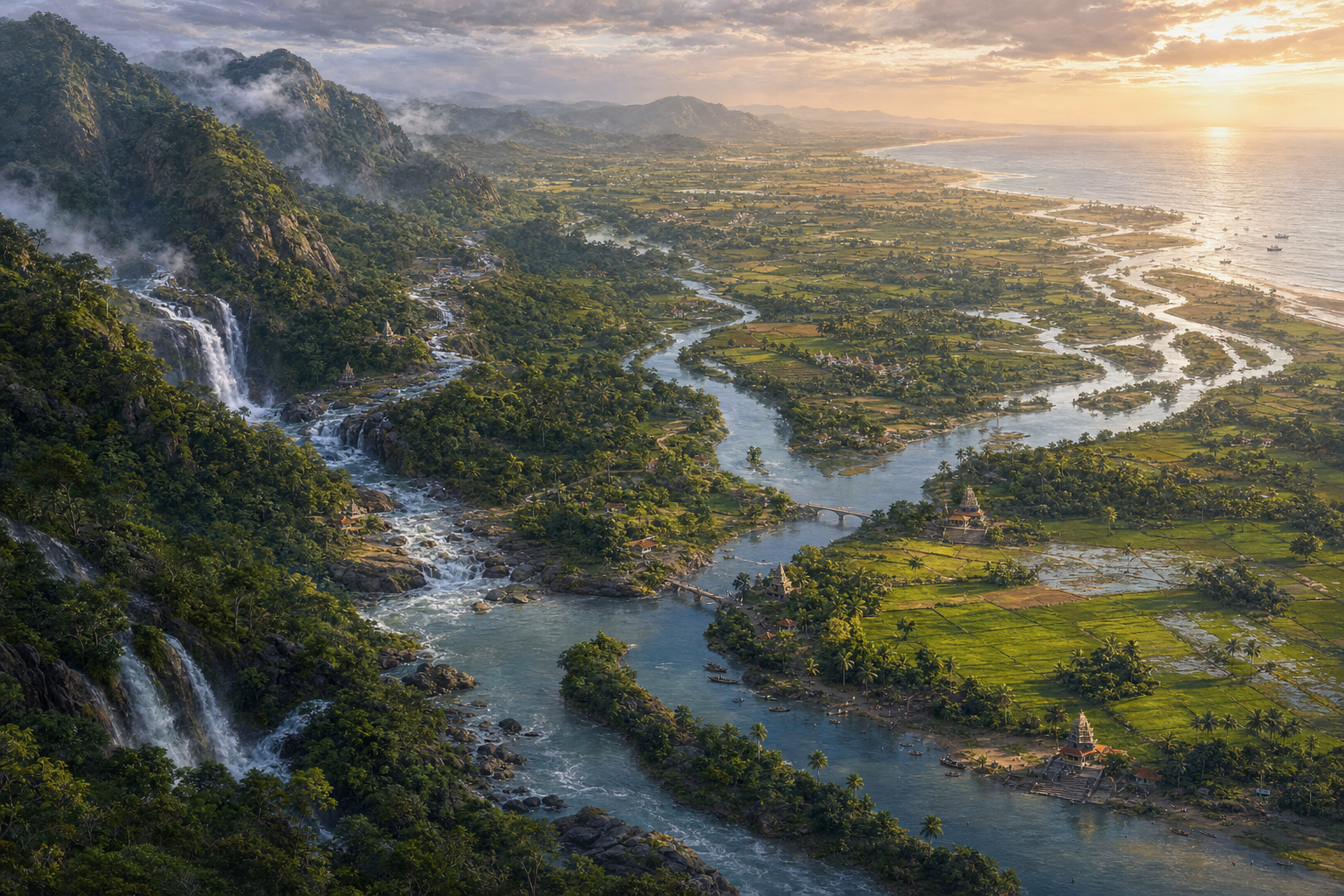
Kaveri’s sacred geography is not a list of unrelated holy sites. Each part of the river reveals a different aspect of her personhood. If you travel through the basin, read the route as a sequence: manifestation, release, protection, embrace, fertility, confluence, and arrival at the ocean.
At Talakaveri in Kodagu, the governing idea is origin. The presence of Kaveramma alongside Agastyeshwara and Ganapati places the river’s emergence within a sacred family of relationships. This is the right setting in which to notice the vessel narrative, the role of Agastya, and Ganesha’s part in releasing the contained waters. Kaveri Sankramana, observed in autumn, remembers her sacred rise through domestic and communal worship. Here you should ask how ritual makes a source present even when ordinary visual expectations about a large river do not apply.
As the river moves through Karnataka, places such as Srirangapatna and Shivanasamudra show that sacred water is not confined to a spring or sanctum. Island, channel, temple, settlement, and moving current belong to one religious landscape. Architectural images should therefore be read in relation to the nearby water rather than as isolated objects in a museum-like setting.
At Bhavani Kooduthurai, where Kaveri meets the Bhavani and Amaravathi, confluence worship presents her as a gathering power. The theological emphasis shifts from origin to meeting. Local deities, pilgrims, communities, and waters converge without losing their distinct identities. If you visit a confluence, note which direction worship faces, which waters are named, and whether the goddess is approached as one river among several or as the maternal presence binding the meeting together.
Srirangam gives sacred geography an unusually legible architectural body. The island is formed by the division of Kaveri and Kollidam, while local tradition remembers Kaveri receiving the boon of embracing Sri Ranganatha. The river is therefore not just scenery around a major Vaishnava temple. She is understood as holding the island and maintaining a ritual bond with the reclining deity. Processional paths, ceremonial approaches to water, temple memory, and the island’s physical form all participate in that relationship.
Farther into the Tamil country, the temple-rich landscapes of Thiruvaiyaru, Kumbakonam, and Mayiladuthurai reveal Kaveri as a sustaining mother of settled life. Here the meaningful visual field includes irrigation, cultivation, seasonal swelling, temple tanks, ghats, and the distribution of water across the delta. The affectionate Tamil name Ponni carries this sense of cherished bounty. A goddess with a vessel in this landscape belongs to an agrarian and devotional ecology, not merely to an inventory of sculptural symbols.
Near Poompuhar, Kaveri reaches the Bay of Bengal. Coastal Kaveri Amman traditions complete the movement from contained source to ocean. Monumental coastal representation can be read as an act of recognition at the river’s final threshold: the mother who nourished the interior is honored where her waters enter a larger expanse.
You do not need to visit every location to use this geographical method. At any Kaveri-side temple, ask where you are along the river’s life. A source shrine, an island temple, a confluence, a delta settlement, and a coastal sanctuary will not emphasize the same aspect of the goddess. Location does not merely decorate her mythology; it helps determine which meaning comes forward.
Let narrative and ritual explain what stone cannot
Kaveri’s genealogy gives her an intimate, personal identity. She is remembered as the daughter of Sage Kavera and as the consort of Agastya. Yet the decisive movement in her narratives is outward. Her divine life becomes a river for the welfare of beings, the nourishment of agriculture, the purification of communities, and the support of temple civilization.
One narrative places Kaveri within Agastya’s kamandalu. Another remembers Ganesha taking the form of a bird and tipping the vessel so that she could flow at Talakaveri. The point is not simply that a container was overturned. The episode presents sacred abundance as something that must be released into the world. When you see the water pot, Ganapati, Agastyeshwara, and Kaveramma within one ritual setting, read them as a narrative ensemble rather than as unrelated shrine elements.
The Srirangam tradition brings out a different relationship. Kaveri seeks the honor of embracing Sri Ranganatha, and the island’s geography realizes that desire spatially. The surrounding river becomes maternal custody: she holds deity, temple, pilgrims, and community within her course. This is why the landscape matters so much. A sculpture can show Kaveri as a woman, but the divided river around the island shows what her embrace means.
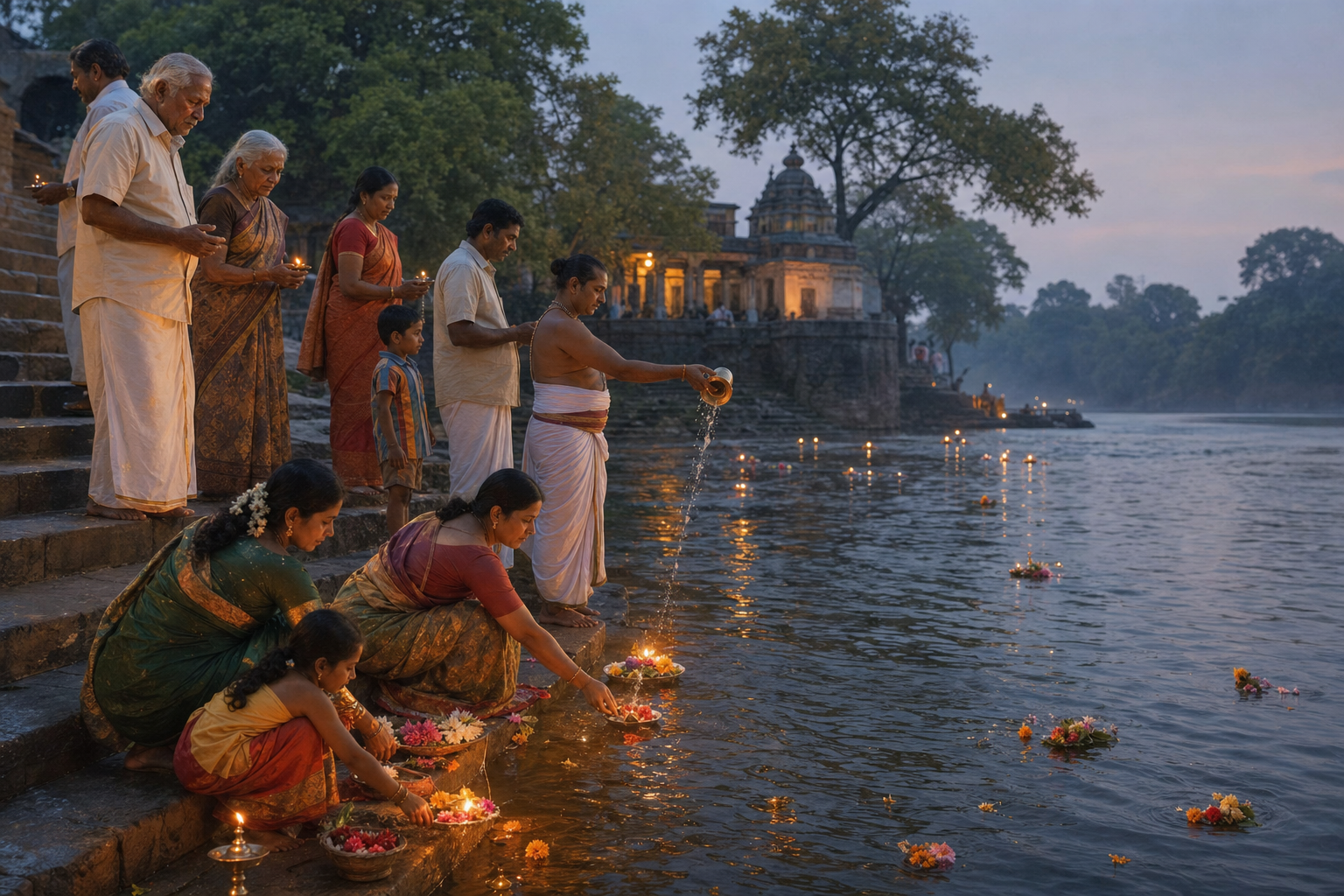
Ritual gives these meanings a calendar. During Aadi Perukku in Tamil Nadu, families honor the swelling river with flowers, lamps, cooked rice, and prayers for fertility, livelihood, and harmony. The observance directs attention to increase: water rises, fields receive nourishment, and households acknowledge dependence on a shared source. An image of Kaveri seen during this season is activated by the river’s condition and by collective thanksgiving.
Kaveri Sankramana in Kodagu turns attention toward sacred emergence. Pushkaram observances and temple Theerthavari days foreground bathing, ceremonial water, and the meeting between deity and river. During such occasions, a movable image is not a secondary copy of a “real” deity left inside. It allows divine presence to travel through the community and publicly reconnect with the water from which the iconography draws its meaning.
This distinction matters when you plan a visit. An ordinary day may be best for examining the niche, attributes, and architectural setting. A festival day may reveal the image’s full ritual function but make close visual study difficult. If possible, learn the local festival name and processional route before arriving. You will know whether to look toward the sanctum, a river entrance, a ghat, or an embankment.
Build a record worthy of a living sacred river
A useful pilgrimage record should preserve relationships, not just attractive images. For each place, write down the locally used divine name, the river feature nearby, the figure’s attributes, its position in the temple, accompanying deities, and any rite that joins the shrine to the water. Mark uncertain identifications as uncertain. That is more respectful and more useful than assigning a famous name to every graceful river figure.
You can use a simple sequence on site:
- Stand back and identify the architectural unit: doorway, wall niche, subsidiary shrine, independent sanctum, or processional pavilion.
- Record the hands, vessel, flowers, crown, posture, pedestal, attendants, and aquatic frame.
- Look for a paired river figure before assuming the image is independently Kaveri.
- Ask which name devotees and temple personnel actually use.
- Connect that name to the local river condition: source, channel, island, confluence, delta, or coast.
- Note which annual rite brings the image and living water into direct relationship.
The final step is ethical as well as interpretive. Calling Kaveri a mother means more than admiring an old image while ignoring the water beside it. Sacred geography joins worship to the material conditions of communal life: water, soil, cultivation, settlement, and continuity. Care for the river is therefore not an optional modern theme pasted onto an ancient tradition. It follows from recognizing the river as a life-giving divine presence rather than as an inert resource.
This recognition can also open a careful conversation across Dharmic traditions. Hindu practice personifies rivers as compassionate mothers. Buddhist traditions use water and naga imagery in contexts of protection and purification. Jain language preserves the idea of a tirtha, a ford or crossing, as both physical image and spiritual principle. Sikh sacred life gives an important place to sarovars associated with remembrance and equality. The traditions remain distinct, but reverence for water offers practical ground for shared stewardship.
Key takeaways
- A water pot, lotus, or makara supports a river-goddess identification but does not prove that the figure is Kaveri.
- The strongest identification combines attributes, temple placement, the locally worshipped name, sacred geography, and active ritual.
- Chola and Hoysala styles express watery movement differently; regional style helps you read an image but should not replace local evidence.
- Talakaveri emphasizes origin and release, Srirangam divine embrace, confluences gathering, the delta nourishment, and Poompuhar arrival at the sea.
- Festival processions reveal a relationship that a stationary viewing can miss: the temple image returns to the living waters and the gathered community.
- To venerate Kaveri coherently is to treat the river’s ecological life as part of its sacred heritage.
On your next visit, do not stop after photographing the goddess. Step back, locate her within the temple, ask what the community calls her, and then walk toward the water. The distance between the murti and the river is where Kaveri’s iconography becomes sacred geography.
References
