
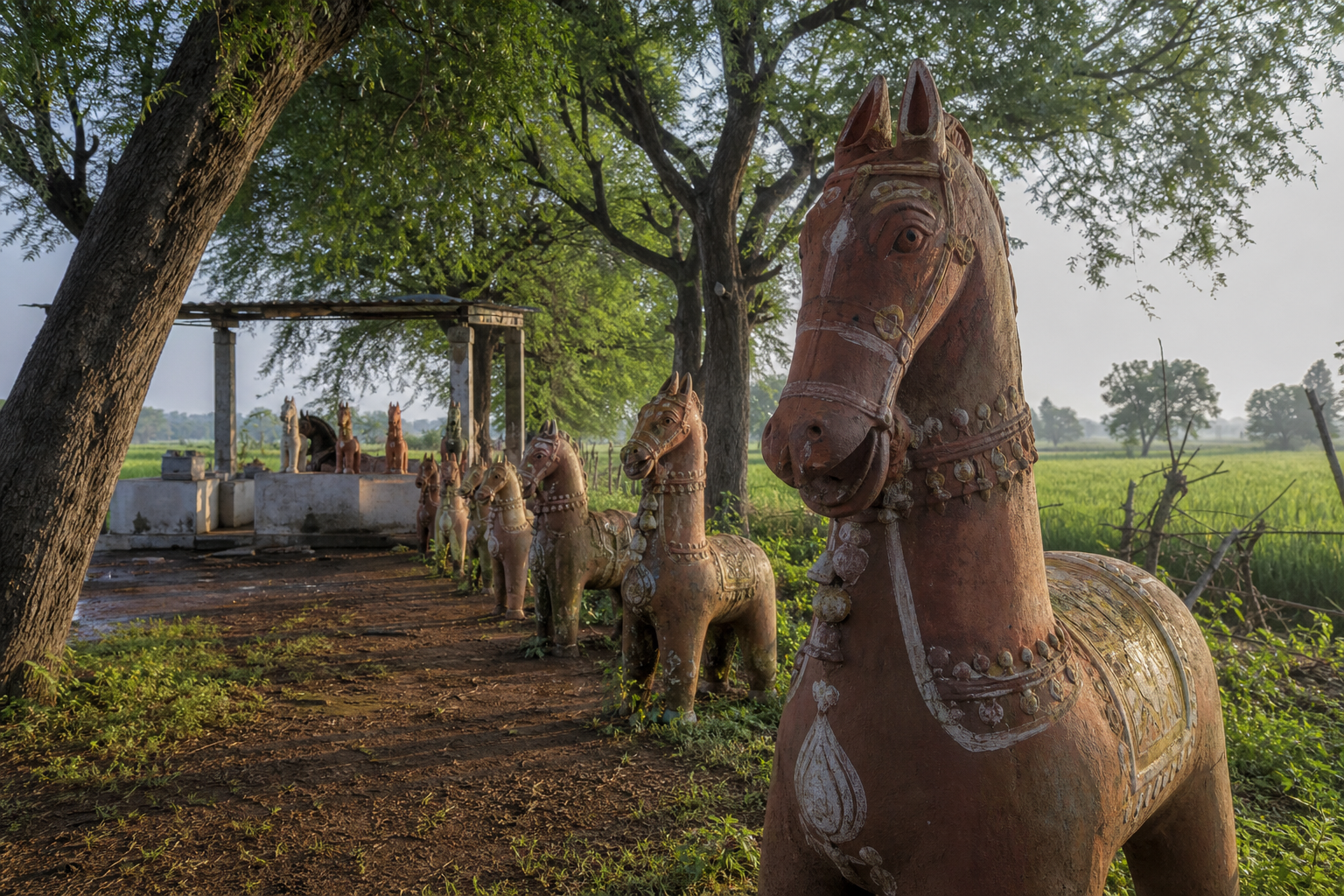
You may meet Ayyanar’s horses beside a village road, in a grove, or as a detached figure in a museum. The easiest mistake is to admire the object and miss the shrine: these horses belong to a living relationship among a guardian deity, a settlement, its potters, its land, and the vows made by its people.
If you want to understand what you are seeing, don’t begin by asking how old the largest horse is. Begin with three better questions: Why is it here? Who offered it? What is it guarding? Those questions turn an unusual sculpture into a legible expression of Tamil Dharma.
Key takeaways
- An Ayyanar horse is usually a votive offering within an active religious setting, not an isolated piece of decorative folk art.
- The shrine’s position near fields, paths, tanks, groves, and village limits is part of its meaning: Ayyanar is a kāval deivam, or guardian deity.
- The horse signifies alertness, movement, and the capacity to protect the settlement’s perimeter; its enlarged eyes, raised ears, and harness reinforce that purpose.
- The clay figure carries several kinds of knowledge at once: a devotee’s vow, a potter’s engineering, a village’s ritual protocol, and a community’s relationship with its environment.
- Weathering does not automatically mean neglect. Some communities intentionally replace old horses, allowing material impermanence and ritual renewal to coexist.
Begin with the boundary, not the horse
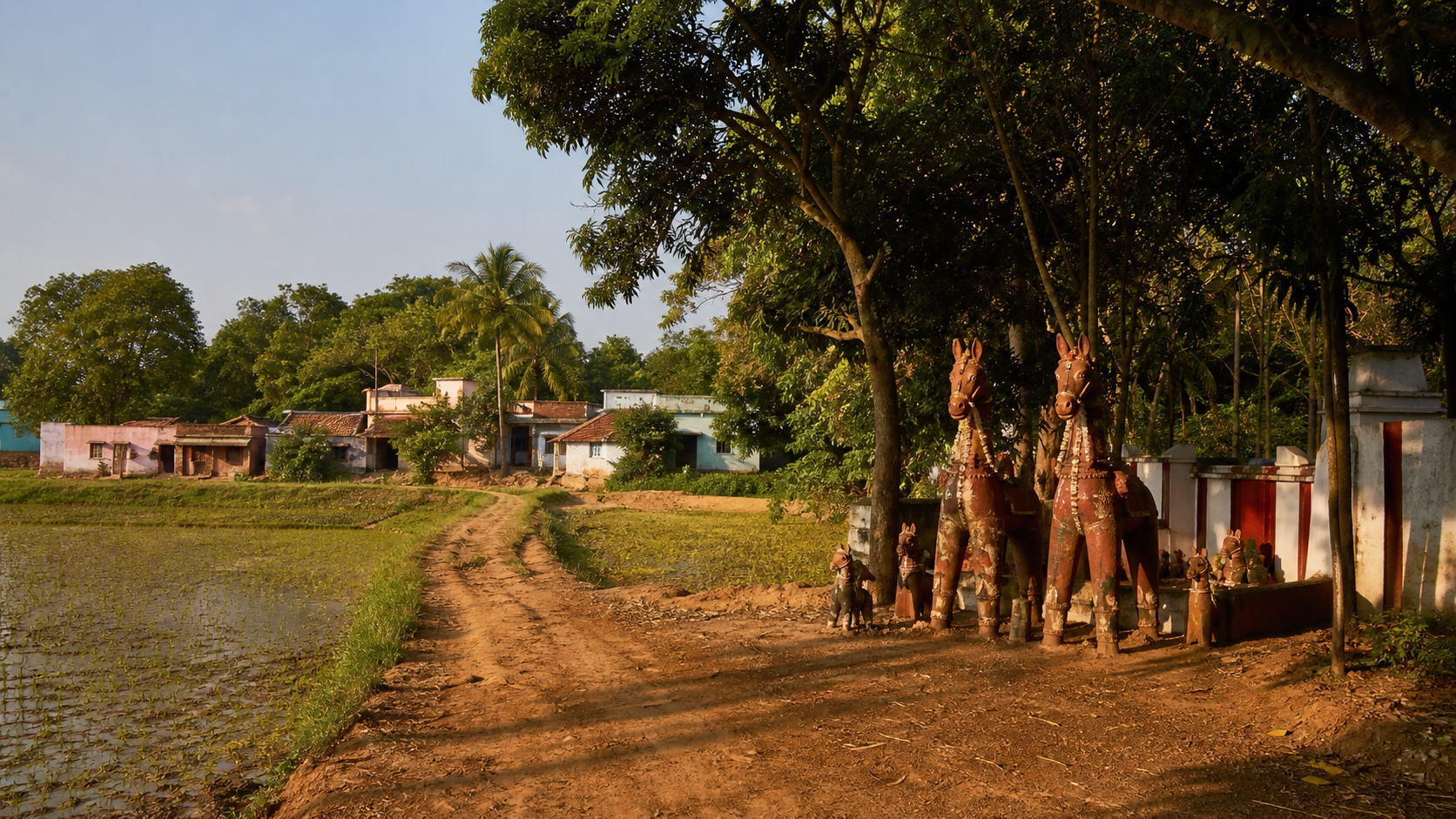
Ayyanar shrines often stand where settled village space meets something less controlled: a cart-track, open countryside, scrub, a water tank, or the transition from cultivated fields to a grove. This placement is not leftover space. It gives the shrine its ritual job.
Ayyanar’s protection is understood to extend around the settlement, including its crops, water, approaches, and communal order. Rows of horses make that protective presence visible. In the ritual imagination, a stationary clay horse can therefore communicate movement: it belongs to the retinue of a deity capable of ranging along the perimeter.
Some examples reach an extraordinary four to six metres in height. Their scale is easier to understand when you stop treating them as oversized ornaments. A monumental guardian addresses a village-sized field of concern.
When you stand at such a shrine, turn around before concentrating on the figures. Notice what lies behind them and what lies ahead. Look for the road entering the settlement, the edge of cultivation, a tank, or a surviving cluster of trees. A photograph that includes this setting will usually explain more than a tightly cropped image of a horse’s face.
This spatial reading also corrects a common misunderstanding about so-called village religion. The shrine is not peripheral merely because it stands on the periphery. Its location expresses responsibility for the whole community. The edge is where water, agriculture, wildlife, travel, and possible danger meet, so the edge becomes sacred.
Ayyanar is associated in parts of South India with Śāstha and has theological resonances with Ayyappa. That connection can help you see the continuity between village worship and wider Hindu traditions, but it should not be used to erase local distinctions. Ask which name, attendants, stories, and rites the community itself observes. A living Hindu tradition can participate in a broad theological family without becoming identical everywhere.
Read the horse as a vow made visible
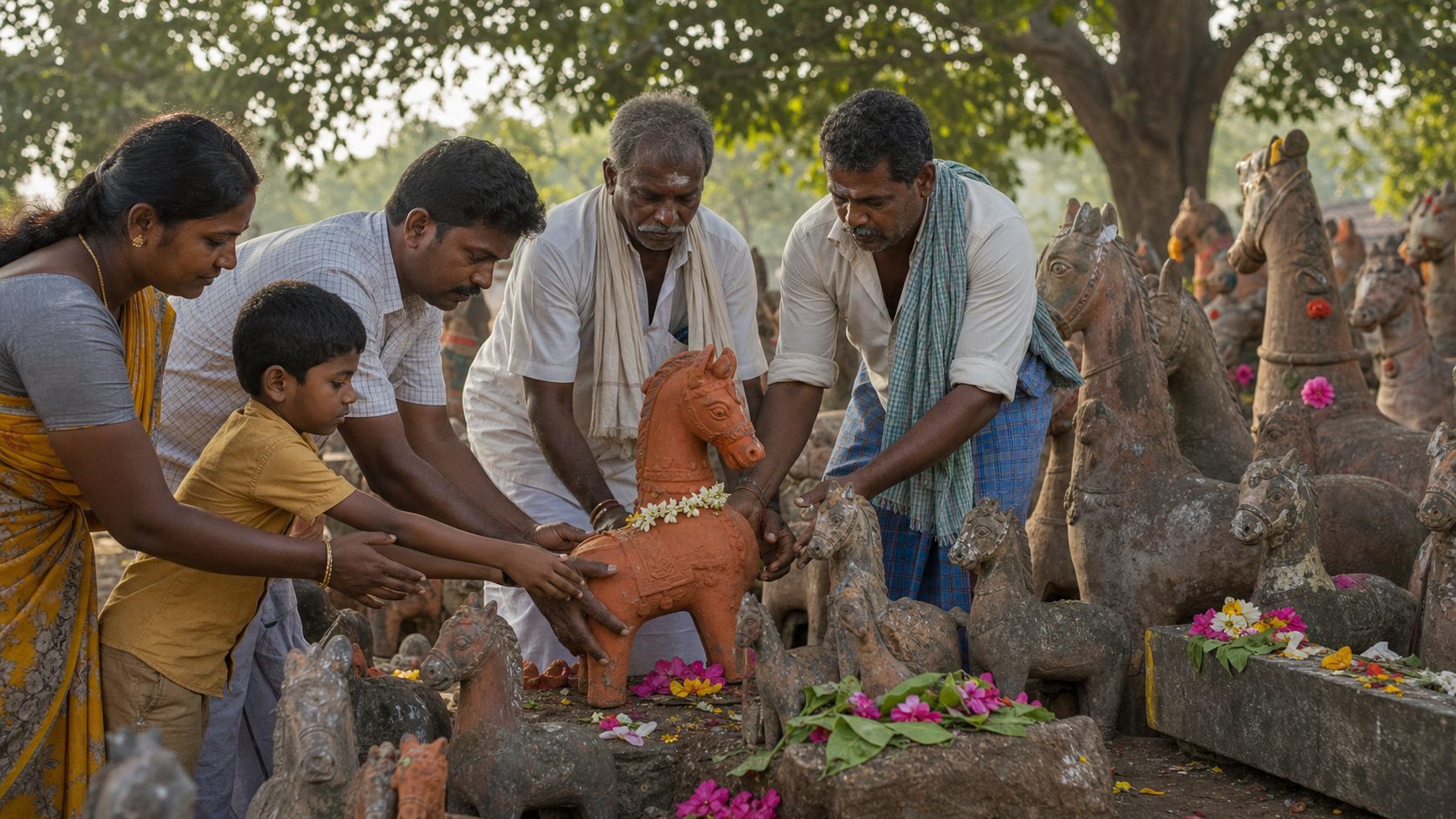
The most useful correction is simple: the terracotta horse is generally an offering to Ayyanar, not a substitute for Ayyanar. A household or a larger group may sponsor one while seeking protection or after a vow has been fulfilled. Harvest thanksgiving, family milestones, rain, health, and collective welfare can all enter this exchange, although the occasion and procedure differ by locality.
That distinction changes how you interpret a row of figures. You are not necessarily looking at several competing deities. You may be looking at accumulated acts of petition, gratitude, and renewal. Differences in size can express the scale of an offering or the protective power being invoked; they should not automatically be converted into a social ranking of donors unless local knowledge supports that conclusion.
The animal’s form is unusually well suited to guardianship. High ears listen. Flared nostrils suggest energy. Wide, fixed eyes announce unbroken attention and can carry an apotropaic function, turning away harmful influence. Modeled bridles, collars, and harnesses make the horse appear ready for service rather than at rest. Riders, attendants, or moustachioed guardian figures may extend the same visual language of mobility and deterrence.
Rows and rings matter as much as individual details. Repeated horses build a collective rhythm, while variations of scale can produce a rising visual force around the compound. Instead of searching for one universal iconographic code, compare the figures within that particular shrine. The locally repeated treatment of ears, collars, eyes, and ornament will tell you more than a generic label.
Ritual timing must also be read locally. Many communities emphasize the post-harvest months of Maasi and Panguni, when new offerings may be installed and processions may circle the village, but calendars and offerings vary across Tamil regions. Don’t arrive with a fixed script assembled from another district. Ask when the village observes its festival, which families or specialists coordinate it, and whether visitors may witness particular rites.
This is where Ayyanar worship reveals a distinctly Dharmic social logic. Protection is not imagined only as a supernatural service delivered to passive recipients. It is joined to gratitude, restraint, mutual obligation, care for shared resources, and the maintenance of proper relationships. Parallels with Buddhist and Jain concern for living beings or habitats can illuminate shared ethical resonances, but they are parallels, not proof that the traditions are interchangeable.
The clay records a whole community’s knowledge
Monumental terracotta is an engineering achievement
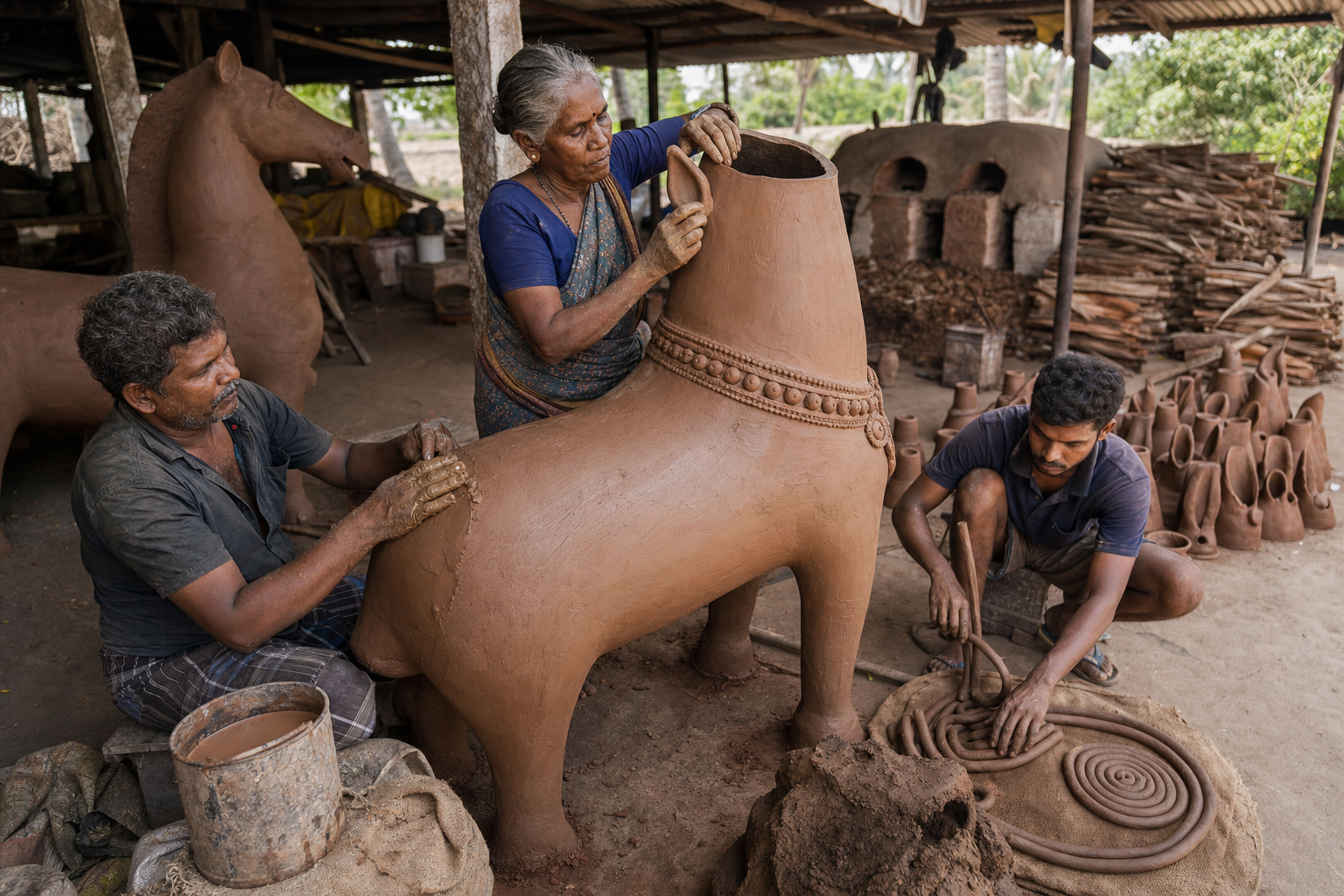
A large hollow horse has to survive shaping, drying, firing, transport, installation, intense sun, and monsoon rain. Its maker must solve structural and thermal problems long before the figure becomes a sacred offering.
Specialist Velar or Kuyavar potters prepare local clay and may add sand or crushed potsherd, also called grog, to improve strength and resistance to sudden temperature change. Large bodies are constructed as hollow sections with coil-and-slab methods. Supports or removable armatures help control the form; adjoining sections are fitted, scored or keyed, and bonded with liquid clay slip.
The firing is especially demanding. Temporary enclosures or open clamp kilns are packed with fuels such as wood, coconut fronds, or husk. The potter must manage the rise and fall of heat while accounting for wall thickness and openings that allow gases and heat to move. Heating or cooling too abruptly can crack work that may have required many people to prepare and handle.
After firing, surfaces may remain earthen red, receive red slip, be covered with white lime, or carry painted details around the eyes and harness. District styles differ: some favour tall, elongated profiles and dramatically flared ears, while others emphasize compact bodies, strong collars, or geometric ornament. Treat those variations as local signatures, not as imperfect attempts to reproduce one standard design.
When you look closely, notice construction joins, openings, wall edges, applied ornaments, and differences between modeled and painted detail. These aren’t merely technical curiosities. They show how a potter translated ritual expectations into a structure that clay and fire could sustain.
Ritual continuity depends on living relationships
A completed horse connects more people than its donor and maker. Ritual specialists arrange offerings and processions. Teams transport and install large figures. Elders preserve local rules. Younger participants learn how to approach the shrine, place new offerings, and retire damaged ones. Patronage, in turn, supports the potters who hold the necessary knowledge of clay, proportion, drying, and firing.
This is why preserving only a few impressive objects is not enough. If potters lose access to workable clay or fuel, if apprentices do not learn monumental construction, or if a community loses control of its shrine, a displayed horse can survive while the tradition that made it becomes weaker.
Do not turn continuity into a false date
The Ayyanar complex brings together several strands of South Indian religious life, including village-deity worship, regional Śaiva and Śākta traditions, and forms of remembrance associated with hero stones. Epigraphic references to Śāstha occur in the Chola period, and later Nayak patronage belongs to the tradition’s evolving history.
Those facts do not establish one uncontested birth date for every feature now found at an Ayyanar shrine. The precise antiquity of monumental terracotta horses remains debated. What can be said more carefully is that repeated forms and inherited techniques indicate a well-established, self-renewing system by the late medieval period.
This distinction protects the tradition from two distortions. Calling it merely recent ignores deep continuities in Tamil guardianship and worship. Claiming a precise, extremely ancient date for the present monumental form goes beyond the available basis. If you are writing a caption, use separate language for the history of Ayyanar or Śāstha worship, the history of the shrine, and the estimated date of the particular horse.
Weathering may be part of renewal, not evidence of abandonment
Earthenware remains vulnerable to rain, heat, invasive plants, and termites. Cracks, faded pigment, and surface loss are therefore unsurprising. Yet the religious answer has not always been to freeze every object in its newest condition. Some villages allow older horses to weather and replace them through a fresh cycle of vows and craftsmanship.
Before proposing cement repairs, repainting, relocation, or permanent shelter, find out whether the community regards the figure as active, retired, replaceable, or historically exceptional. An intervention intended to preserve material can disrupt ritual practice, damage porous clay, or bypass the potter families responsible for renewal. Community custodianship must determine the purpose of conservation.
The surrounding grove deserves the same attention as the figures. Sacred groves associated with some Ayyanar shrines can protect native plants and animals and help support local hydrology. A cleared compound containing freshly painted horses may look orderly to an outsider while having lost part of the shrine’s ecological function. Preserve the relationship among shrine, grove, tank, path, and field rather than treating vegetation as visual clutter.
How to visit, document, or support an Ayyanar shrine
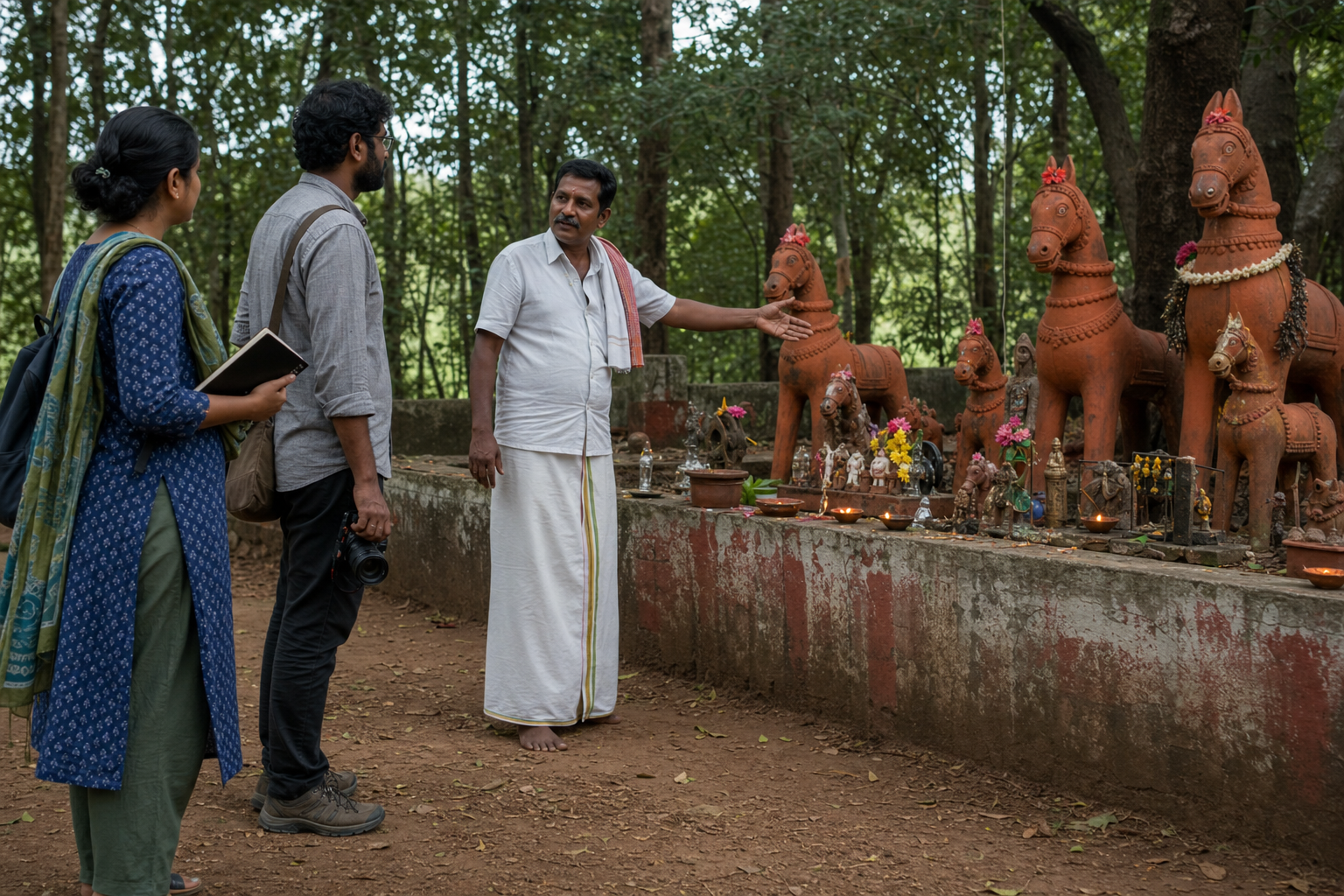
Your conduct should begin with one fact: you are entering a place under community care, not an open-air sculpture park. Local practice has priority over a visitor’s desire for a photograph, measurement, fragment, or dramatic story.
- Ask before entering or photographing. Find a custodian, resident, ritual specialist, or informed local guide. Permission to stand near the compound does not automatically include permission to photograph a rite, touch an offering, or enter every part of the shrine.
- Learn the local name first. Ask whom the shrine serves, how the deity is named there, and which attendants are represented. Don’t impose the vocabulary of another village merely because its figures look similar.
- Record the setting. With permission, note the horses’ relationship to the village boundary, road, fields, grove, and water. Include orientation and grouping in your notes; a detached close-up cannot preserve those relationships.
- Separate observation from interpretation. You can observe that a horse has wide eyes, a high collar, or weathered red clay. Whether it fulfilled a family vow, petitioned for rain, or belongs to a particular festival requires local confirmation.
- Ask who made and commissioned it. The potter’s community, the donor, the occasion, the installation date, and the retirement practice are essential parts of the object’s history. If a precise answer is unavailable, leave the uncertainty visible.
- Leave fragments where they are. A broken ear or painted shard is not a souvenir. It may remain ritually significant, and removing it destroys context even when the piece appears discarded.
- Support transmission, not just display. Where the community welcomes help, prioritize artisan commissions, apprenticeships, responsible documentation, access to clay and firing resources, and village-led care of the shrine and grove.
If you encounter an Ayyanar horse in a museum, apply a similar test to the label. Does it identify the deity, village or district, maker or craft community, approximate date, votive purpose, and acquisition history? A label that gives only material, height, and style describes the surviving object but not the religious system to which it belonged.
On your next encounter, spend the first few minutes looking away from the horse and toward the landscape it faces. Then ask one local question before forming your interpretation. That small discipline will help you meet Ayyanar worship on its own terms: as guardianship enacted through place, vow, skilled labour, and continuing communal responsibility.
References
