
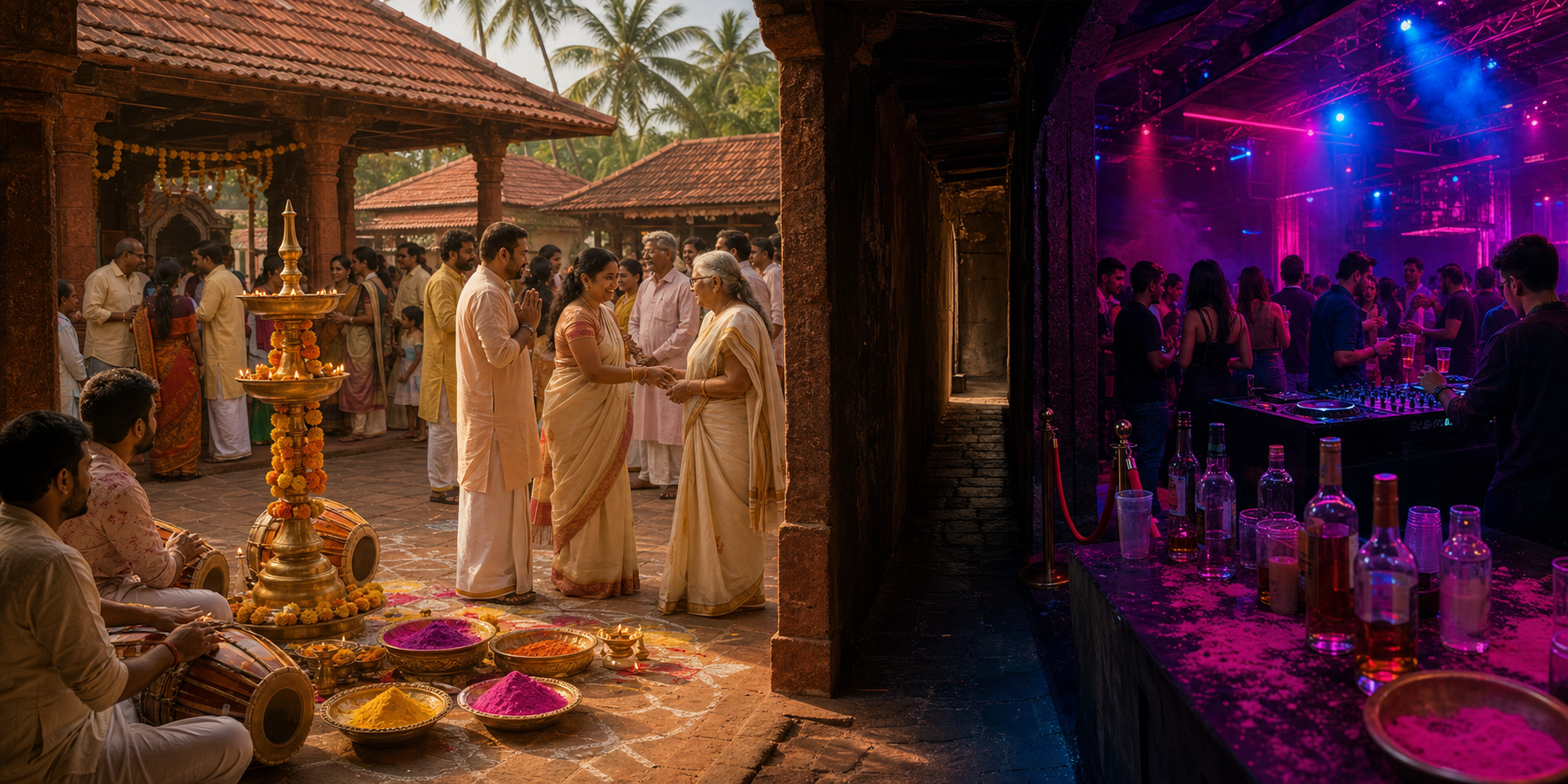
If you are deciding whether a Goa event deserves the name Holi, ignore the coloured powder on its poster for a moment and read the actual offer. Is Holi the heart of the gathering, or is it a visual wrapper around liquor packages, a DJ set and an after-party?
The practical line is not commerce versus devotion. It is whether commerce supports the festival or consumes its identity. Our clearest dharmic standard is simple: an event that trades on Holi’s name, stories or sacred symbols should be alcohol-free. Lawful nightlife can operate separately and describe itself honestly.
What is being protected when Holi is called sacred
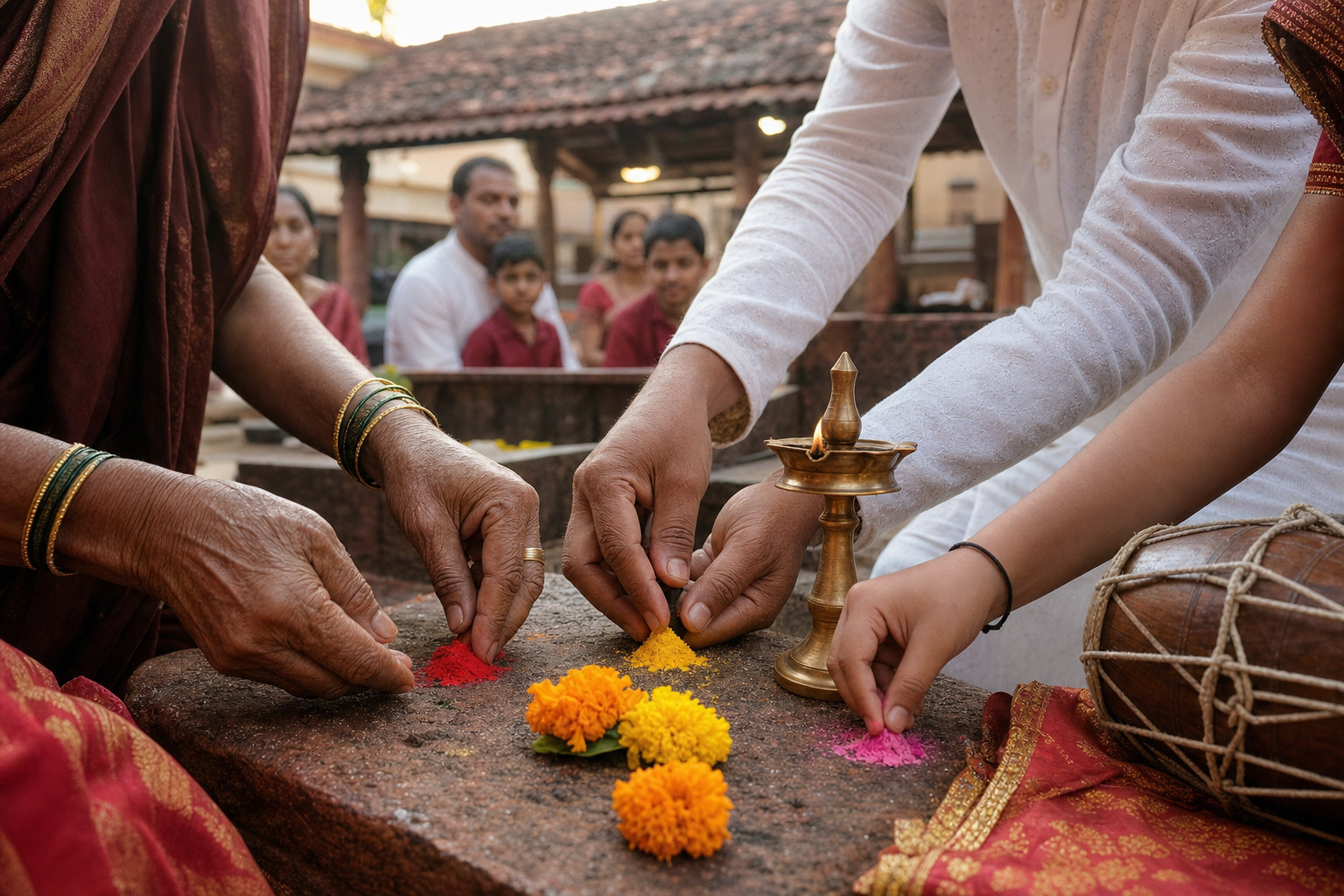
Holi is not sacred merely because it is old or popular. Holika Dahan recalls the triumph of devotion and dharma over adharma. The play of colour carries a social promise: resentment can be released, relationships renewed and joy shared across ordinary boundaries. Song, prayer, hospitality and communal participation are not ornamental additions. They give the celebration its moral shape.
That distinction helps separate three different objections. One person may oppose alcohol in all circumstances. Another may object to alcohol being sold at an event advertised as Holi. A third may object specifically to sacred imagery being used to sell intoxication. Public policy will not necessarily treat all three positions alike, but an organizer seeking cultural legitimacy should understand why the second and third objections are especially strong.
Legal permission is not the same as cultural approval. A business may satisfy its ordinary licensing obligations and still misuse the public meaning of a festival. A community, likewise, may ask more of an organizer than the statutory minimum without demanding that every nightclub, cruise or private business be closed.
This is why the demand to halt commercial Holi parties serving alcohol in Goa deserves a serious hearing. The concern is not that Holi has become too joyful. It is that alcohol-led marketing can reverse the proper order: the intoxicant becomes the product, while a sacred festival becomes its costume.
Holi remains a specifically Hindu observance. Its public ethic nevertheless meets values honoured across dharmic traditions: ahimsa and restraint in Jain thought, mindfulness and compassion in Buddhist practice, and seva and disciplined collective strength in Sikh life, including the spirit associated with Hola Mohalla. These parallels do not make distinct traditions interchangeable. They do give Goa a clear standard for public celebration: do not injure, degrade, coerce or exclude in the name of festivity.
Commerce itself is not the desecration. Artisans selling natural gulal, musicians presenting local traditions, cooks feeding visitors and families booking a well-run cultural program can all strengthen Holi. Use one diagnostic question: if the alcohol branding disappeared, would the event still be recognizably Holi? If the answer is no, the promoter is borrowing the festival rather than serving it.
Key takeaways
- A Holi-branded event should be alcohol-free if it seeks recognition as a sacred or cultural celebration.
- Generic nightlife and Holi observance can coexist in Goa when they are honestly labelled, separated by place and time, and not joined through sacred imagery.
- Before attending, ask about alcohol, colours, confetti, water, noise, crowd controls and provision for families and non-drinkers.
- Organizers should place ritual, community and seva at the centre of the schedule rather than adding them as decoration around a liquor-led party.
- Authorities can protect temples, ritual periods and festival identity through precise licensing conditions without treating every business or every part of Goa identically.
Use this six-question test before you attend or promote an event
You should not have to infer the character of an event from a colourful poster. Before buying a ticket, taking children, accepting a sponsorship or sharing a promotion, check six things.
- What is the event actually called? A devotional or cultural Holi program should describe its rituals, music, community activities and family arrangements. If the description is almost entirely about DJs, drink packages and an after-party, treat it as nightlife regardless of the artwork.
- Is alcohol incidental, restricted or the main sales hook? Look for bundled drinks, unlimited service, bar-led promotions or liquor bottles placed beside gulal, deities, temples or ritual fire. The closer alcohol is to the centre of the offer, the weaker the claim that Holi is the event’s true subject.
- Where and when will it happen? Proximity to a temple, heritage precinct, residential area or Holika Dahan gathering changes the effect on other people. So does amplified entertainment during a core ritual period. A promoter should disclose the venue, schedule and boundaries before asking the community for trust.
- What will touch your skin or enter the environment? Ask whether the organizer can identify the colours being used, whether hazardous synthetic dyes are excluded, and whether microplastic confetti is banned. The word “gulal” on its own is not a materials policy.
- How are water, noise and crowding controlled? A credible answer should cover water use, run-off, waste collection, entry control, venue capacity and sound management. “Celebrate responsibly” is a slogan, not an operating plan.
- Can families and non-drinkers participate fully? An event is not inclusive merely because children are admitted. Ask whether there is an alcohol-free program and space, whether people can enjoy the principal activities without crossing a bar area, and whether the atmosphere remains suitable throughout the advertised family hours.
One incomplete answer calls for a follow-up. Several incomplete answers tell you that the event has not earned your attendance, endorsement or money. Silence on safety and alcohol is not reassuring; it transfers the uncertainty to you.
If you are attending with children, visiting primarily for darshan or ritual, or seeking a culturally grounded experience, prefer a temple-led, community-led or explicitly alcohol-free program. Ask the venue direct questions in writing so that you are not relying on an ambiguous social-media image.
How to organize Holi without reducing it to a theme
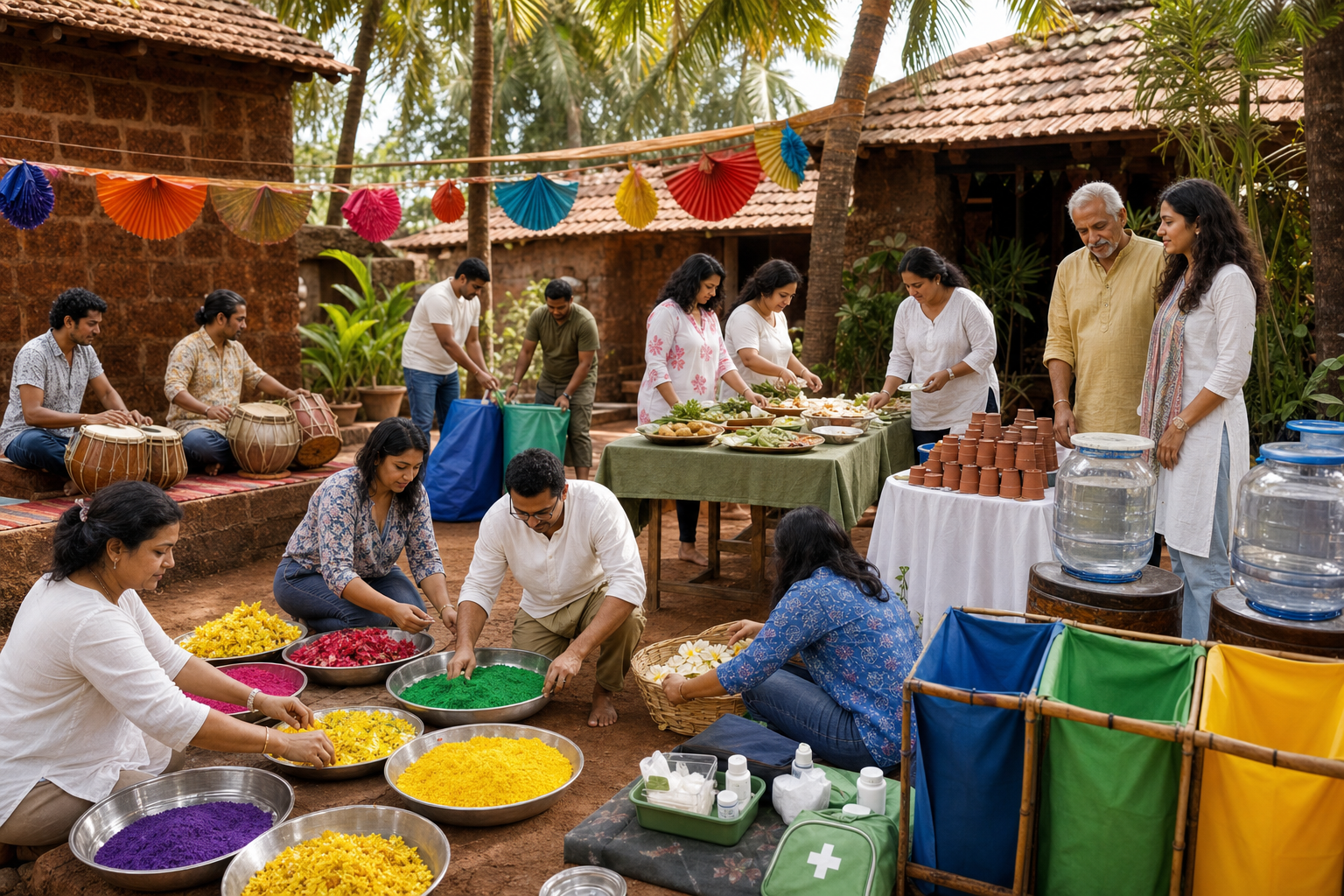
A responsible event begins with meaning and then builds its operations around that meaning. Adding a token rangoli or brief prayer to a liquor-led program does not repair the underlying design.
Give the sacred core protected time and space
- Publish a clear ritual and cultural schedule rather than hiding it beneath entertainment promotions.
- Keep Holika Dahan, prayer, kirtan, family colour play and associated cultural programming free from alcohol service and alcohol branding.
- Create a clearly marked family area that does not require visitors to pass through a bar or high-intensity dance floor.
- Coordinate sound and finishing times with nearby temples and residents instead of waiting for complaints.
- If the business also operates ordinary nightlife, separate that program in its name, imagery, location or timing. Do not call the transition a Holi after-party merely to extend the festival brand into alcohol sales.
Treat the name and imagery as responsibilities
Do not place deities, temple forms, Holika Dahan imagery, mantras or other sacred signs beside bottles, drink offers or invitations to excess. This is more than a graphic-design preference. Advertising teaches an audience what the festival means, especially when a visitor’s first encounter with Holi comes through a commercial venue.
Label the event truthfully. “Alcohol-free community Holi” makes a verifiable promise. “Holi-themed club night with alcohol” at least discloses its commercial nature, but it should not claim devotional or family standing and should not appropriate sacred motifs. An unclear label lets a promoter collect the cultural value of Holi while avoiding responsibility for its character.
Turn safety and environmental claims into conditions
- Obtain ingredient information for colours and exclude hazardous synthetic dyes instead of relying on an unverified “safe” label.
- Ban microplastic confetti and specify how waste will be collected before it reaches streets, drains or water.
- Set a water-use and run-off plan appropriate to the venue. Do not create chemical discharge merely to produce more dramatic photographs.
- Document entry controls, crowd flow and emergency access. Intoxication makes weak crowd management more dangerous; removing alcohol from Holi programming eliminates one avoidable source of impairment.
- Set sound levels and operating hours with residential and temple spillover in mind, as well as compliance with the Noise Pollution (Regulation and Control) Rules, 2000.
- Confirm every permission relevant to the venue. Excise and public-amusement requirements may apply on land, while cruise operators must also account for the maritime approvals governing their operations. Do not assume that an event ticket or venue booking settles these questions.
Make authenticity economically visible
Spend the program budget on the people who carry culture: folk and classical performers, local craft workers, makers of suitable colours, cooks and community groups. Include seva through food distribution or another concrete community contribution. Visitors then encounter Goa as a place with living traditions, not merely as a backdrop for a portable nightclub format.
Segmentation is useful when it is honest. Devotional mornings, community afternoons and entertainment in appropriate areas can serve different audiences without forcing them into one confused product. Family-friendly and alcohol-free programming can bring in parents, devotees and culturally motivated visitors who would avoid an alcohol-led party, while directing spending towards small businesses and artisans.
Goa needs precise rules as well as a clear cultural standard
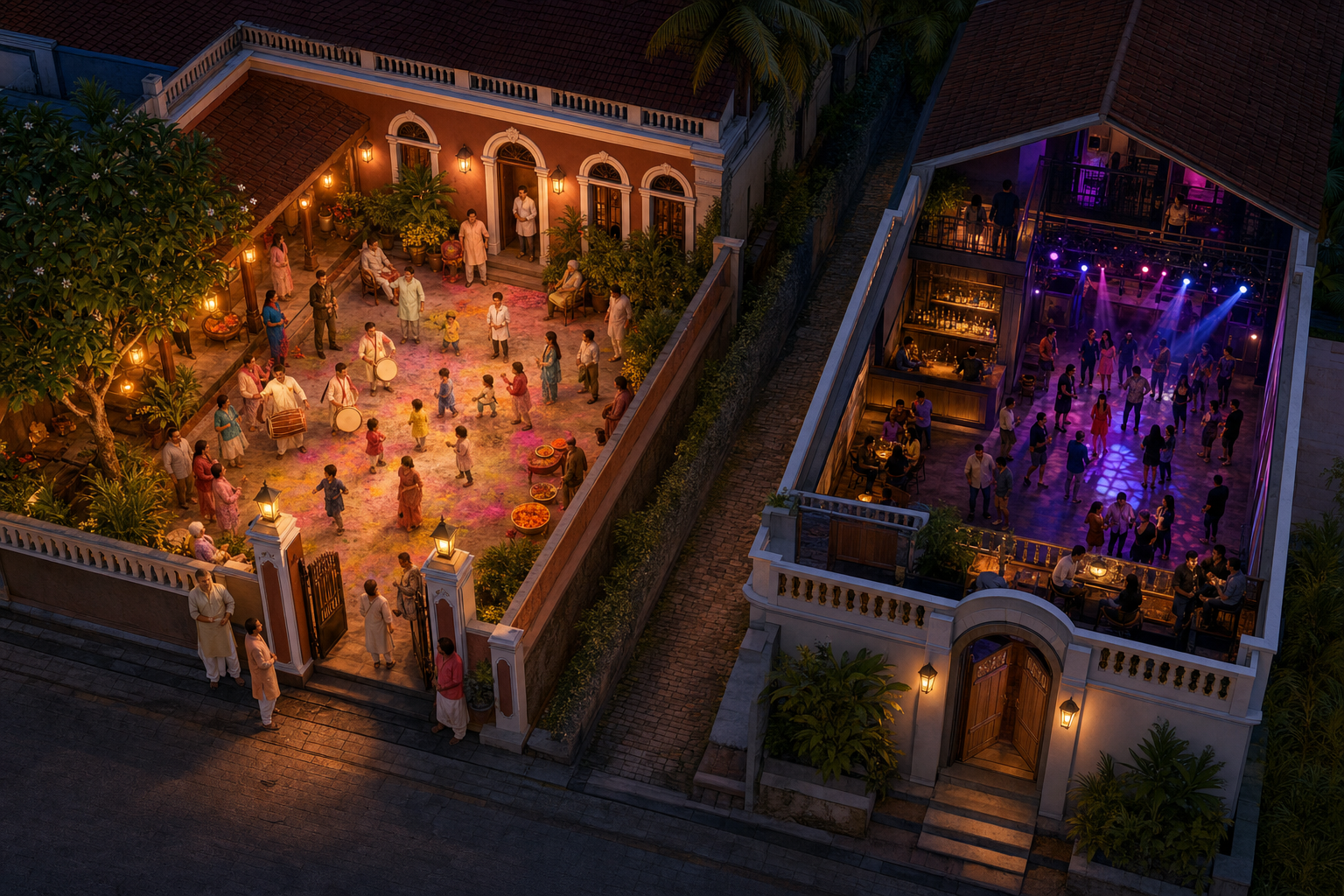
The ethical standard and the legal minimum are related, but they are not identical. A dharmic organization can reasonably insist that every Holi-branded program be alcohol-free. Government action, however, should be lawful, proportionate, clearly notified and consistently enforced.
Articles 25 and 26 of the Constitution protect religious freedom subject to public order, morality and health. Those provisions do not automatically decide whether a particular club or cruise may hold a particular event. Goa’s authorities also regulate excise, public entertainment, noise and maritime operations. That makes targeted licensing conditions more practical than slogans on either side of the dispute.
A workable rule has three layers
- Protect sacred places and core ritual periods. Notify locally appropriate protective areas around temples and heritage sites, and identify the ritual windows in which Holi-branded alcohol service and disruptive amplified entertainment will be restricted. The radius and hours should be published rather than improvised during enforcement.
- Protect the festival’s public identity. Distinguish devotional and cultural Holi listings from generic nightlife. Licensing and tourism-promotion conditions should prohibit the use of sacred symbols as liquor advertising and require prominent disclosure when alcohol is served.
- Apply safety rules to every event. Require credible plans for colours, microplastics, water, run-off, waste, noise and crowds. These conditions address observable conduct and harm rather than testing anyone’s private beliefs.
Advance notice matters. Promoters should receive the conditions before they sell tickets or commission advertising. Enforcement should apply fairly across comparable venues, with written reasons for restrictions and a rapid channel for correcting violations. Predictability protects devotees, residents and legitimate businesses alike.
How to object effectively when a boundary is crossed
If you see sacred imagery tied to liquor promotion, excessive noise near a temple, unsafe materials or an alcohol-led event being presented as family Holi, make the objection concrete. General outrage is easy to dismiss; a documented licensing or conduct issue is harder to ignore.
- Save the public advertisement and record the stated venue, date, hours and organizer. Preserve what was publicly visible without entering a restricted area or escalating a confrontation.
- Name the exact problem: sacred imagery beside a drink offer, alcohol service during an advertised family period, noise affecting a ritual gathering, undisclosed colour materials, microplastic confetti or absent crowd information.
- Ask the organizer for a specific correction, such as removing the image, separating the program, pausing alcohol service during sacred hours or publishing the safety plan.
- If the issue remains, direct the same evidence to the authority responsible for the relevant event, excise, noise or maritime permission. Ask for the applicable condition and the remedy, not for arbitrary punishment.
- If there is an immediate danger to people, contact local emergency authorities rather than personally confronting an intoxicated or overcrowded gathering.
Goa does not have to choose between hospitality and cultural confidence. It can welcome visitors, support enterprise and still refuse to let a sacred Hindu festival become a liquor-marketing device. Before you attend, advertise, sponsor or permit the next event, apply the simplest test: would it still look and feel like Holi if every alcohol logo vanished? Support it when the answer is yes. When the answer is no, choose another celebration and ask the promoter or authority for a precise correction.
References
