
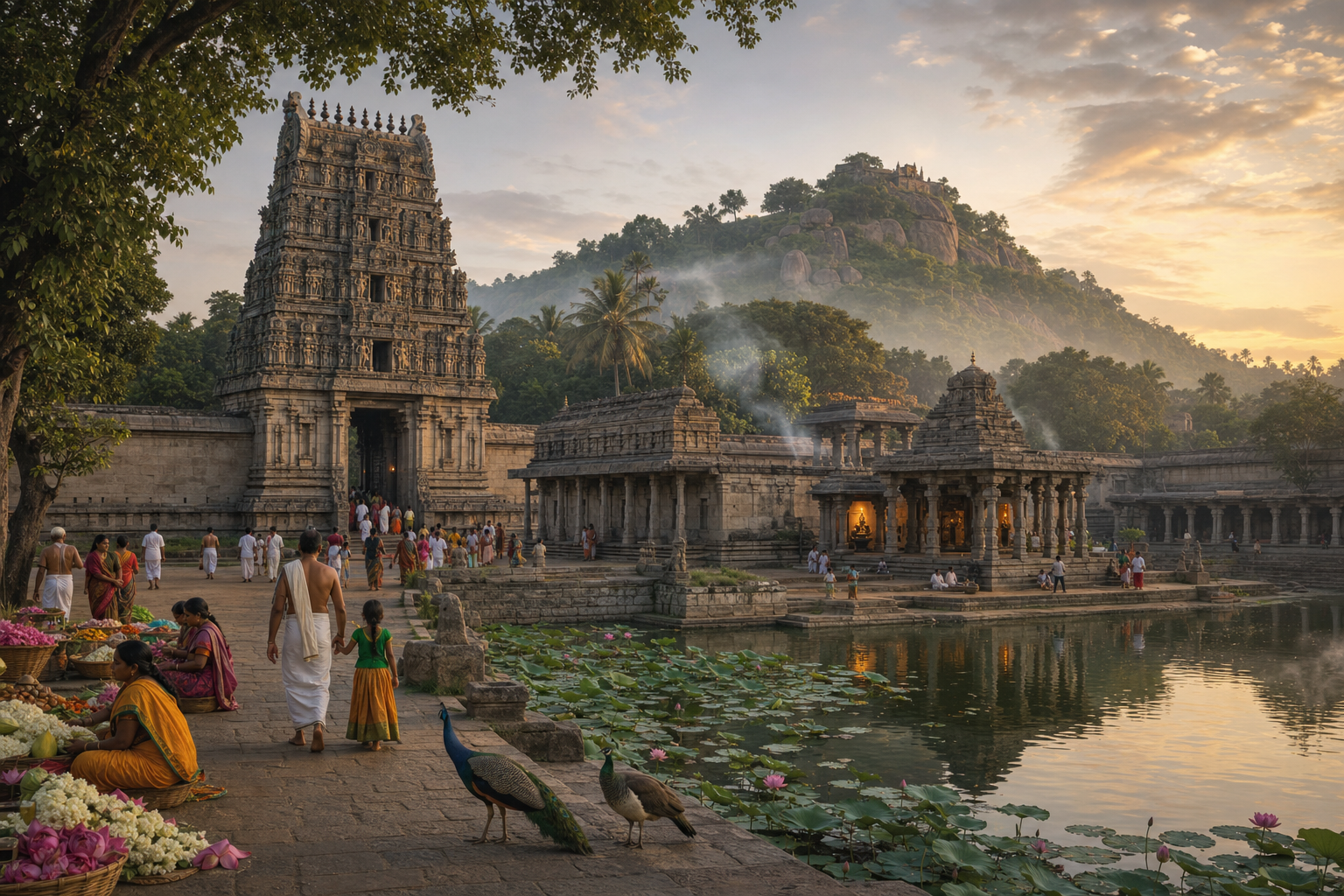
You enter a South Indian temple and meet several things at once: a many-armed image, lamps moving before the sanctum, music or recitation, subsidiary shrines, a processional path, and perhaps a hill, grove, tank, or resident peafowl outside. If you treat these as separate attractions, much of the temple’s meaning remains hidden.
A more useful approach is to read the temple as one sacred system. The icon identifies a particular divine presence. Ritual reveals how devotees relate to that presence. Architecture directs your body through that relationship. The surrounding ecology gives it a living place. This method will help you visit attentively without reducing the temple to either an art museum or a list of religious customs.
Begin with the exact divine form before decoding symbols
Do not begin with a generic question such as, What does Shiva, Devi, or Murugan symbolize? Begin with the name used in that sanctum. South Indian temple iconography is precise about form, relationship, mood, and place. Two shrines dedicated to the same broad deity may present markedly different theological experiences.
Bhadrakali Amman, for example, is not simply a generic image of the Goddess. Bhadra conveys auspiciousness and benevolence, while Kali is connected with kāla, or time. The Tamil title Amman makes the cosmic power intimate: Mother as the protector of families, neighborhoods, and villages. Her fierce appearance therefore needs to be read alongside her local, maternal role. She is fearsome because she confronts what threatens life and dharma, yet auspicious because that confrontation protects and awakens. This union of ferocity, protection, time, and maternal nearness is the form’s governing idea.
At Viralimalai, Murugan appears as Shanmuganathar: six-faced, twelve-armed, and seated upon the peacock. The form belongs to the sacred identity of the hill rather than functioning as an interchangeable representation of Murugan. The six faces express awareness extending in every direction, the many hands convey active protective capacity, and the seated posture brings power under sovereign composure. The seated Shanmuganathar and his mayil vāhana must be read as a complete composition.
Use the following five-pass method when you face a temple image:
- Name the form. Look for the local name, title, consorts, and associated legend. Shanmuganathar, Bhadrakali Amman, and Subrahmanya with Valli and Deivayanai disclose different relationships even before individual objects are interpreted.
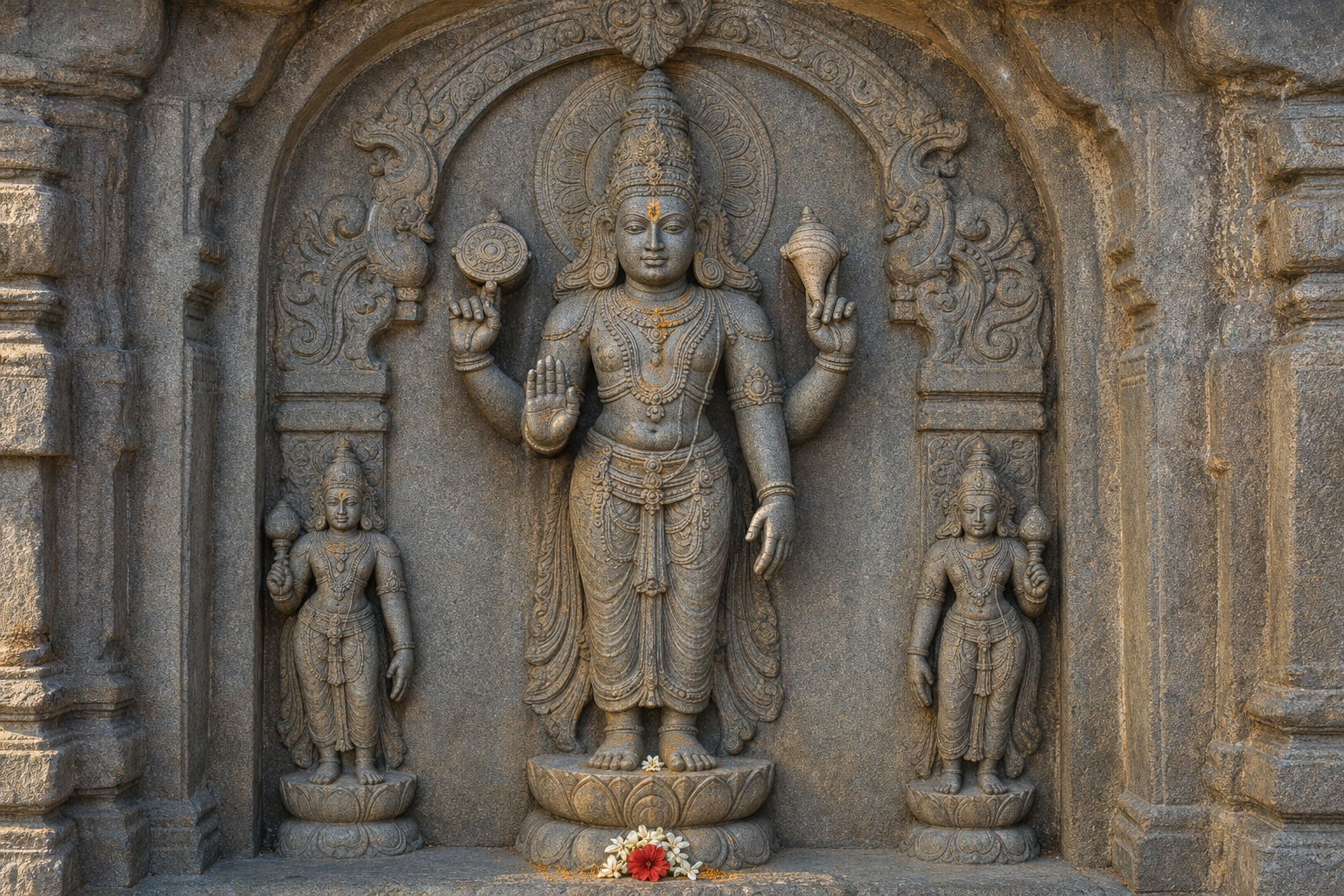
- Notice body, posture, faces, and arms. A seated form communicates differently from a dynamic standing form. Multiple faces indicate an expanded field of awareness; multiple arms allow several divine functions to appear simultaneously. These are not attempts at naturalistic anatomy.
- Identify attributes without isolating them. Bhadrakali’s sword can signify discriminative knowledge, while her trident gathers the three guṇas and threefold time into a single power. The skull directs attention to impermanence; the noose to the restraint of harmful impulses; the damaru to the pulse of creation; the shield to protection; and fire to transformation. Murugan’s vel similarly brings grace, discernment, courage, and protective action together.
- Read the hands that do not hold objects. Abhaya mudrā grants fearlessness, while varada mudrā offers blessing. In a fierce image, these gestures prevent a serious misreading: the deity’s power is directed toward refuge and right order, not uncontrolled violence.
- Include the vāhana. Murugan’s peacock is not a decorative pedestal. It represents splendor disciplined by virtue and the mastery of pride and poisonous impulses. When living peafowl inhabit the temple landscape, image and ecology begin to interpret one another.
Only after all five passes should you propose an interpretation. A sword by itself may look violent. A sword held by a protective Mother who also displays abhaya becomes a lesson in courageous discernment. A skull by itself may seem macabre. Within Bhadrakali’s theology of time, it reminds you that mortality can produce clarity, humility, and compassion. The whole composition governs the meaning of each part.
This discipline also protects a pan-Dharmic reading from becoming careless. Vajrayana protectors and wisdom ḍākinīs, Jain protective yakṣīs such as Ambika and Padmavati, and the martial feminine associated with Chandi in Sikh tradition offer meaningful resonances with courage guided by wisdom and ethical restraint. Resonance is not identity, however. Notice the shared moral vocabulary without declaring distinct deities, doctrines, or rites to be interchangeable.
Let ritual tell you what the icon does in community life
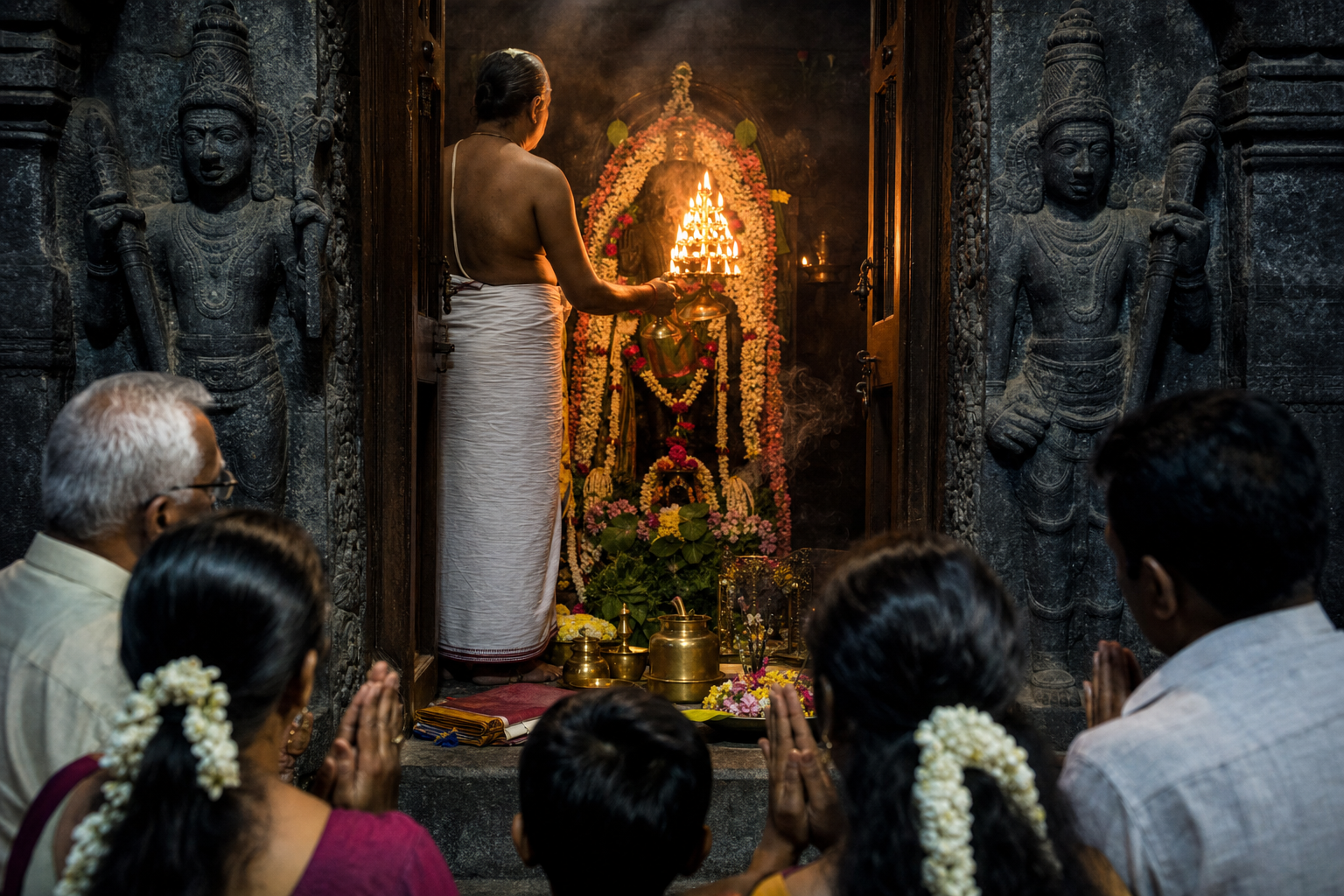
An iconographic description can tell you what a deity holds. Ritual tells you how the divine form enters time, relationship, and collective memory. A mūrti is bathed, adorned, praised, illuminated, carried, and approached. Each action functions like a verb attached to the visual form.
Abhishekam, or ritual bathing, directs attention to purification, consecrated care, and the underlying form. Alankāra, or adornment, may foreground beauty, sovereignty, maternal closeness, martial power, or a festival identity. Kumkuma archana is especially associated with forms of the Goddess. During deepa ārati, moving flame makes darśan a reciprocal encounter: the devotee sees the deity as the illuminated form becomes present to the devotee’s attention. These acts belong to a coherent rhythm of bathing, adornment, offering, and light, not to a collection of unrelated ceremonies.
The daily cycle is also local. At Viralimalai, it includes kālasaṇdhi, uchikālam, and sayaratchai pūjā, accompanied by abhishekam, alankāram, and hymnal recitation. Do not assume that a schedule from one temple applies everywhere, or that a ritual name guarantees the same public access at every shrine. Check the current temple schedule and arrive early enough to settle before worship begins.
During a ritual, give your attention to four changes:
- Visibility: Which features become clear during bathing, and which become prominent after adornment?
- Relationship: Is the deity approached as child, teacher, sovereign, warrior, mother, guardian, or member of a divine household?
- Sound: Which mantra, hymn, drum pattern, bell, or poetic name accompanies the form?
- Movement: Does worship remain centered on the sanctum, or does a festival carry the deity into mandapas, processional paths, streets, and community space?
Festival ritual makes these relationships particularly legible. At Viralimalai, Skanda Ṣaṣṭi presents Murugan’s victory as the conquest of adharma; Karthigai Deepam places radiance and insight at the center; Thaipoosam emphasizes vows and devotional endurance; and Panguni Uttiram celebrates Murugan with Valli and Deivayanai. The reenactment of Valli Kalyanam remembers a deity who enters the idiom of the hill people as a hunter and meets Valli within her own landscape. When you attend, ask which relationship the festival is making public. That question is more revealing than asking only what spectacle will occur.
Bhadrakali worship creates a different ritual field. Navaratri can move from the invocation of divine power toward victory over inner negativity, with recitation of the Devi Mahatmya turning fierce mythology into reflection on resilience and ethical renewal. Kerala traditions such as Theyyam and Kaliyattam use costume, movement, rhythm, and public participation to embody protective presence. In such settings, theology is not confined to an image in stone; it is transmitted through trained bodies, community memory, and shared attention.
Sound deserves the same concentration you give sculpture. Viralimalai’s association with Arunagirinathar brings Tiruppugazh into the temple’s devotional identity. Its intricate rhythmic organization makes tempo and tāla part of the approach to Murugan. Popular recitations such as Skanda Ṣaṣṭi Kavacham likewise shape courage and inward resolve. You do not need technical musical training to listen well. Notice repeated divine names, changes of pace, the point at which the assembly joins, and whether the sound accompanies bathing, adornment, ārati, or procession.
Keep public worship distinct from self-directed esoteric practice. A salutation such as Om Bhadrakalyai Namah may be used devotionally, while bīja-centered practice involving syllables such as Krīm belongs to a more guided discipline. If you want to move beyond public recitation into specialized mantra sādhana, seek a qualified guru and retain the ethical disciplines of ahimsa, restraint, and discernment. Intensity without guidance is not a deeper reading of the temple.
Read architecture as a path rather than a backdrop
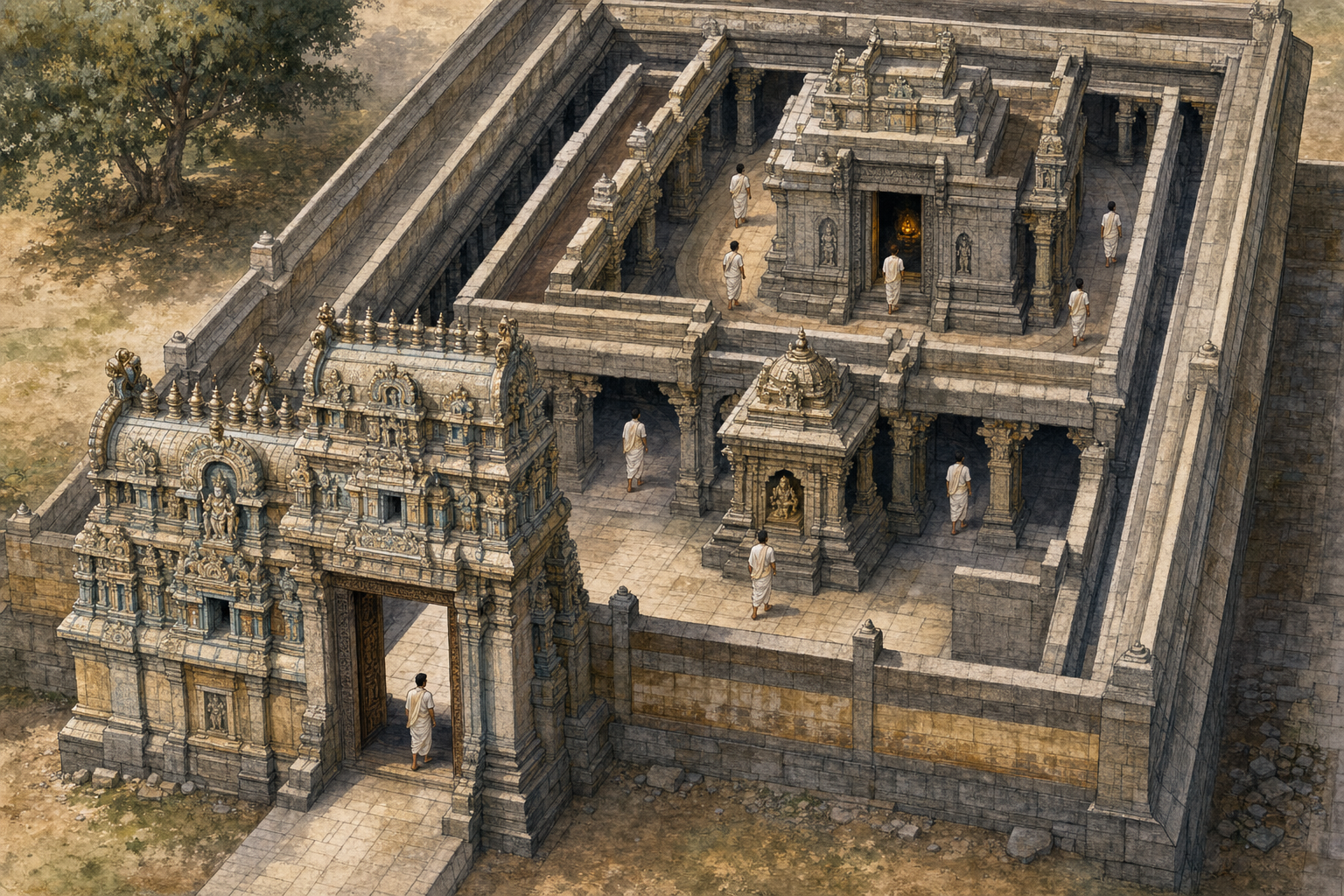
Temple architecture does more than house the central image. It regulates approach. Thresholds slow you down; mandapas gather people; subsidiary shrines establish divine relationships; a circumambulatory path changes your viewpoint; and the sanctum concentrates attention. Your movement is part of the temple’s religious grammar.
Viralimalai offers a clear hill-temple sequence. Granite steps turn ascent into sustained bodily effort. Images of Gaṇeśa and guardians along the way ritually prepare the visitor. Within the temple, the entrance, mandapa spaces, dhvajasthambha, balipīṭha, courtyard, prākāra, and sanctum organize a progression toward Shanmuganathar. Sub-shrines for Valli and Deivayanai prevent Murugan from being seen only as an isolated warrior. They place him within love, kinship, and household divinity. The independently revered vel keeps grace and discernment at the center of the site’s Kaumāra identity.
Walk this sequence without rushing directly to the sanctum:
- At the first threshold, identify what you are being asked to leave behind: footwear, noise, haste, photography, or an assumption that the site exists for casual viewing.
- During the approach, notice which deities or guardians come before the principal form. Their placement often tells you how the tradition prepares a devotee for darśan.
- At the flagstaff and offering area, look along the main axis toward the sanctum. This reveals how public space is oriented toward the deity even when the inner chamber is small.
- Use the permitted circumambulatory route to see relationships among the central sanctum, consort shrines, guardians, festival images, and landscape.
- On the way out, look back. The return view often makes the movement from concentrated sacred space to the wider community more apparent.
Follow local instructions at every stage. A processional route is not permission to enter restricted areas, and the desire for a clear photograph never overrides the sanctum’s rules or another devotee’s worship.
Architecture also accumulates history. Viralimalai’s plan, granite construction, stairway, pillared halls, and processional arrangement point to a medieval foundation with later work associated with regional polities, including the Vijayanagara–Nayak era. A complete epigraphic census has not been established in the available account, so a responsible visitor should resist assigning one date to every visible feature. Temples are often layered inheritances. Different walls, halls, images, and repairs may belong to different moments while serving one continuing ritual life.
This is why stylistic observation should remain modest. You can notice changes in stonework, scale, carving, or spatial organization without turning a visual impression into a firm historical claim. When an inscription, temple record, or careful epigraphic account is available, let that evidence carry more weight than a guess based on apparent age.
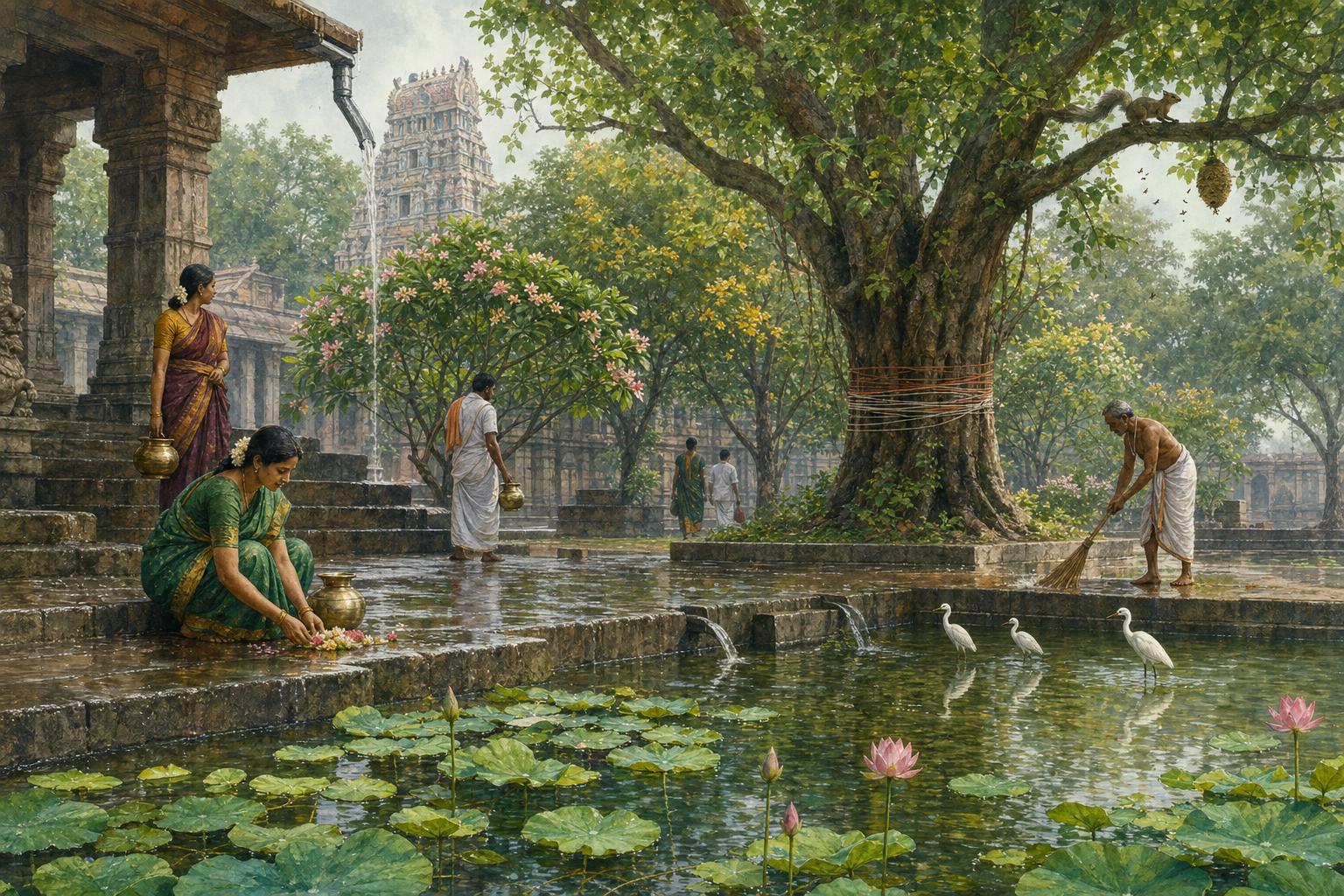
Treat the hill, animals, water, and community as sacred ecology
Sacred ecology is not greenery added around a temple after its theology has been completed. In many South Indian traditions, landscape helps determine how a deity is imagined and encountered. The form belongs somewhere.
Murugan’s bond with the kurinji, the Tamil mountain landscape, is especially important at Viralimalai. The hunter form used in the Valli narrative is intelligible because the deity enters a hill community’s geography and social idiom. Rocky ground, ascent, vegetation, and peafowl do not merely illustrate a story. They keep the story inhabitable. The presence of peafowl around the shrine brings the living bird into direct relation with Murugan’s mayil iconography, while Mayil Attam carries that relationship into embodied cultural expression. The result is a shared field of hill, deity, peacock, dance, and pilgrimage.
Bhadrakali Amman reveals another dimension of place. As Amman, the Goddess protects households, neighborhoods, and villages. Public observances, community offerings, temple kitchens, and performative traditions make guardianship social as well as spatial. Attukal Pongala is notable for women’s collective preparation of offerings, while Amman temple communities more broadly create room for women’s ritual leadership and organization. Sacred ecology therefore includes human relationships: who prepares, leads, feeds, serves, remembers, and takes responsibility for the place.
Yet social vitality does not excuse physical damage. If the peacock is honored as Murugan’s vāhana, disturbing peafowl for a photograph contradicts the meaning you have just admired. If the Goddess is approached as guardian, leaving waste after her festival shifts the burden of devotion onto the land and the people who clean it. Ecological conduct is not an optional modern theme pasted onto worship. It is a practical test of whether reverence extends beyond the instant of darśan.
Use this visitor discipline:
- Keep your voice and device volume low near habitat areas, not only inside the sanctum.
- Remain on established paths and avoid trampling vegetation to obtain a better view.
- Do not chase, corner, touch, or lure peafowl and other animals for photographs.
- Carry packaging and disposable items to designated collection points. If facilities are unclear, take your waste with you.
- Offer only what the temple accepts. Do not assume that an item is harmless merely because it is natural or biodegradable.
- Do not place food, flowers, oil, ash, or ritual remnants in a water body unless temple practice explicitly directs their handling there.
- During festivals, support arrangements that reduce waste and unnecessary resource use, including responsible community-kitchen practices.
These choices preserve more than visual beauty. They protect the conditions in which iconography remains credible. A mayil vāhana beside a degraded peafowl habitat would become a symbol severed from its living referent. A guardian deity surrounded by avoidable festival waste would expose a gap between ritual declaration and ethical action.
Ahimsa provides the clearest bridge from devotion to stewardship. It asks you to consider the effects of noise, waste, crowd behavior, offerings, and photography on animals, plants, water, workers, and fellow pilgrims. In that sense, sacred ecology begins before any conservation project: it begins when you stop treating the temple environment as consumable scenery.
Key takeaways for your next temple visit
- Name the precise form first. Local titles, posture, consorts, legends, and festival identities are more informative than a generic deity label.
- Read the complete icon. Faces, arms, attributes, mudrās, vāhana, and expression modify one another. Never build an interpretation around one weapon or ornament in isolation.
- Watch ritual as a sequence of verbs. Abhishekam, alankāra, recitation, ārati, and procession show how a community approaches and understands the divine form.
- Let architecture direct your attention. Thresholds, preparatory shrines, mandapas, the central axis, prākāra, and sanctum turn bodily movement into a disciplined approach.
- Include the living landscape. Hill, grove, animal life, water, sound, waste, and community labor are part of the shrine’s sacred ecology.
- Preserve difference while noticing shared values. Hindu, Buddhist, Jain, and Sikh traditions can resonate through ahimsa, courage, protection, and disciplined compassion without becoming the same theology.
On your next visit, choose one relationship and follow it all the way through the site. If you begin with Murugan and the peacock, trace that bond from mūrti to hymn, hill, living bird, and your own conduct. If you begin with Bhadrakali’s abhaya mudrā, watch how fearlessness moves from icon to lamp, festival, community protection, and ecological responsibility. One carefully followed relationship will reveal more than a hurried attempt to catalogue every shrine.
References
- DharmaRenaissance Blog — Bhadrakali Amman Unveiled: Sacred Iconography, Rituals, and Time-Transcending Philosophy
- DharmaRenaissance Blog — Viralimalai Murugan Temple & Arunagirinathar: Hunter-Lord Legend, Art, Rituals, and Peacocks