
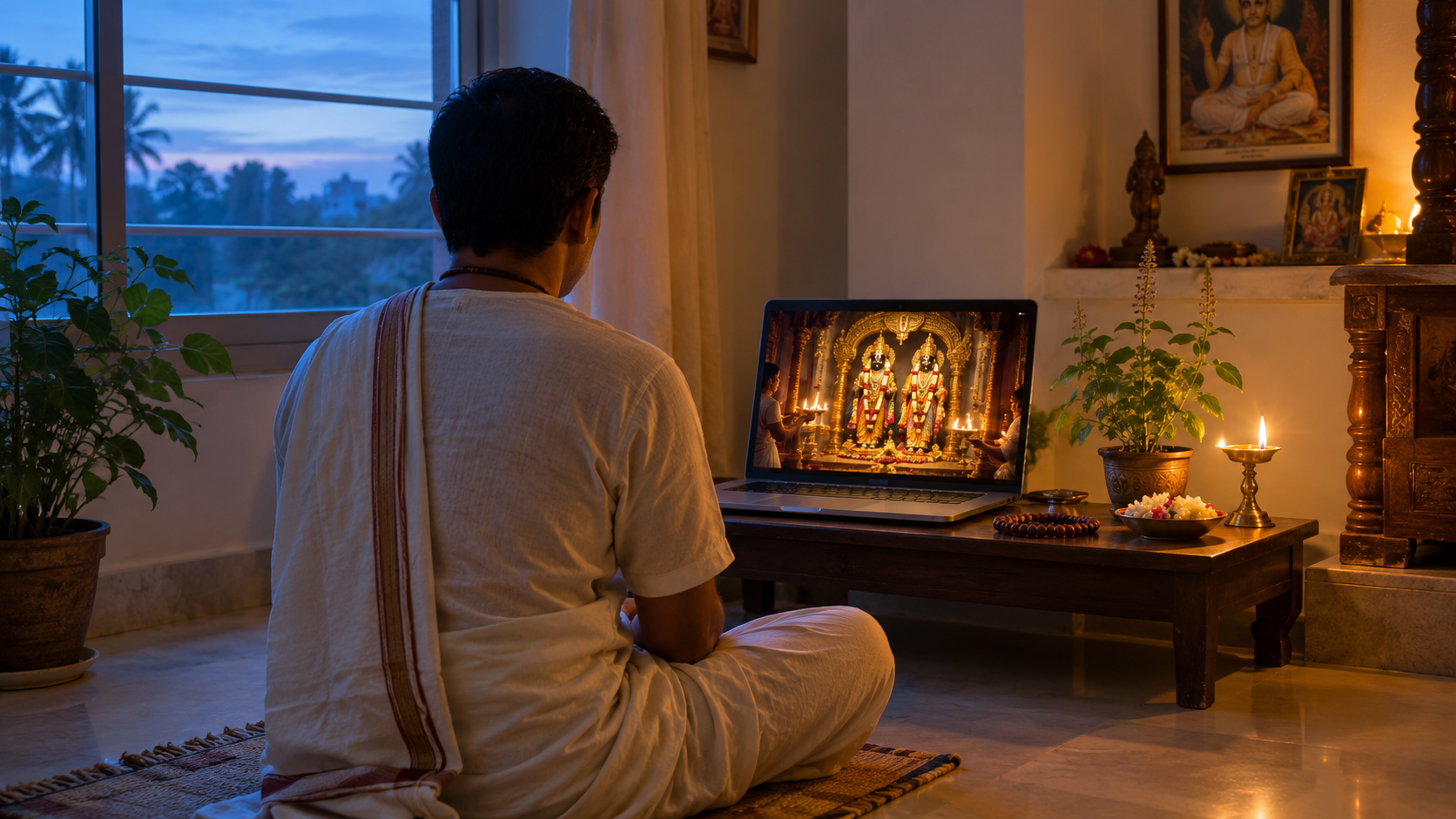
If you have opened an ISKCON Vrindavan broadcast because you cannot be in the temple, the central question is not whether a screen can reproduce Vrindavan. It cannot. The useful question is whether you can give this occasion the attention needed for darshan, hearing, and remembrance to shape the rest of your day.
You can begin by treating the broadcast as a devotional appointment rather than another video. The 8 October 2026 offering is presented as live Mangal Arati darshan from Sri Sri Krishna Balaram Mandir in ISKCON Vrindavan and identifies His Holiness Subhag Swami Maharaj with Srimad Bhagavatam 11.5.10. That gives you two clear modes of participation: receiving darshan and listening carefully to a specific scriptural teaching.
Let the broadcast serve devotion, not imitate a temple visit
A temple visit involves embodied presence: entering a sacred place, observing its discipline, standing among devotees, and responding to worship as it unfolds before you. A broadcast gives you images and sound through a mediated channel. Respecting that distinction protects you from two unhelpful extremes. You need not dismiss online darshan as merely digital content, and you need not pretend that it is identical to being physically present.
Decide what you are coming for before you press play. If your immediate purpose is Mangal Arati darshan, receive that portion without simultaneously checking messages or reading comments. If you have come to hear the Bhagavatam discourse, keep the cited passage within reach and listen as a student. If you intend to do both, allow the transition from worship to teaching to change the way you attend: first see and pray, then hear and examine.
If attending a local temple is realistically available to you, an online broadcast can supplement rather than displace that participation. If illness, distance, work, caregiving, or another constraint keeps you at home, the broadcast still gives you a definite occasion for prayer and study. What matters at home is not recreating every external feature of temple worship. It is removing the habits that turn a sacred occasion into background media.
Prepare the room before you prepare the stream

The most common interruption is not a weak devotional intention. It is an environment left in its ordinary entertainment mode. Notifications arrive, autoplay proposes another video, household conversations continue, and attention becomes fragmented before the arati has settled in the mind.
Use this simple preparation:
- Choose whether you will receive the entire broadcast or a defined portion. Make that decision before playback so that impatience does not make it for you.
- Put the broadcast on a stable screen in a clean, settled place. Holding a phone invites touching, scrolling, and switching apps.
- Silence notifications, close unrelated tabs, and disable any queue that will launch entertainment when the broadcast ends.
- Tell other people in the room that you are entering a period of worship or study. A clear boundary is kinder than repeated irritation at interruptions.
- Follow the bodily preparation customary in your own practice. The aim is recollection and respect, not inventing ritual requirements for other people.
- Keep your Bhagavatam edition and a notebook nearby if you plan to hear the discourse. Searching for them after the speaker begins breaks the thread of attention.
You do not need an elaborate home arrangement to participate sincerely. A modest space with fewer distractions is more useful than a decorative setup surrounded by an active phone, unfinished tasks, and constant movement.
Receive Mangal Arati as darshan, not visual content
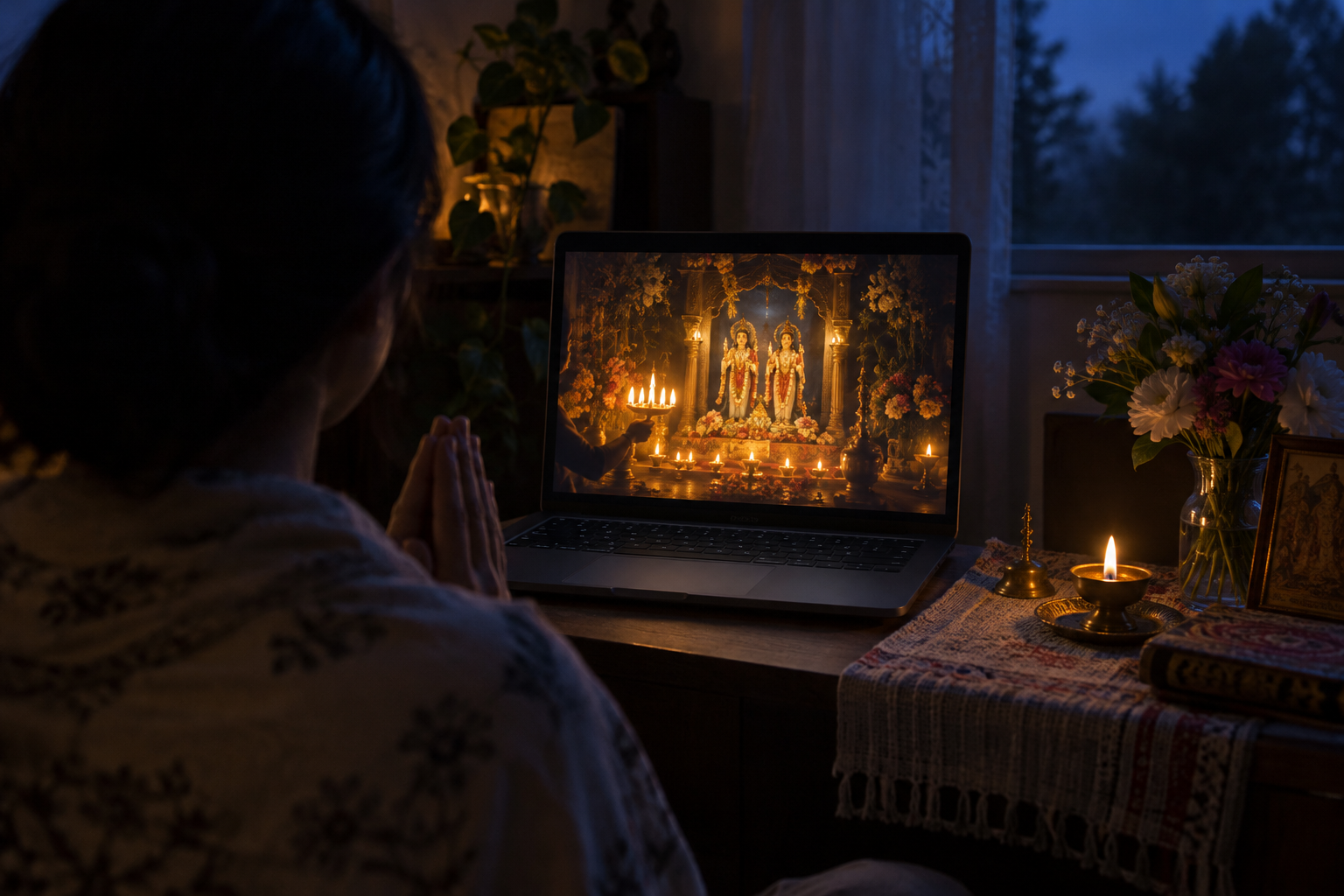
Online viewing trains us to evaluate images: Is the camera close enough? Is the sound clear? Is another angle available? Darshan asks for a different movement of mind. Once the stream is functioning, stop managing it. Let your attention rest on Sri Sri Krishna Balaram, the worship being offered, the sacred sound, and your own response.
Participate in the way appropriate to your tradition and circumstances. You may offer pranam, join familiar prayers, stand where that is your practice, or remain quietly attentive. Someone sharing a room, caring for a child, or watching with limited mobility need not copy the physical behaviour of devotees visible on screen. Reverence should steady the mind; it should not become a performance for the camera or for other viewers.
When attention wanders, return it without turning the lapse into a second distraction. During a live transmission, do not chase a missed instant by repeatedly moving the playback controls. Rejoin what is happening now. On a recording, pause when a genuine household or technical interruption requires it, then resume deliberately. The discipline is continuity of attention, not flawless viewing.
Resist the urge to collect screenshots while the worship is underway. If you want an image for later remembrance, return after your devotional participation has ended. Otherwise, the effort to capture darshan can quietly replace the act of receiving it.
Use the Bhagavatam reference as a study anchor

The reference to Srimad Bhagavatam 11.5.10 is more than a label for the broadcast. It allows you to connect spoken instruction with a definite passage rather than leaving the discourse as an uplifting but indistinct impression.
Read the verse in a trusted edition available to you. Also look at its immediate context so that an isolated line does not carry more weight than the surrounding discussion permits. If your edition provides the original text, translation, and commentary, keep those layers distinct. Translation choices, established commentary, the speaker’s explanation, and your personal application are related, but they are not interchangeable.
Organise your notes under these headings:
- Text: Record the words, terms, or ideas explicitly grounded in the cited passage.
- Teaching: Note the emphasis His Holiness Subhag Swami Maharaj gives those ideas and the practical connection he develops.
- Question: Write what remains unclear rather than covering uncertainty with a confident paraphrase.
- Practice: Choose a concrete adjustment in hearing, chanting, conduct, or study that genuinely follows from what you understood.
This method also makes replay useful. Live participation gives you a shared devotional moment and a fixed beginning. Recorded viewing gives you the ability to revisit a difficult explanation or compare it with the verse. Use that control for study, not for skipping everything that does not immediately hold your attention.
Key takeaways
- Treat the broadcast as a devotional appointment with a defined purpose, not as background sound.
- Do not claim that online darshan and physical temple attendance are the same. Let each serve its proper place in your practice.
- Prepare your surroundings before playback by silencing notifications, settling the room, and keeping any scripture or notebook ready.
- During Mangal Arati, stop evaluating the production once the stream works and direct attention toward darshan, prayer, and sacred sound.
- Use Srimad Bhagavatam 11.5.10 to distinguish the scriptural passage, the teacher’s explanation, your questions, and your intended practice.
- After the broadcast, carry forward a definite act of remembrance or study instead of allowing the platform’s next recommendation to choose what enters your mind.
Before opening the ISKCON Vrindavan broadcast, clear the next distraction, place your Bhagavatam nearby, and decide how you will respond when the viewing ends. That final decision turns a stream you watched into a teaching you can continue to live with.
References

Leave a Reply
You must be logged in to post a comment.