
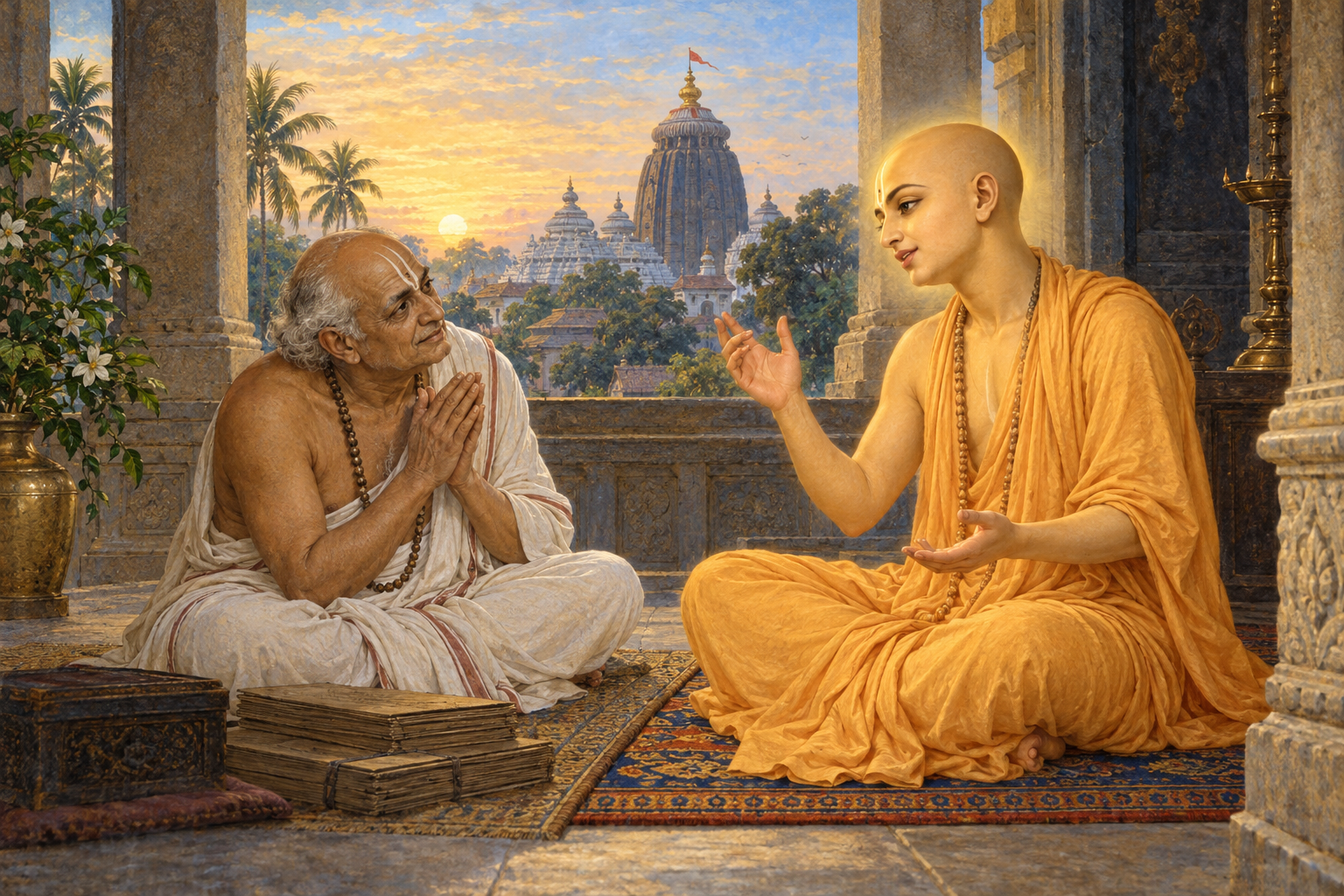
If you have encountered Sarvabhauma Bhattacharya only as the scholar whom Sri Chaitanya Mahaprabhu corrected, you have only one part of his identity. His life brings together three distinct roles: a formidable teacher of Nyaya and Vedanta, a householder devoted to Jagannath Puri, and a transformed devotee whom Gaudiya tradition identifies with Brihaspati.
Keep those roles distinct and his significance becomes much clearer. You can then understand what happened in Puri without reducing him either to a defeated intellectual or to a divine identity detached from his earthly choices.
Key takeaways
- Sarvabhauma was a householder renowned for his learning in Nyaya and Vedanta.
- He had taken kshetra-sannyasa, a vow never to leave Jagannath Puri; this did not make him a conventional wandering sannyasi.
- He was already living in Puri when Sri Chaitanya arrived and met him there for the first time.
- He initially taught Vedanta through Shankaracharya’s commentary to Mahaprabhu, but later accepted a different understanding through Mahaprabhu’s grace.
- Gaura-ganoddesha-dipika 119 identifies his spiritual identity as Brihaspati, the guru of the devas.
A householder scholar rooted in Jagannath Puri
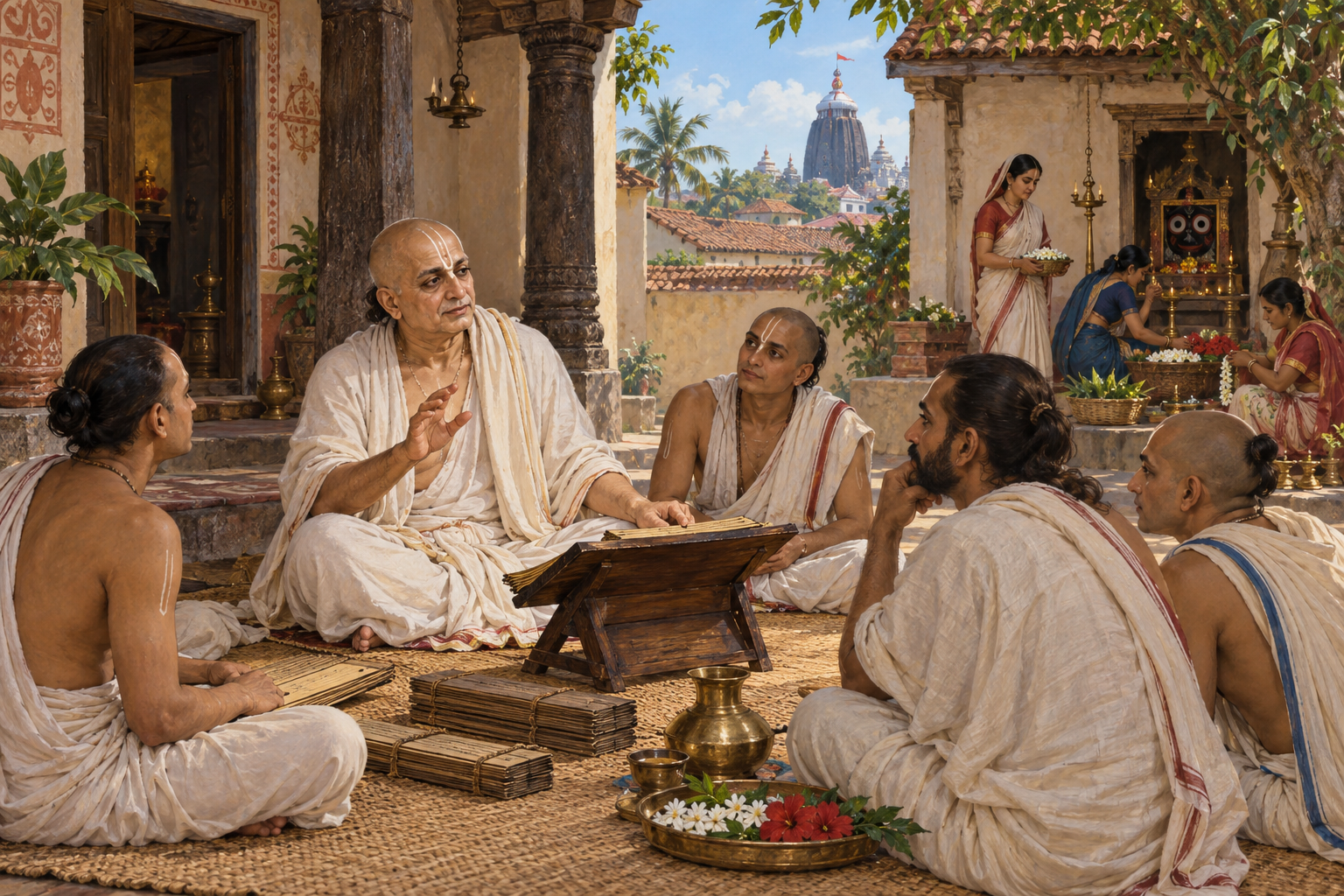
The first correction to make is simple: Sarvabhauma Bhattacharya was not an uneducated opponent of bhakti. He possessed exceptional learning in both Nyaya and Vedanta. Nyaya cultivates disciplined reasoning and debate, while Vedanta investigates ultimate reality, the self, bondage and liberation. Mastery of both placed him among the serious intellectual authorities of his setting.
His social and devotional status also requires precision. Sarvabhauma remained a grihastha, or householder, while observing kshetra-sannyasa. His particular vow bound him to the sacred place: he would not set foot outside Jagannath Puri. You should therefore picture a settled householder-scholar teaching in a major pilgrimage centre, not an itinerant monk travelling from court to court.
This rootedness explains his position when Mahaprabhu entered Puri. Sarvabhauma was already living and teaching there. He belonged to the circle of devotees whom Chaitanya encountered in Puri rather than to the Bengali companions who arrived with him. His brother-in-law, Gopinath Acharya, was another important member of this circle.
Chaitanya Charitamrita 1.10.130 uses the image of branches growing from Sri Chaitanya and counts Sarvabhauma as one of the largest, with Gopinath named alongside him. That position matters. Sarvabhauma was not remembered merely because he once participated in a philosophical exchange; he became an important bearer of Mahaprabhu’s devotional movement.
The encounter in which the teacher became the student
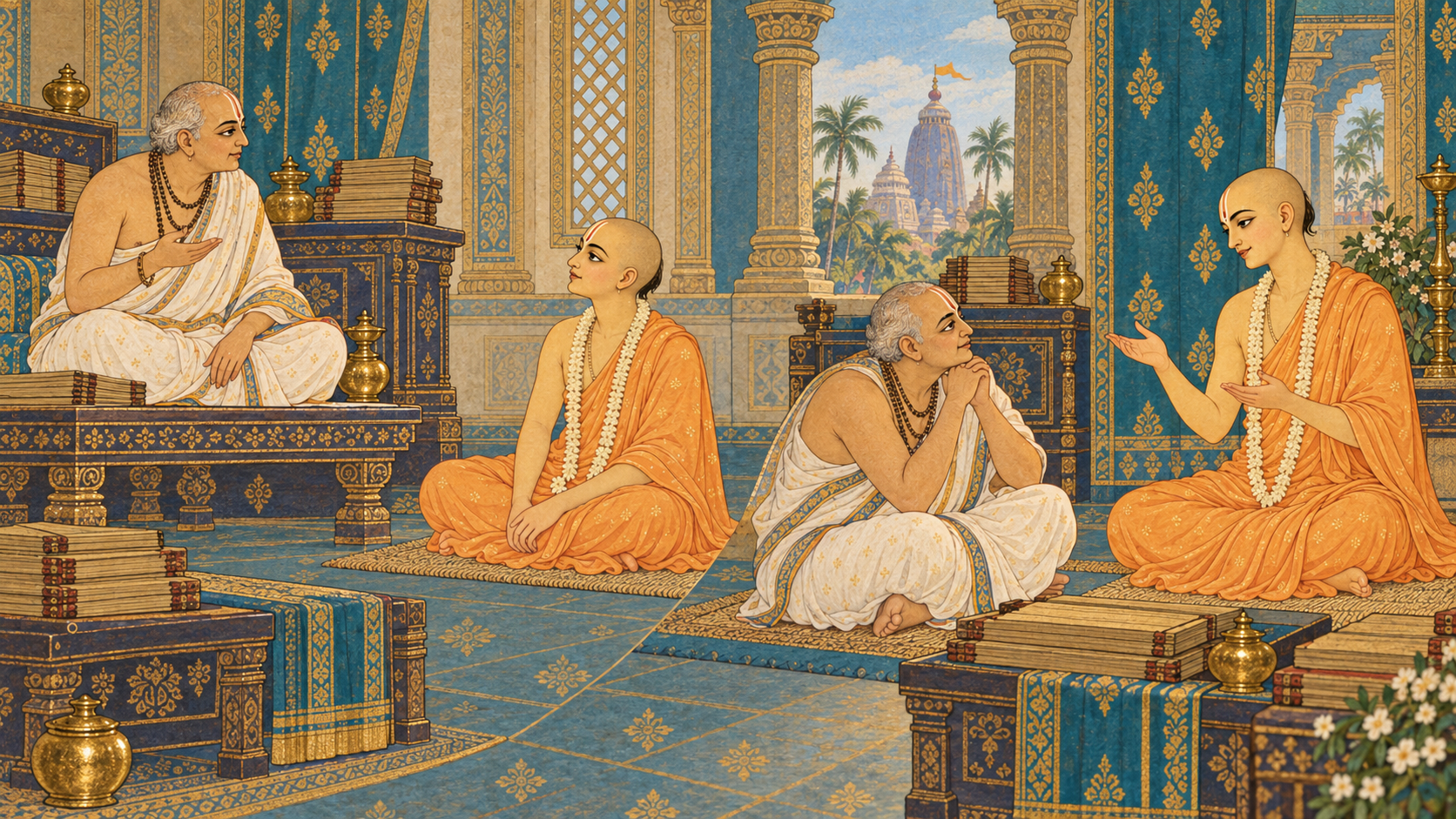
The meeting between Sarvabhauma and Mahaprabhu is easiest to understand as a reversal of spiritual roles. Sarvabhauma first approached the encounter from the position he knew well: that of an established teacher explaining Vedanta. He delivered discourses to Mahaprabhu based on Shankaracharya’s commentary. Within the Gaudiya telling, however, the teacher eventually received instruction from the person he had intended to teach.
- Sarvabhauma met Mahaprabhu in Jagannath Puri.
- Confident in his Vedantic learning, he explained Shankaracharya’s interpretation to him.
- Mahaprabhu’s response overturned Sarvabhauma’s understanding of the text.
- Through Mahaprabhu’s grace, Sarvabhauma accepted what the tradition regards as Vedanta’s true meaning.
- He subsequently became one of Sri Chaitanya’s foremost devotees in Puri.
The change was therefore deeper than losing an argument. An intellectual defeat can leave the defeated person inwardly unchanged. Sarvabhauma’s encounter is remembered as deliverance because it changed the authority by which he interpreted Vedanta and the spiritual relationship in which he placed himself. The learned instructor became receptive to grace.
Gaudiya texts call his former position Mayavada and describe Mahaprabhu as having delivered him from it. Mayavadi is a confessional term used by Vaishnavas for an impersonal or nondual interpretation they reject; it is not a neutral label for every form of Vedanta. When you retell Sarvabhauma’s life, use the term as the Gaudiya tradition’s theological judgment rather than as a substitute for describing what he actually taught: Shankaracharya’s commentary on Vedanta.
Both Vrindavan Das Thakur and Krishnadas Kaviraj Goswami gave this transformation a place in their biographies of Sri Chaitanya. Its enduring force lies in a demanding principle: learning is valuable, but learning does not exempt its possessor from correction. Sarvabhauma’s stature makes his receptivity more meaningful, not less.
His spiritual identity as Brihaspati
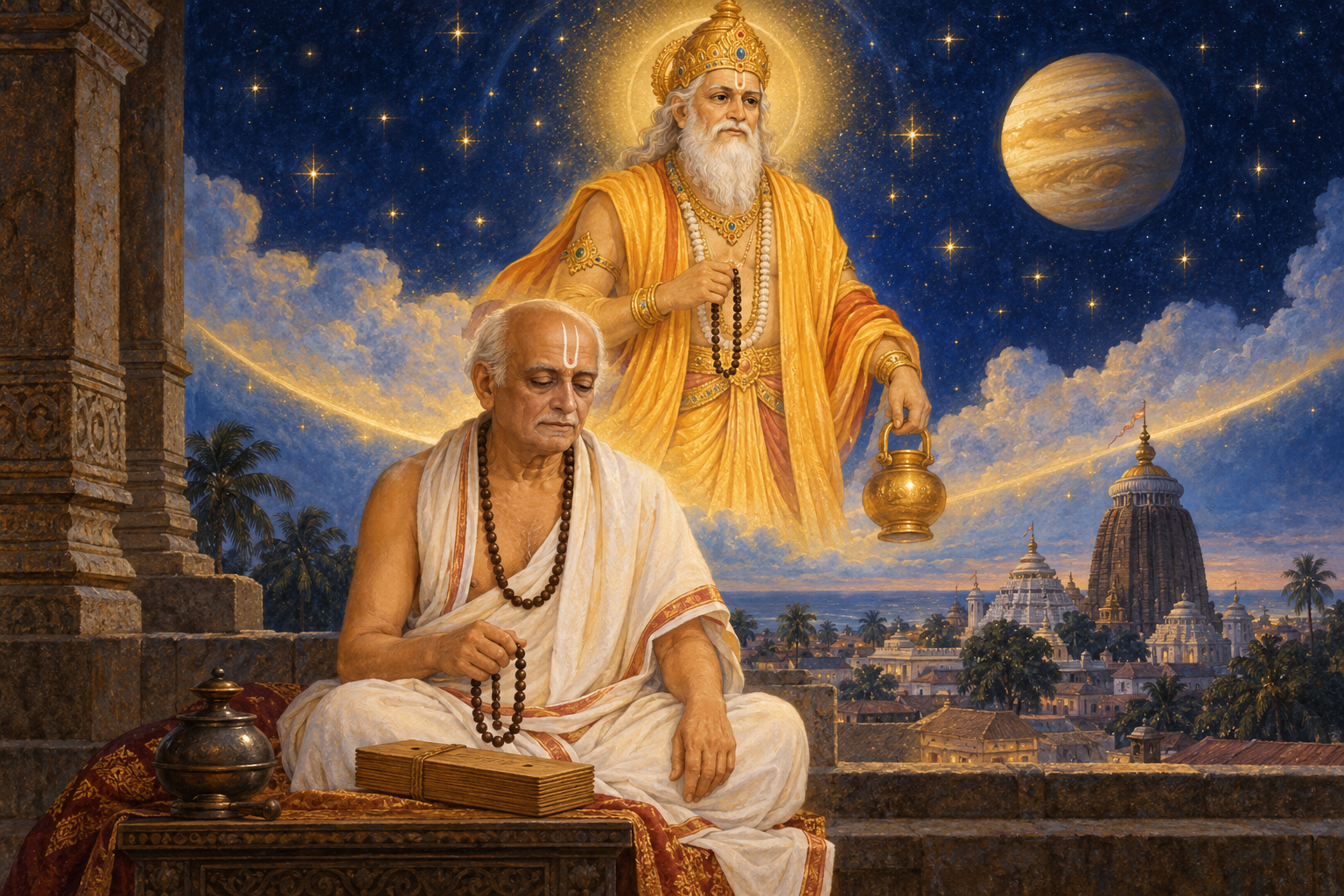
Gaudiya sacred biography often identifies Chaitanya’s associates with personalities from Krishna-lila or the wider Vedic divine order. In this theological register, Gaura-ganoddesha-dipika 119 identifies Sarvabhauma Bhattacharya as Brihaspati, the guru of the devas.
This identification is not another episode in his public career. It is a statement about his eternal or prior spiritual identity within Gaudiya Vaishnava theology. The distinction protects both kinds of claim from confusion:
- Earthly biography: Sarvabhauma was a householder, a scholar of Nyaya and Vedanta, a resident teacher in Puri and the brother-in-law of Gopinath Acharya.
- Transformative identity: He moved from instructing Mahaprabhu through Shankaracharya’s commentary to receiving Mahaprabhu’s interpretation and grace.
- Spiritual identity: Gaura-ganoddesha-dipika identifies him with Brihaspati, the devas’ guru.
These are complementary answers to different questions. If someone asks what Sarvabhauma did in Puri, answer from his earthly biography. If someone asks who Gaudiya tradition understands him to be eternally, answer with the Brihaspati identification. Saying only that Sarvabhauma was Brihaspati leaves out the very human drama of scholarship, correction and surrender. Treating him only as a historical teacher erases the sacred identity through which devotees understand his place in Chaitanya-lila.
The safest phrasing is also the most accurate: Gaura-ganoddesha-dipika identifies Sarvabhauma Bhattacharya as Brihaspati. That wording neither dismisses the tradition’s claim nor presents a theological identification as though it were an ordinary biographical fact established by the same means as residence, kinship or teaching.
What his transformation asks you to notice
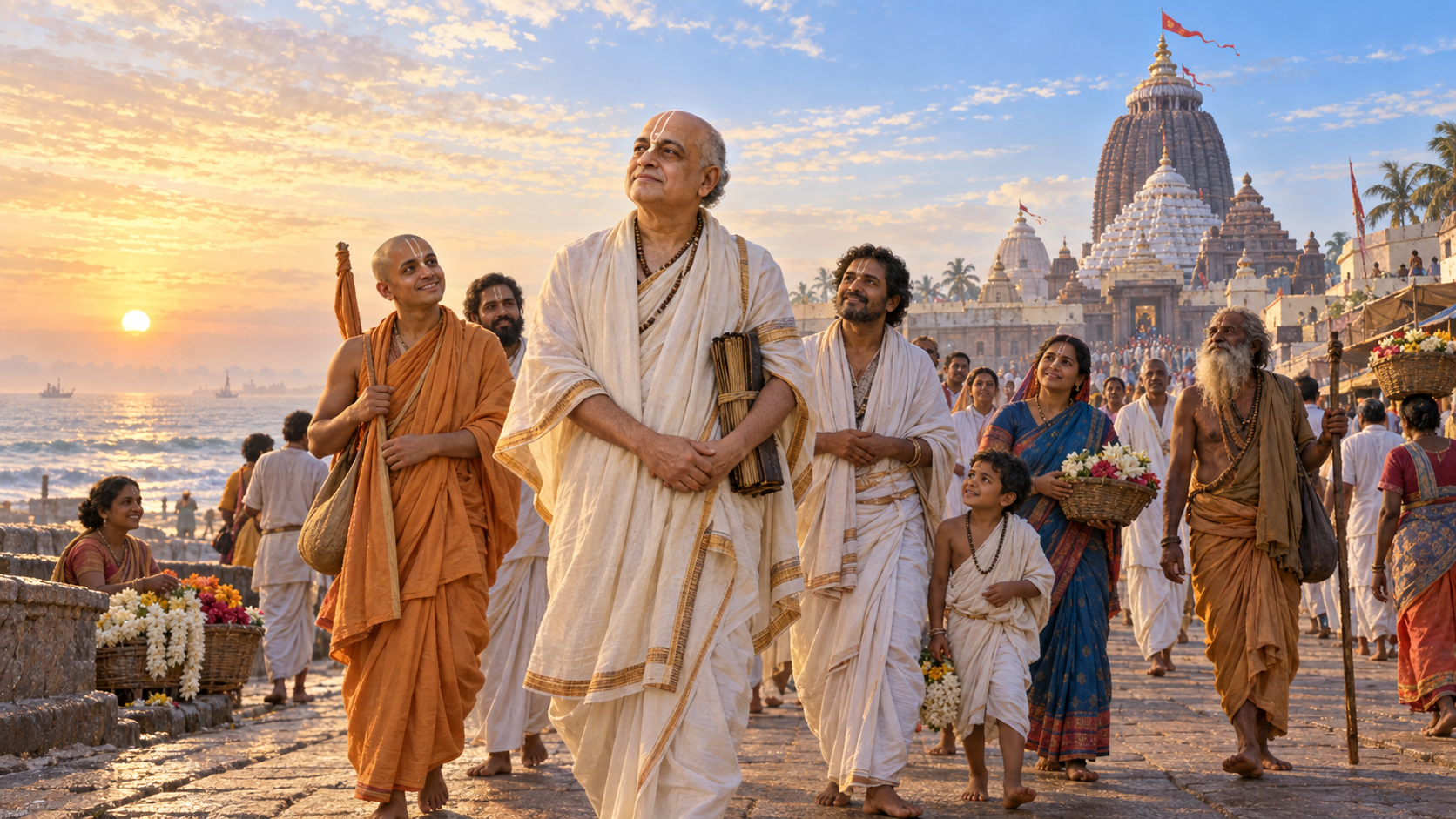
Sarvabhauma’s life is sometimes compressed into a crude opposition between dry philosophy and devotion. That misses the point. His scholarship did not disappear when his allegiance changed, and the tradition did not preserve his learning merely to mock it. His intellectual authority makes the transformation consequential: even mastery of reasoning and commentary could not, by itself, settle the question of Vedanta’s ultimate meaning.
You can use three questions whenever you read or explain his story:
- Which kind of identity is being discussed? Separate his social role, his philosophical position and his sacred identity.
- Which side of the encounter is being described? Before meeting Mahaprabhu, he taught Shankaracharya’s commentary; after receiving grace, he understood Vedanta differently.
- Is the language descriptive or confessional? Terms such as grihastha and teacher describe his visible life, while delivered from Mayavada and identified as Brihaspati express specifically Gaudiya theological judgments.
This method also prevents two common distortions. The first is to make Sarvabhauma a conventional sannyasi, despite his simultaneous identity as a grihastha and observer of kshetra-sannyasa. The second is to portray him as an enemy of Mahaprabhu. He first occupied the role of instructor, but the defining movement of his life was toward discipleship and service.
His example does not ask you to distrust reason. It asks you to examine what reason serves and whether intellectual authority has become resistant to revelation, devotion or correction. When you next encounter Sarvabhauma’s name, follow that change of posture: from explaining truth as an accomplished scholar to receiving it as a devotee. That is where his biography and his spiritual identity meet.
References

Leave a Reply
You must be logged in to post a comment.