
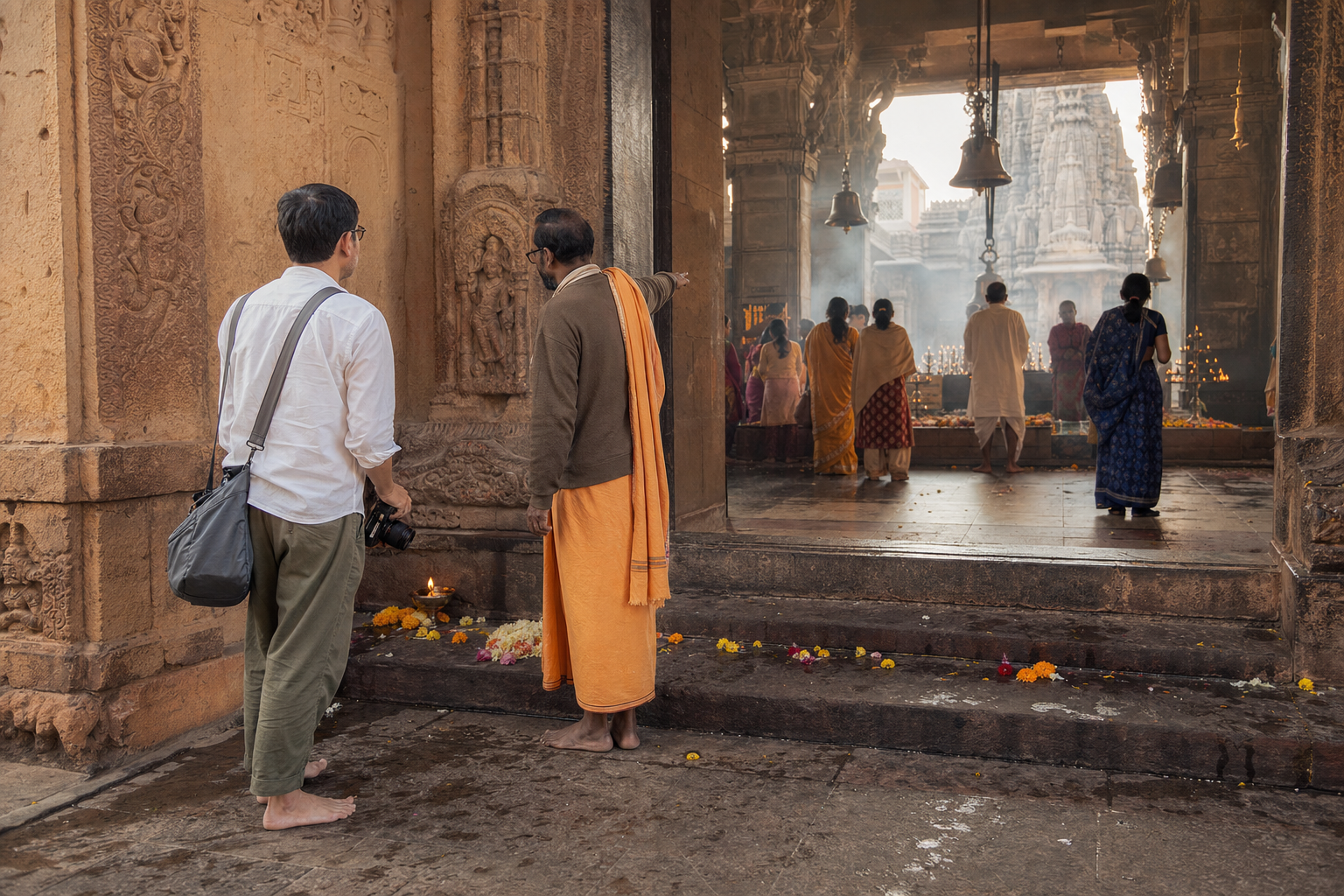
You may arrive at a Hindu sacred site wanting to pray, learn, photograph, preserve, or write. The difficult question is not simply what you are allowed to see. It is how to enter a living tradition without turning worship into spectacle, a family’s grief into content, or a devotional memory into a claim it was never meant to prove.
You need a method that respects both continuity and change. The practical standard is simple: identify who carries the tradition, learn what the rite means locally, separate participation from documentation, and leave the community with more control over its heritage than it had before your visit.
Key takeaways for your next sacred-site visit
- Ask separately whether you may observe, participate, record, and publish. Permission for one does not automatically include the others.
- Record the local name, community, purpose, sequence, setting, and boundaries of a rite before trying to explain it.
- Present sacred narratives in the form in which devotees preserve them. Do not inflate devotional memory into empirical proof or dismiss it because it is not an empirical claim.
- Give the strongest privacy protection to rites involving bereavement, deceased children, family relationships, or identifiable personal histories.
- Preserve transmission, not merely appearances: verify your account, return useful records, follow local rules, and support upkeep only through authorised channels.
Recognise what makes the heritage living
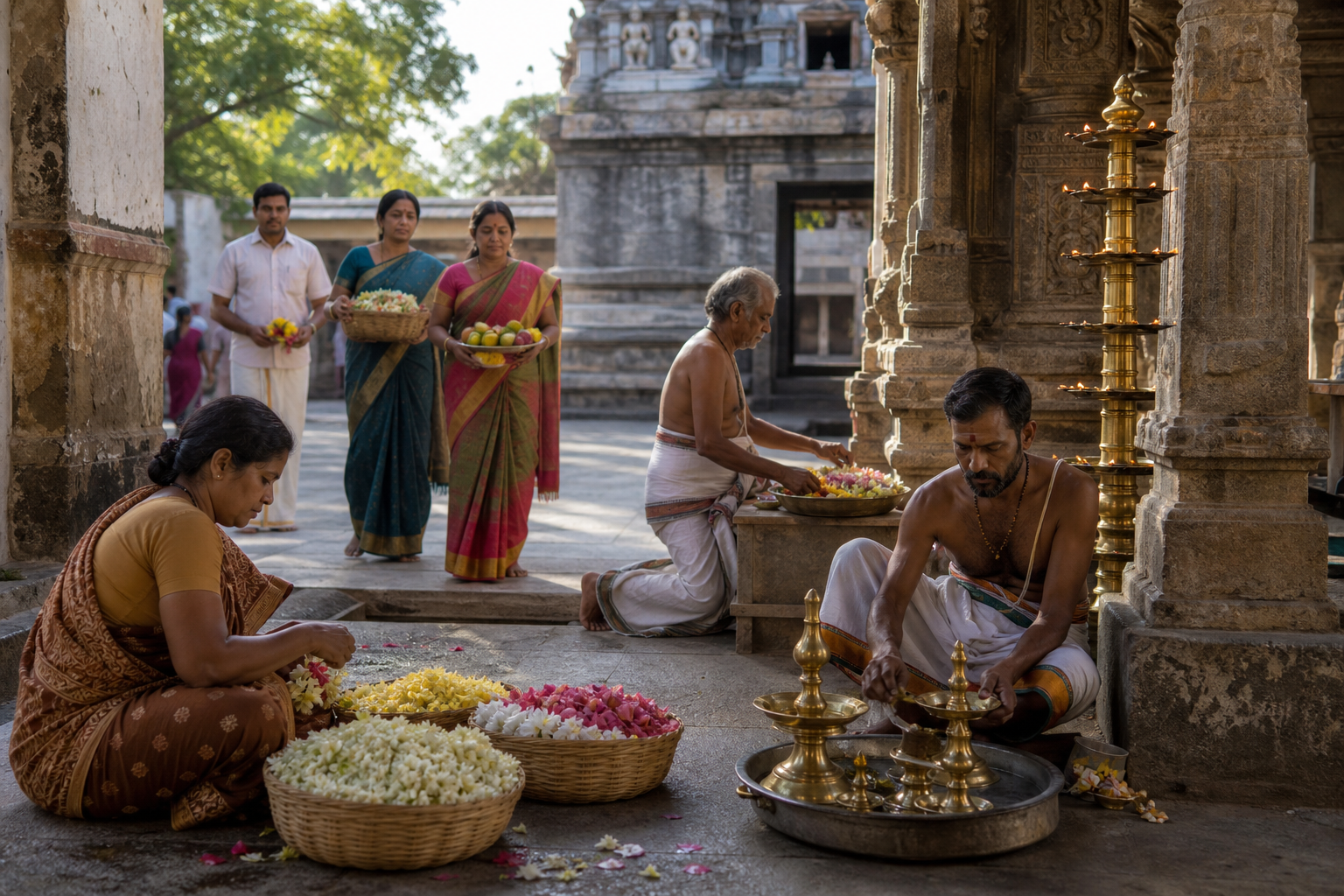
A temple can survive as a structure while its ritual life weakens. The reverse can also happen: a community may sustain a meaningful rite in a home shrine or modest gathering place without monumental architecture. Living heritage therefore consists of relationships among people, practices, places, objects, stories, and obligations. If you document only the most photogenic object, you may miss the tradition that gives the object meaning.
Preta Kalyanam makes that distinction especially clear. The centuries-old custom is maintained by certain communities in South Karnataka and Kerala’s Kasaragod district. It symbolically honours a child or adolescent who died before undergoing the samskara of marriage. Its significance lies less in creating the appearance of an ordinary wedding than in extending remembrance, dignity, ritual inclusion, and communal care to a life understood to have ended before that life-cycle rite.
Alalanatha offers a different configuration. There, parikrama, sacred storytelling, a forest gathering beneath a mango tree, and darshan form a sequence rather than a collection of unrelated attractions. The route, the natural setting, the remembered narrative, and the sanctum all participate in the experience. A photograph of the temple may be valuable, but it cannot by itself preserve the cadence of circumambulation or the discipline of attending to the deity.
Before you describe a rite or site, make a four-part field note. This prevents the common error of treating a single visible object as the whole heritage:
- Place: Note where each action belongs: route, threshold, tree, home shrine, community space, temple exterior, or sanctum. Do not assume that every part of a site has the same rules.
- Practice: Record the sequence of actions and pauses. Include what participants deliberately refrain from doing, because restraint can be part of ritual discipline.
- Custodians: Identify who carries the knowledge: kin, elders, temple servants, priests, pilgrims, storytellers, or another locally recognised group. Let them define their own role.
- Meaning: Ask what participants believe the practice accomplishes. Keep their explanation distinct from your interpretation of it.
Keep the community qualifier attached to every claim. A custom observed by certain families in a particular region is not automatically a rule for all Hindus, all of Karnataka, or all of Kerala. Precision protects Hindu diversity from being flattened into an invented uniformity.
Separate observation, participation, recording, and publication
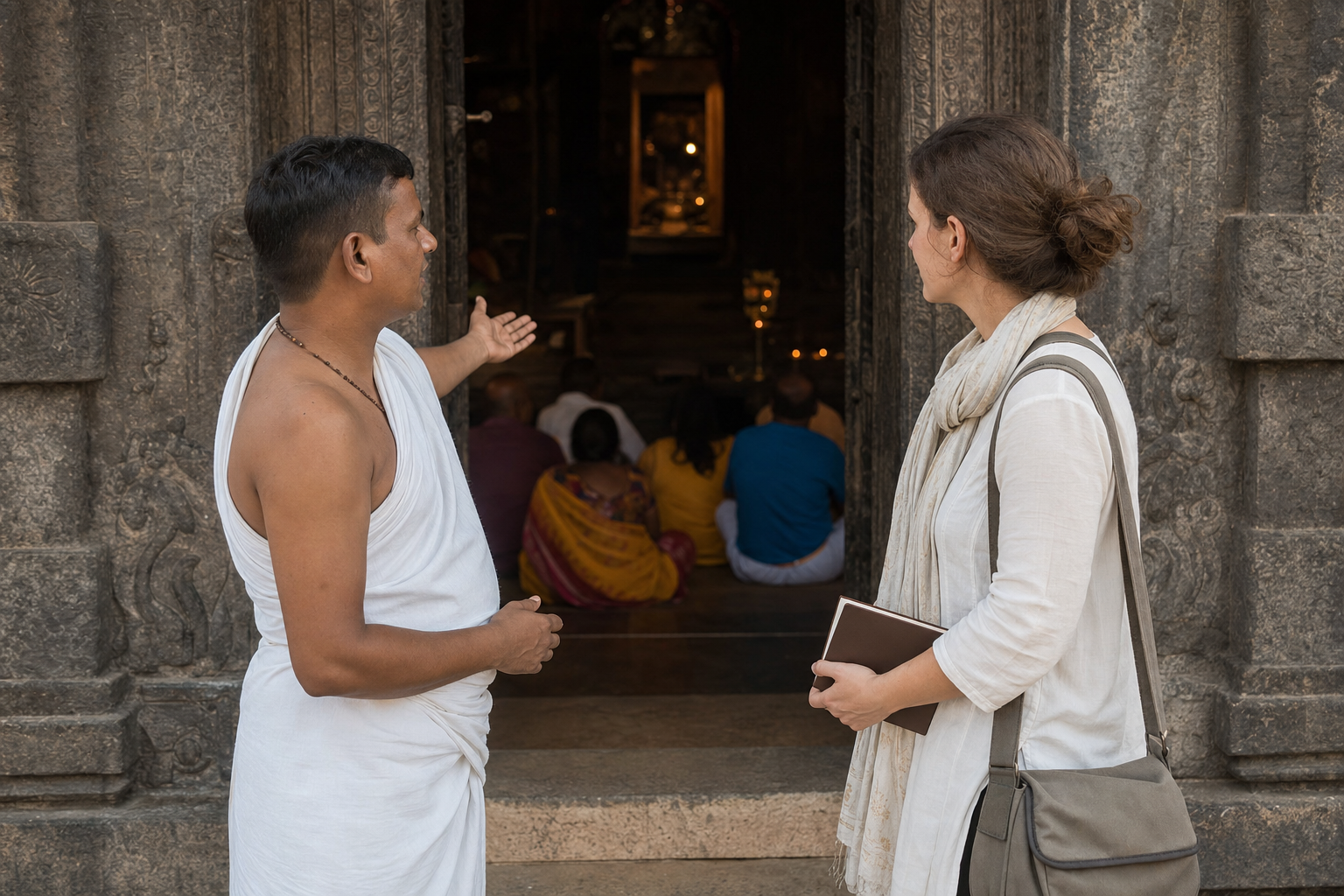
Visitors often ask one broad question such as, “May I take part?” That is not enough. Sacred spaces operate through several layers of access, and consent at one layer does not settle the next. A person may welcome your quiet presence but not your camera. A family may permit a private photograph but not its publication. A temple may allow images in an outer area while restricting them nearer the sanctum.
Ask these questions before the rite begins, when possible:
- May I remain here and observe?
- Would participation be appropriate for me, or should I watch quietly?
- May I take written notes, photographs, video, or audio?
- May any recording be published or shared outside my household?
- Are there people, objects, prayers, locations, or stages of the rite that must not be recorded?
- Who can check the spelling of local terms and the accuracy of my explanation?
If the answer is unclear, observe without recording. Silence is not publication consent, and public visibility is not the same as an invitation to reproduce an event for another audience.
Your conduct should also follow the ritual rhythm rather than the needs of your camera. Do not step across a procession route, direct worshippers, request a repeated gesture, move an offering, or prolong a private moment to obtain a cleaner image. If a recording cannot be made without altering the practice, the recording is already a poor record of that practice.
When you are invited to participate, ask for one or two concrete instructions: where to stand, what to do with footwear or belongings, and when not to move or speak. You do not need to imitate every action. Attentive restraint is usually more respectful than enthusiastic guessing.
Carry sacred narratives without forcing a verdict
Sacred-site narratives require careful language because they often communicate devotional truth through memory, place, and embodied practice. At Alalanatha, devotees preserve the tradition that a stone once “melted” and received impressions when Sri Chaitanya Mahaprabhu lay upon it in intense devotion. The responsible description identifies this as a cherished devotional memory. It neither advertises the event as an empirically demonstrated phenomenon nor reduces it to a curiosity that sensible people should discard.
A useful sentence form is: “Devotees preserve a tradition that…” You can then explain what the memory does within the site’s religious life. Does it direct attention toward bhakti? Does it shape how pilgrims approach a stone, shrine, route, or period of silence? Does it connect the present community with a revered figure? Those questions help a reader understand the heritage without demanding that the narrative pass through a false choice between laboratory proof and contemptuous dismissal.
Keep three kinds of statement distinct in your notes and final account:
- Observed: What you directly saw or heard during the visit, such as a route followed, a garland offered, or a story narrated.
- Transmitted: What a community preserves as sacred history, devotional memory, or inherited explanation.
- Interpreted: What you think the practice means or how you relate it to a broader theme.
Do not quietly move a claim from one category to another. A transmitted memory does not become your direct observation merely because you heard it at the site. Your interpretation does not become the community’s unanimous position merely because it sounds plausible.
Give grief-centred rites a higher boundary
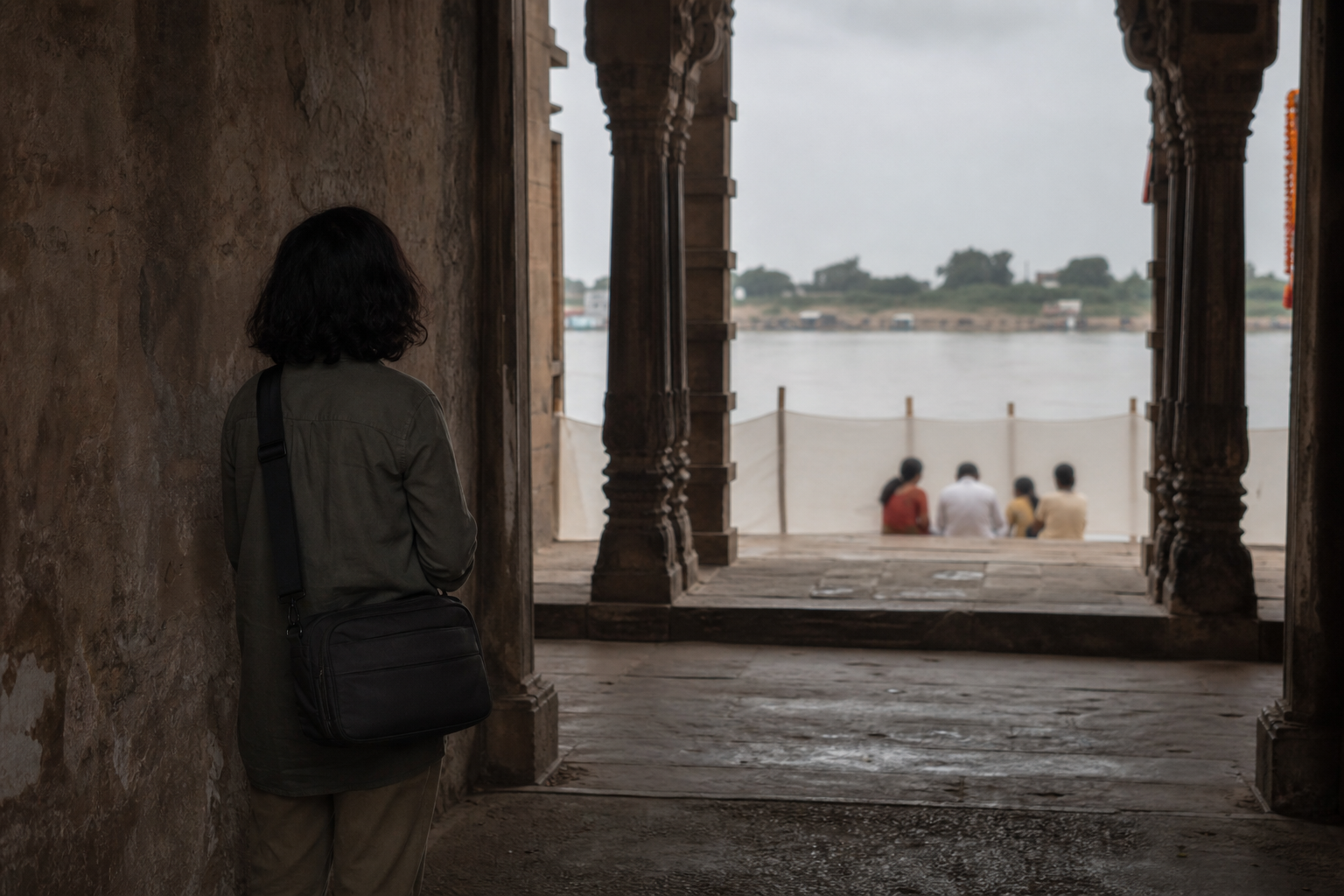
A rite connected with death cannot be approached like a public festival. Preta Kalyanam may involve a symbolic pairing represented through photographs or tokens, with garlands, turmeric, a sacred thread, prayers, blessings, and gathered kin. Depending on the community, it may take place at a home shrine, temple, or community space. None of those settings turns family sorrow into open-access material.
Use a stricter protocol whenever a rite reveals bereavement or identifiable family history:
- Begin with an invitation. Do not seek entry merely because the custom seems unusual. Let a family or recognised community representative establish whether observation is appropriate.
- Ask before collecting names or images. A photograph of a token may still identify a deceased child or a grieving household. Clarify what can leave the ritual setting.
- Do not stage the rite. Never ask participants to repeat a gesture, rearrange memorial objects, or pose with a photograph of the deceased.
- Let participants name its purpose. Terms such as completeness, peace, dignity, remembrance, reconciliation, and communal care may overlap, but they are not interchangeable. Preserve the language used by the people whose rite it is.
- Minimise what you disclose. Publication rarely requires every name, image, kinship detail, or precise location. Remove what does not help the reader understand the tradition.
- Accept refusal completely. If publication permission is absent, do not publish. A valuable encounter does not have to become public content.
Preta Kalyanam can create communal space for mourning and may give the living a meaningful form through which to honour the departed. That should not be converted into a clinical promise or presented as a guaranteed cure for grief. Ritual, family support, and mental-health care answer different needs; respect for one does not require making unsupported claims about another.
Continuity also does not mean freezing one outward form. Migrating families and changing circumstances have led some communities to retain the intention through memorial gatherings, charity in the child’s name, or collective prayer shaped by local custom. Document both the inherited form and the reason for an adaptation. Otherwise, future readers may mistake a photograph from one time and place for the only legitimate version of the rite.
Leave a stronger chain of transmission
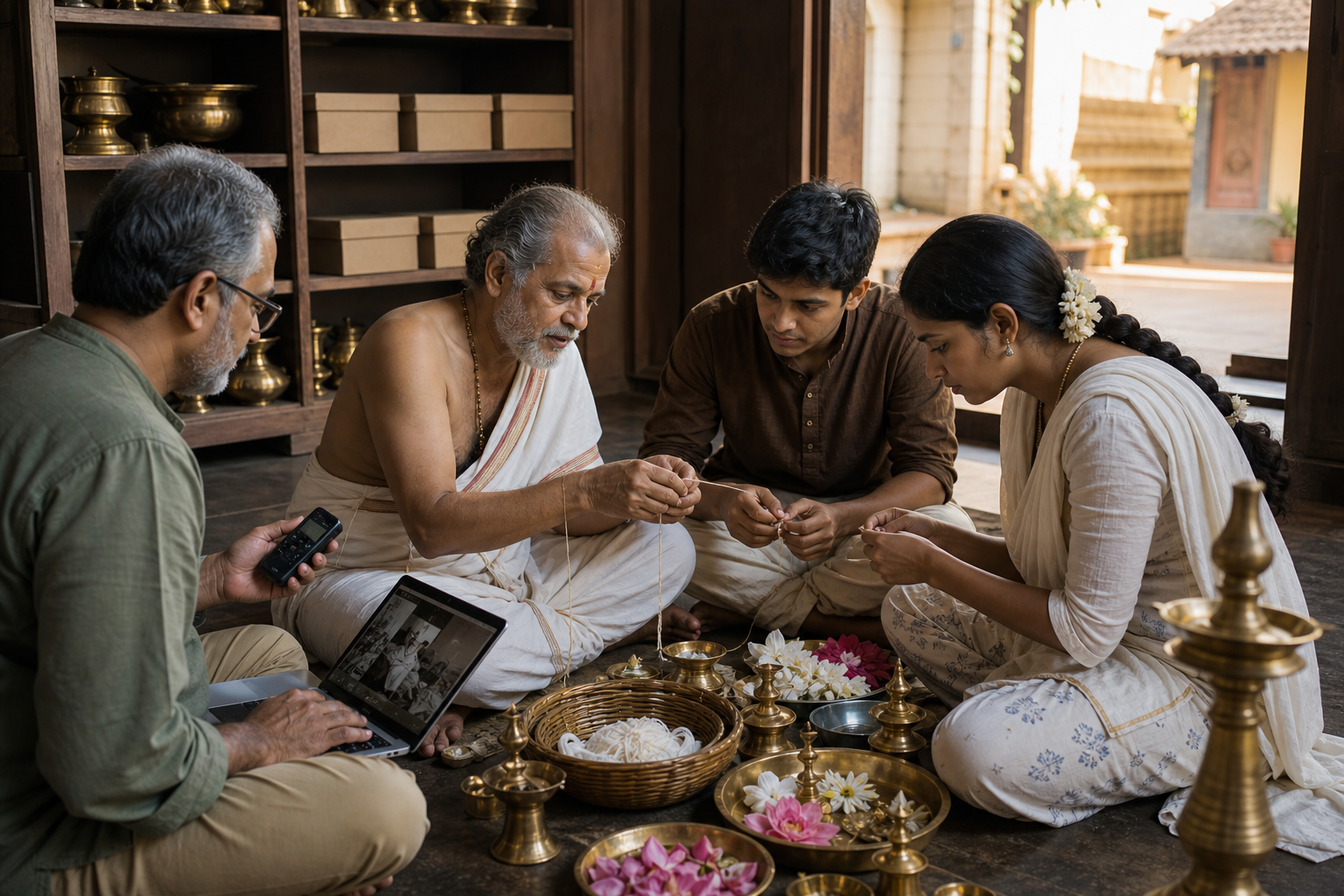
Ethical conduct during a visit is only half the work. What you do with your notes, images, and influence afterwards can either return value to the tradition or extract value from it.
Create one compact heritage record for each practice you document. It should contain:
- the local name and any spelling confirmed by a custodian;
- the locality and the specific community scope of the description;
- the people or roles responsible for carrying the practice;
- the ritual sequence, material markers, and spatial boundaries;
- the meaning participants assign to the rite;
- the status of each narrative as observed, transmitted, or interpreted;
- the exact permissions governing notes, images, names, and publication;
- any adaptation described by the community and the reason given for it;
- the date and method by which a copy was returned or corrections were requested.
Then complete the return journey of the record. Send photographs or text to the person authorised to receive them in a format the community can actually open and retain. Invite correction of names, sequence, and context. Remove anything later identified as private. If you offer financial or material support, use a locally authorised channel and never make the contribution conditional on privileged access.
When you publish, preserve boundaries as visibly as you preserve details. Say when a practice belongs to certain communities. Attribute a sacred memory to the devotees who carry it. State when photography was not appropriate rather than filling the gap with a reconstruction. A boundary honestly recorded is itself part of the heritage.
Before your next visit, write down the four permissions you will request: observation, participation, recording, and publication. If you cannot yet identify who carries the rite, why it matters locally, and what must remain unrecorded, you are not ready to interpret it for others. Begin there, and let reverence shape the record as much as curiosity does.
References
- DharmaRenaissance Blog — Preta Kalyanam: A Poignant ‘Marriage of the Dead’ in South Karnataka and Kasaragod
- Dandavats — Alalanatha’s Sacred Calm: Final Temple Parikrama, Forest Gathering, and Living Heritage
