

If you are a Hindu American voter and a political leader speaks carelessly about a Hindu spouse, family, or community, you have an immediate decision to make. Do you condemn it, seek a clarification, contact the official, or treat it as ordinary religious disagreement?
The answer should not depend on the leader’s party. Start by distinguishing disagreement, disparagement, and coercion. Then judge the conduct through three separate lenses: policy, rhetoric, and repair. That approach protects Hindu dignity without weakening the religious freedom that makes pluralism possible.
Start by naming the kind of problem you are looking at

Religious freedom, interfaith courtesy, and political accountability overlap, but they are not interchangeable. A statement can be rude without being unlawful. It can be lawful yet unworthy of a public official. It can also be part of conduct that raises a serious legal question. If you collapse all three categories into the word prejudice, your demand will be easy to dismiss.
Religious disagreement
People in a free society may hold exclusive theological beliefs. A Christian may believe Christianity is true. A Hindu may defend a Hindu sampradaya or philosophical position. Buddhists, Jains, Sikhs, Muslims, Jews, atheists, and others may make their own claims about truth, liberation, revelation, or the nature of the self. Religious liberty would be hollow if it protected belief only when everyone found that belief agreeable.
Someone’s wish that another person eventually embrace a different faith may be unwelcome or painful, but the belief by itself is not equivalent to government coercion. Ask what was actually said, whether the other person’s identity was described accurately, and whether public power or material pressure was attached to the statement.
Your response at this level can be firm: defend Hindu teachings, challenge a theological claim, or ask for better interfaith language. Do not claim that every doctrinal difference is a constitutional violation. The same freedom that permits you to reject another religion’s claim permits another citizen to reject yours.
Disparagement and civic degradation
The problem changes when a speaker stops debating an idea and begins reducing a person. Hindu identity is disparaged when it is treated as a joke, a contamination, a mark of civic inferiority, or a temporary defect that need not be respected. A stereotype also deserves correction when it compresses varied Hindu beliefs and practices into a caricature.
Examine the nouns and verbs in the actual statement. Did the speaker criticize a proposition, or downgrade the believer? Did the speaker describe what a Hindu person said, or assign beliefs to that person without evidence? Did the wording imply that Hindu citizenship, loyalty, judgment, or family life is less legitimate?
Your response should identify the exact wording, correct the precise error, and ask for equal civic regard. This is stronger than saying only that the community was offended. Offense describes a reaction; precise criticism identifies the conduct that must change.
Coercion or unequal treatment
A sharper religious-freedom concern arises when government authority or material leverage is used to pressure belief or impose unequal treatment. Denial of access, an official penalty, a credible threat, or an adverse decision tied to someone’s religion is different from a disagreeable opinion.
If you encounter concrete discrimination, preserve the original message, recording, decision, date, names of witnesses, and any written explanation. Legal rules depend on the actor, setting, jurisdiction, and facts. Seek advice from a qualified civil-rights lawyer or an appropriate advocacy organization rather than treating a social-media argument as a substitute for legal review.
A single event may contain more than one problem. Separate them. You can say that a theological belief is protected, the public framing was demeaning, and a particular official action requires investigation. That is more credible than forcing every concern into one label.
Keep interfaith marriage out of the conversion scoreboard

In November 2025, Representative Raja Krishnamoorthi publicly criticized Vice President JD Vance over comments concerning Usha Vance’s Hindu faith. The dispute reached beyond one marriage because national political language can influence whether Hindu identity is treated as an ordinary part of American life or as an anomaly requiring explanation.
Interfaith families require a strict boundary: each person owns his or her conscience. A spouse may explain personal beliefs, hopes, and practices. A spouse should not be treated as the final authority on another adult’s religious identity.
- Use the person’s stated identity. If that person has not spoken, acknowledge that you do not know the details of the person’s private belief.
- Separate private prayer from public classification. Someone may privately pray for a spouse while still owing that spouse public respect and accuracy.
- Do not treat children as evidence that one religion defeated another. An interfaith home is a family, not a campaign result.
- Do not turn one couple into a judgment on all Hindus or all Christians. Collective accusations reproduce the essentialism you are trying to challenge.
Dharmic pluralism does not require pretending that every tradition teaches the same doctrine. It requires coexistence without compulsion and room for people to describe their own paths. That standard protects Hindu families while also protecting Buddhist, Jain, Sikh, Christian, Muslim, Jewish, and nonreligious members of mixed households.
Use a symmetry test before reacting. Replace Hinduism with your own faith, switch the political party, and ask whether you would still defend the wording. The test will not decide every case because context and power can differ, but it exposes partisan standards disguised as principle.
Once a public official invokes a spouse’s religion to explain values or identity, voters may fairly examine the official’s framing. They are not entitled to invent the spouse’s private convictions, speculate about family conflict, or demand a public account of the children’s beliefs.
Judge every leader on policy, rhetoric, and repair

One clipped sentence rarely tells you everything about a political leader, but a favorable policy record does not make demeaning language irrelevant. Keep three columns in your assessment and examine each with the best evidence available.
| Dimension | Question to ask | Evidence to examine |
|---|---|---|
| Policy | Does the official protect equal treatment and freedom of practice? | Votes, executive decisions, administrative conduct, appointments, and responses to concrete threats or discrimination |
| Rhetoric | Does the official describe Hindus as equal citizens with agency over their own beliefs? | The complete recording or transcript, surrounding context, repeated language, and corrections of factual errors |
| Repair | What happens after a legitimate concern is raised? | A direct clarification, acknowledgment of impact, correction of the wording, and conduct after the controversy |
Policy is not a proxy for tone
Ask whether Hindu citizens can worship, organize, participate, and seek public protection on the same terms as everyone else. Look at official acts, not just festival greetings, temple photographs, or campaign outreach.
Keep domestic religious freedom distinct from every debate involving Bharat. Criticism of a particular Indian government policy is not automatically anti-Hindu. Praise for India does not automatically establish respect for Hindu Americans. Conflating the two makes it harder to identify actual hostility and easier for politicians to substitute symbolism for equal treatment.
Rhetoric reveals the civic hierarchy a leader accepts
Political speech matters even when it does not create a standalone legal violation. Leaders help establish which identities are treated as normal, which require constant explanation, and which can be used as applause lines. Listen for whether Hindus are spoken to as citizens or spoken about as an exotic category.
Pattern matters. One poorly formed sentence does not prove permanent hostility, just as one polished interfaith statement does not erase recurring stereotypes. Save full remarks and compare language across settings. A leader who speaks differently to a temple audience and a partisan rally is giving you relevant information in both places.
Repair shows whether criticism changed anything
A meaningful repair has four parts:
- It identifies the wording or act at issue rather than hiding behind a vague reference to controversy.
- It acknowledges the effect without insisting that intent cancels impact.
- It states the intended position in accurate language.
- It adopts a clear standard that will apply to Hinduism and other religions in future remarks.
A leader may reasonably dispute an interpretation or supply missing context. That is why the original record matters. But saying that listeners misunderstood does not, by itself, correct careless wording or an inaccurate description of Hindu belief.
Do not combine the three dimensions into a mechanical score. A serious coercive act can outweigh courteous rhetoric. A strong policy decision does not purchase permission to demean a community. A sincere correction should count, but it should be tested against what the leader says and does next.
Make a response that persuades beyond the Hindu community
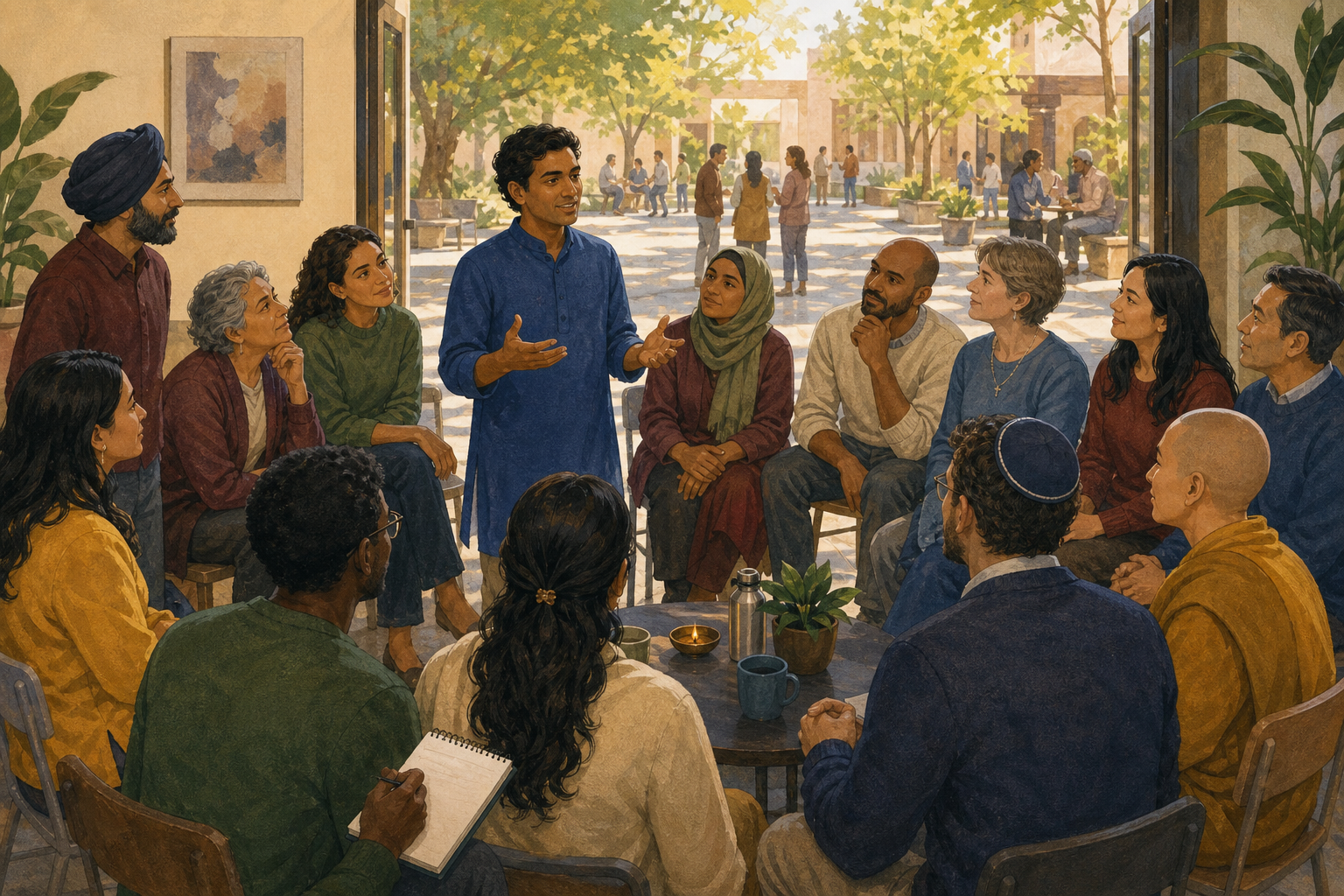
The purpose of public advocacy is not merely to win a day of outrage. It is to create an accurate record, correct a falsehood, secure better conduct, and strengthen a rule that allies can defend even when political control changes.
- Verify the full context. Save the exact words, date, venue, complete recording or transcript, and relevant surrounding sentences. Do not build a campaign around a clipped paraphrase.
- Classify the problem. State whether you are addressing doctrinal disagreement, disparagement, factual inaccuracy, coercion, unequal treatment, or a combination. If an important fact is unknown, say so.
- Describe the civic harm precisely. Explain that the language denied a Hindu person’s agency, repeated a stereotype, or suggested unequal standing. Avoid relying only on a general claim that the words were offensive.
- Make a bounded request. Ask for a correction, clarification, meeting, policy commitment, or withdrawal of a specific phrase. A demand that has no identifiable completion point is difficult to satisfy and easy to evade.
- Apply the rule reciprocally. State that Christians, Muslims, Jews, Buddhists, Jains, Sikhs, atheists, and others deserve the same protection. This makes clear that Hindu advocacy is defending pluralism rather than seeking a religious privilege.
- Match escalation to the evidence. Ordinary political speech calls for political accountability. A documented denial, threat, or adverse decision may require professional legal review. Keep those tracks distinct.
A concise public statement can follow this form: Public officials are free to explain their own beliefs. They should also describe a citizen’s Hindu faith accurately and with the same civic respect they expect for their own tradition. Please clarify the exact words at issue, affirm that the individual alone defines her religious identity, and apply that standard to every faith.
That wording does not ask anyone to surrender theology. It asks a public leader to distinguish personal conviction from the civic standing of another person.
Avoid four shortcuts that weaken the case:
- Do not attack a spouse or child who did not make the disputed statement.
- Do not guess at private beliefs, conversion plans, or family disagreements.
- Do not answer an individual’s words with accusations against an entire religious community.
- Do not label an unrelated policy disagreement anti-Hindu unless you can show how Hindu identity, practice, or equal treatment is actually implicated.
Key takeaways
- Protected religious disagreement is not the same as disparagement, and disparagement is not automatically the same as unlawful coercion.
- In an interfaith family, each adult remains the authority on his or her own religious identity.
- Evaluate politicians through policy, rhetoric, and repair instead of party loyalty or one favorable gesture.
- Quote exact words, identify the precise problem, and request a correction that can be recognized when it occurs.
- Use a reciprocal standard that you would accept for every religious and nonreligious community.
When the next controversy arrives, pause before sharing the shortest clip. Preserve the full record, name the category, run the policy-rhetoric-repair test, and make one precise demand. That discipline makes the Hindu civic voice harder to caricature and easier for principled allies to support.
Religious freedom is strongest when it is reciprocal. Defend a Hindu family’s dignity with the same rule you would want applied if a politician discussed a Christian, Muslim, Jewish, Buddhist, Jain, Sikh, or nonreligious spouse. Then vote, advocate, and build coalitions on the evidence.
References
