
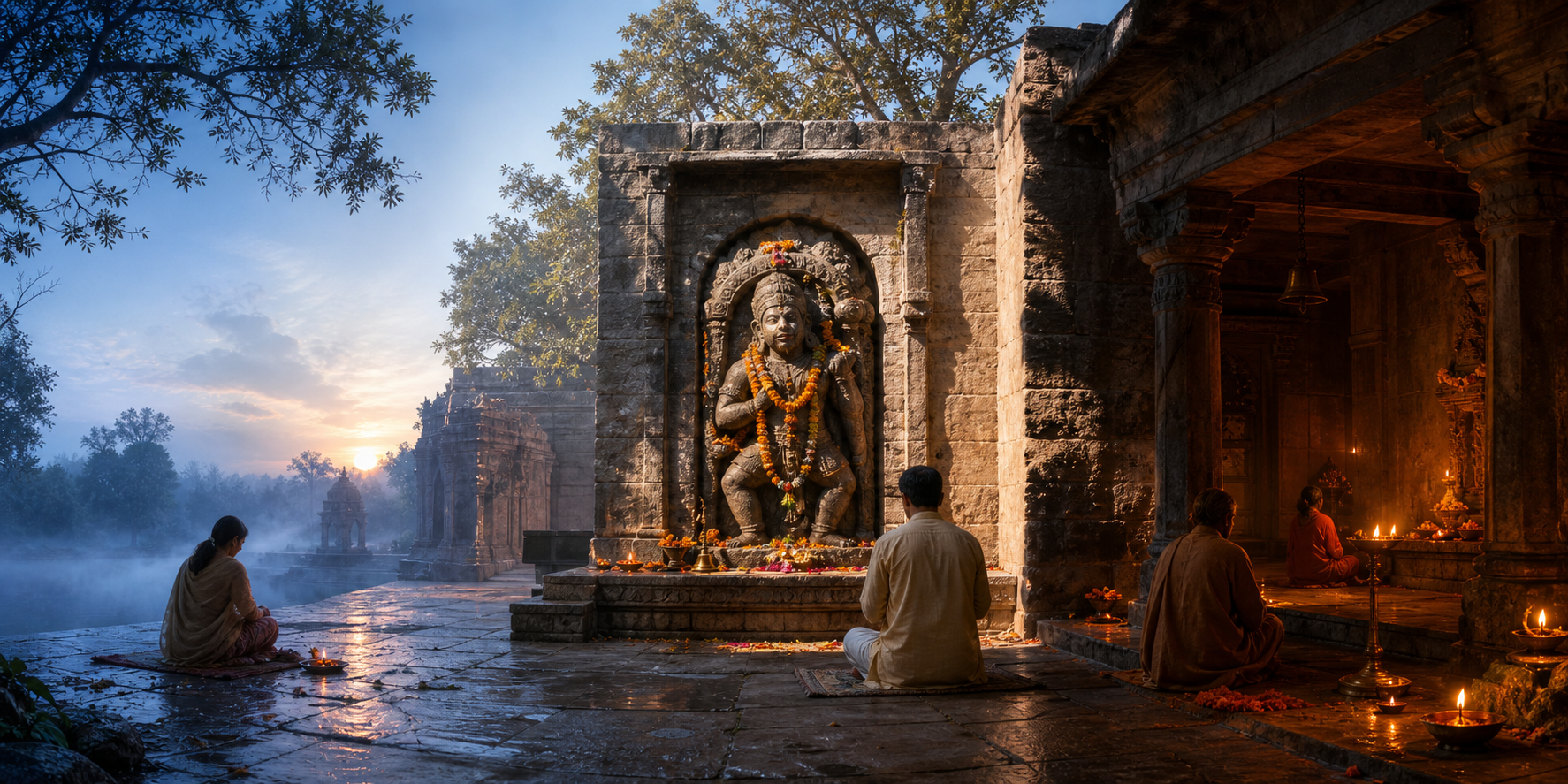
If you are going to Surajkund Hanuman Temple in Mandla because you have heard that Hanuman appears as a child, a youth, and an elder in one day, do not plan a single quick stop. The tradition becomes intelligible when you return at three thresholds: morning, midday, and evening.
This is not a promise that every visitor will perceive an identical change. Your task is not to force a result or collect three photographs. It is to make time for three unhurried darshans, keep your viewing conditions reasonably comparable, and allow the meaning of Hanuman’s forms to unfold across the day.
Read the three forms as a daily sequence
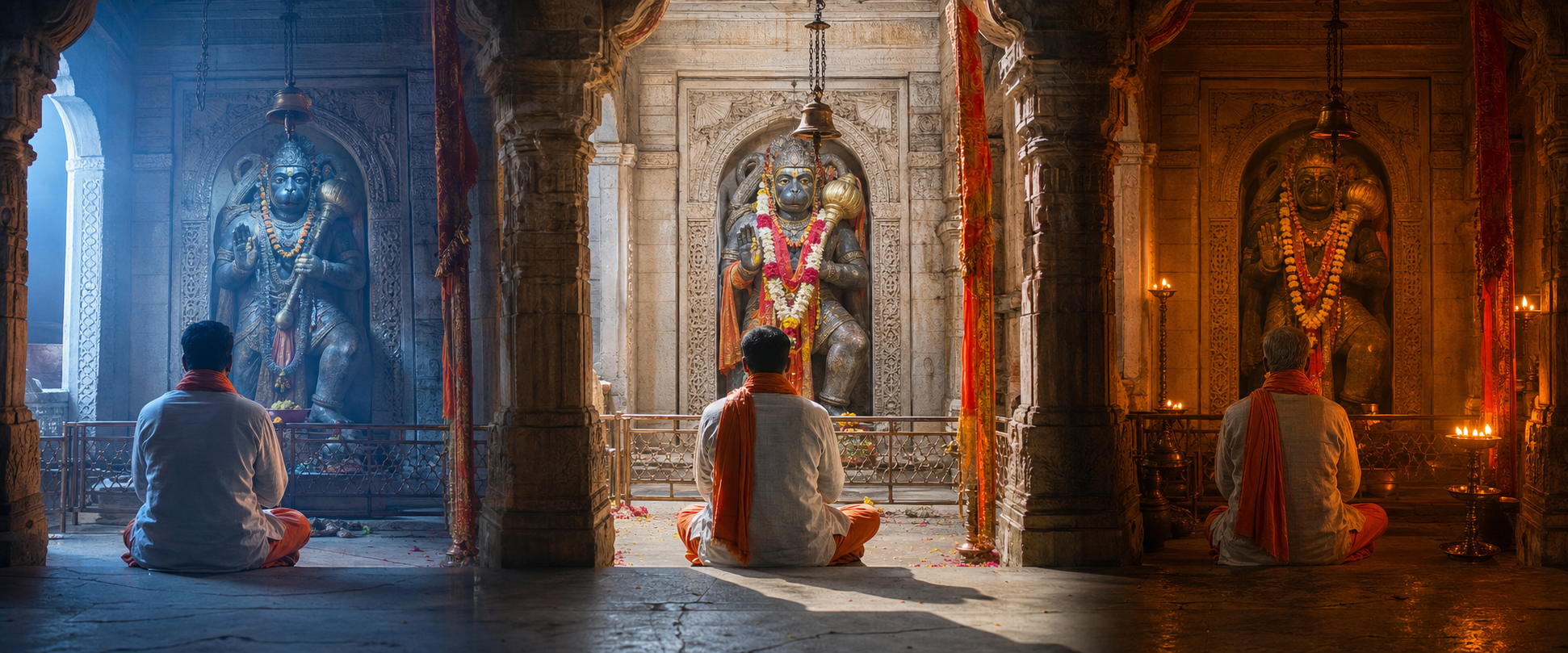
The living tradition at Surajkund concerns three successive impressions of the same murti. In the morning, devotees commonly perceive Bala Hanuman, the child. Around midday, the impression is Yuva Hanuman, the vigorous youth. By evening, the murti is received as Vriddha Hanuman, the serene elder.
| Part of the day | Traditional form | Devotional quality | What to notice |
|---|---|---|---|
| Morning | Bala Hanuman | Fresh faith and innocent trust | A gentler, softer impression in the face and overall presence |
| Midday | Yuva Hanuman | Courage, discipline, and protective strength | Clearer contours and a more focused, vigorous presence |
| Evening | Vriddha Hanuman | Wisdom, compassion, and contemplation | Greater depth, stillness, and gravity under evening illumination |
These are not three disconnected images. They form one arc. Bala is devotion before calculation. Yuva is devotion expressed through disciplined action. Vriddha is devotion ripened into discernment. The child, servant-warrior, and elder complete one another, just as tenderness, strength, and wisdom must coexist in a mature life.
Do not turn the table into a rigid timetable. The temple’s abhishekam, alankaram, and aarti shape the visual and ritual setting, and their timing can vary with the season and the day’s schedule. Morning, midday, and evening are the reliable phases; an exact universal clock time is not.
Plan three visits without inventing fixed hours
When you arrive in Mandla, first confirm the day’s puja and aarti sequence with temple authorities or local devotees. Build your visit around the actual ritual schedule rather than an hour copied from an undated travel note. Then make three separate approaches to the murti.
- Arrive before sunrise for the morning sequence. This gives you time to settle before the Bala darshan rather than entering hurried and distracted. Follow the temple’s opening arrangements and wait until darshan is permitted. Observe the face, eyes, contours, and overall emotional impression without deciding in advance what you must see.
- Return after the midday aarti. Use approximately the same viewing position if the queue and temple instructions allow it. Notice whether the murti now appears firmer, more sharply defined, or more protective. This is the phase associated with Yuva Hanuman.
- Come back at or after the evening aarti. Let your eyes adjust to the changed illumination before comparing the murti with your morning memory. The evening darshan is associated with Vriddha Hanuman’s composure, depth, and contemplative authority.
Comparability matters, but decorum comes first. Never obstruct a queue or insist on a particular spot. Keep your device silent during puja, do not use flash, and do not hold up other devotees while trying to reproduce an angle. If photography is allowed, treat it as a record of pilgrimage, not as an entitlement or a laboratory procedure.
Wear modest clothing and follow all local instructions concerning footwear, offerings, and access. Laddoo and urad-based preparations are customary offerings in this Hanuman worship tradition, but hand over anything you bring only in the manner directed at the temple. The same rule applies to recitation: Hanuman Chalisa and Sundara Kanda can deepen your smarana, but they should support the shared worship rather than compete with an aarti or priestly instruction.
A useful discipline is to make your comparison only after each darshan. Step away from the sanctum and write one or two short observations: the quality of the light, the expression you perceived, and your own state of attention. Constant note-taking in front of the murti shifts your attention from darshan to documentation.
Watch light, ritual, and stone without reducing darshan
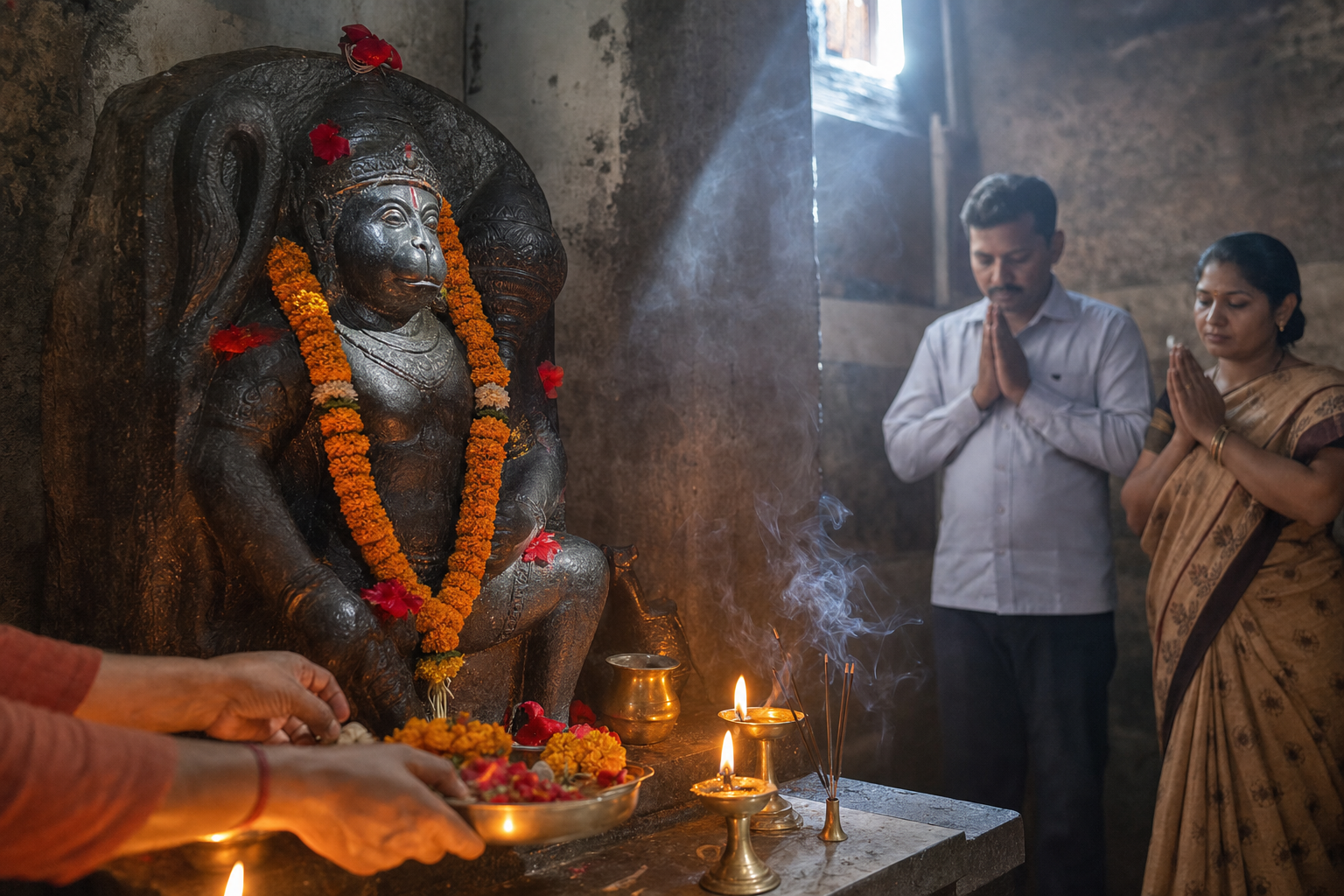
Surajkund’s setting near water and open sky matters. The name Surajkund commonly refers to a sun-oriented ritual tank or reservoir, and here sunlight, possible water reflection, ritual illumination, and the murti’s surface meet in a changing visual field. If you want to understand why the three impressions can be so compelling, pay attention to four conditions.
- Direction of light: Low-angle morning light can soften features through highlights and gentle shadow. The more overhead light of midday can flatten some shadows while defining edges more clearly. This can strengthen the impression of youth and physical readiness.
- Sindoor and oil: Hanuman murtis are often adorned with a sindoor layer mixed with oil during chola or alankaram. As the coating settles and gradually changes in sheen, the distribution of highlights can change with it.
- Surface relief: Fine variations in the stone catch light differently as its direction changes. A contour that appears delicate in the morning may look more pronounced at midday or deeper under evening lamps.
- Evening lamps: Warm lamp light changes contrast and color perception. Under it, the same features can acquire the gravity and repose that devotees associate with Vriddha Hanuman.
These mechanisms offer ways to notice the experience; they do not settle its ultimate meaning. Some devotees receive the forms as a miraculous sign of Hanuman’s living presence. Others emphasize the interaction of light, pigment, oil, stone, viewing angle, and ritual timing. You do not need to stage a contest between those readings.
In a dharmic setting, attentive observation need not be hostile to reverence. Abhishekam and alankaram are acts of seva, not visual effects performed for spectators. Sunlight and lamp light are not intrusions into worship. The embodied conditions of darshan can be part of the way sacred presence is encountered. Explaining how perception is shaped does not explain devotion away.
This is also why a photograph should not become your final judge. A camera fixes one fraction of a second, while darshan includes movement, ritual sound, changing light, memory, expectation, and your own quality of attention. Compare your three encounters honestly, but leave room for the possibility that the most consequential change may occur in the devotee rather than in an image file.
Turn the changing forms into a day of sadhana
The most useful way to receive the tri-darshan is to give each form a task in your own day. Otherwise, you may leave with an unusual observation but miss the spiritual instruction carried by the sequence.
- At Bala darshan, recover simple trust. Begin with one clear sankalpa rather than a long list of demands. Ask where suspicion, pride, or overthinking has made your devotion needlessly complicated. Bala Hanuman directs you toward sincerity that does not bargain before serving.
- At Yuva darshan, convert devotion into action. Choose one concrete act of seva you can complete. Courage here is not excitement or display; it is disciplined readiness to protect, help, speak truthfully, or carry an assigned duty without seeking credit.
- At Vriddha darshan, examine the action. Review what you intended in the morning and what you actually did. Wisdom is not passivity after effort. It is the ability to learn without self-deception and to let strength become compassionate rather than harsh.
Hanuman’s familiar attributes reinforce that progression. Abhaya communicates protection and reassurance. The gada expresses strength placed in the service of dharma. His attentive presence recalls unwavering devotion to Sri Rama. Morning gentleness, midday force, and evening gravity do not produce three competing Hanumans; they disclose complementary dimensions of one ideal sevaka.
The wider dharmic lesson is rhythm, not sameness. Sikh nitnem, morning and evening recitation cycles in Buddhist communities, and Jain pratikraman each anchor remembrance in time, even though their doctrines and practices remain distinct. Surajkund’s cycle gives you a particularly vivid Hindu form of the same practical insight: what you remember at dawn must guide conduct during the day and submit to reflection at night.
If you are visiting with children, explain the sequence before the first darshan in those practical terms: trust, brave service, and wise reflection. Ask them what changed after each visit, but do not supply the answer or tell them they failed if they saw no visible difference. The tradition is better transmitted through careful attention than through pressure to report a predetermined result.
Key takeaways
- Reserve a full day if you want to encounter the complete Bala, Yuva, and Vriddha sequence.
- Confirm the current ritual schedule locally; do not rely on a fixed universal hour for each form.
- Attend morning, midday, and evening darshan from a similar position when temple arrangements permit.
- Notice light direction, surface sheen, stone relief, and lamp contrast without treating worship as an experiment.
- Keep devices silent, avoid flash, respect queues, and never interfere with abhishekam, alankaram, or aarti.
- Carry one discipline from each darshan: trust in the morning, seva during the day, and honest reflection at night.
If you can give Mandla a full day, reserve it as a three-part pilgrimage rather than fitting the temple between hurried stops. If you have time for only one darshan, choose the phase that speaks most directly to your present need – tender trust, courageous service, or seasoned reflection – and receive it without claiming to have witnessed the complete cycle.