
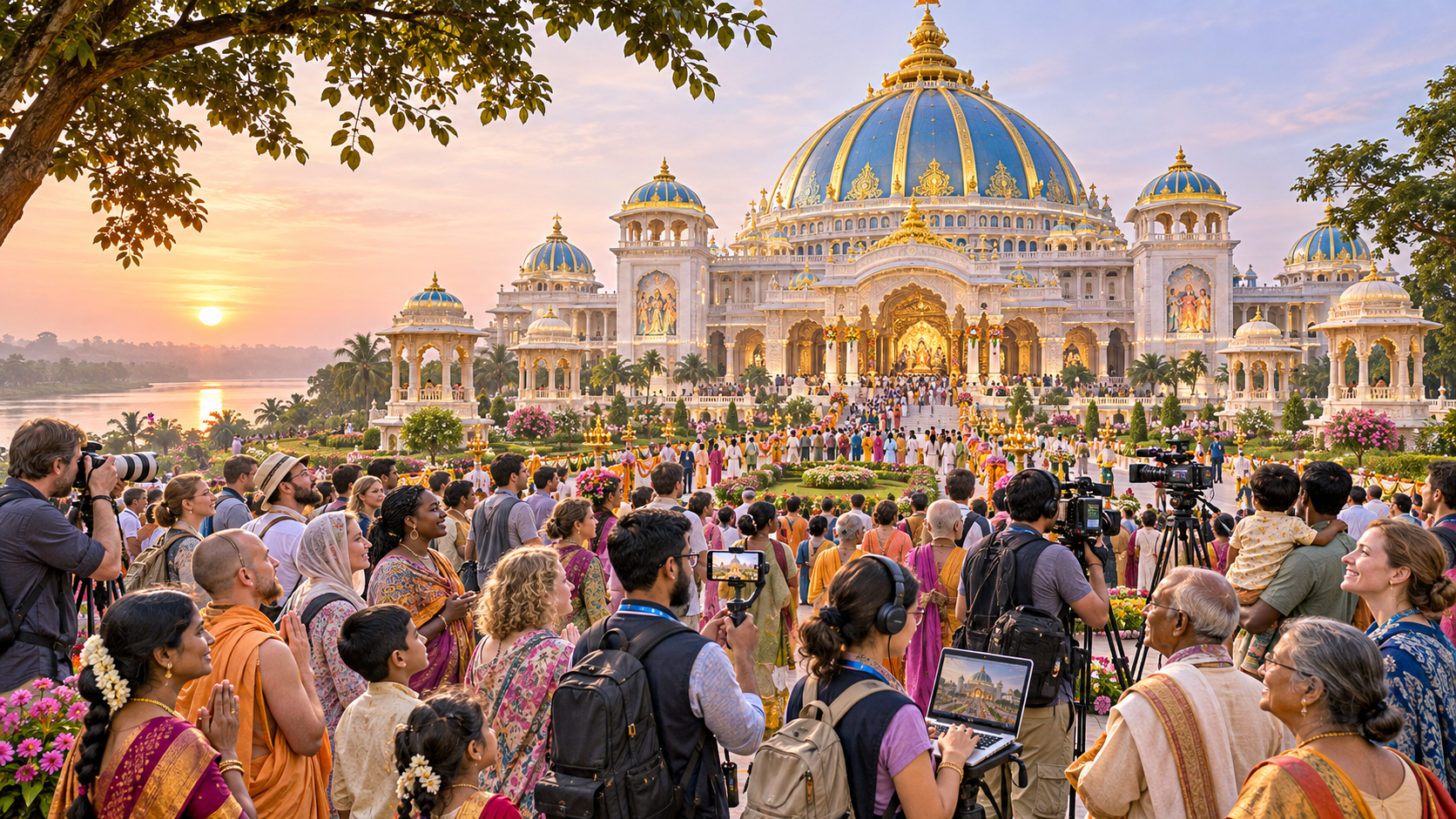
If you are helping explain the TOVP grand opening – through a temple office, congregation, media team or personal channel – your hardest decision is not where to post. It is what someone should understand, trust and do after encountering the opening for the first time.
ISKCON has framed the preparation around a global communications strategy that brings media outreach, publicity initiatives and promotional planning together. That is the right scale for the task. A Dharmic landmark can speak to devotees, the wider Hindu world, journalists and people unfamiliar with the tradition, but those audiences should not receive contradictory versions of its meaning.
Start with one message spine, not one universal slogan

A worldwide campaign does not need identical wording everywhere. It needs a stable centre. Before producing trailers, posters, interviews or translated posts, write a message spine that every public statement can be traced back to.
The spine should answer four practical questions:
- What is happening? Use the official name of the opening and only the event details that have been confirmed for publication.
- Why does it matter? Explain the temple’s sacred purpose before describing its scale, architecture or publicity value.
- Why should this audience care? Connect the opening to a living tradition rather than presenting it as an isolated spectacle.
- What should the person do next? Direct them to a single official destination for updates, participation information or verified media.
The central meaning can remain stable while the doorway changes. A devotee may enter through seva, pilgrimage and worship. A broader Hindu or Dharmic audience may respond to the continuity of living civilisation. A journalist needs plain answers about significance, responsibility and public access. Someone unfamiliar with Sanskrit terms needs a clear explanation without being asked to master insider vocabulary first.
That is localisation, not inconsistency. The test is simple: each version should preserve the same verified facts, sacred purpose and official next step. If a regional message has to exaggerate the event to make it interesting, the message is not ready.
Keep promotional superlatives out of the spine unless they can be proved and precisely defined. Words such as “largest,” “first” and “unprecedented” invite an argument about rankings when the public should be learning why the temple matters. Sacred significance does not need an unsupported record claim.
Create a source of truth before publicity scales

Promotion amplifies ambiguity as efficiently as it amplifies truth. If a date, access rule or broadcast link changes, hundreds of attractive graphics can become liabilities. Your first communications asset should therefore be a canonical public page, not a poster.
Use that page to hold the current event name, confirmed programme information, participation guidance, media contact, approved images and correction notices. Every email, social post, press note and local announcement should point back to it. If a detail has not been confirmed by the responsible TOVP or ISKCON authority, mark it internally as pending and leave it out of public copy.
Behind the public page, maintain a fact register with three clear states:
- Confirmed: approved for public use and attached to an accountable owner.
- Pending: plausible or expected, but not ready to publish.
- Corrected: previously circulated information that now requires replacement.
Record where each confirmed fact came from, who approved it and which assets use it. This is not bureaucracy for its own sake. It gives the communications team a reliable way to update translations, local posters and media replies when circumstances change.
Define the correction path before you need it. Update the canonical page first, notify local communication leads, replace downloadable assets and publish a concise correction wherever the outdated claim travelled. Quietly editing the original post is not enough when people may already have saved or forwarded it.
Do not let an elegant graphic outrank the current official page. A poster is a snapshot; the official page is the record.
Give local communities a kit they can actually use
Global communication becomes credible through local voices. Congregations and volunteers already know their languages, media environments and community relationships. What they often lack is an approved package that lets them act without guessing.
A practical communication kit should contain:
- approved short and extended descriptions of the opening;
- a terminology sheet covering official names, preferred spellings and plain-language explanations;
- a frequently asked questions file with an owner for each answer;
- photographs and video assets with captions, credits and usage instructions;
- editable announcement copy for congregational email, social channels and local media;
- a press note that local teams can adapt without changing the central claims;
- the canonical page address and the verified destination for participation or viewing information;
- a named route for questions, corrections and media requests that the local team cannot answer.
Separate the kit into immutable and adaptable elements. Official names, confirmed facts, quotations, links and credit lines should not change. Examples, explanatory language and the order of presentation may be adapted to local understanding. Marking that boundary gives volunteers useful freedom without turning every translation into a new factual version.
Translation needs both linguistic and theological review. A fluent speaker can make the words natural; a practitioner who understands the tradition can notice when a devotional term has been flattened or shifted. Ask reviewers to preserve the meaning of specialised terms, then explain those terms in the surrounding language. Replacing every Sanskrit or Bengali word with an approximate English concept can remove the very worldview the communication is meant to convey.
Localisation also requires restraint. Do not imply that the TOVP speaks for every Hindu sampradaya or every Dharmic religion. Present its Gaudiya Vaishnava and ISKCON identity clearly while inviting others to understand its wider civilisational significance. Respect becomes more persuasive when it is precise.
Prepare spokespeople for the questions publicity creates
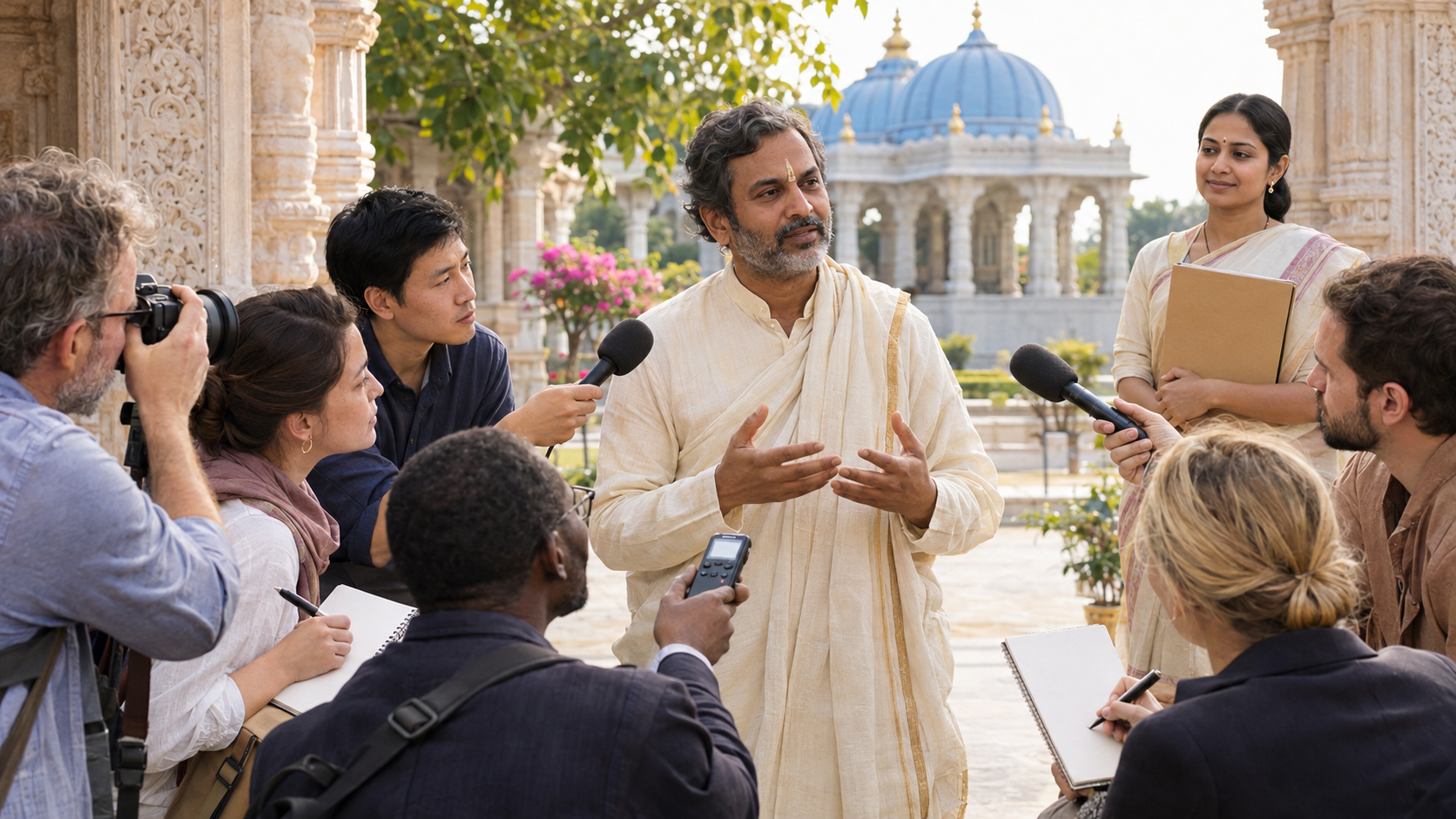
Media outreach does more than distribute your preferred message. It creates questions, including questions the promotional team may not have chosen. A spokesperson needs an answer system, not just enthusiasm.
Assign questions by subject. Devotional meaning, event arrangements, organisational responsibility, visitor access, funding, architecture and media logistics may require different accountable people. Give the public and press a single intake point, then route each request internally. This prevents several representatives from improvising incompatible answers.
The name “Temple of the Vedic Planetarium” will naturally prompt questions about “Vedic” and “planetarium.” Prepare plain-language explanations of what those words mean in this institution’s own presentation. When a question touches theology, symbolism or empirical science, identify which kind of claim is being made instead of sliding between them. Clarity protects both intellectual credibility and the integrity of the tradition.
Rehearse difficult questions as carefully as welcoming ones. Useful preparation includes:
- the approved answer and the evidence supporting it;
- the boundary beyond which the spokesperson should not speculate;
- a plain-language bridge back to the temple’s purpose;
- the official place where the audience can verify updated details;
- the person to whom an unanswered question must be routed.
“I do not have a confirmed answer” is better than a confident invention. The spokesperson can acknowledge the question, record the request and promise only the follow-up that the team is equipped to provide. In a global campaign, an improvised sentence can be clipped, translated and detached from its context; disciplined uncertainty is therefore a communications strength.
The same discipline applies to photographs and video. Captions should identify what is actually visible, credits should travel with the asset, and archival material should not be presented as current footage. If a livestream is offered, circulate only the verified official link and make the canonical page the fallback destination.
Treat the opening as the start of a public relationship
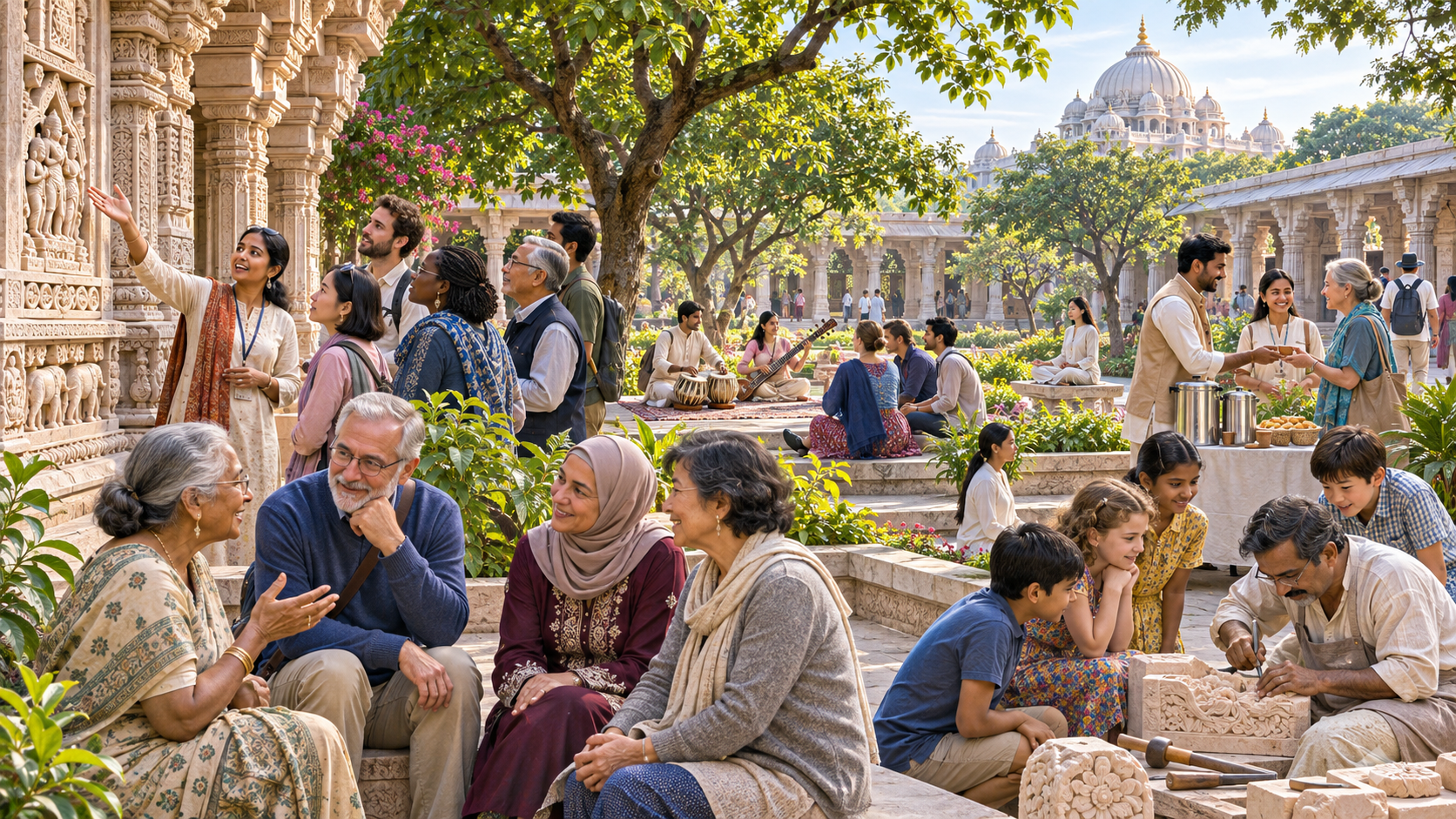
An opening campaign can attract attention that disappears as soon as the ceremony ends. Avoid that outcome by planning the public journey beyond the event itself.
Before the opening, publish meaning and context, not a stream of repetitive countdown graphics. Help people understand the temple, the tradition it belongs to, the correct vocabulary and the available forms of participation. During the opening period, prioritise verified practical information, accessible official media and prompt corrections. Afterwards, turn the strongest material into a durable archive: edited recordings, transcripts, translated summaries, image galleries, frequently asked questions and a clear route for future visitors or supporters.
Measure whether people reached a trusted destination, found accurate answers and continued into deeper engagement. Raw views can be useful, but they do not reveal whether viewers understood the temple or encountered conflicting information. Also track which questions recur, which translations are being used, where outdated claims remain visible and whether local communities can find the assets they need. Those signals tell you what to clarify next.
Keep the sacred purpose visible in every phase. Architecture may win the first glance, and ceremony may generate the first headline, but neither should displace worship, teaching and service as the centre of the public meaning. Communications succeeds when it opens a truthful doorway into the tradition rather than merely producing attention around it.
Key takeaways
- Write a stable message spine covering the opening, its sacred meaning, its relevance and the official next step.
- Place confirmed facts on a canonical page and make every public asset point back to it.
- Give local teams approved material, translation guidance and a clear boundary between fixed facts and adaptable expression.
- Route media questions to accountable subject owners and never improvise unconfirmed details.
- Plan the archive, follow-up material and correction process before publicity reaches its widest audience.
- Judge success by accurate understanding and continued engagement, not attention alone.
Your next move is concrete: draft the message spine and fact register, assign an owner to every public claim, and test the resulting kit with a local communicator who did not help create it. Any point they cannot explain or verify is the point to repair before the world sees it.
References

Leave a Reply
You must be logged in to post a comment.