

You may have opened a Kartik katha because you cannot be in Vrindavan, or because you are in Vrindavan but do not want the month to pass as a sequence of beautiful impressions. In either case, the practical question is the same: how does hearing become a change in the way you remember, speak, serve, and use your time?
The most useful response is neither to imitate every visible austerity nor to remain a spectator. Receive the teaching carefully, extract a definite instruction, and give it a modest but protected place in your ordinary day.
Let sacred time interrupt your ordinary schedule
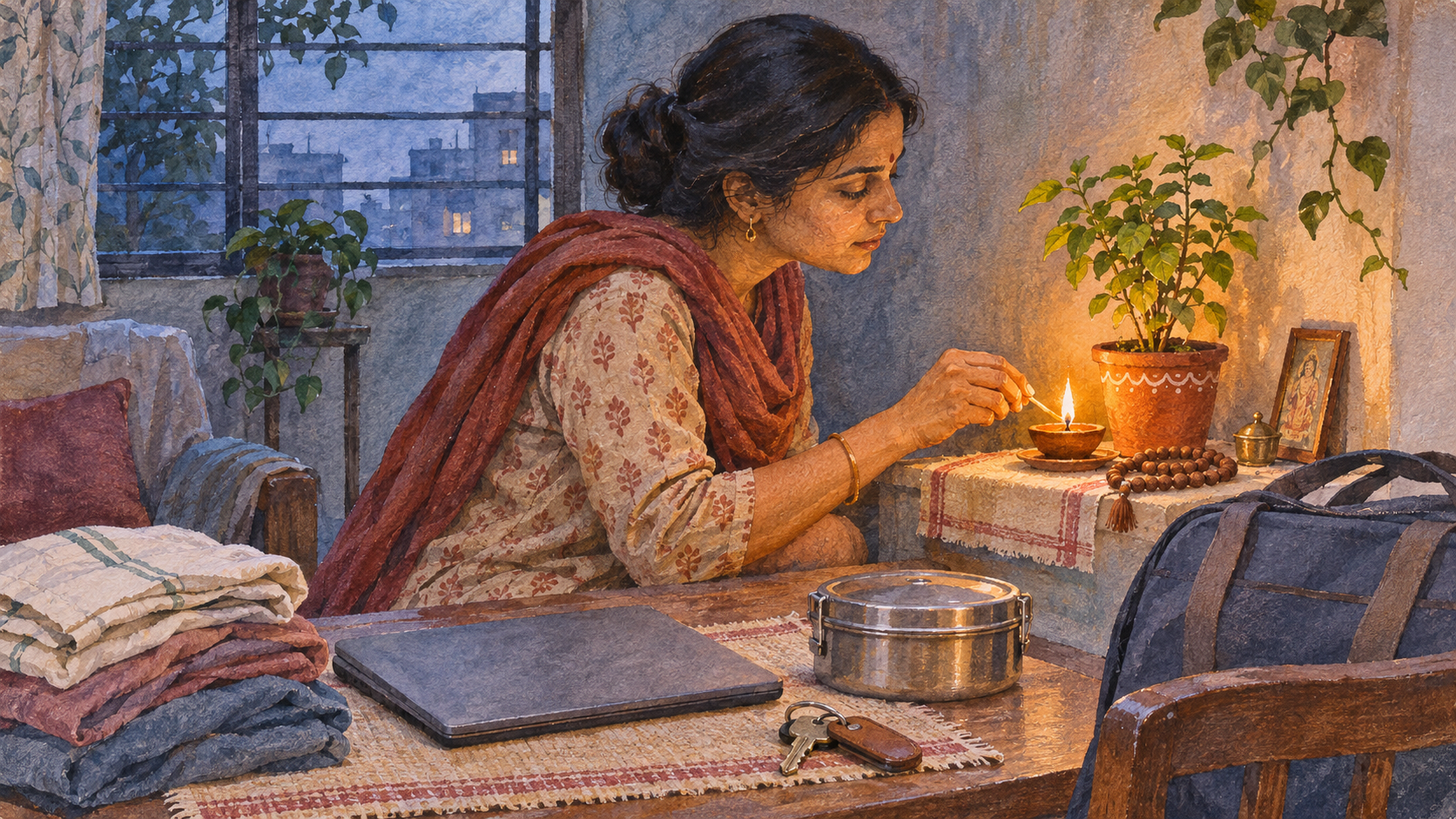
Kartik can decorate your existing routine, or it can discipline it. The difference is visible in your calendar. If katha, prayer, and aarti are fitted into whatever attention remains after work, messages, and entertainment, devotion receives the leftovers. A sustainable Kartik practice assigns it a place before distractions claim that place.
You do not need to reproduce an ashram timetable. You do need to make a change that can be observed. Begin by answering these questions:
- Which stable event in your day will become a cue for remembrance: waking, bathing, returning home, or preparing for sleep?
- Which avoidable distraction will you remove from that period?
- Which form of speech will you restrain, especially when irritation makes it attractive?
- Whose burden will become lighter because you are practising seva?
- What part of the practice will remain possible on a difficult day?
Write the answers as behaviour, not aspiration. Be more devotional is too vague to guide you. Put the phone outside the room during evening worship is clear. Become humble cannot be scheduled. Let another person finish speaking before answering can be practised immediately.
This is the first lesson to carry from Kartik: sacred intention needs a structure. Without one, the strongest feeling eventually loses to the most convenient habit.
Hear katha as instruction, not religious atmosphere
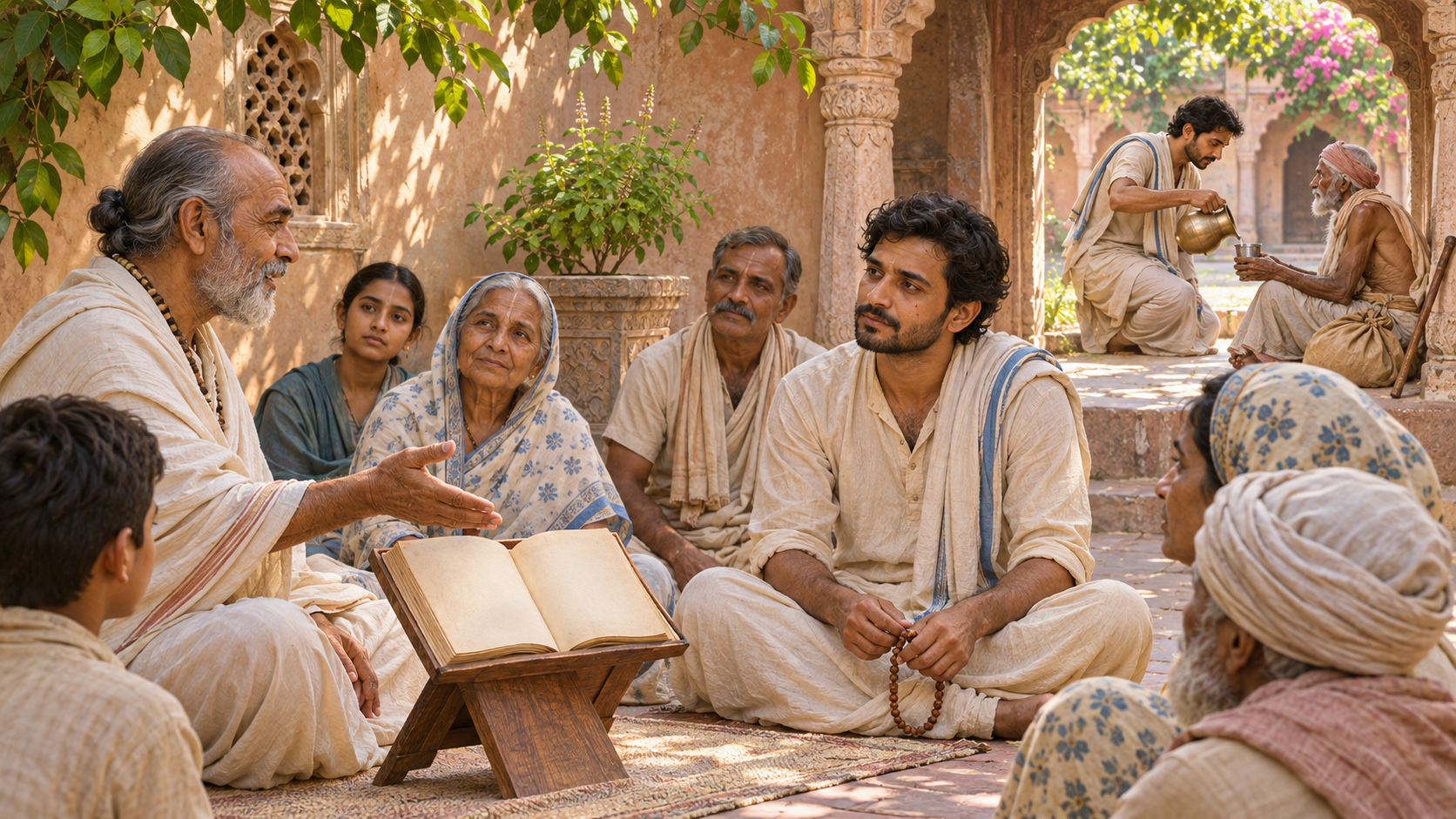
When you receive a 2026 Kartik katha presented live from Vrindavan through a screen, physical distance is no longer a barrier to hearing. The screen introduces a different obstacle: it makes sacred narration easy to consume in the same distracted manner as any other stream.
Do not play katha as background sound while moving between unrelated tasks. If circumstances allow only partial attention, choose a shorter portion and hear it properly. Depth of reception matters more than the amount of audio completed.
A simple listening discipline can turn hearing into practice:
- Arrive with a living question. Ask where you are struggling now: steadiness, harmful speech, resentment, distraction, service, or remembrance.
- Keep a page under three headings: what I heard, what it exposed, and what I will practise.
- Record the teaching in your own words. If you cannot restate it plainly, listen again before drawing a conclusion.
- Choose an application that belongs to your actual circumstances, not to an imagined devotional life.
- Put the instruction into practice before the day closes, while its meaning is still present.
If the katha gives an image or mood rather than an explicit command, ask what quality it invites: patience, dependence on Bhagavan, gratitude, restraint, tenderness, courage, or readiness to serve. Then identify the next situation in which that quality will be tested.
Do not confuse emotional intensity with spiritual assimilation. Tears may come or may not come. A quiet or distracted mind does not automatically make the hearing fruitless. The useful test appears later: do you notice anger before it becomes speech, distraction before it takes over prayer, or another person’s need before convenience closes your eyes to it?
Bring Vrindavan into your orientation, not your performance
In Krishna-bhakti, Vrindavan is sacred geography, not a decorative setting for devotional content. A transmission can carry words, singing, and the cadence of worship, but it cannot make your room physically identical to the place from which the katha is heard. There is no need to pretend otherwise.
What you can bring home is an orientation: Krishna at the centre, remembrance protected from interruption, service given precedence over display, and daily life understood as a place of practice rather than an obstacle to it.
Build that orientation with a few concrete decisions:
- Keep a clean, fixed place for hearing and prayer. Use the form of worship already proper to your household and sampradaya.
- Attach the practice to a dependable part of the day instead of waiting to feel inspired.
- Remove notifications and unrelated screens while you hear. A boundary around attention is itself a form of respect.
- If aarti is already part of your household worship, perform it without multitasking and with ordinary fire safety.
- Pair inward remembrance with outward seva. Wash what someone else expected to wash, help prepare the worship space, care for a family member, support temple work, or attend to a neglected duty without seeking recognition.
Avoid copying specialised temple rites, strict fasting disciplines, or demanding night practices merely because they are visible in Vrindavan. Rules differ among lineages, and personal duties and health conditions differ as well. Where a practice has formal requirements, learn it from a trusted teacher in your tradition rather than assembling it from fragments online.
Distance should produce neither discouragement nor imitation. Let it produce humility. You may not be able to recreate the setting, but you can stop treating devotion as content and begin arranging your life around what you have heard.
Choose a Kartik vow that survives an ordinary day

A Kartik vow is useful when it gives devotion a repeatable form. It becomes counterproductive when it is chosen for drama, announced for admiration, or made so elaborate that ordinary responsibilities begin to look like interruptions.
Test a proposed vow before adopting it:
- Can you describe the exact action without using vague words such as more, better, or regularly?
- Can you keep its essential form on a tiring or crowded day?
- Does it deepen remembrance, restraint, study, worship, or seva?
- Does it preserve your obligations to family, work, health, and people who depend on you?
- Will it make you more attentive to others, or merely more occupied with your own religious performance?
A workable vow might be to begin and end the day with the divine name, hear a selected portion of katha with full attention, protect evening aarti from phone use, refrain from a recurring form of cruel or wasteful speech, or complete a quiet act of service each day. Choose the practice that addresses your real weakness. The most impressive option is not necessarily the most honest one.
Give the vow an essential form and a fuller form. The essential form is what remains possible when the day is difficult. The fuller form is what you offer when time and strength permit. This prevents the familiar cycle in which an ambitious beginning is followed by exhaustion, shame, and abandonment.
This is abhyasa in a practical sense: returning to the chosen act without requiring ideal conditions. If you lapse, follow any remedy prescribed by your tradition. Where no specific remedy applies, resume at the next opportunity instead of inventing a punishing austerity or declaring the entire month lost.
Review the effect of the vow, not only whether you completed it. Is your speech less careless? Is remembrance arising sooner? Are you more willing to serve when service is inconvenient? Are you becoming steadier without becoming harsh toward people whose practice looks different? Those changes reveal whether discipline is educating the heart or merely strengthening self-importance.
Key takeaways for your next Kartik katha
- Give Kartik a protected place in your schedule; do not leave it to whatever time remains.
- Hear with a present difficulty in mind, then translate the teaching into an action that belongs to your real life.
- Treat Vrindavan as sacred orientation, not as an aesthetic to imitate from a distance.
- Choose a vow that strengthens remembrance and service while preserving legitimate duties.
- Measure the practice by its effect on attention, speech, humility, and willingness to serve.
- Carry a sustainable part of the discipline beyond Kartik so the month leaves a living trace.
At your next sitting, listen for the clearest instruction rather than the most memorable phrase. Write it in plain language, decide where the day will test it, and act before sleep. Return to the same process when you hear again. That is how Kartik katha stops being something you watched from Vrindavan and becomes something that begins to shape the life you are actually living.
References

Leave a Reply
You must be logged in to post a comment.