
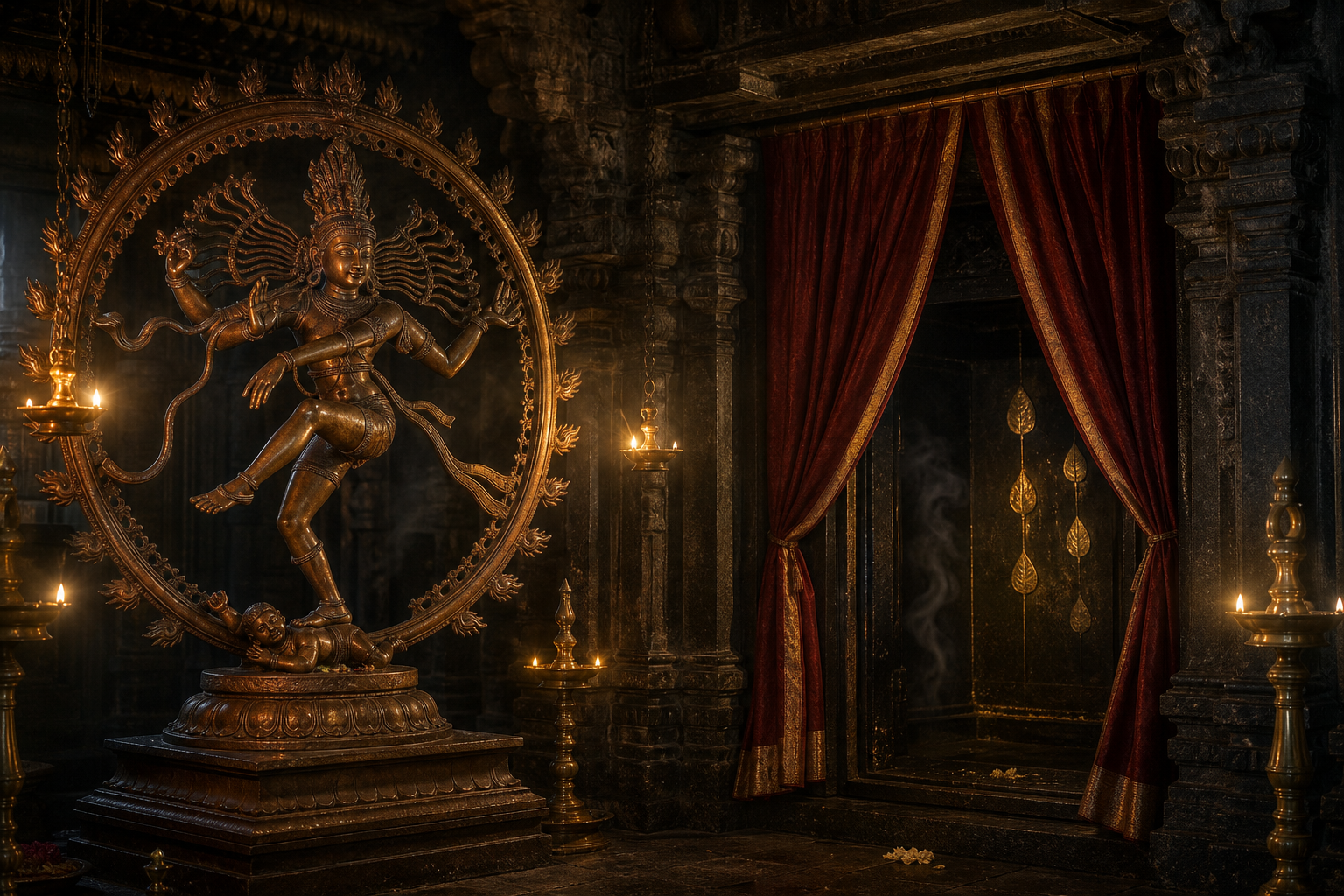
You may arrive at Chidambaram expecting the rahasya to be a concealed idol, an ancient code, or a spectacle revealed when a curtain moves. If you look only for an unusual object, however, you can see the ritual and still miss its point.
The key is to hold two darshanas together. Lord Nataraja gives you Shiva in a form on which devotion can rest. The Chidambaram Rahasya asks whether you can recognize divine presence when no conventional form occupies the center of your vision.
The rahasya is a revelation, not a riddle
The name Chidambaram is traditionally understood as cid-ambaram: the space, sky, or expanse of consciousness. Rahasya means a secret or mystery. Put together, the expression points toward a mystery of consciousness and sacred space, not merely a fact withheld from outsiders.
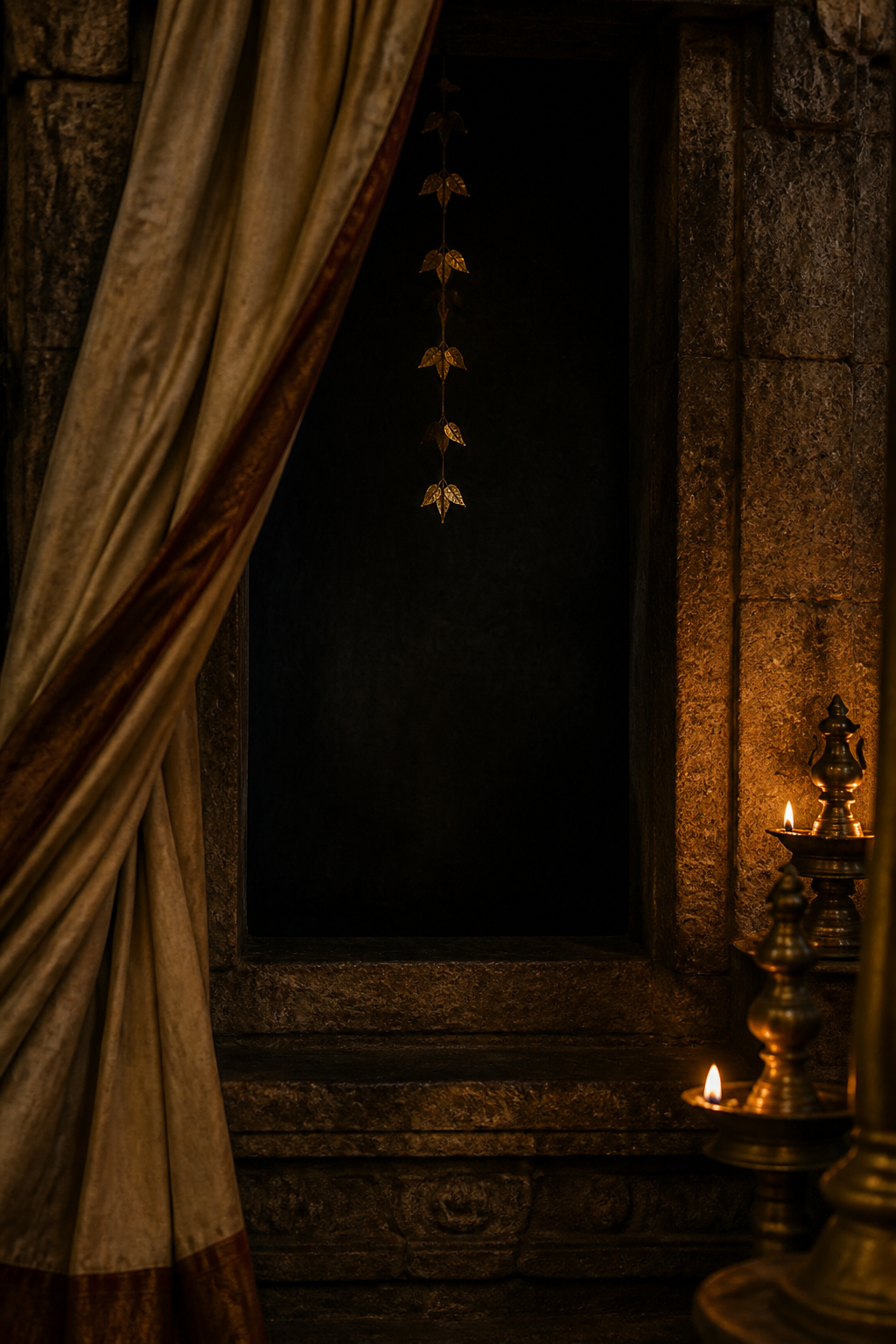
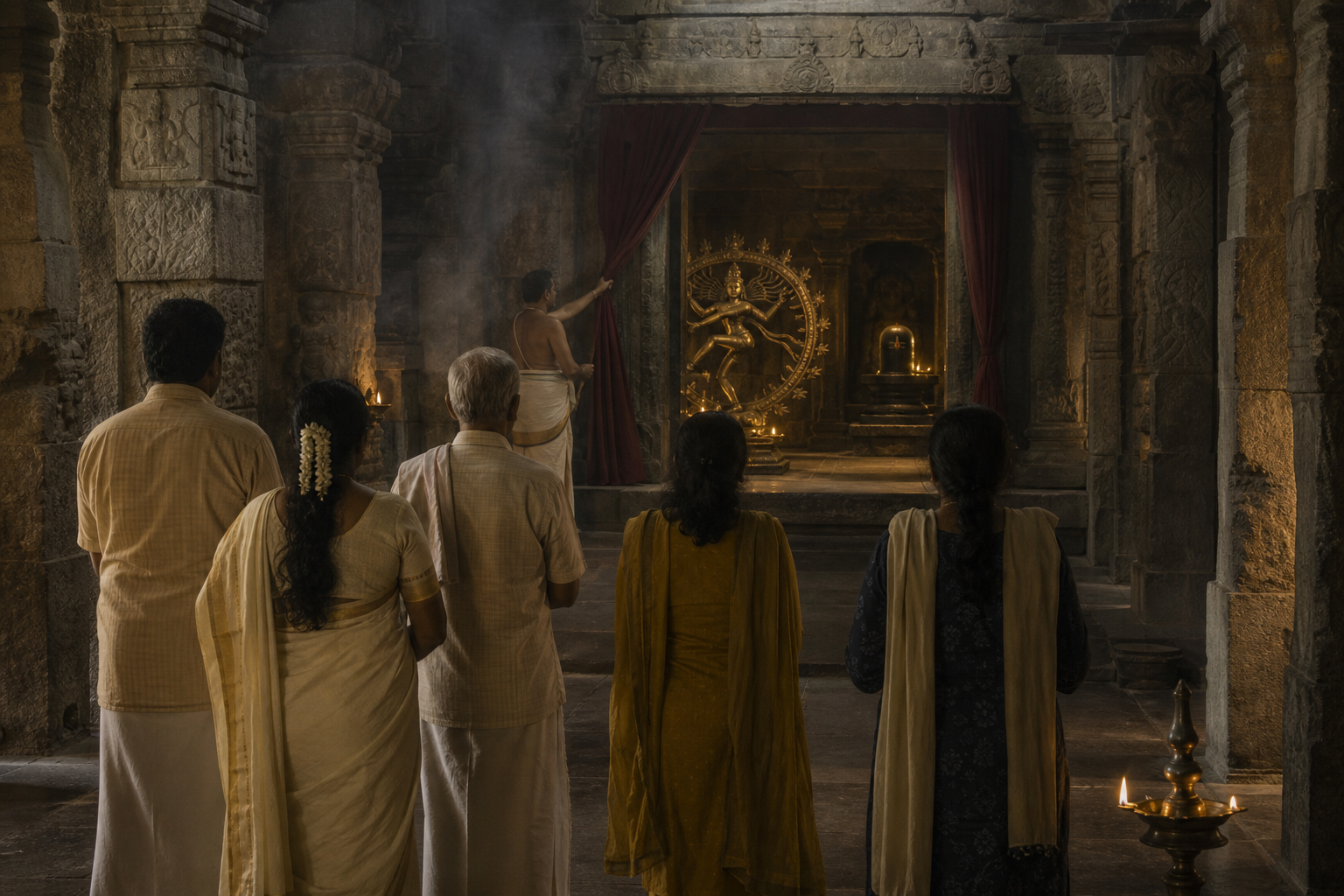
In the conventional explanation of the temple rite, a curtain conceals a space indicated by golden bilva leaves. When the screen is drawn aside, the devotee does not encounter a second anthropomorphic image competing with Nataraja. The apparent emptiness is intentional.
Chidambaram is also associated with akasha, or space, within the Shaiva tradition of temples linked to the five elements. A solid image would represent something bounded by an outline. Space is disclosed differently: it is made perceptible through an opening, a boundary, and the absence of the object you expected to find.
This is why saying that there is “nothing there” is inadequate. There may be no ordinary figure behind the curtain, but the lack of such a figure is doing theological work. The rahasya teaches that Shiva’s presence cannot be confined to the visible form through which you first approach Him.
If someone asks you for the simplest accurate explanation, use this one: the Chidambaram Rahasya is the worship of Shiva’s subtle, formless presence through sacred space. It is hidden and revealed ritually so that the devotee notices the difference between not seeing an object and encountering absence.
Why Nataraja and the empty-looking space belong together
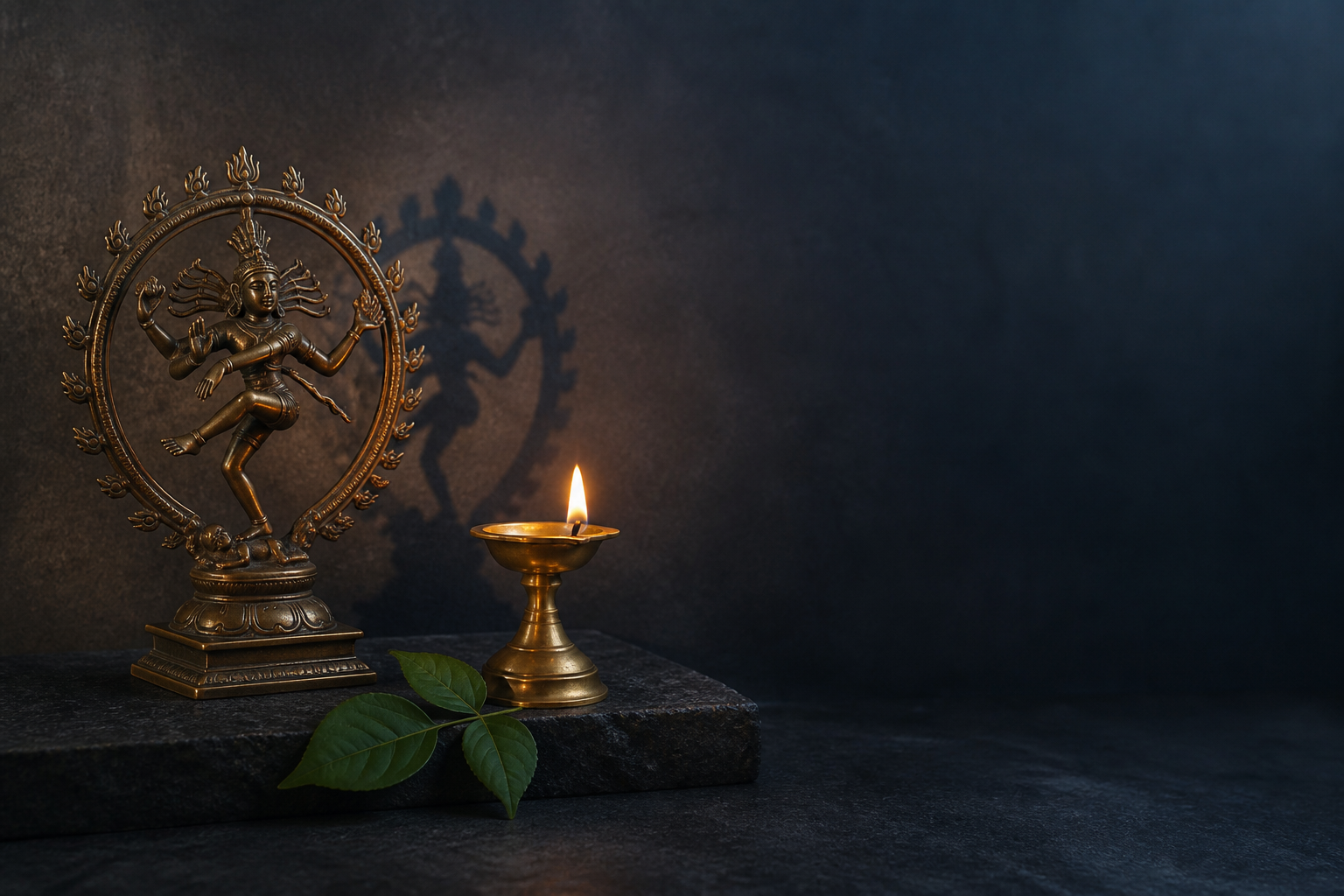
Nataraja and the rahasya should not be treated as rival explanations of Shiva. One does not say that form is false while the other supplies a supposedly superior truth. Chidambaram places the two modes of encounter beside each other because each corrects a possible mistake in the other.
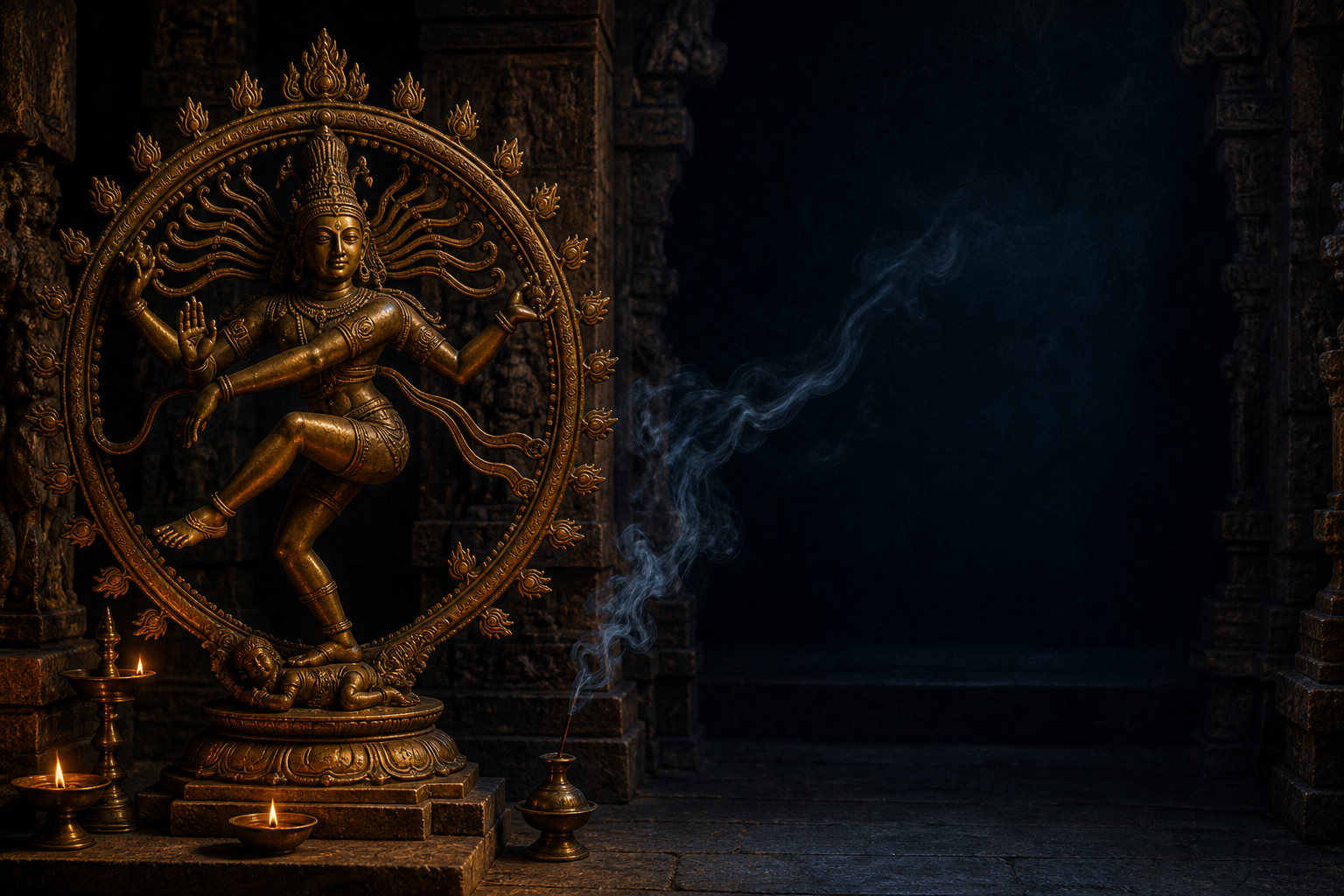
- Nataraja gathers your attention. The face, matted locks, sacred ash, posture, movement, and lifted foot give the mind something precise to behold and the heart someone to adore.
- The rahasya releases your attention from its dependence on an object. It prevents you from reducing Shiva to the material boundaries of even the most sacred image.
- The curtain joins concealment and disclosure. Moving it does not manufacture divine presence. It changes the conditions under which you are being asked to recognize that presence.
A helpful way to read the sequence is as temple pedagogy. Form trains attention; formlessness tests it. Beauty draws you into concentration; space prevents concentration from becoming possession. You are permitted to behold, but you are not permitted to conclude that the whole reality of Shiva has been contained by what your eyes can hold.
That distinction also protects the mystery from two shallow readings. The first dismisses the disclosed space as a clever presentation of nothing. The second turns it into an exotic secret that must resist all explanation. Neither is necessary. The rite can be explained plainly while its meaning still has to be realized through disciplined attention.
Shaiva schools may articulate the relationship among Shiva, consciousness, the individual self, and the world in different ways. You do not need to erase those differences to understand the temple’s immediate lesson: visible form and unbounded presence are not mutually exclusive.
Read Nataraja’s lifted foot before seeking the secret
The word rahasya easily captures a visitor’s curiosity, but curiosity can make you rush past the Lord standing openly before you. Chidambaram does not ask you to solve an invisible mystery while ignoring visible beauty.
Appar Nayanar’s hymn Kunitha Puruvamum lingers over Nataraja’s curved brows, gentle smile, wet matted locks, sacred ash, radiant body, and lifted golden foot. Its devotional force comes from exact seeing. The form is not treated as decoration around an abstract concept; darshana itself makes human birth worthwhile.
That gives you a practical discipline for the sanctum. Do not demand that you feel what a saint felt, and do not imitate someone else’s display of emotion. Give the form the kind of attention that made such devotion possible:
- Begin with Nataraja’s face rather than trying to absorb the entire image at once.
- Notice the matted locks and the sacred ash instead of reducing the murti to a general impression of movement.
- Let your attention come to the lifted golden foot, the feature on which Appar’s vision places particular weight.
- Step back mentally and receive the whole figure as a dance rather than a collection of details.
- Only then turn toward the rahasya, carrying the same quality of attention into a space where there is less for the eye to grasp.
This movement from detail to wholeness, and from form to space, keeps the darshana from becoming a hunt for novelty. The visible Lord prepares you for the invisible teaching. The rahasya, in turn, stops you from imagining that the visible Lord has exhausted the reality of Shiva.
How to approach the darshana without missing it
At the temple
- Replace the wrong question before entering. Instead of asking, “What hidden thing will I see?” ask, “Why are form and sacred space shown together?” The second question prepares you for what the temple actually communicates.
- Follow the temple’s ritual order. Do not treat the rahasya as an exhibit to be demanded on your schedule. Stand where directed, observe the worship, and let the disclosure occur within its liturgical setting.
- Give Nataraja undivided attention. Resist the urge to keep watching for a curtain movement. The openly manifest form is not a waiting room for the supposedly more interesting secret.
- When the space is disclosed, stop scanning for a concealed sculpture. Notice the golden bilva emblems if they are visible, but also notice your impulse to demand a material object. That impulse is part of what the rahasya exposes.
- Do not manufacture a mystical reaction. Quiet recognition is enough. A darshana is not invalid because you did not experience tears, stillness, or an immediate philosophical insight.
- Leave with one precise distinction. Say to yourself: “What looked empty was not presented as spiritually absent.” That sentence is more useful than a vague claim that the mystery is beyond words.
After you leave
You can carry the temple’s central contrast into a brief reflection without pretending that a private exercise replaces darshana. First, recall one exact feature of Nataraja rather than a blurred mental image. Next, allow that image to recede and notice the mental space in which the memory appeared. Then bring the form back without treating form and awareness as enemies.
Use this as a question, not as proof of a doctrine: what remains present when a particular image is no longer before the mind? The value lies in learning to notice the field of awareness as well as its contents. That is a more faithful response to the rahasya than repeating the phrase “God is everywhere” while paying attention nowhere.
Key takeaways
- The Chidambaram Rahasya is not chiefly a hidden object or a puzzle with a verbal password.
- The veiled, empty-looking space signifies Shiva’s subtle and formless presence; golden bilva leaves serve as sacred indicators rather than a replacement idol.
- Chidambaram’s association with akasha explains why space itself is central to the temple’s theological language.
- Nataraja and the rahasya are complementary: the murti concentrates devotion, while the disclosed space prevents divine reality from being confined to visible form.
- Appar Nayanar’s attention to Nataraja’s features shows how to prepare for the mystery: look carefully before trying to interpret.
- You do not need to force an extraordinary feeling. The first task is to recognize that an apparent lack of form is not being presented as a lack of presence.
If you plan to visit Chidambaram, carry one intention into the sanctum: behold Nataraja completely, and then do not demand another object from the sacred space. That simple discipline allows the temple’s two modes of darshana to illuminate each other.
The rahasya becomes useful when it changes how you see. Form need not imprison the Infinite, and formlessness need not mean a blank nothing. Chidambaram asks you to become capable of reverence in the presence of both.
References
