
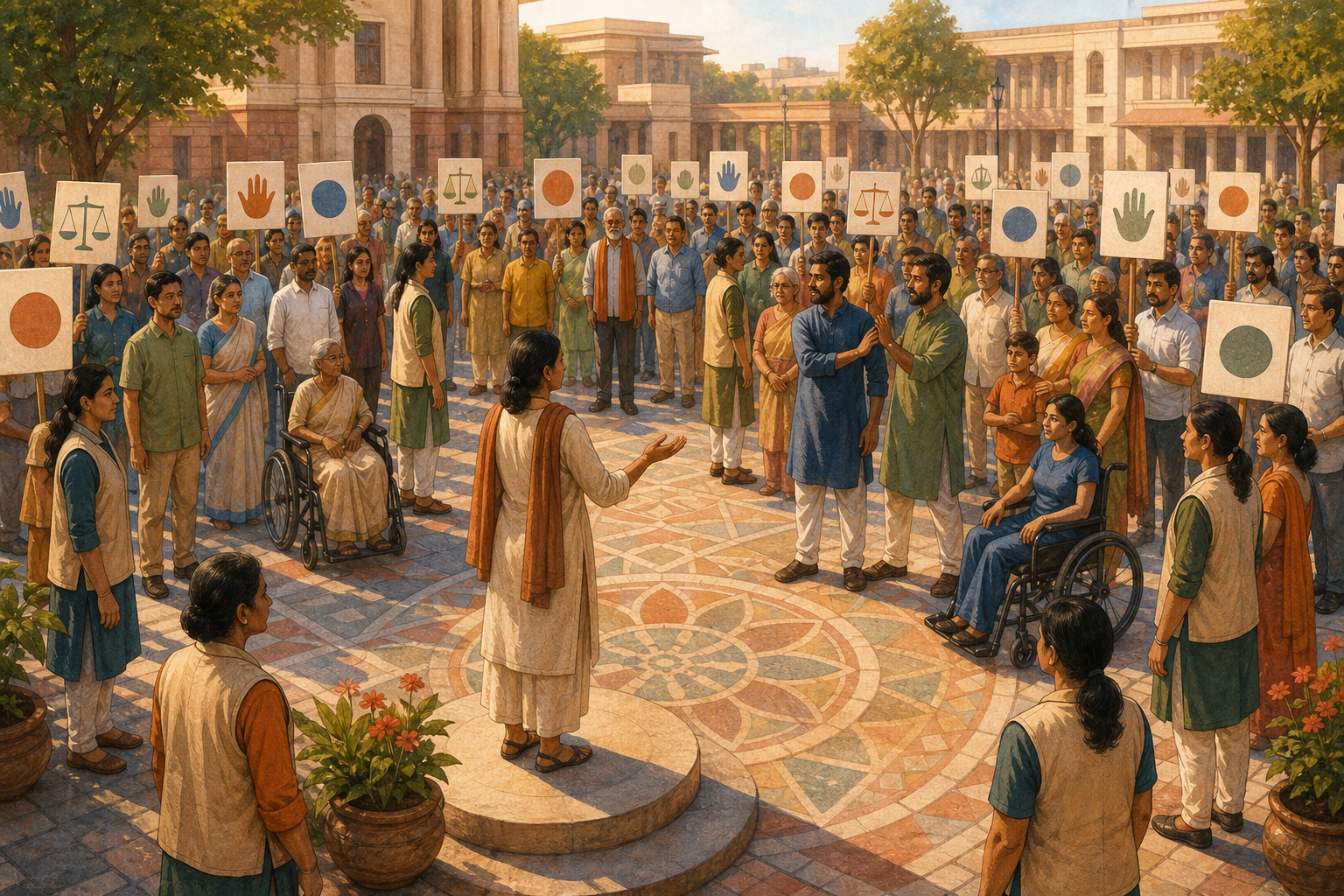
If you are deciding whether to join a march, or helping to organise one, you have two duties at once: make the grievance impossible to ignore and keep the movement from becoming unjust in its own conduct. The second duty does not weaken the first. It determines whether the public remembers your demand or only the ugliest moment around it.
That distinction became painfully concrete during a July 20, 2026 confrontation at Jantar Mantar. Stones and improvised projectiles flew, barricades broke, more than 118 police personnel were reported injured, and protesters were also taken to hospitals. Obscenity-laced chants competed with the grievance for public attention. Whatever you think of the cause involved, the practical warning is hard to miss: once injury, abuse and spectacle dominate the scene, a movement loses control of its public meaning.
Decorum is discipline, not submission
Dharma does not require silence in the face of wrong. It requires right conduct while confronting wrong. You may condemn a policy, disrupt complacency, demand accountability and refuse intimidation. Cultural decorum asks whether the means you choose remain answerable to the values you claim to defend.
This is not etiquette designed to make authority comfortable. It is command over your own movement. A crowd that can raise its voice without surrendering its judgment demonstrates greater strength than one that needs abuse, property damage or bodily danger to appear serious.
- Intensity is not abuse. You can name wrongdoing plainly, repeat a demand relentlessly and reject evasive answers without degrading a person’s body, family, community or faith.
- Disruption is not indiscriminate harm. A visible assembly may interrupt ordinary routines, subject to applicable law, but that does not license throwing objects, damaging public property or blocking medical care.
- Courage is not loss of control. The person who refuses to throw a stone when others are cheering may be showing more courage than the person who throws it.
- Solidarity is not moral exemption. Supporting a cause does not oblige you to excuse everything done under its banner.
Use a simple reversibility test before approving any tactic: if an opposing movement used the same words and conduct against your community, would you still call it legitimate civic action? If your answer changes with the identity of the crowd, you are defending a faction rather than a principle.
Write the protest code before the crowd forms
Good intentions are too vague for a tense street. Before people assemble, put the movement’s operating rules on one page. Send them to participants, brief volunteers on them and have the stage repeat the essentials. A boundary announced only after a breach will look improvised or selective.
- State one public demand. Complete this sentence: “We oppose [specific action] and ask [responsible institution] to [specific remedy].” If organisers cannot agree on that sentence, the crowd will fill the vacuum with competing messages.
- Confirm the lawful operating conditions. Check the applicable permission, route, timing, amplification and prohibited-item rules for the jurisdiction. Do not rely on a forwarded message or an assumption based on an earlier event. Where the requirements are unclear, the organiser should obtain local legal guidance before inviting people to assemble.
- Name prohibited conduct. Ban thrown objects, damage to barricades or property, physical intimidation, threats, dehumanising language and slurs. Make clear that the prohibition applies to speakers, prominent supporters and organisers as well as ordinary participants.
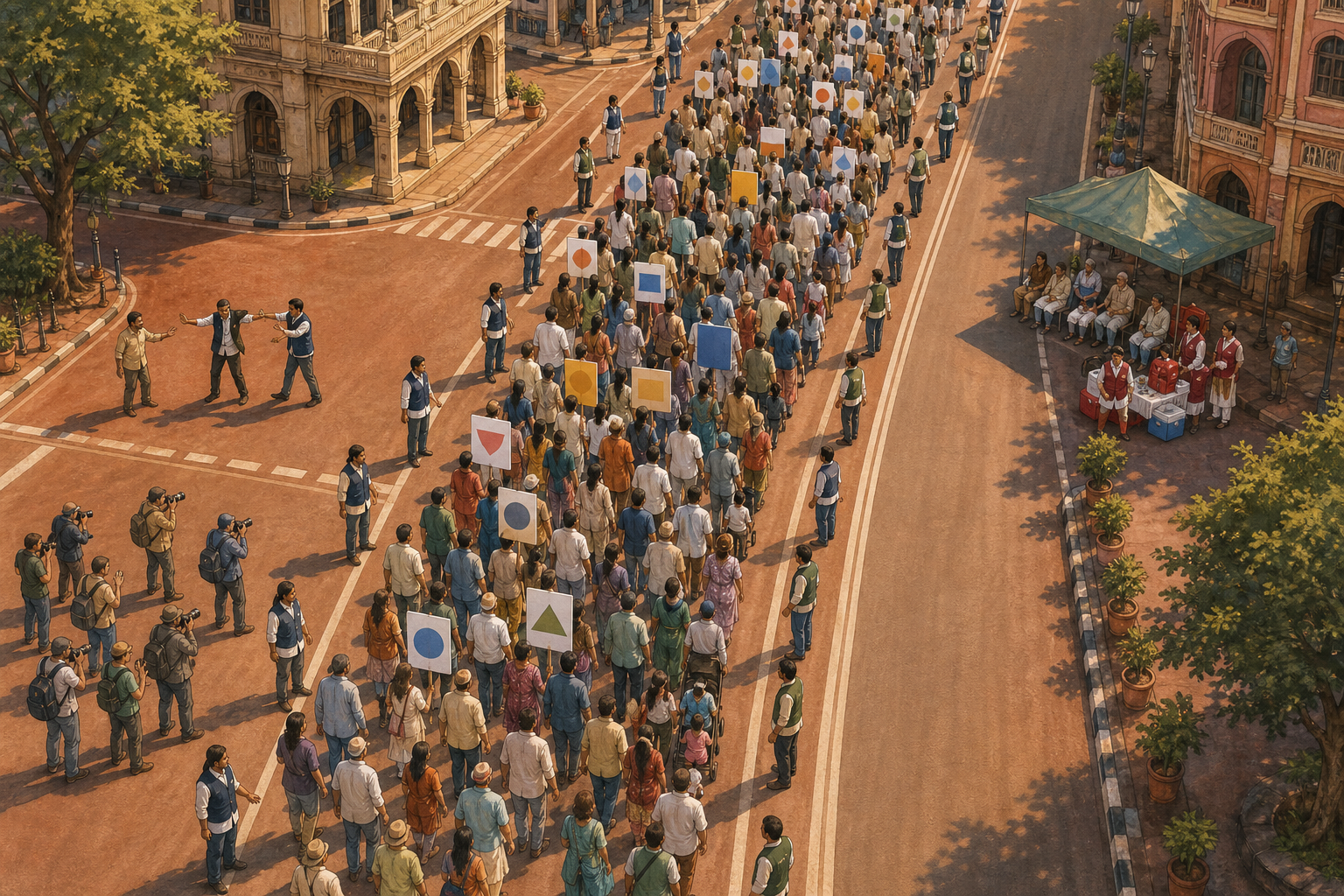
- Assign real responsibilities. Identify who controls the microphone, who communicates with authorities, who speaks to media, who guides the crowd, who keeps access open for medical help and who has authority to suspend the event.
- Define the intervention signal. A thrown object, a surge against a barrier, a call for violence or repeated refusal to follow safety instructions should trigger an immediate pause rather than a louder chant.
- Set an end condition. Decide in advance when the gathering will conclude and what conditions require early dispersal. Without an agreed stop rule, leaders may keep escalating merely because ending the event feels like losing.
The code should be short enough to read aloud. Avoid abstract promises to “remain peaceful.” Tell people exactly what that means at the point of friction: do not throw anything, do not push a barrier, step away from anyone urging violence, keep emergency access clear and follow the designated dispersal route.
Participants have a decision to make as well. Before joining, ask the organiser for the demand, route, conduct rules and exit plan. If no one can tell you who is responsible for crowd safety or who can end the gathering, you are not looking at harmless informality. You are looking at unmanaged risk.
Give anger a precise public language
A chant is not a private outburst. It is a compressed statement of what the movement believes, repeated in unison and easily detached from its context. The sharpest insult may produce the quickest cheer, but that reward teaches the crowd that breaking the next boundary will earn even more attention.
Abusive speech does not automatically produce physical violence. It does, however, weaken a useful restraint: the shared expectation that every person remains responsible for what they say and do. Once humiliation becomes entertainment, the participant urging calm can be treated as timid while the participant escalating hostility is treated as brave.
Put every proposed slogan through four filters:
- Truth: Does it make a factual claim the movement can defend, or does it depend on rumour, exaggeration or collective blame?
- Target: Does it identify an action, decision or responsible office, or does it attack a person’s body, family, caste, religion, sex or humanity?
- Remedy: Does it tell the listener what must change, or does it merely display hatred?
- Replay: If the words were broadcast without your explanation, would they still communicate the grievance accurately?
A useful chant vocabulary has three functions: name the wrong, state the remedy and reinforce discipline. Prepare all three before the event. When tension rises, the stage should be able to move from a demand to a calming instruction without improvising.
The Mahabharata’s Shishupala offers a relevant warning. A torrent of insults may be performed as fearlessness, yet it can reveal that the speaker has no stronger argument left. Words travel outward toward an opponent and inward toward the character of the speaker. Your movement is judged by both directions.
This standard also prevents a common mistake: confusing restraint with euphemism. Do not hide wrongdoing behind soft language. Name the decision, evidence and responsible authority as precisely as you can. Precision is not politeness. It is what allows severe criticism to remain credible.
Control the dangerous moment before it controls the cause
A crowd rarely changes character all at once. The warning signs usually arrive as changes in conduct: the stated demand disappears from the chants, attention shifts toward a barrier, an object is lifted, abuse draws louder approval, or leaders increase the emotional tempo instead of answering the danger. Treat those signs as operational information, not as background noise.
- Interrupt the rhythm. Stop speeches, music and call-and-response chanting. A crowd cannot hear a safety instruction while the stage is still feeding its momentum.
- Give one concrete instruction. Use plain commands such as “Put the object down,” “Step back from the barrier,” or, where safe, “Move toward the marked exit.” Avoid a lecture at the moment of danger.
- Create distance. Trained marshals should guide uninvolved participants away from the person or pressure point causing the risk. Their job is to open space and relay instructions, not to punish anyone.
- Protect medical access. Injured police personnel and injured protesters are human beings before they are symbols in a political argument. Clear a route for qualified responders and do not turn treatment into a media performance.
- End the gathering if control is not restored. Continuing after organisers have lost the ability to enforce basic boundaries exposes participants, bystanders and responders to further harm. Use the pre-announced dispersal plan and comply with applicable emergency directions.
Do not instruct ordinary volunteers to grapple with an armed or violently aggressive person. That can multiply the danger. Their safer role is to create distance, warn others, contact the appropriate emergency or security personnel and direct the crowd away from the threat.
Nor should uncertainty about an instigator’s identity become an excuse for passivity. You may not know whether someone is a committed participant, an opportunist or a provocateur. You still know whether throwing an object violates the movement’s rules. Intervene against the conduct without inventing a story about the person’s affiliation.
After a serious incident, preserve original recordings and a factual timeline rather than circulating edited clips or unverified accusations. Do not publish private details merely to direct online anger at an individual. Where injury, arrest or potential criminal conduct is involved, provide material through appropriate legal or investigative channels and obtain qualified local advice.
Judge the protest by what survives the spectacle
Noise is immediately measurable, so movements often mistake it for impact. The more strategic questions come after dispersal: Can a neutral observer repeat the demand? Did the responsible institution have to answer it? Did coverage focus on the grievance or on the crowd’s worst conduct? Were persuadable people brought closer, or told that the movement could not govern itself?
Conduct a written debrief while events are still fresh. Record injuries, property damage, interventions, failures of communication and any departure from the code. Identify what organisers will change before the next gathering. A debrief that discusses media reach but omits harm is public relations, not accountability.
Then ask the Chanakyan question: who gained from the disorder? If a stone moved public attention from a policy failure to street violence, the target of the protest may have gained the easier argument. If a vulgar slogan displaced a documented grievance, momentary applause may have purchased long-term reputational damage. Strategy requires noticing when your adversary benefits from your indiscipline.
Key takeaways
- Cultural decorum is self-command in public, not silence or submission before power.
- Put the demand, lawful boundaries, prohibited conduct, responsible roles and stop conditions in writing before people assemble.
- Direct slogans at decisions and remedies. Reject threats, collective blame, dehumanisation and attacks on identity or family.
- Pause the event at the first serious escalation signal. Clear instructions work better than emotional appeals in a dangerous moment.
- Protect injured people and medical access regardless of which side they are on.
- Measure success by clarity, accountability, persuasion and the next concrete step, not by volume or viral footage.
Before the next banner is printed, bring together the people who will hold the microphone, manage the route and make the decision to stop. Agree on the movement’s one-sentence demand and its non-negotiable boundary. If the leadership cannot do that in a room, it is not ready to take responsibility for a crowd in the street.


References
