
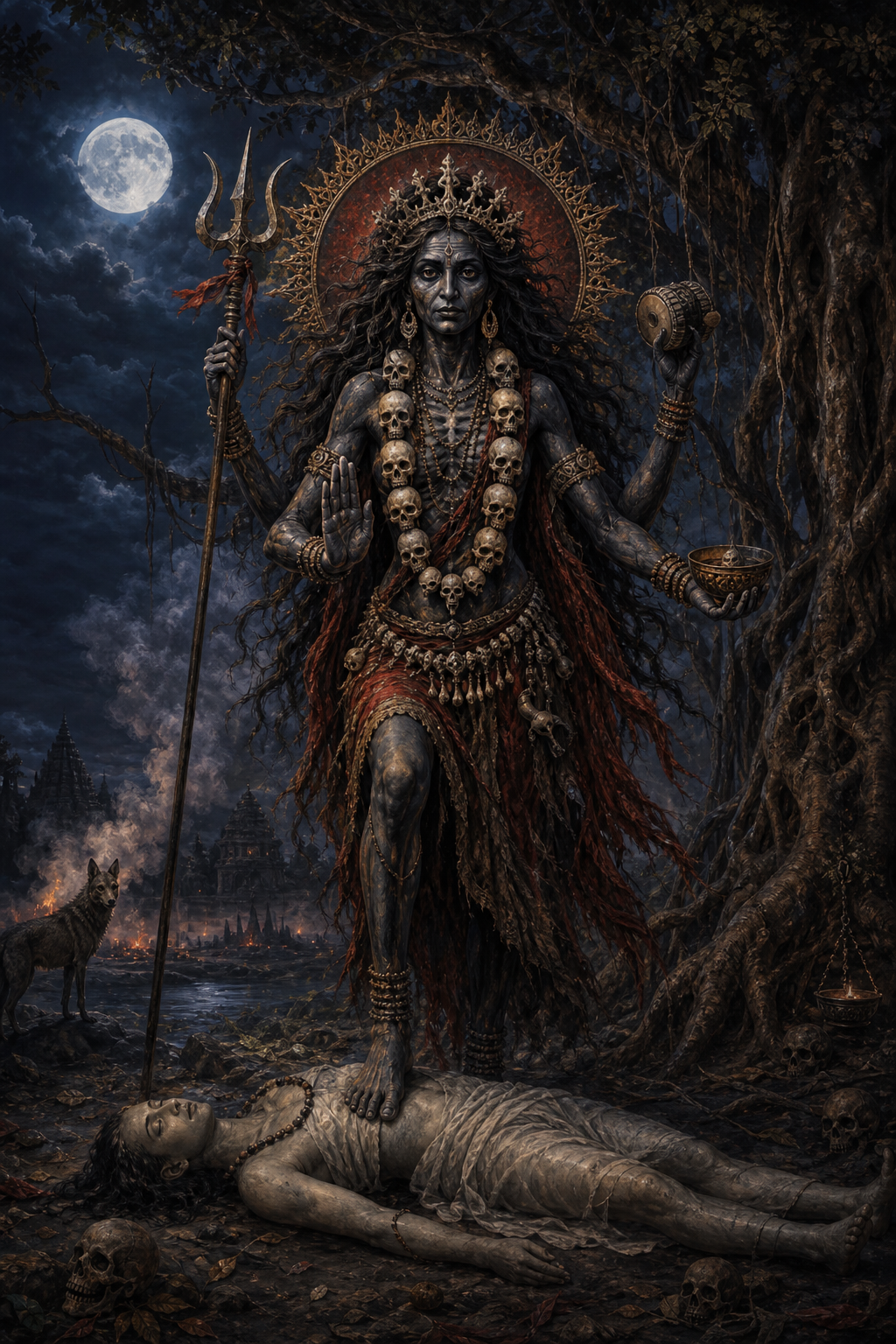
You may be looking at Chamunda and wondering how a figure so frightening can be called Mother at all. The corpse or ghostly being beneath her seems to push in the opposite direction from everything comforting, auspicious, or nurturing.
That tension is the doorway into her meaning. Chamunda’s image is not asking you to admire horror for its own sake. It is asking you to examine power, desire, mortality, and the part of the mind that wants temporary things to remain under its control.
Why a frightening appearance does not make Chamunda malevolent
The first mistake is to infer a deity’s moral character from whether the image feels pleasant. In Shakta traditions, a fierce form can express the destruction of forces that gentler imagery would leave unchallenged. The useful question is therefore not whether Chamunda looks reassuring. It is what her terrifying form is meant to confront.
Her place within the Sapta Matrikas, the seven Mother goddesses, prevents a simplistic reading of her as an evil or demonic figure. Maternity and terror are not mutually exclusive here. The maternal power protects and sustains, but it can also remove what threatens life, order, and spiritual clarity.
Chamunda’s name also derives from Chanda and Munda. The defeated opposition is remembered in the Goddess’s own name, so destruction is not an incidental feature added to her image. It belongs to the way her identity is presented: she is power known through what she overcomes.
When you encounter a fierce Dharmic image, begin with three questions:
- What destructive, disordered, or limiting force is being opposed?
- What relationship defines the deity: mother, protector, victor, member of a divine group, or some combination of these?
- Which part of the image is dominant, and which part has been placed beneath, subdued, or dissolved?
These questions keep you from treating Tantric imagery as a catalogue of strange objects. They reveal a visual argument. The composition tells you which power acts, which condition has reached its limit, and why a comforting appearance would be inadequate to the teaching.
It also helps to keep two terms distinct. Shakta refers to the Goddess-centred religious frame in which divine power is primary. Tantra refers to bodies of teaching and practice that can employ concentrated ritual, contemplation, and symbolic correspondences. Calling an image Tantric should clarify its disciplined symbolic setting; it should not become a loose synonym for anything dark, shocking, or transgressive.
Three relationships keep Chamunda’s symbolism in balance
The Mother and the destroyer
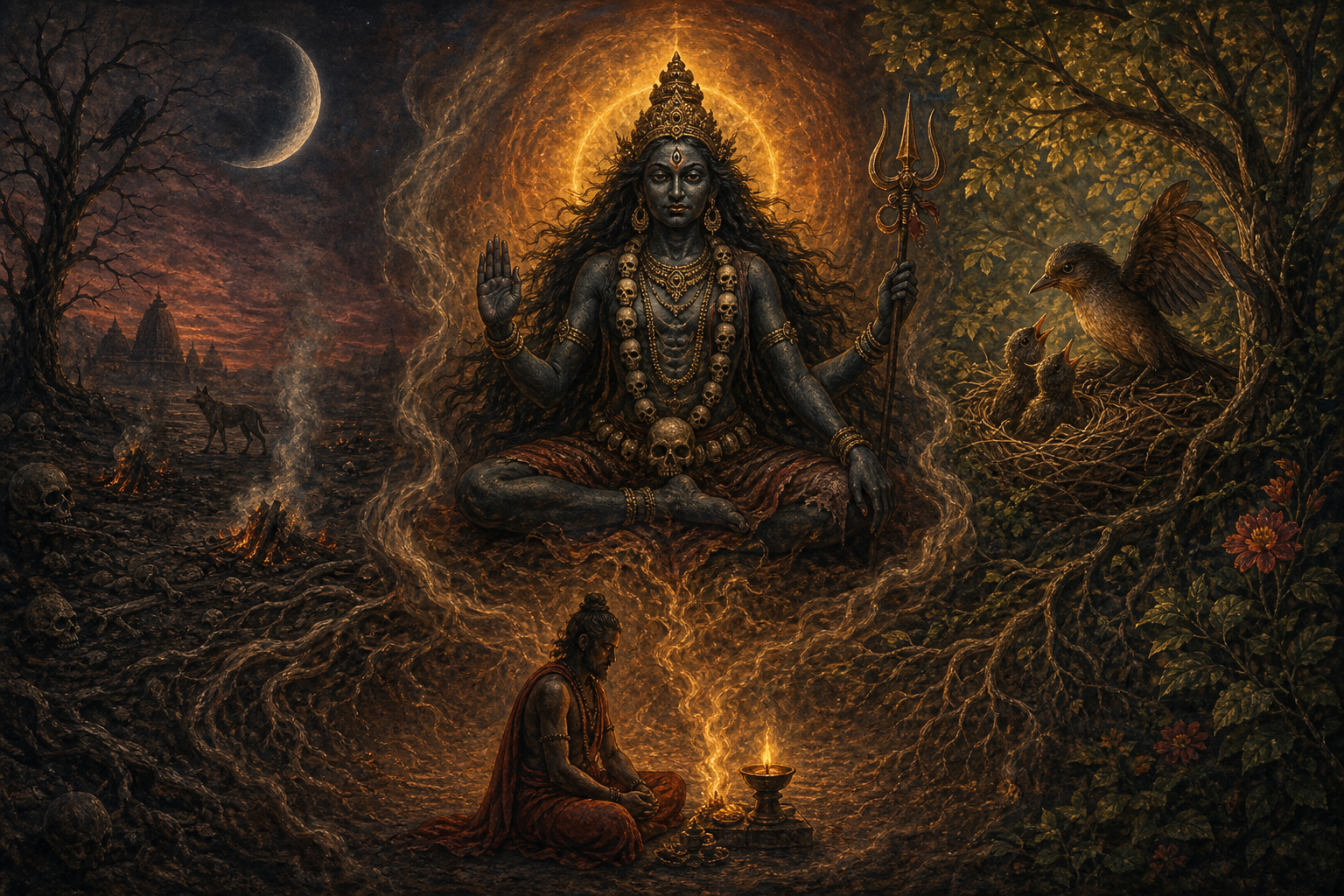
Chamunda’s maternal status tells you how to interpret her destructive force. She does not cease to be Mother when she becomes terrifying. Instead, the image expands motherhood beyond tenderness. A mother who only soothes but never confronts danger would represent incomplete protection.
This gives you a practical test for any interpretation: does it account for both maternity and destruction? A reading that sees only violence misses the Matrika. A reading that turns Chamunda into a harmless symbol of comfort erases the severity of her form. The tension must remain intact.
Chamunda and Kali
Chamunda is identified with Kali in a supremely terrifying aspect. This relationship places her within a recognisable Shakta language of time, destruction, and the exposure of what ordinary consciousness would rather avoid.
Identification does not require you to discard the name Chamunda and relabel every image as Kali. The name carries its own emphasis, including the memory of Chanda and Munda. When a tradition gives you a specific divine name, preserve it long enough to notice what that name contributes. Related forms can illuminate one another without becoming featureless duplicates.
The solitary figure and the seven Mothers
Chamunda can command attention as an individual deity, yet her classification among seven Mothers gives her a collective setting. If you see her represented with the Matrikas, read the arrangement before isolating her: position, neighbouring figures, and shared features may tell you how her fierce function participates in a larger field of divine power.
If she appears alone, retain that collective identity in your interpretation. Her solitude in a particular image does not cancel her place among the Mothers. This prevents a common error in which her terrifying form is detached from the theological relationships that make it intelligible.
The corpse turns fear into a teaching about desire
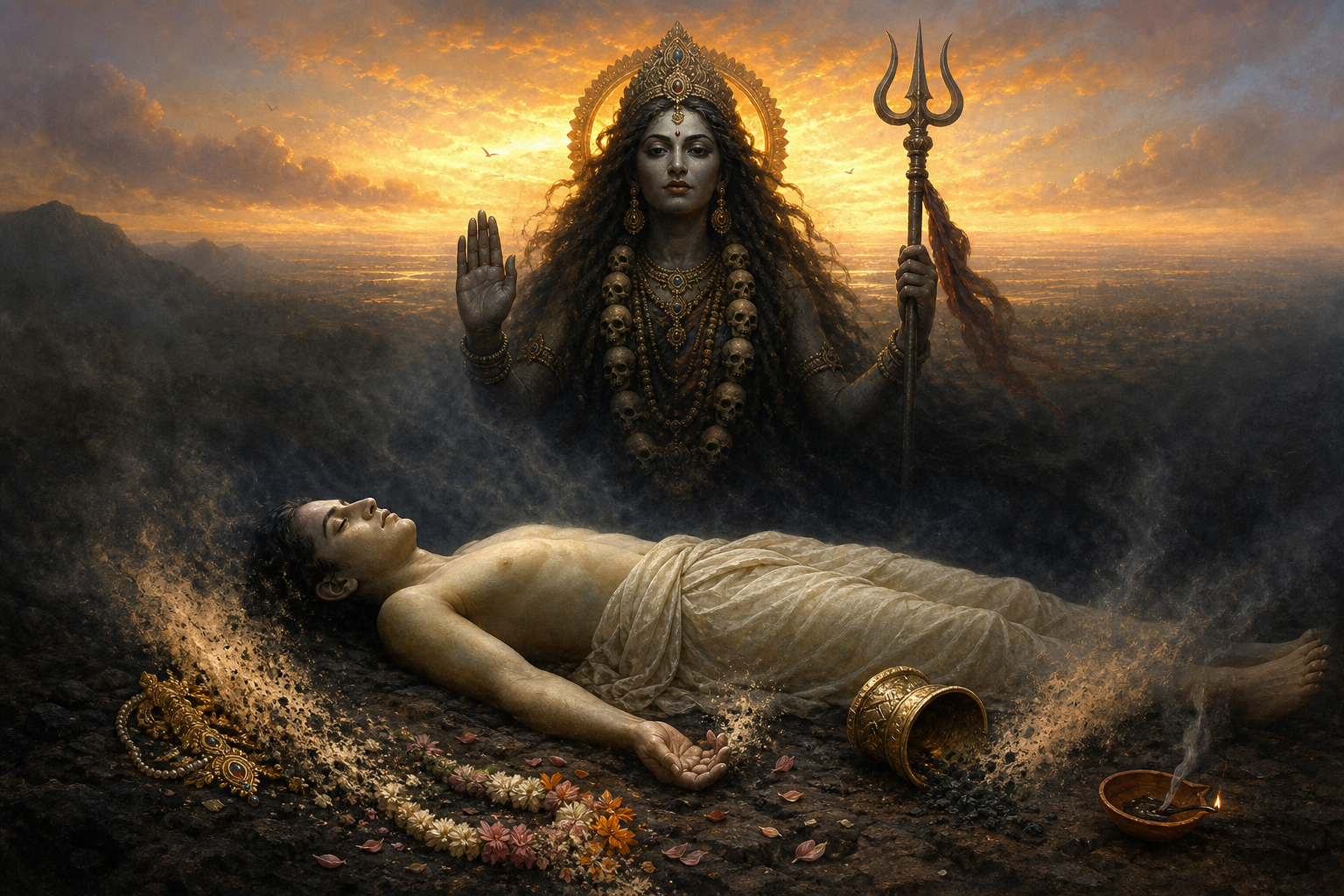
The corpse beneath Chamunda is not background decoration. It is the interpretive centre of the composition. Its position establishes a contrast between inert form and active divine power. What lies below cannot command the Goddess; what appears final to ordinary sight has become her support.
At the most immediate level, the corpse makes dissolution impossible to ignore. Every constructed form has a limit. Desire resists this because desire does more than seek an object: it often demands continued possession, repeated satisfaction, and a guarantee that change will not take the desired thing away.
Chamunda breaks that imagined guarantee. The image does not merely say that death exists. It places divine agency over the condition that human beings most often treat as the defeat of all agency. Dissolution is no longer outside sacred reality, hidden behind pleasant symbols. It has been brought into the Goddess’s field.
This is why the image should not be reduced to body-hatred or pessimism. A reminder that forms dissolve is not a command to despise embodied life. It is a challenge to stop asking finite things to provide permanence. You can care for a body, fulfil a duty, love another person, or build something worthwhile without pretending that possession makes any of them unchanging.
The symbolism works on several levels at once:
- As an image of dissolution, the corpse confronts the ending of constructed forms.
- As a contrast with Chamunda’s power, it distinguishes inert condition from active Shakti.
- As a challenge to desire, it exposes the demand that satisfaction become permanent.
- As a support beneath the Goddess, it places what you fear within a greater sacred order rather than outside it.
You can test your reading with a simple rule: it should explain the corpse’s position, not merely mention its presence. If an interpretation could remain unchanged after removing the figure beneath Chamunda, it has probably missed the image’s central relationship.
For personal reflection, ask questions the composition itself can sustain. Which desire are you treating as a guarantee rather than a preference? Which role or possession feels so essential that its loss seems like the loss of your whole identity? What duty would still deserve to be done if it brought no permanent status, control, or recognition? These questions turn the symbolism toward honest examination without pretending that a public reading of an image is the same as formal Tantric practice.
A disciplined way to contemplate Chamunda
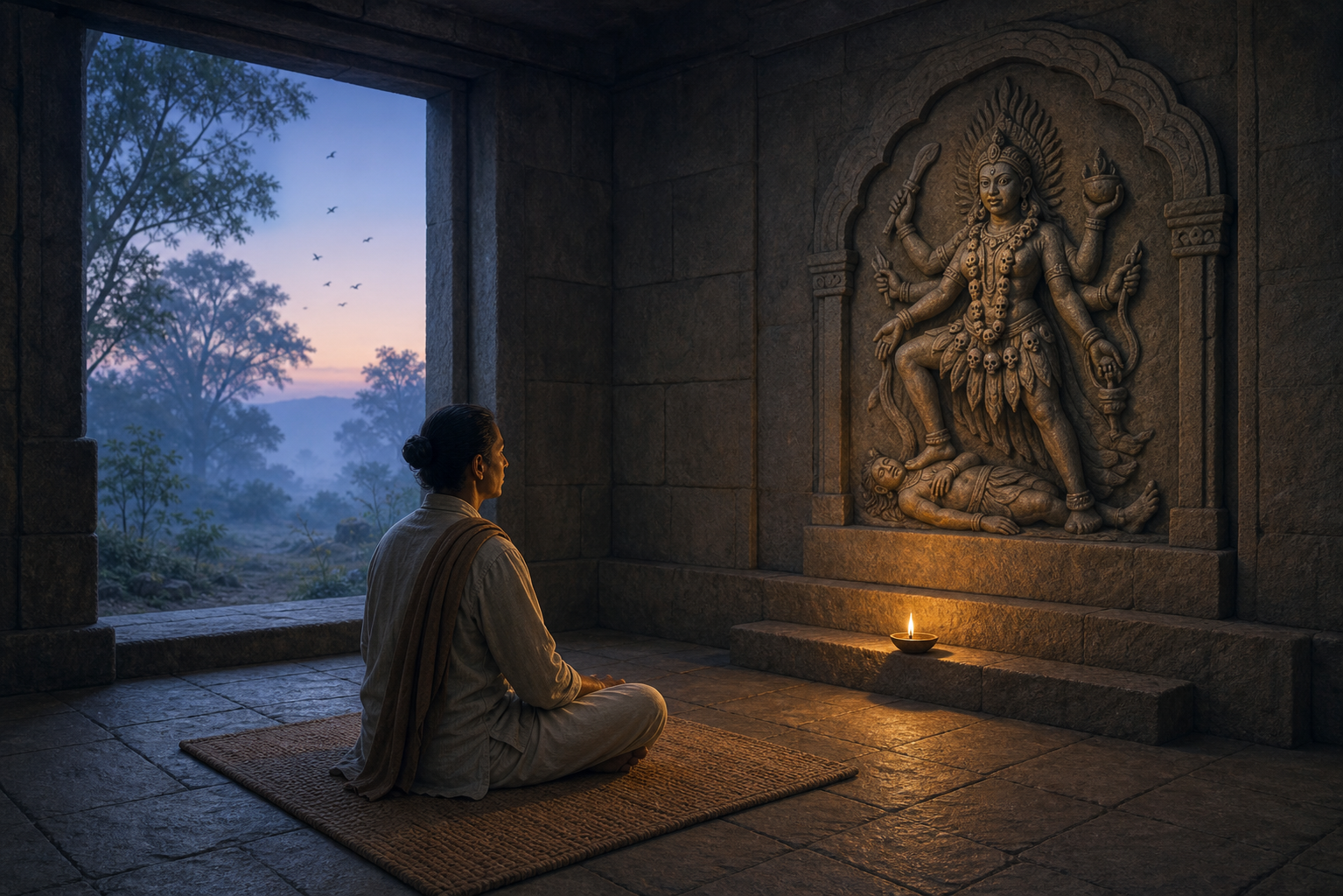
You do not need to invent an esoteric ritual to learn from this image. In fact, improvising rites from isolated visual details usually replaces tradition with imagination. Keep public contemplation within its proper scope, and seek qualified, tradition-specific guidance if you intend to undertake formal practice.
- Begin with what is actually present. Note Chamunda, the figure beneath her, their relative positions, and any group setting. Do this before assigning psychological meanings.
- Preserve the central oppositions. Hold Mother and destroyer, terror and protection, desire and dissolution, active power and inert form together. Do not solve the discomfort by deleting one side.
- Use the name as evidence. Remember Chanda and Munda rather than turning Chamunda into an anonymous image of death. Her identity includes victory over opposition.
- Test each interpretation against the whole composition. A sound reading should explain why the Goddess is dominant, why the corpse is subordinate, and why a maternal deity appears in a terrifying form.
- Refuse to make the deity only a mental metaphor. Psychological reflection can be useful, but Chamunda belongs to a living sacred framework. Your inner conflict is one possible field of application, not the full measure of the Goddess.
- Choose one concrete response. Release a false claim of permanence, complete a neglected duty without demanding recognition, or admit where fear of loss has been disguising itself as control.
Four reductions are especially worth watching. Do not demonise Chamunda because her appearance is severe. Do not sanitise her into generic empowerment. Do not aestheticise the corpse until mortality becomes mere decoration. And do not use the word Tantra to manufacture mystery where careful observation would tell you more.
A mature reading allows the image to remain difficult. Chamunda’s terror is not an obstacle that must be explained away before devotion or reflection can begin. It is part of the instruction. Your recoil shows where you expect sacred reality to flatter your preferences, hide dissolution, or promise that what you grasp can be kept forever.
Key takeaways
- Chamunda’s fearsome appearance expresses a function; it does not make her a malevolent figure.
- Her place among the seven Mothers requires you to read destruction together with protection.
- Her identification with Kali clarifies her terrifying Shakta character, while the name Chamunda preserves a distinct emphasis.
- The corpse beneath her contrasts inert form with active divine power and makes dissolution central to the image.
- The symbolism challenges desire’s demand for permanence; it does not require contempt for embodied life.
- Contemplative interpretation should remain distinct from formal Tantric ritual practice.
The next time you encounter Chamunda, do not begin with the most frightening feature of her face. Begin with what supports her. Ask what has become powerless beneath the Goddess, what desire still refuses that dissolution, and what truthful action remains available to you. That is where the image stops being a spectacle and begins to work as a Shakta teaching.
References
