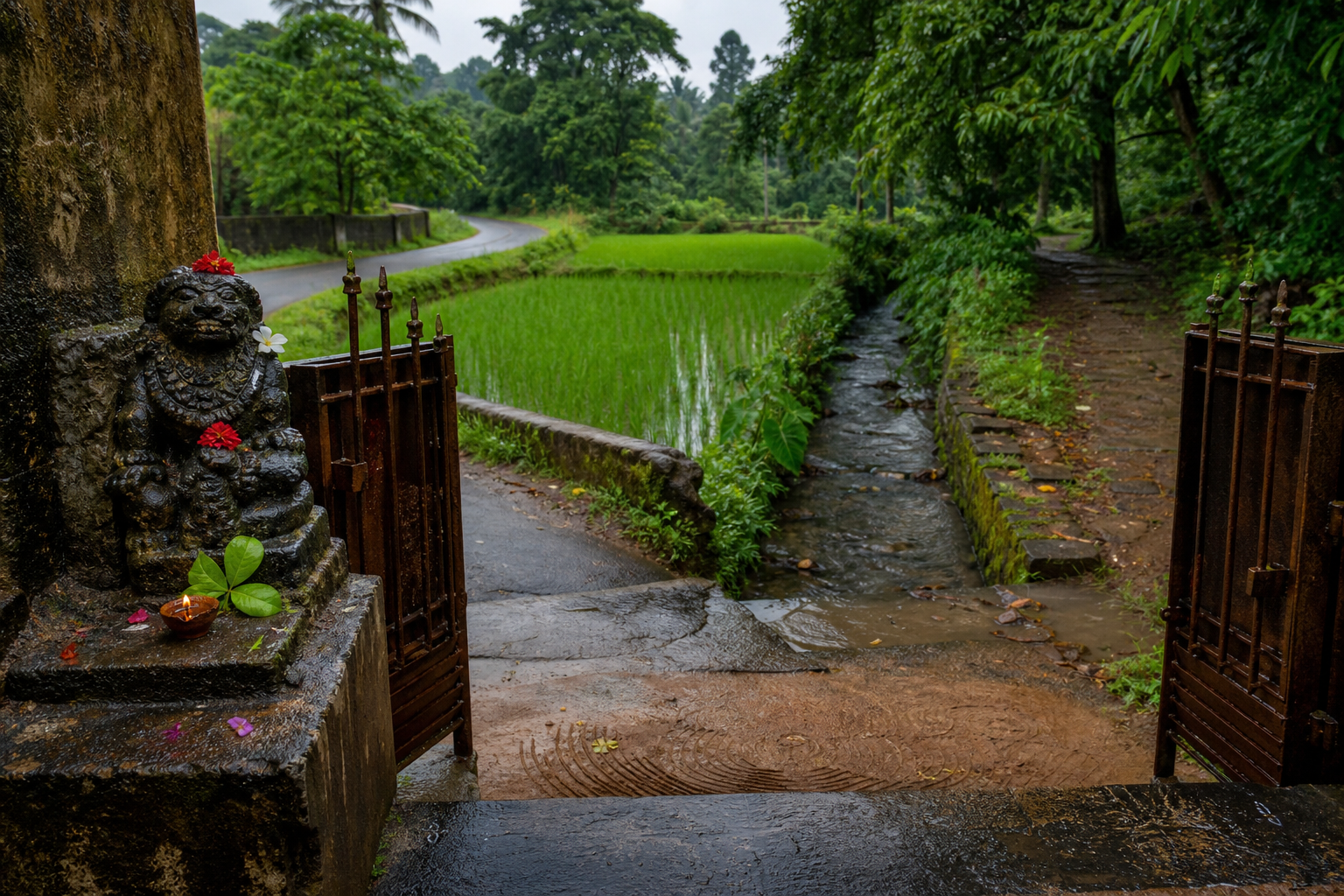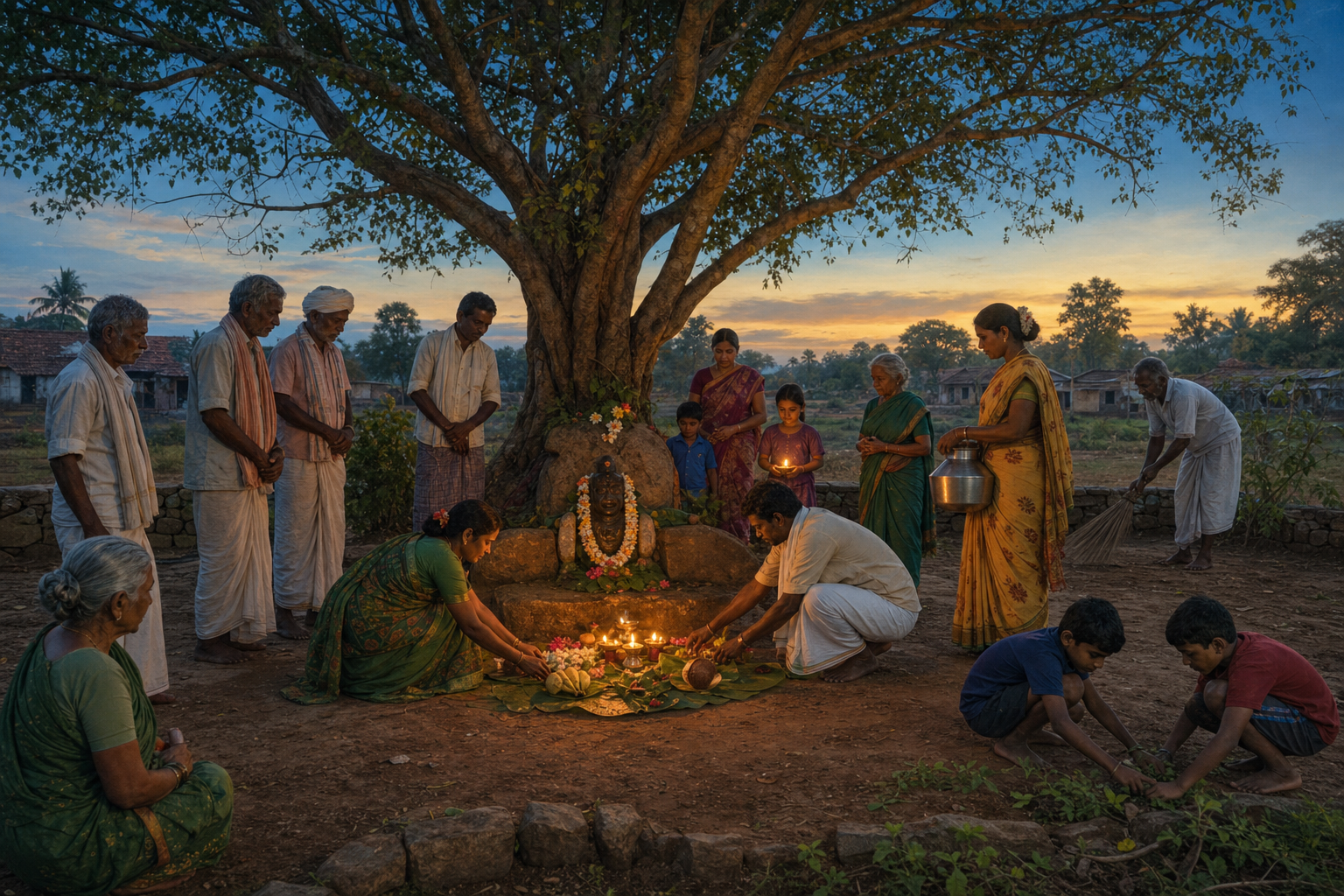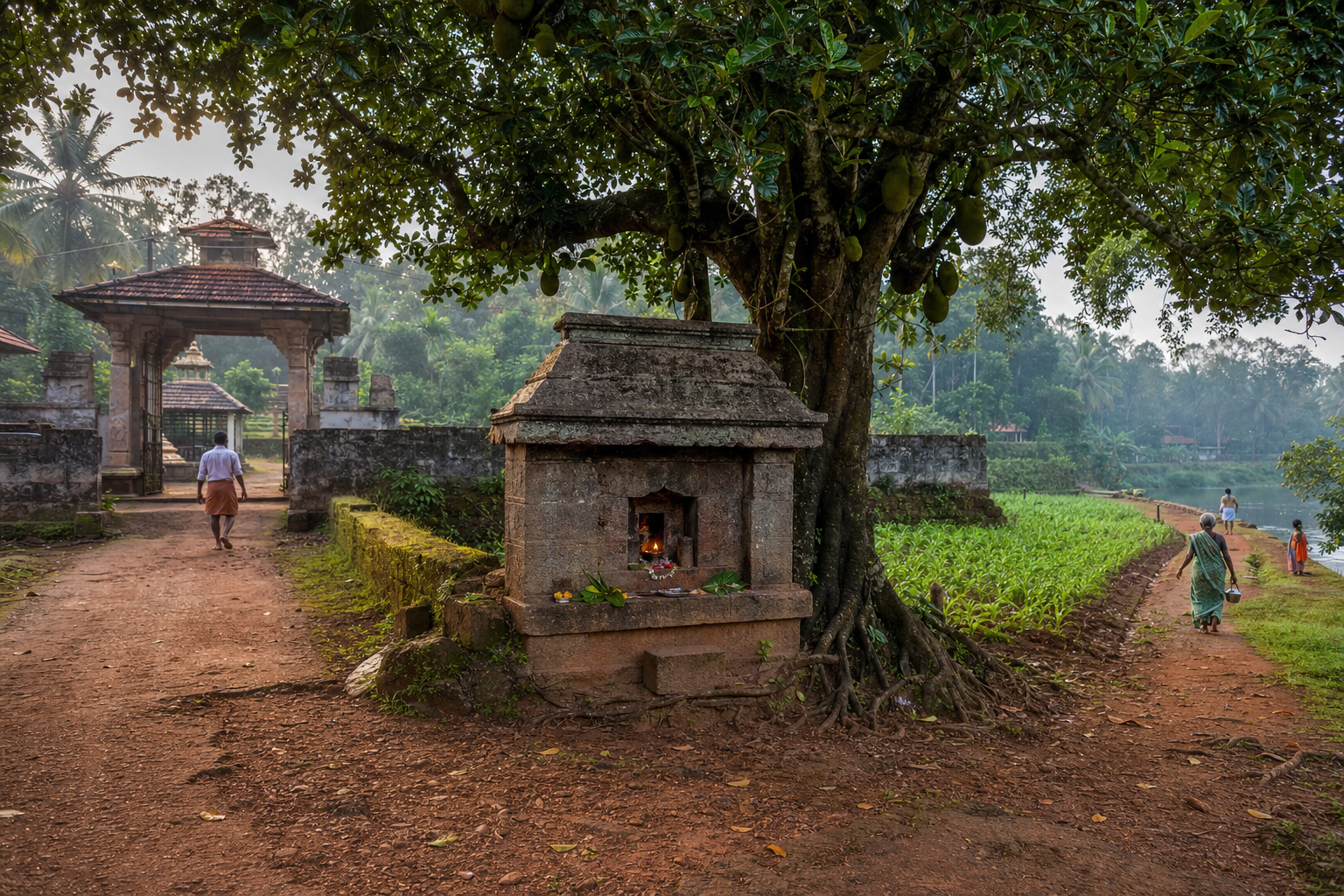
You have stopped beside a low stone platform under a tree, just outside a temple or at the edge of a village. It looks modest, but the lamps, bells, weapons, or red markings tell you that people do not regard it as incidental. If you judge the place by its architecture alone, you will miss what Bhutappa guards.
Bhutappa makes sense when you read three things together: the boundary, the promises made there, and the living landscape around it. That reading helps you behave respectfully, assess claims of folk justice without romanticising coercion, and protect the shrine as a functioning community institution.
Key takeaways
- Bhutappa is a protective guardian, not a malevolent ghost or demon.
- The shrine’s position near a gate, path, field, water approach, or village edge explains much of its purpose.
- Folk justice is dharmic when it encourages truthful speech, restitution, reconciliation, and voluntary compliance.
- The tree, water, soil, procession route, and gathering space are part of the sacred site, not scenery around it.
- Your first respectful act is to ask a local caretaker what the shrine protects and how visitors should approach it.
Start with the boundary, not the image
A temple’s garbhagriha concentrates worship within the sanctum. Bhutappa often stands beyond that interior, where sacred order meets roads, fields, water, animals, travellers, and ordinary disputes. Shrines therefore appear at thresholds, crossroads, field edges, and approaches to water. The location is part of the deity’s identity as a kshetrapala, or guardian of a defined place.
Do not wait for an elaborate murti before recognising a shrine. Bhutappa may be present as a dressed stone, laterite block, low katte, mask-like mukha, trident, spear, sickle, bell, or group of ritual objects. This spare form directs attention toward presence and responsibility rather than artistic grandeur.
Language matters here. In Karnataka and Tulunadu, bhuta can name a deified spirit or territorial guardian, while appa is an honorific. Translating the name as a ghost strips away its local meaning. Daiva, grama devata, and kshetrapala are usually more helpful points of reference.
When you encounter such a place, pause before entering. Locate the temple gate, the nearest path, the old tree, the field boundary, and any water source. Ask where the annual procession travels and which goddess Bhutappa serves. Associations with Chamundi, Durga, or a local Amman express a familiar dharmic relationship: sovereign shakti is accompanied by vigilant guardianship. Fierceness here is disciplined toward protection. Lamps, water, vows, and regular worship direct ugra energy toward shanti.
Folk justice should restore balance, not create fear
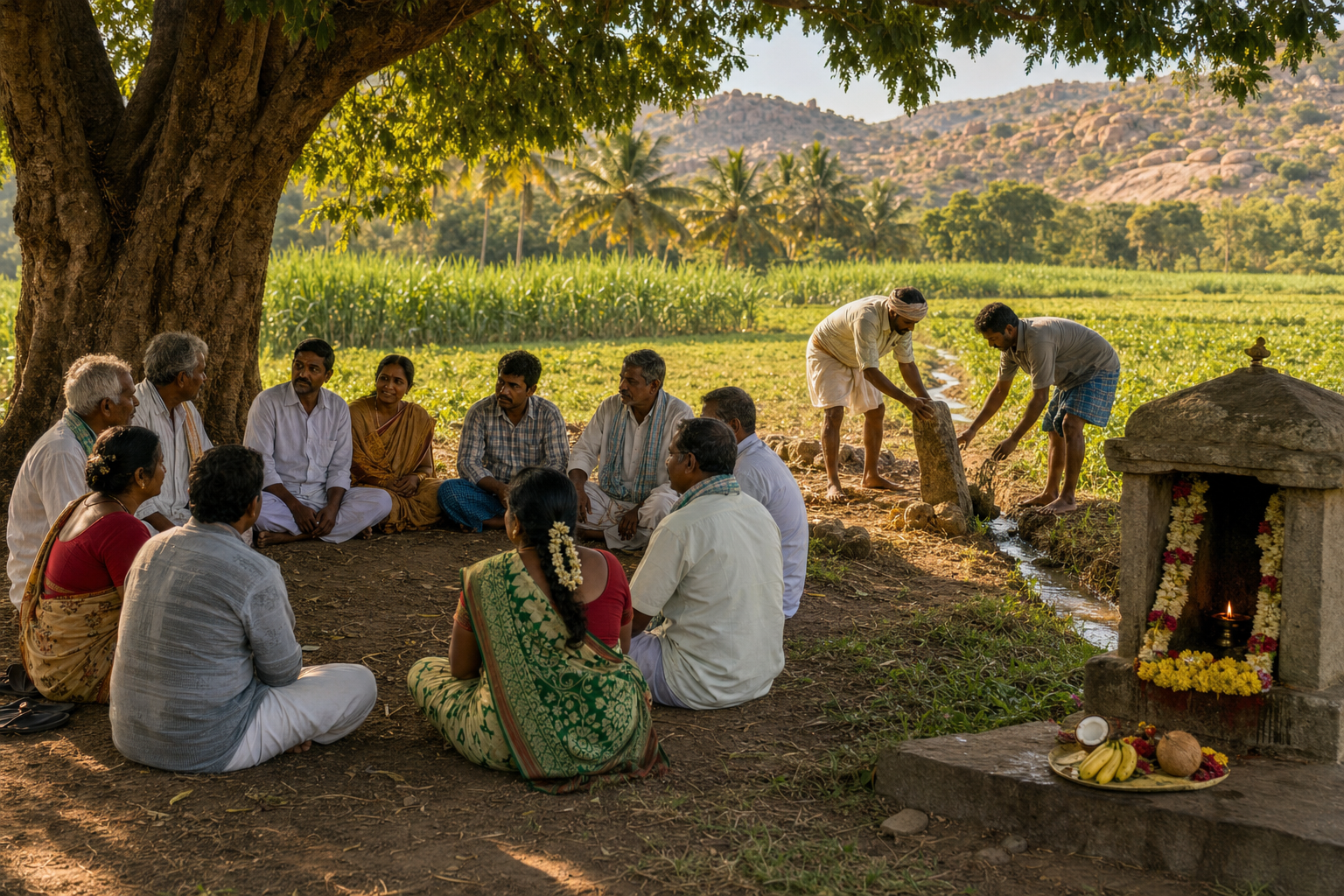
Bhutappa shrines have served as places where disputants take oaths, state their claims, and accept remedies before a sacred witness. The ideal is truth-speaking followed by restitution and reconciliation, not punishment for its own sake. The deity’s moral authority can make a promise harder to dismiss once everyone returns to daily life.
That authority deserves careful handling. Before accepting a settlement as dharmic, ask four questions. Did each person participate voluntarily? Could every side speak without intimidation? Does the remedy repair a concrete harm rather than humiliate someone? Does the process leave lawful recourse open? A sacred setting cannot make coercion just.
The distinction matters because the same fear of divine sanction that encourages honesty can be misused against a weaker neighbour. Do not use Bhutappa’s name to force testimony, silence an objection, or evade civic responsibility. When immediate safety, violence, criminal conduct, or enforceable legal rights are involved, a shrine oath cannot replace the appropriate lawful authorities.
If you help convene community mediation, keep the human remedy clear. Let each side describe the harm in ordinary language. Identify what can be returned, repaired, corrected, or acknowledged. Separate a harake, the return-offering promised to the deity, from restitution owed to another person. A fulfilled vow does not cancel an unpaid debt or an unrepaired injury.
This is the sound meaning of legal pluralism in practice: customary moral authority can strengthen mediation and compliance, but it supplements civic law rather than providing a shortcut around it.
Treat the shrine, habitat, and ritual route as one site
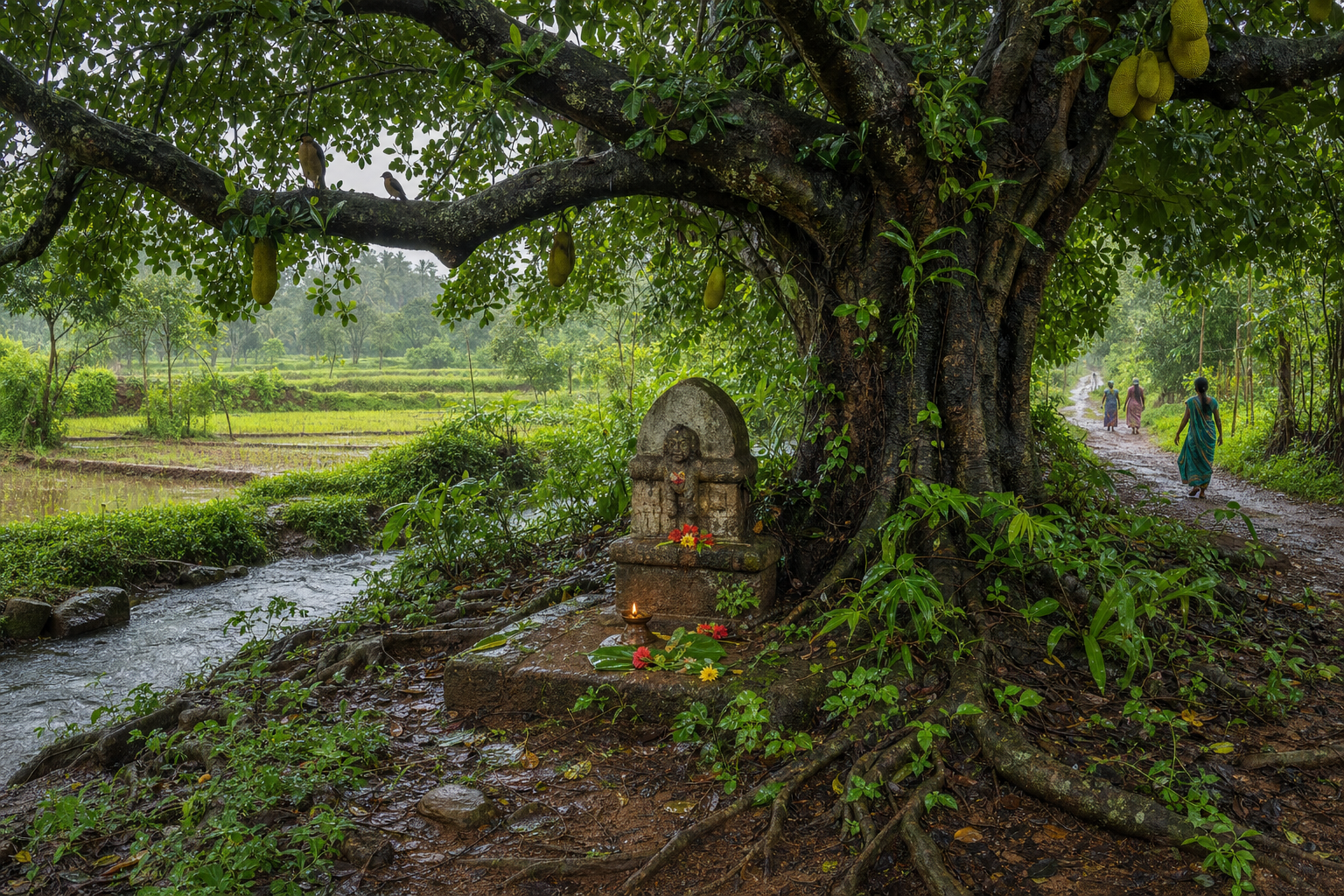
A jackfruit tree above Bhutappa is not merely decorative. Its shade creates room for offerings, conversation, seasonal rites, and dispute settlement. Its long life gives several generations a stable point of return. Seasonal fruit can also enter the offering cycle, tying worship to the rhythms of the land.
Shrines beneath mature trees, beside springs, or within sacred stands can help conserve microhabitats, pollinators, soil moisture, and local biodiversity. This protection is practical as well as devotional. A community that preserves a guardian’s tree and water approach may also preserve shade, living soil, and refuge for other species.
You can assess the site’s ecological health without specialised equipment. Ask which mature tree supports the shrine, whether water still follows its customary course, whether the gathering ground remains permeable, and whether the procession can still reach the boundary. Record changes over time with the caretaker’s permission. Treat the shrine, its habitat, and its route as one protected unit.
This approach changes maintenance decisions. Do not enlarge a platform, pave a root zone, redirect water, cut a mature branch, or introduce permanent decorations merely to make the site look more formal. First ask what the ritual requires and what the tree can tolerate. A polished structure is not an improvement if it weakens the living canopy that made worship possible.
Simple offerings such as lamps, turmeric, vermilion, coconuts, arecanut, cooked rice bali, and seasonal jackfruit already belong to local practice. Follow the community’s method for placing and clearing them. Sacred status can encourage conservation, but it does not remove the need for attentive stewardship.
Your conduct becomes part of the shrine’s protection
Begin by finding a caretaker, elder, or regular worshipper. Ask whether you should remove footwear, where you may stand, and whether an offering is appropriate. If invited, a simple lamp or coconut is usually more fitting than an elaborate display. More expense does not create more respect.
Photography requires explicit permission, especially during kola, nema, drumming, possession, or oracular sequences. These are not performances staged for an outsider’s collection. Stay where the community directs you, keep your device away if asked, and do not circulate recordings whose meaning or consent you cannot explain.
Use local ritual vocabulary when you speak or write about the shrine. Describe Bhutappa as a guardian or daiva when that matches community usage. Do not impose labels such as demon, superstition, or primitive worship. Those words conceal the shrine’s actual work as a place of protection, vow-keeping, mediation, and collective memory.
If you are documenting the tradition, ask who should control the photographs, recordings, names, and ritual details. Community-led archives and multilingual glossaries can support transmission without turning living practice into an exhibit. The people who sustain the shrine should decide what remains local and what may be shared.
Keep continuity when roads and settlements change
Road widening, land conversion, and changing work patterns can leave a threshold shrine isolated from the boundary it once guarded. Moving the stone alone may preserve an object while breaking the relationship among deity, tree, route, and village.
Before any alteration, create a community record. Mark the shrine’s position, orientation, tree canopy, water approach, procession path, festival halts, ritual objects, and locally used names. Ask elders and hereditary caretakers which features are essential. Then bring those requirements into planning discussions before a new road alignment or construction footprint becomes fixed.
Where relocation is unavoidable and locally accepted, maintaining sight-lines to the old threshold and preserving the Bhutappa halt in a revised procession can carry continuity into the changed settlement. The decision should remain community-led; heritage professionals can document and advise, but they cannot assign ritual meaning from outside.
Younger people can help by mapping processional paths, learning ritual terms, recording seasonal calendars, and listening to elders with permission. This gives them a practical role in transmission rather than asking them to inherit a frozen account of the past.
If a Bhutappa shrine stands near you, take one useful step this week. Ask its caretaker what currently threatens its function: a proposed road change, land conversion, a broken procession route, or fading ritual knowledge. Support that locally named priority instead of inventing a project for the community.