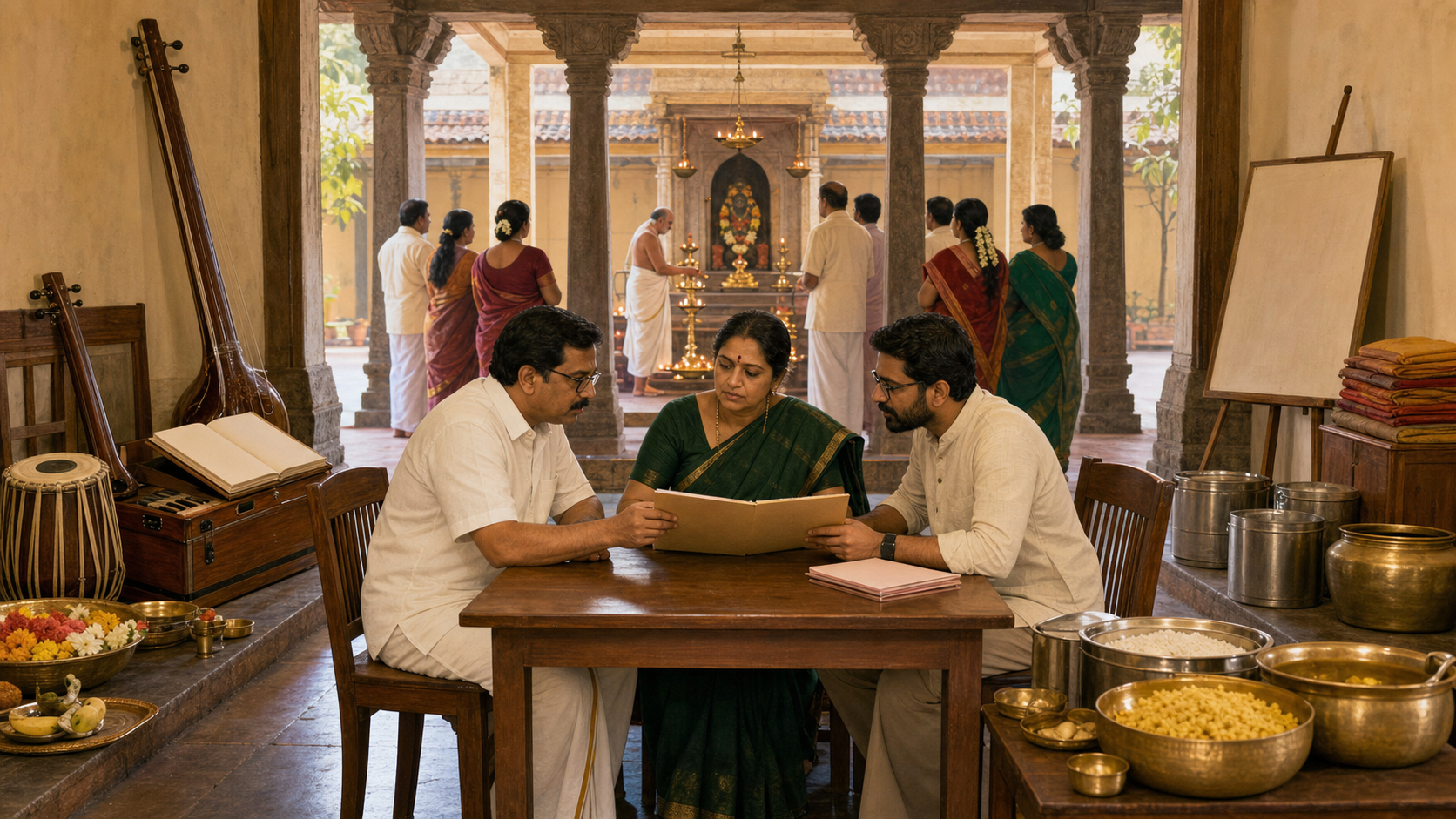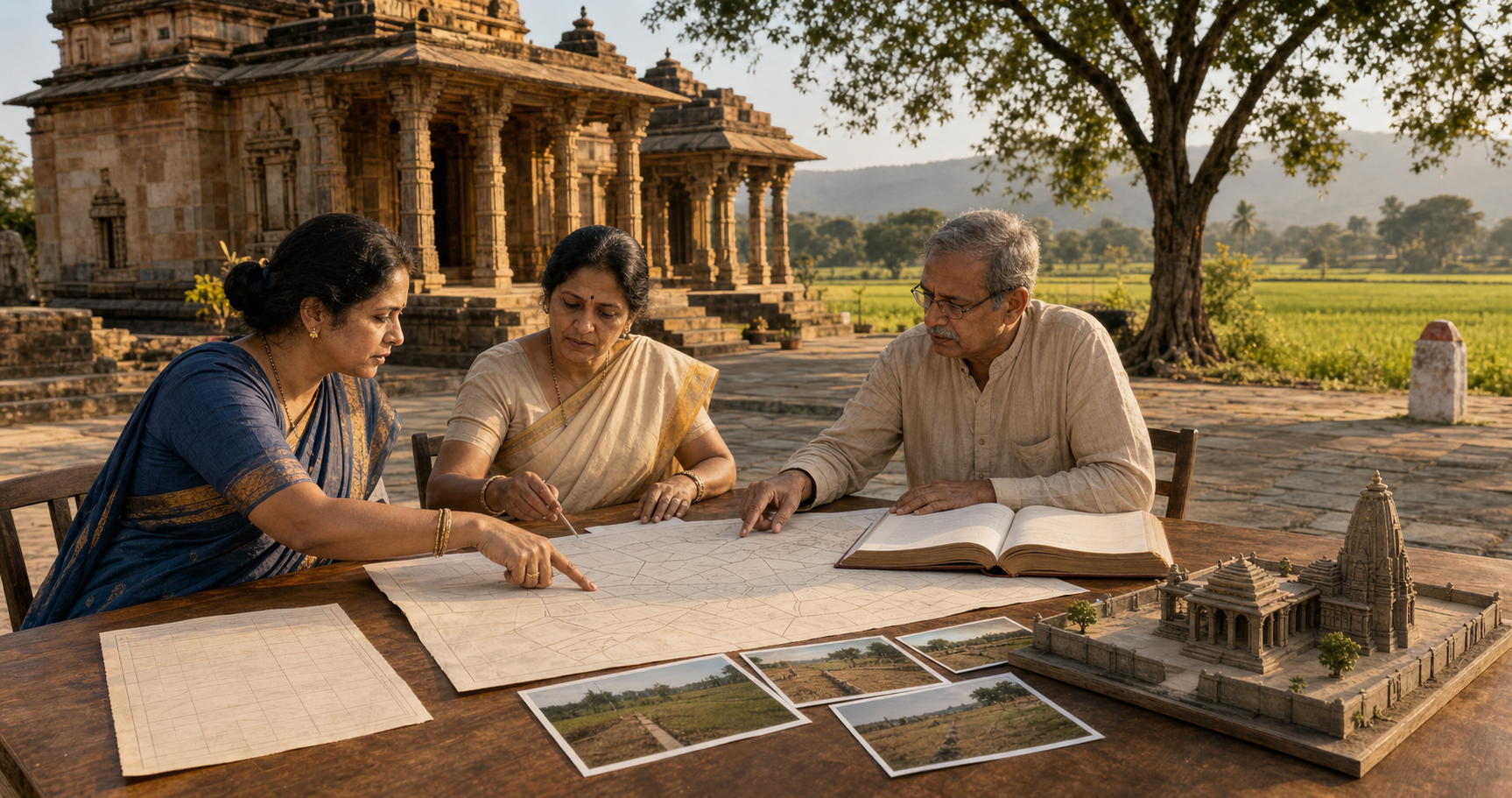
If you are a trustee and cannot place the current 7/12 extract, mutation history, boundary map and trust records for a temple parcel on one table, that land is already harder to defend than it should be. Concern about government policy matters, but missing paperwork can harm a temple long before a courtroom does.
Your aim is not to turn the temple into a legal office. It is to make stewardship orderly enough that rituals, festivals, education and seva are not put at risk by an avoidable title gap, encroachment or rushed policy response.
Key takeaways
- Create one complete, searchable file for every temple land parcel.
- Reconcile trust records, historical grants, 7/12 extracts, mutation entries and boundary maps instead of assuming they agree.
- Keep audits, accounts and Charity Commissioner filings current; accountability makes an autonomy claim more credible.
- Answer legislation and official notices with precise records, reasoned representations and qualified legal advice.
- Give devotees defined roles in documentation, compliance and communication rather than mobilizing them around rumor.
This is a governance checklist, not a substitute for advice from a lawyer who has examined the documents and facts of a live dispute.
Build one defensible file for every parcel
Temple property is not merely an entry in a land register. Its income, access and physical integrity may support daily worship, seasonal festivals, education, music and community service. Devasthan inams historically included revenue-free or concessional grants to religious institutions, so an old grant may sit behind several later administrative entries. That history has to be connected to the present record.
Start with a parcel register. Do not begin with loose bundles of papers. Give each parcel a consistent entry and attach the supporting documents to it. For every piece of land, record:
- The parcel identifier and location exactly as they appear in the current record.
- The document on which the trust relies for ownership or endowed use.
- The historical grant, deed or other archival material connected with the property.
- The latest 7/12 extract and the relevant mutation entries.
- The available cadastral map, digitized land record and boundary material.
- The person or entity presently occupying or using the land.
- Any lease, notice, pending mutation, encroachment concern or dispute known to the trustees.
- The location of the original file and the name of its designated custodian.
Then compare the documents line by line. A spelling difference, an incomplete mutation, an outdated trustee name or a boundary that does not match the map belongs in a written discrepancy log. Do not silently choose the version that appears most favorable. Record the conflict, preserve each version and send the issue for appropriate land-record or legal review.
Digitize the complete chain, including legible scans of endorsements and reverse sides. Keep originals protected, maintain more than one secure copy and use consistent file names that connect each scan to the parcel register. Add dated photographs and a mapped boundary inventory where practical. Geo-referencing can help trustees notice occupation or boundary changes, but it should support rather than replace documentary title review.
If you suspect encroachment, first preserve what can be observed lawfully, compare it with the recorded boundary and obtain advice before confronting an occupant or making legal assertions. An orderly evidence trail is more useful than an angry exchange that creates new factual disputes.
Make accountability the evidence for autonomy
Articles 25 and 26 protect religious freedom and important aspects of denominational self-government, including the management of religious affairs and the ability to own and administer property. The Supreme Court’s Shirur Mutt decision remains central to the constitutional protection given to religious matters and essential religious practices. These principles deserve careful use, not slogan-level treatment.
A constitutional claim does not cure an incomplete land record or an unexplained account. Clean administration helps a trust show who is responsible, how the endowment is used and why interference would affect a living religious institution. It also makes engagement with public authorities more focused.
For temples registered as public trusts, the Bombay Public Trusts Act, 1950 and the Charity Commissioner framework form an important part of day-to-day compliance. Your internal governance routine should therefore cover:
- An updated trust deed and an organized record of registered changes.
- Timely audits, transparent accounts and required filings.
- Recorded trustee resolutions for decisions affecting land, income or long-term use.
- A clear link between temple revenue and the religious or charitable purposes for which it is held.
- Assigned responsibility for land records, legal notices, accounts and archival custody.
- A review process that brings missing records or unusual transactions before the full trustee body.
Autonomy should not be confused with secrecy. Trustees can protect confidential and personal information while still giving devotees meaningful visibility into governance. A non-sensitive asset summary, completion status for audits and a plain account of corrective work can build confidence without publishing documents that could expose the trust or individuals to misuse.
Treat every policy proposal as text, not rumor
Concern about a proposed Devasthan Inam abolition measure should lead to disciplined preparation. It should not lead trustees to assume that a proposal has already become law, that every temple will be affected identically or that a circulating summary contains the operative language. Obtain the exact version under consideration and establish its formal status before announcing a position.
Next, prepare a clause-level impact note. General claims about danger to temples are easy to dismiss. A useful submission identifies the affected category of property, shows the supporting record, explains the effect on the endowment and states the safeguard being requested.
- Mark the provisions that may affect ownership, administration, possession, revenue or adjudication.
- Match each concern to actual temple records rather than hypothetical examples.
- Explain how the change could affect worship, festivals, access, education or charitable activity.
- Identify risks created by pending mutations, incomplete archives or existing encroachments.
- Ask for clear safeguards, transparent consultation and protection for denominational rights.
- Have the analysis reviewed by independent counsel familiar with constitutional and trust matters.
Lawful routes for raising these concerns include reasoned representations to the relevant Maharashtra departments, testimony before legislative committees, independent opinions on Article 26 implications and, where necessary, judicial review. Keep copies of every submission, enclosure and acknowledgement. Assign one person to maintain the official chronology so that later responses do not contradict earlier ones.
Engagement with the state need not be adversarial on every issue. Trustees and authorities have room to cooperate on encroachment prevention, heritage conservation, crowd management and disaster preparedness. The trust can support legitimate accountability while insisting that temple revenue remain devoted to its chartered religious and charitable purposes.
Create a steward network, not a flash crowd
Devotees are more useful to land protection when they have defined responsibilities. Create a volunteer registry based on skills and availability. An archivist can help index documents. Someone familiar with mapping can organize boundary material. Accountants can support compliance workshops. Lawyers can help trustees prepare notice-response procedures and vetted representation templates.
Set boundaries for volunteer access. Original deeds should remain under documented custody. Personal information and sensitive legal material should not be circulated in messaging groups. Public updates should distinguish verified facts, pending questions and decisions that require professional advice. This protects both the temple and the people serving it.
Inter-temple cooperation can reduce duplicated work. Trusts can share audit checklists, archive conventions, counsel directories, training sessions and policy feedback while retaining control of their own records. Buddhist viharas, Jain derasars and Sikh gurdwaras have distinct institutional arrangements, but they can also contribute practical knowledge about endowment records, ethical administration and the protection of sacred spaces.
At your next trustee meeting, pass a recorded resolution naming a records custodian, authorizing a parcel-by-parcel reconciliation and directing unresolved discrepancies for professional review. Begin with land whose documents are missing, boundaries are unclear or occupation is contested. Religious autonomy becomes more durable when devotion is matched by evidence, responsible administration and calm civic action.