

If you serve on a Hindu temple board, organize festivals, or volunteer at a mandir, the useful question is not whether every hateful comment predicts an attack. It is whether your community can recognize a serious warning, move it quickly to the right people, and protect devotees without allowing hatred to drive Hindu life out of public view.
The alleged plot against a Hindu temple in Illinois makes that work immediate. You need a response that is alert without being reckless, evidence-based without minimizing anti-Hindu intent, and firm without assigning collective guilt.
What the Illinois allegation establishes, and what it does not
US law enforcement arrested 19-year-old Alexandros Paporakis of Palatine, Illinois, on 11 October 2026 after investigating threats involving a potential mass shooting at a Hindu temple in the Aurora area. He allegedly shared an eight-page document describing violence against people of Indian origin, accompanied by images of weapons and tactical equipment. He also reportedly described himself as a white supremacist and Neo-Nazi.
Bharat’s Ministry of External Affairs responded on 15 October by expressing deep concern, seeking a thorough investigation and describing the alleged anti-Hindu and racist elements as part of growing anti-India hostility. That intervention matters because the reported target was not merely a building. The alleged language joined hostility toward a Hindu place of worship with threatened violence against people of Indian origin.
Those elements can overlap, but they should not be blurred. A temple selected because it is Hindu points to religious hostility. People selected because they are, or are presumed to be, of Indian origin introduces a racial or national-origin dimension. When you document an incident, preserve the actual words, symbols, named targets and references to identity. Do not force everything into one label before investigators have examined it.
An arrest and an allegation are not a conviction. One alleged plot also cannot establish a statistical trend across the United States. The defensible conclusion is narrower: a reported threat was grave enough to prompt an investigation and arrest; the alleged anti-Hindu and anti-Indian content warrants direct scrutiny; and temples have a concrete reason to prepare before the next warning arrives.
Use a three-level response instead of debating whether a threat is real
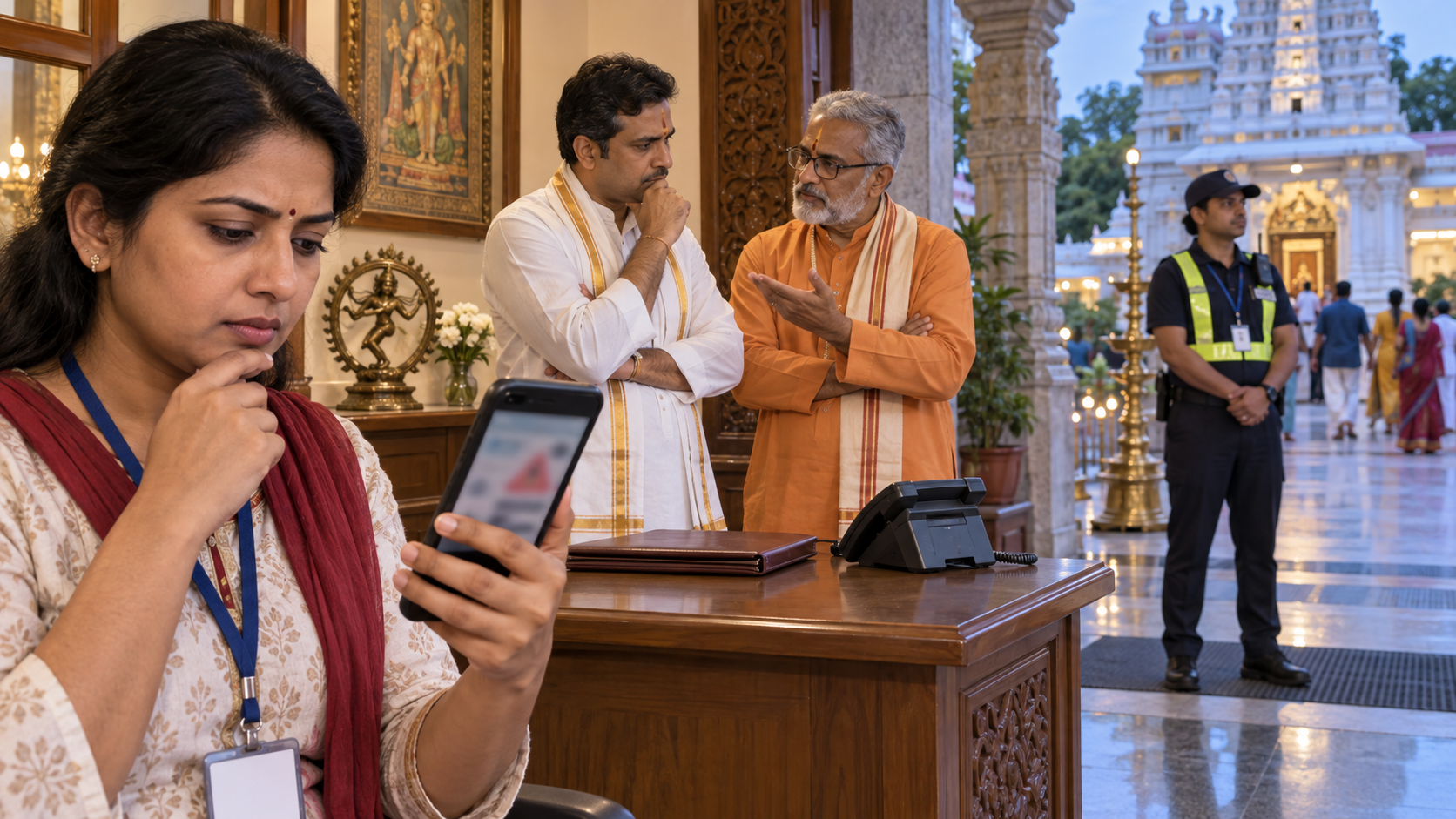
A temple volunteer should not have to decide whether a hostile sender truly intends to act. That is an investigative question. The volunteer’s job is to recognize the operational level, preserve what was received, and escalate it. The following is a practical triage framework, not a legal definition of a threat or hate crime.
Level one: abusive but non-specific hostility
A slur, mocking comment or hostile political message may contain no target, plan, time, location or indication of intended violence. Do not argue with the sender from an official temple account. Record the date, time zone, platform, account name, exact wording and permanent link where available. Apply the temple’s moderation rules consistently, and preserve the material before reporting or removing it.
A single vague comment may remain a moderation issue. Repetition, movement across platforms, references to individual devotees, publication of private information, or signs that the sender knows the temple’s routine should move it out of that category. Review the accumulated record rather than treating each message as an isolated nuisance.
Level two: a targeted threat that requires investigation
Escalate when a message names the temple, a service, a festival, a leader or an identifiable devotee; refers to weapons, access points or schedules; depicts preparations for violence; or appears to contain surveillance or private information. A sender calling the message a joke does not settle the matter. Neither does the absence of a stated date.
Send the material to the temple’s designated safety lead. If there is no apparent immediate danger, use the local police non-emergency channel and ask how investigators want the digital evidence submitted. Request an incident or case number and record the name or unit receiving the report. Do not ask a volunteer to approach a suspected person, contact the sender, or conduct an amateur investigation.
Level three: immediate or unfolding danger
If there is a reasonable indication of imminent violence, a weapon at the site, forced entry, or danger already in progress, call 911. Give the exact street address first, then describe what is happening, where the danger was last seen and any description you can provide safely. Follow the dispatcher’s instructions and the site’s established emergency procedure. Do not delay the call while a committee meets, and do not send anyone to verify the danger by confronting it.
Preserve the original message or file whenever it is safe to do so. Capture the full conversation, account name, URL, date, time and time zone. Save the complete email, including headers if the platform permits. Do not crop away context, add annotations to the only copy, or circulate it through large community groups. Widespread forwarding creates confusion, exposes recipients to violent material and makes it harder to identify the authoritative copy.
Build a one-page temple response plan before the next gathering

A long security manual that no volunteer can find is less useful during a crisis than a short plan with named people and clear decisions. Keep the operational version restricted to those who need it, and review it before major gatherings.
- Name the roles. Assign a primary safety lead, an alternate, a 911 caller, a law-enforcement liaison, a person responsible for children and family reunification, and one communicator. A small mandir may give one person several roles, but every role still needs a named backup.
- Put the exact site information on the first page. Include the temple’s official name, street address, main phone number, entrances and the locations responders may need to reach. Keep sensitive access details out of the public version.
- Create separate paths for a digital warning and an on-site emergency. State who receives screenshots, who decides whether to contact the non-emergency line, who can postpone an event, and who initiates the emergency procedure when danger is immediate.
- Establish contact before a crisis. Ask local police and fire personnel how they prefer to receive threat evidence, which site information they need, and how event organizers should report concerns during a large festival. Give them one consistent temple liaison.
- Review the physical space. Keep exits visible and unobstructed, verify that doors used for access control still allow lawful emergency egress, and account for children, elders and people with limited mobility. Do not improvise a locking arrangement that could trap worshippers; building and fire requirements are local matters that need qualified review.
- Plan for the busiest realistic service, not an ordinary weekday. Decide how greeters report a concern discreetly, how parking volunteers reach the safety lead, where families receive instructions, and which communication channel remains available if the public address system cannot be used.
- Rehearse decisions without staging panic. Walk leaders through an abusive comment, a targeted online message and an immediate danger at the entrance. Afterward, replace every answer beginning with someone will with a person’s name, a contact method and an alternate.
Security should be based on conduct, not identity. Race, religion, nationality, clothing and accent are not threat indicators. An explicit threat, attempted forced entry, stalking, violence or refusal to obey a legitimate safety direction is conduct that can require action. This distinction protects devotees while preventing an anti-Hindu incident from becoming an excuse to mistreat another community.
A temple considering armed security should not treat it as another volunteer shift. Licensing, weapons rules, insurance obligations, training standards and authority to use force vary by state and locality. Obtain qualified local legal and security advice, and use properly authorized professionals. Adding a firearm without command, training and accountability can create another danger rather than solve the first one.
The aim is neither an unguarded campus nor a fortress. A trained greeter, a clear reporting path and a working relationship with local responders can support both welcome and vigilance. Security is a boundary around worship, not a replacement for it.
Name anti-Hindu hostility accurately without spreading the attacker’s message

Silence leaves a vacuum for rumor. Overstatement destroys trust when early details change. A useful temple notice answers four questions: what is verified, which authority has been contacted, whether services are affected, and where the next official update will appear.
Use this internal alert structure: We received [brief factual description] at [time]. [Police or the designated safety lead] has been notified. [Named service or event] is [continuing, postponed or moved]. Do not circulate screenshots. Send relevant information to [single contact]. The next update will appear through [official channel] by [chosen time].
If the words or selected target indicate anti-Hindu animus, say so. You do not have to dissolve a direct threat against Hindus into vague language about tension. But distinguish an apparent or alleged motive from a final legal classification. A temple can describe the evidence it received while leaving criminal charges and findings to the appropriate authorities.
Do not republish a violent manifesto, weapons imagery or pages of slurs merely to prove that hostility exists. Summarize only what people need to understand the danger and the response. Avoid repeatedly naming the accused unless identification serves a clear public-safety purpose. The community’s statement should give more space to the safety plan and continuation of worship than to the person who threatened it.
Reject collective blame as firmly as you reject minimization. The reported Illinois allegations concern one accused person and a specific claimed ideology, not every American or every member of another racial or religious community. Precision is both dharmic and practical: it keeps attention on the conduct, the alleged motive, the evidence and lawful accountability.
Nearby mandirs, gurdwaras, Jain derasars and Buddhist centers can maintain a simple reciprocal alert network without creating a rumor chain. Each institution should designate one contact, share only verified operational information, and direct raw evidence to law enforcement rather than broadcasting it. The purpose is faster awareness, not uncontrolled speculation.
Key takeaways for temple leaders and devotees

- Treat a targeted threat as a safety matter, not an invitation to debate the sender.
- Call 911 when danger appears imminent or is already unfolding; use the local non-emergency channel for a threat that needs investigation but presents no apparent immediate danger.
- Preserve the original message, full context, link, account details, date, time and time zone before reporting or removing content.
- Give every response role a name and a backup. Someone will handle it is not a plan.
- Name apparent anti-Hindu and anti-Indian hostility when the evidence supports those descriptions, while preserving the distinction between an allegation and a legal finding.
- Do not amplify manifestos, weapons imagery, rumors or collective blame. Tell devotees what is verified, what they should do and when they will hear more.
Before your next major gathering, put a 30-minute tabletop exercise on the calendar. Hand the leadership team three scenarios: an abusive comment, a targeted message and danger at the gate. Require each person to say who calls whom, what gets preserved and what worshippers are told. Assign every unresolved task before the meeting ends. Hindu public life should remain visible and confident, protected by disciplined preparation rather than governed by fear.
References

Leave a Reply
You must be logged in to post a comment.