

If you are trying to understand the Bangladeshi immigrant detention case in Kodagu, keep two obligations in view at once: Bharat must enforce its immigration laws, and the public must not turn preliminary allegations into conclusions that the investigation has not established.
The useful question is not whether to choose security or fairness. It is whether the authorities can verify the family’s status, trace any assistance they received, protect the two children involved, and bring the case to a transparent legal conclusion.
What has actually been established so far

Police took four members of one family into custody in Balele village, Ponnampet taluk, in Karnataka’s Kodagu district. The adults were identified as Mohammed Sujan, 32, and Sonia Akhtar, 28; their two children were also taken into custody. Police inquiries reportedly identified all four as Bangladeshi citizens and raised the suspicion that they had entered Bharat without legal authorization.
The reported timeline is specific but still preliminary. The family is said to have travelled through Kolkata before reaching Bengaluru around two years earlier. After working in Bengaluru, they moved to Balele about six weeks before the detention and found work on local plantations. Local Hindu residents reportedly questioned them and alerted the authorities after becoming concerned about their identity and movements.
Legal proceedings have been initiated, and the family was expected to be transferred to the Foreigners Regional Registration Office in Bengaluru for further action. That expected transfer should not be described as completed unless authorities confirm it. Nor should custody be confused with a final finding by a court or the competent immigration authority.
Investigators had, at the preliminary stage, found no evidence connecting the family to any other illegal activity. The suspected immigration violation is serious enough to investigate on its own. Adding unsupported allegations of terrorism, organized crime, or a wider conspiracy would weaken public understanding rather than strengthen enforcement.
Key takeaways
- Four people from one family, including two children, were detained; this is not evidence by itself of a larger criminal network.
- Bangladeshi nationality and unauthorized entry are separate questions. Nationality must be verified, and the alleged lack of authorization must be established through documents, records, and the applicable legal process.
- The family’s reported route through Kolkata and Bengaluru makes the assistance they may have received an important part of the inquiry.
- A person from Assam reportedly helped the family reach Balele, but that person’s identity, conduct, and possible legal responsibility had not yet been established.
- Firm enforcement is compatible with due process, child protection, and restraint in public claims.
The facilitator and employment trail require close scrutiny
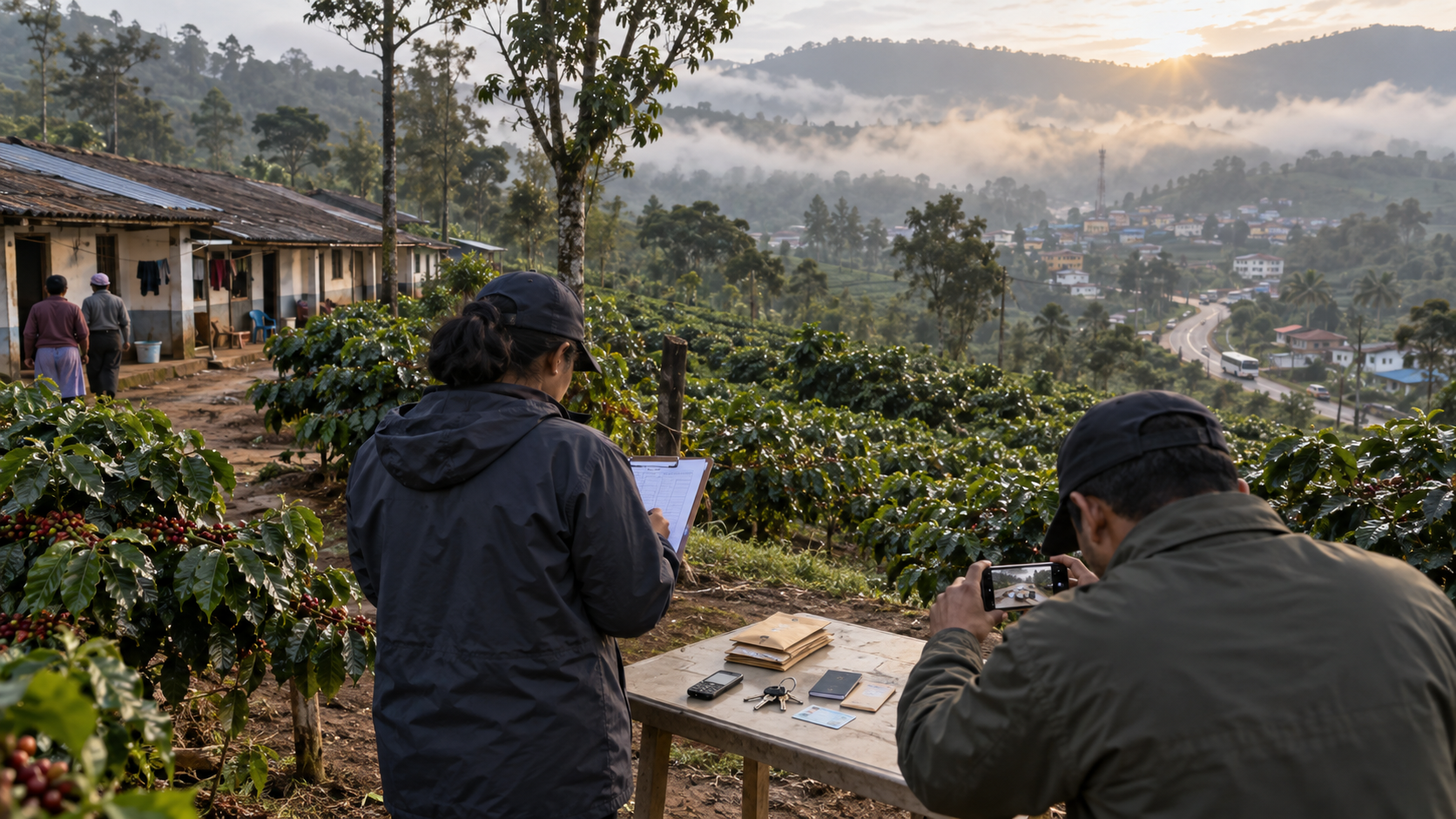
The most consequential unanswered question may lie beyond the four people in custody. Preliminary findings indicate that a person from Assam facilitated the family’s arrival in Balele. Facilitated movement does not automatically prove trafficking, document fraud, or an organized network. It does give investigators a concrete lead that should not be allowed to disappear once the family leaves local custody.
A credible inquiry should keep four questions separate and answer each with evidence:
- Who are the four individuals, and what records reliably establish their nationality and family relationships?
- How did they enter Bharat, and did any of them possess a passport, visa, permit, application receipt, or other document relevant to their status?
- Who arranged their travel, housing, and plantation employment as they moved from Bengaluru to Kodagu?
- Did any intermediary or employer knowingly help them evade lawful checks, use false documents, or conceal their identity?
Those questions matter because enforcement that stops with vulnerable workers can leave the enabling mechanism untouched. If someone recruited, transported, housed, or employed the family while knowingly bypassing legal requirements, that conduct deserves independent investigation. If no such knowledge can be proved, officials should say so rather than forcing the facts into a predetermined narrative.
The reported two-year period in Bengaluru also deserves attention. Authorities should examine how the family obtained work and accommodation, what identity details were supplied, and whether any documents were used. That record can show whether this was an isolated movement by one family or whether particular intermediaries repeatedly place people in informal employment. It can also expose routine verification gaps without presuming that every employer or migrant worker in the same sector is involved.
What responsible citizens and employers should do

Residents were entitled to alert the police when they believed there was a genuine immigration concern. But questioning a person in the street is not the same as verifying nationality or legal status. Citizens generally cannot determine those matters from language, clothing, religion, occupation, or place of residence.
If you encounter a comparable situation, act in a way that produces usable information without creating a second public-order problem:
- Report concrete observations to the police: the location, the activity that caused concern, and any directly known inconsistency. Separate what you witnessed from what someone else told you.
- Do not detain, threaten, assault, or publicly expose a person. Such conduct can endanger innocent people, interfere with an inquiry, and create separate legal consequences.
- Do not circulate names, photographs, addresses, or claims about children on social media. A child’s presence does not establish responsibility for an adult’s immigration decisions.
- If you employ migrant labour, use lawful identity and work-eligibility checks, retain the permitted records, and verify doubtful documents through the appropriate authorities. Do not confiscate original documents or substitute informal profiling for verification.
- Ask the authorities for the eventual procedural outcome: whether nationality and entry status were confirmed, whether the facilitator was identified, and which legal authority made the final decision.
Employers and labour contractors are especially important because informal recruitment can allow doubtful documentation to go unexamined. Verification should happen before placement, not after a neighbourhood dispute. At the same time, every adverse conclusion must rest on records and lawful findings rather than a worker’s accent, faith, or poverty.
Security becomes stronger when claims remain disciplined
Illegal entry can create real challenges for border control, internal security, labour regulation, and law enforcement. Those concerns justify coordinated verification and timely proceedings. They do not justify describing every suspected immigration case as proof of an ideological project, demographic conspiracy, or security plot.
In this case, the known facts point to a family that reportedly came looking for employment, while the suspected violation concerns unauthorized entry. That explanation may be incomplete, and investigators should test it. Yet the absence of evidence for other illegal activity must remain part of any honest account unless new findings emerge.
A Dharmic public ethic has room for both satya and nyaya. Satya requires us to say no more than the evidence supports. Nyaya requires the state neither to ignore a possible immigration violation nor to deny fair procedure to the people accused of it. Restraint is not softness; it is what keeps a legitimate security concern from becoming collective suspicion.
The involvement of two children makes that discipline especially important. Authorities can verify the adults’ status, preserve family relationships where legally and practically possible, and protect the children’s welfare without abandoning enforcement. Public anger directed at minors contributes nothing to border security or the investigation of facilitators.
You should judge the handling of this case by its final record: verified identity, documented entry findings, a traced assistance and employment chain, lawful treatment of the children, and a reasoned decision by the competent authorities. Until that record exists, support the investigation, report facts rather than rumours, and insist that scrutiny extends to anyone who may have enabled an immigration violation.
References

Leave a Reply
You must be logged in to post a comment.