
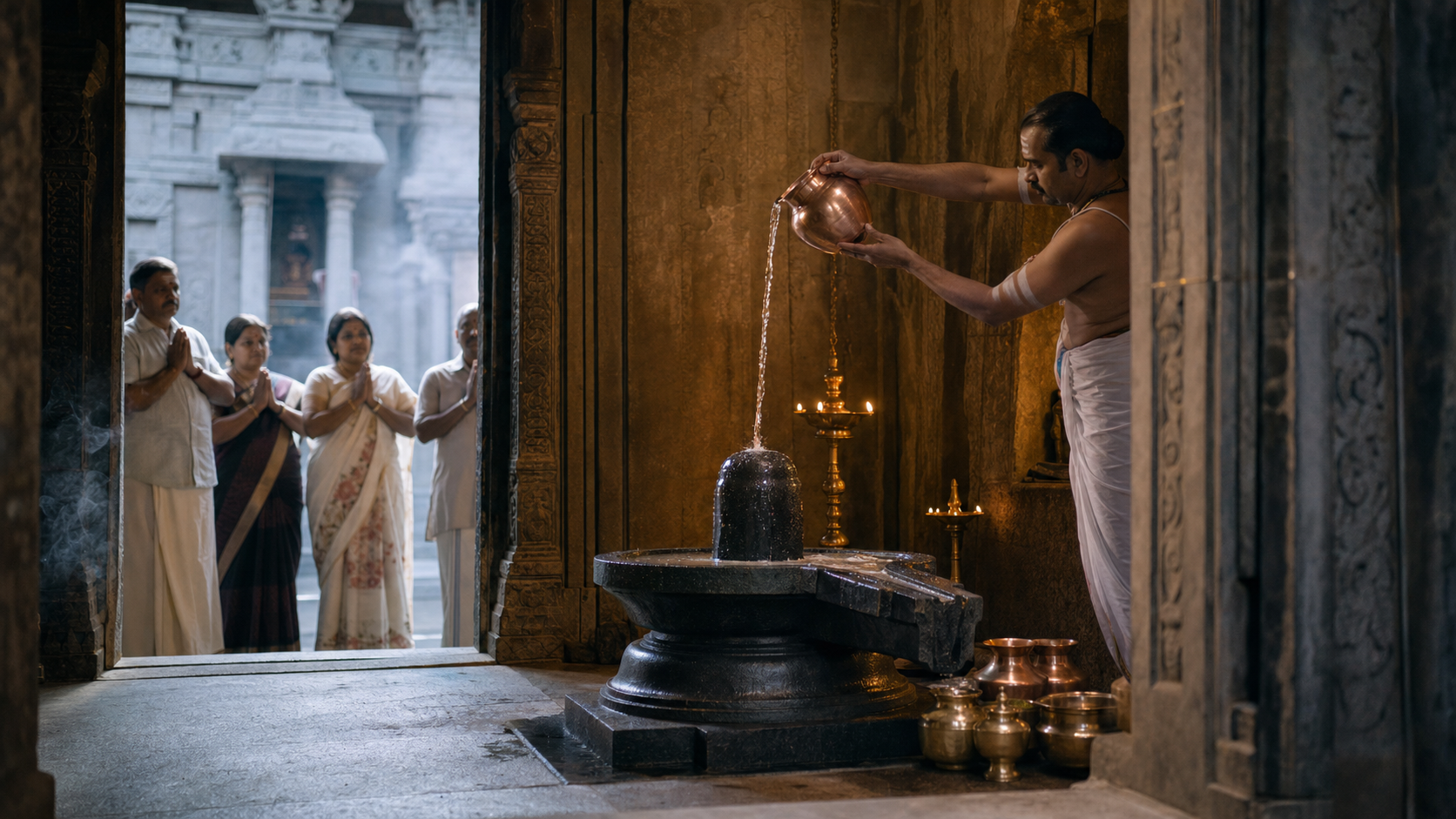
You may enter a temple knowing that abhisheka is sacred, yet still wonder what you are meant to notice while water, milk, curd, ghee, honey, and other offerings pass over the murti. Is each pour a separate prayer? Should you recite something? Does witnessing the rite count if you cannot approach the sanctum?
The most useful answer is to read abhisheka as a complete movement: intention becomes offering, offering becomes inward purification, and purification culminates in renewed darshan. Once you see that pattern, temple procedure stops looking like a series of unexplained actions and becomes a practical discipline you can participate in respectfully.
Read the whole rite, not just the substances being poured
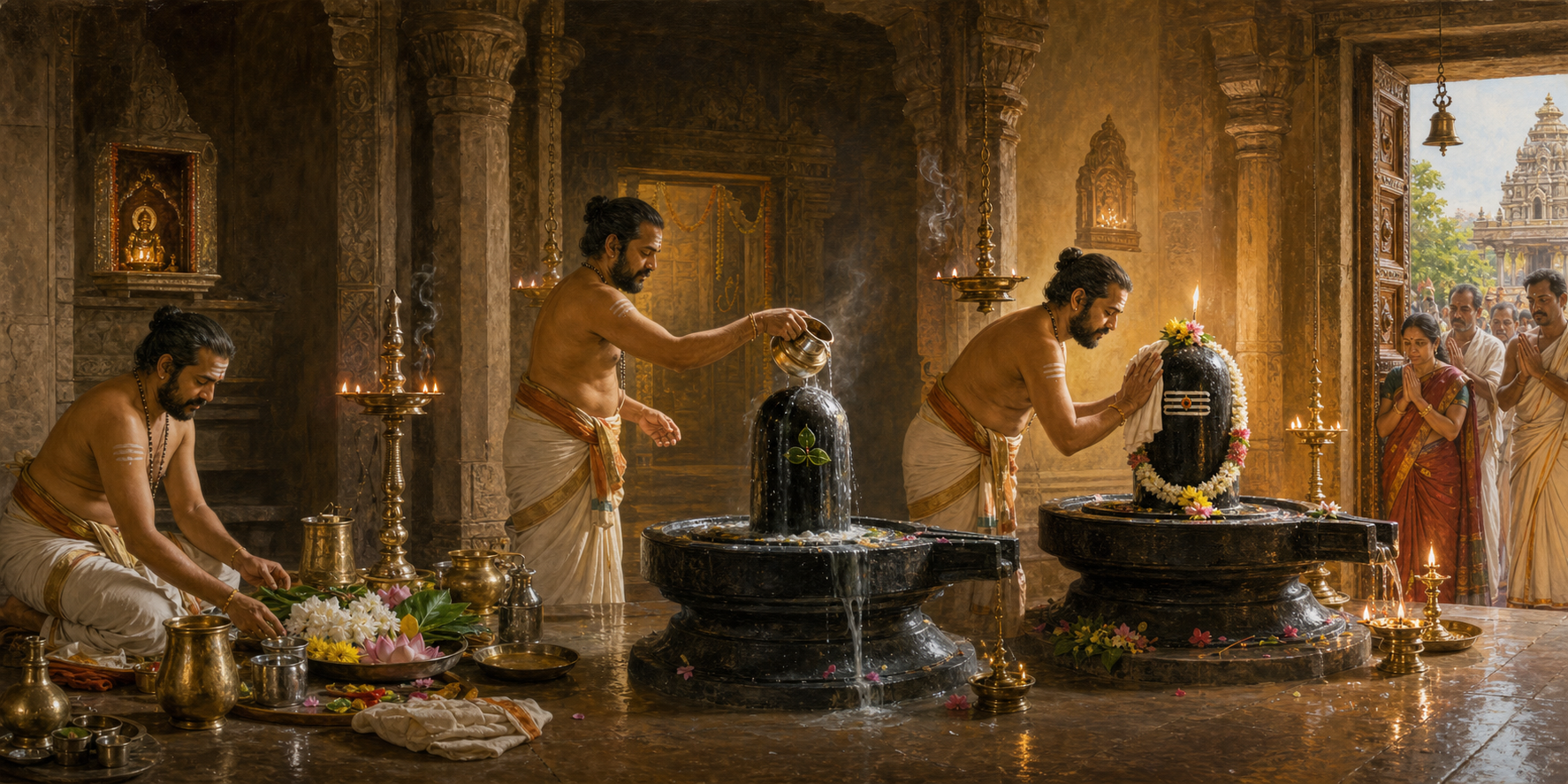
Abhisheka is the ceremonial bathing or anointing of a consecrated murti. The visible action is directed toward the deity, but the discipline also works upon the devotee. You bring attention, gratitude, and valuable substances into an ordered act of surrender. The archaka maintains the prescribed liturgy. The gathered community witnesses, chants, receives darshan, and, where appropriate, shares sanctified offerings.
This is why abhisheka cannot be reduced to cleaning an image. Cleaning may be one material effect, but the ritual joins external care to internal formation. Water suggests clarity. Sweet and nourishing substances train the mind toward gratitude rather than possession. Mantra keeps the senses from wandering. Alankara reveals the deity anew after the bathing is complete.
The exact order is governed by the temple’s Agama, the deity, the murti’s material, and the sampradaya. A useful outline for following the action is:
- Sankalpa: The purpose of the worship is established. This may concern a festival, a family seva, collective welfare, spiritual clarity, or another lineage-approved intention.
- Purification: Achamana and related preparations discipline the worshipper, the officiants, the vessels, and the ritual space.
- Dhyana and mantra: Attention is collected and directed toward the deity. Mantra, stotra, nama-archana, and mudra give the rite its liturgical structure.
- The abhisheka: Water, Panchamrita, or water from consecrated kalashas is offered in the order prescribed for that temple.
- The concluding rinse and care of the murti: Residue is removed, and the image is prepared for drying and adornment.
- Alankara, arati, and darshan: The newly adorned form becomes the culmination of the movement, not a decorative afterthought.
When you attend, give yourself a simple sankalpa before the first pour. One clear sentence is enough: may discernment govern this decision; may our family act without resentment; may this worship strengthen dharmic conduct. A precise intention gives your mind somewhere to return when the sanctum is crowded or the mantras are unfamiliar.
What 108 kalashas signify
Ashtottara Shata Kalasha Abhishekam uses 108 sanctified kalashas. It does not mean 108 different ingredients. The number 108 conveys completeness and auspiciousness in Hindu practice, while the assembled vessels make the worship visibly cumulative: many offerings are directed toward one divine centre.
Such a rite may be undertaken for loka-kalyana, spiritual clarity, and renewed dharmic resolve. At Sri Kodandarama Swamy Temple in Tirupati, for example, the 108-kalasha worship is performed within a precise framework of mantra, mudra, and sanctified water under the temple archakas. The important point for you is that numerical abundance does not replace attention. Let every kalasha return you to the same sankalpa rather than prompting you to count mechanically.
Special abhishekas may also be scheduled on Purnima. The full moon is associated in many Vaishnava settings with luminosity, sattvic reflection, and intensified communal worship. That association does not create a universal calendar rule; the temple’s announced schedule remains decisive.
Panchamrita gives you a vocabulary for inner refinement

Panchamrita means the five nectars. A common form combines milk, curd, ghee, honey, and jaggery or sugar. These are auspicious, edible, predominantly sweet substances that can be offered and then shared as tirtha or prasada when the temple’s rules and preparation standards allow it.
The ingredients are not arbitrary, but neither should their symbolism be treated as a rigid code with only one correct interpretation. Lineages use related mappings as teaching aids. They help you translate a physical offering into a quality worth cultivating:
| Offering | Common symbolic emphasis | What to notice in yourself |
|---|---|---|
| Milk | Purity, nurture, lunar calm, and sattva | Ask whether agitation can give way to a clear and receptive mind. |
| Curd | Transformation, ripening, fertility, and abundance | Notice where you want blessing without accepting the change that growth requires. |
| Ghee | Agni, tejas, discernment, and steady resolve | Direct will toward what is right, rather than merely toward what is desired. |
| Honey | Many becoming one, relational harmony, and sweetness of speech | Examine whether your words unite, clarify, and heal, or merely win. |
| Jaggery or sugar | Grounded contentment, wholesome sweetness, and stability | Practise gratitude without turning sweetness into excess or waste. |
| Concluding water | Clarity, integration, and renewal | Let the distinct lessons settle into one simple direction for conduct. |
Milk becoming curd and ghee adds another layer. The same starting substance takes different forms through patient transformation. The sequence therefore does more than praise purity; it acknowledges that spiritual maturity requires refinement. Remaining unchanged is not the goal.
Ghee also links abhisheka to the imagery of yajna. It feeds fire in sacrificial worship and represents luminosity when used for anointing. Honey, gathered through collective labour, makes unity tangible. Jaggery retains an earthy completeness, while sugar is accepted in many settings when jaggery is not available. The underlying criteria are auspiciousness, edibility, sattva, nourishment, and shareability, with the exact recipe left to the governing tradition.
Do not turn these ritual associations into medical claims. Panchamrita is sacred food, not a treatment. If you cannot consume dairy, honey, or sugar safely, you may decline prasada respectfully or receive it in the manner permitted by the temple. Reverence does not require disregarding a known allergy or dietary restriction.
The murti’s material changes the practical protocol
A dramatic abhisheka seen at one shrine is not automatically suitable for another murti. Granite, soapstone, panchaloha, and stucco do not respond identically to moisture, fats, sugar, or repeated handling. Priests adjust the substances, quantities, dilutions, rinsing, and frequency according to the image and the established temple procedure.
The final water rinse is therefore not a cancellation of the offering. It completes it. Residue must be removed before drying and alankara, both for ritual order and for the responsible care of the murti. Dedicated vessels, fresh ingredients, clean preparation, and careful handling express the same principle: sacredness is maintained through standards, not sentiment alone.
Your role at a temple is active even when you cannot pour
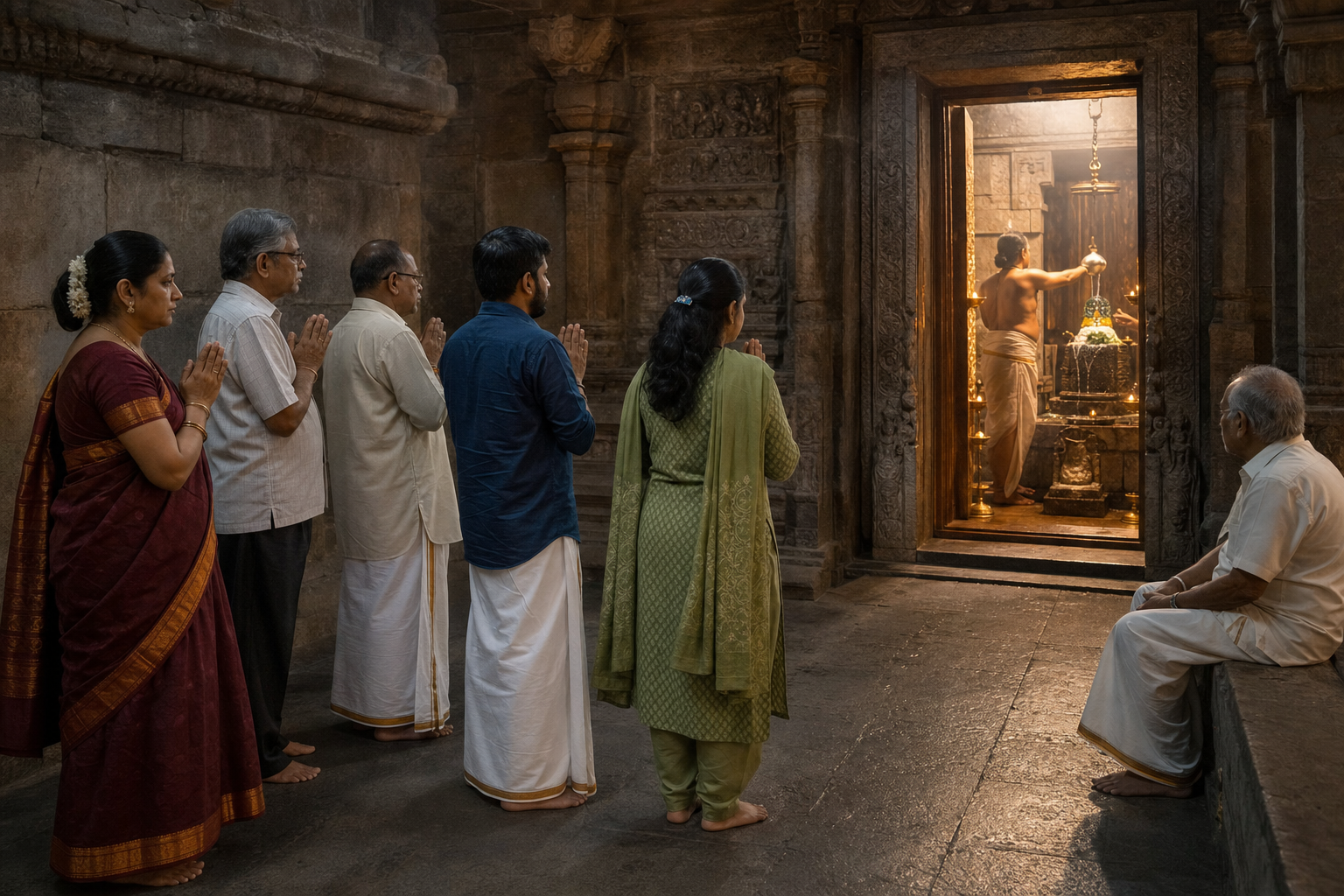
Many devotees assume that the person holding a kalasha has the fullest participation. Temple practice offers a wider understanding. Priests and authorised seva holders may perform the action at the feet of the murti, while everyone else participates through sankalpa, attentive witnessing, mantra, pranam, darshan, and disciplined conduct in the sacred space.
You can prepare for a special abhisheka in four concrete ways:
- Check the exact rite and access arrangement. Find out whether the announced time marks the beginning of worship, public entry, or darshan after the bathing. Confirm whether a seva ticket is required and what general devotees can witness.
- Arrive with a margin. A published Tirupati programme for a 9:30 AM special abhisheka recommends arriving 45 to 60 minutes early, particularly for a Purnima observance when attendance may rise. Treat that as a planning example, not a rule for every shrine.
- Choose one inward discipline. Follow a familiar name of the deity, repeat your sankalpa, or contemplate the quality represented by the current offering. Trying to decode every mantra in real time can scatter attention.
- Respect the ritual boundary. Do not reach toward the murti, vessels, attendants, or flowing substances unless expressly invited. A boundary maintained by the temple is part of the worship, not an obstacle to it.
Conservative attire, quiet near the sanctum, and compliance with queue and security instructions protect other devotees’ opportunity for darshan. If Panchamrita or tirtha is distributed, receive only what is offered in the approved place. Do not demand a larger portion, intercept material draining from the ritual platform, or leave unwanted prasada where it will be stepped on.
Abhisheka may be followed by a procession of the utsava murti. At Sri Kodandarama Swamy Temple, the movement of Rama, Sita, and Lakshmana through the four Mada streets extends the sanctity of the garbhagriha into the surrounding community. The theological movement is important: dharma does not remain enclosed behind the sanctum door.
If you attend such a procession, select a fixed viewing point, arrive before the route fills, and keep the path clear for the palanquin and attendants. Families accompanying elders or children should choose a comfortable place rather than repeatedly pushing toward the moving murti. Bring drinking water where permitted, minimise plastic, and dispose of offerings responsibly. Orderly participation is itself seva.
Keep household abhisheka small, suitable, and lineage-aware
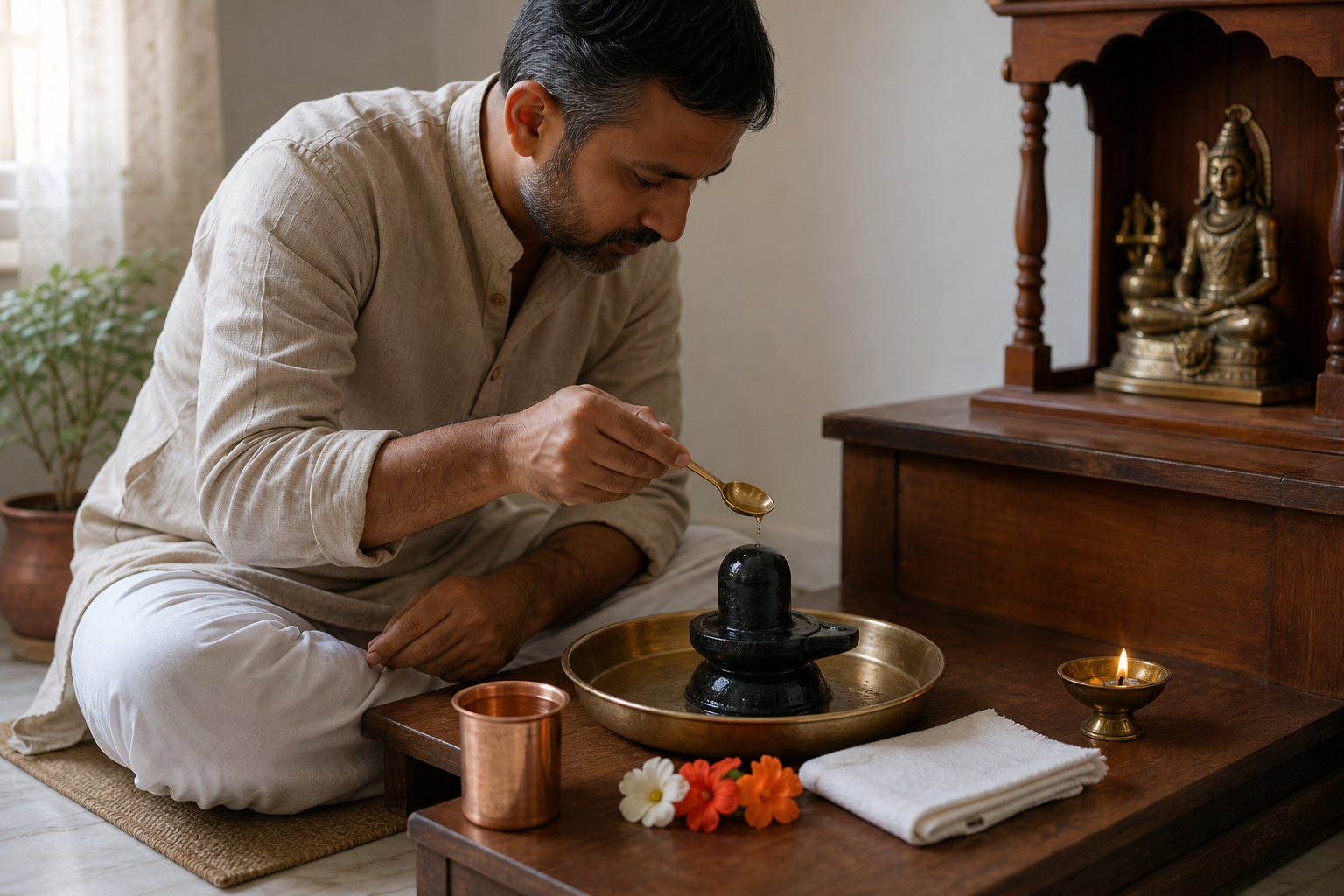
A home abhisheka does not need temple-scale quantities. In fact, smaller quantities make it easier to preserve cleanliness, avoid waste, rinse the murti properly, and distribute only what can be consumed responsibly.
- Confirm that the murti is suitable. Ask a knowledgeable priest or teacher if you do not know the image’s material or the practice prescribed for it. Do not pour dairy, honey, oil, or sugar over an unknown finish.
- Clean the altar, vessels, catch basin, and your hands. Prepare worship as carefully as you would prepare food that others will receive.
- State a concise sankalpa. Name the deity, occasion, and intention according to your practice. Avoid turning the sankalpa into a list of demands.
- Prepare a fresh, modest quantity. Use food-grade ingredients if the mixture will be distributed. Jaggery may be used in a suitable form; sugar is accepted in many traditions when necessary.
- Offer in the sequence you have been taught. Recite a familiar mantra or the divine name without rushing. Do not invent a complicated liturgy merely to make the worship appear more elaborate.
- Complete the water rinse, drying, and alankara. Pay special attention to crevices and metal joins where moisture may remain.
- Offer arati and distribute prasada responsibly. Prepare only enough to use promptly, and do not let the wish for abundance produce avoidable waste.
Substitutions require judgement. Some households use coconut or almond milk, while some Jain traditions omit honey because of their understanding of ahimsa. These practices do not establish a universal replacement chart. If a dietary vow or ethical commitment conflicts with the inherited recipe, ask someone grounded in your lineage whether a substitution, a simpler water abhisheka, or another form of offering is appropriate.
Ethical procurement also belongs inside the ritual rather than outside it. If dairy is offered, consider how it was obtained. Use quantities that can be handled without waste. Keep everything intended for consumption clean. Ahimsa, restraint, and gratitude should be visible in the preparation as well as in the mantra.
Recognise shared Dharmic themes without erasing differences
Jain communities may perform jalabhisheka and, in some traditions, panchamrit snana for Jina murtis, with the emphasis placed on inner purity and self-mastery. The omission of honey in some Jain settings shows how ahimsa can shape the materials of worship.
Some Buddhist communities bathe images of the Buddha with pure water or fragrant infusions during seasonal observances, expressing purification and the renewal of wholesome intention. Sikh practice does not involve murti worship or abhisheka; seva, langar, equality, and the sharing of karah prasad embody sacred nourishment through a different discipline.
You can recognise a shared concern with purification, restraint, service, sweetness, and community without pretending that the rites are interchangeable. Honour each tradition by learning its actual practice rather than assembling a hybrid ceremony from surface similarities.
Abhisheka questions devotees commonly ask
Does witnessing abhisheka count if I cannot offer a kalasha?
Yes. Temple participation is not limited to physical proximity. You can establish sankalpa, attend to mantra, contemplate the meaning of the offering, make pranam, and receive darshan. The priestly restriction protects the liturgy and the murti; it does not exclude the assembled devotee from worship.
Is every Panchamrita recipe and sequence identical?
No. Milk, curd, ghee, honey, and jaggery or sugar form a widely used pattern, but order, consistency, quantity, deity-specific additions, substitutions, and the concluding procedure vary. Follow the relevant Agama, sampradaya, temple instructions, or household tradition rather than treating an online demonstration as universal.
Why is the murti rinsed after the sacred substances are offered?
The rinse completes the abhisheka, removes residue, and prepares the murti for drying and alankara. It also allows the materials to be handled in a way appropriate to granite, soapstone, panchaloha, stucco, or another surface. The offering lies in the disciplined act, not in leaving a coating indefinitely.
What should I concentrate on during a long abhisheka?
Hold one intention and follow the movement from purification to transformation, illumination, sweetness, clarity, and renewed darshan. If attention wanders, return to the deity’s name. You do not need to manufacture a different thought for every vessel.
At your next abhisheka, arrive with one clear sankalpa and remain long enough for the final alankara if temple access allows. Then carry one quality from the rite into conduct that same day. A gentler sentence, a restrained purchase, a repaired relationship, or a duty completed without complaint is where the offered symbolism begins to become dharma.
References
- DharmaRenaissance Blog – Tirupati Kodandarama Swamy Temple May 2026: Auspicious Purnima Abhishekam, Timings & Processions
- DharmaRenaissance Blog – Panchamrita Abhisheka Explained: The Sacred Science of Milk, Curd, Honey, Jaggery, and Ghee