
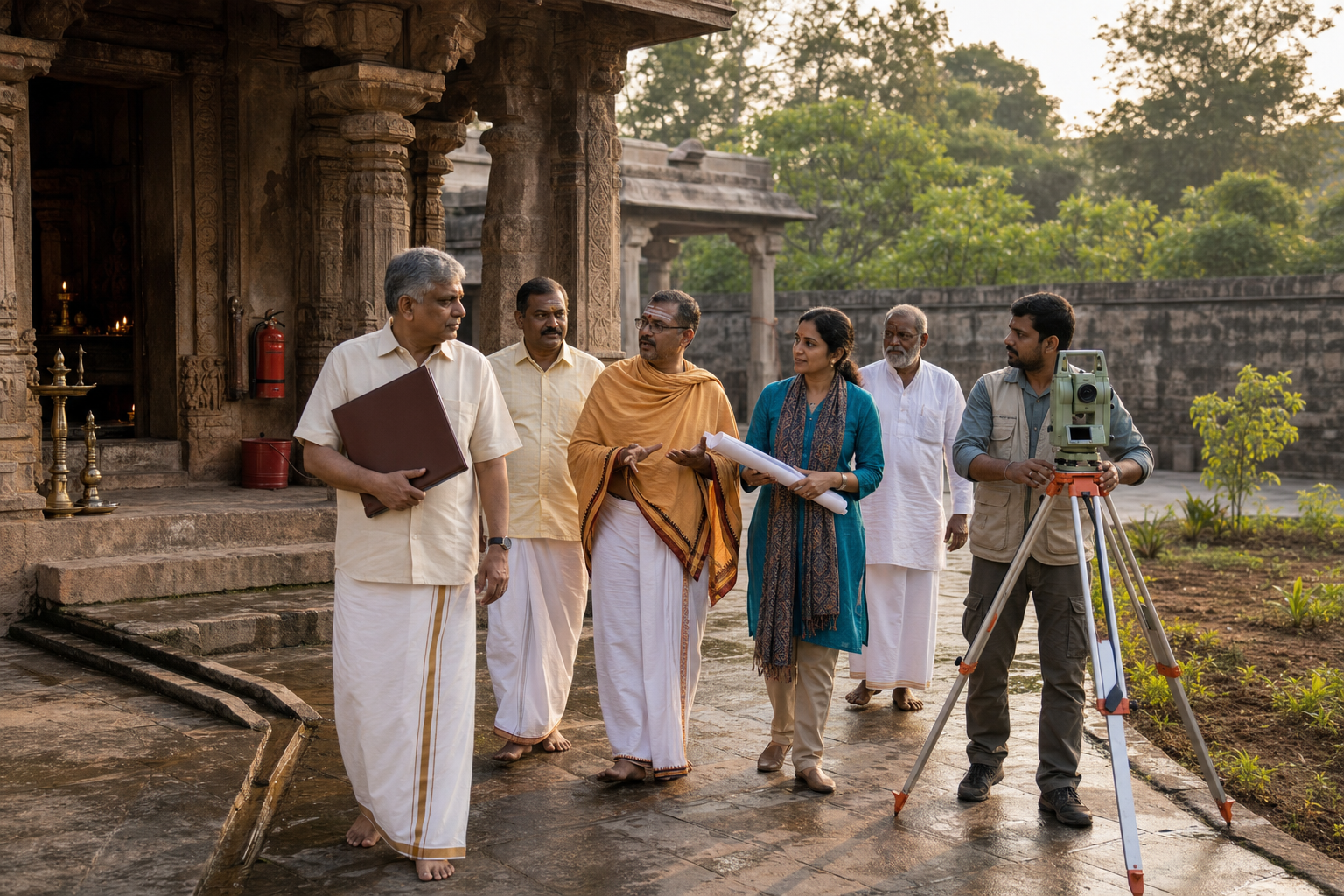
Perhaps the warning has already arrived: an old boundary is being challenged, rainwater is entering historic masonry, festival queues are tightening, or nobody can produce the latest audit. If you are a trustee or committee member, the visible problem will demand an immediate reaction. Your first duty is to make the temple capable of responding with evidence, lawful authority, and a clear chain of responsibility.
Do not begin with a large restoration tender, an angry public statement, or another folder of disconnected certificates. Begin with one board-backed stewardship system that connects governance, land, historic fabric, finance, safety, and digital records. That system protects more than property. It protects uninterrupted worship, the confidence of devotees, and the ability of the institution to pass its inheritance intact to the next generation.
Build governance that can defend a sacred institution
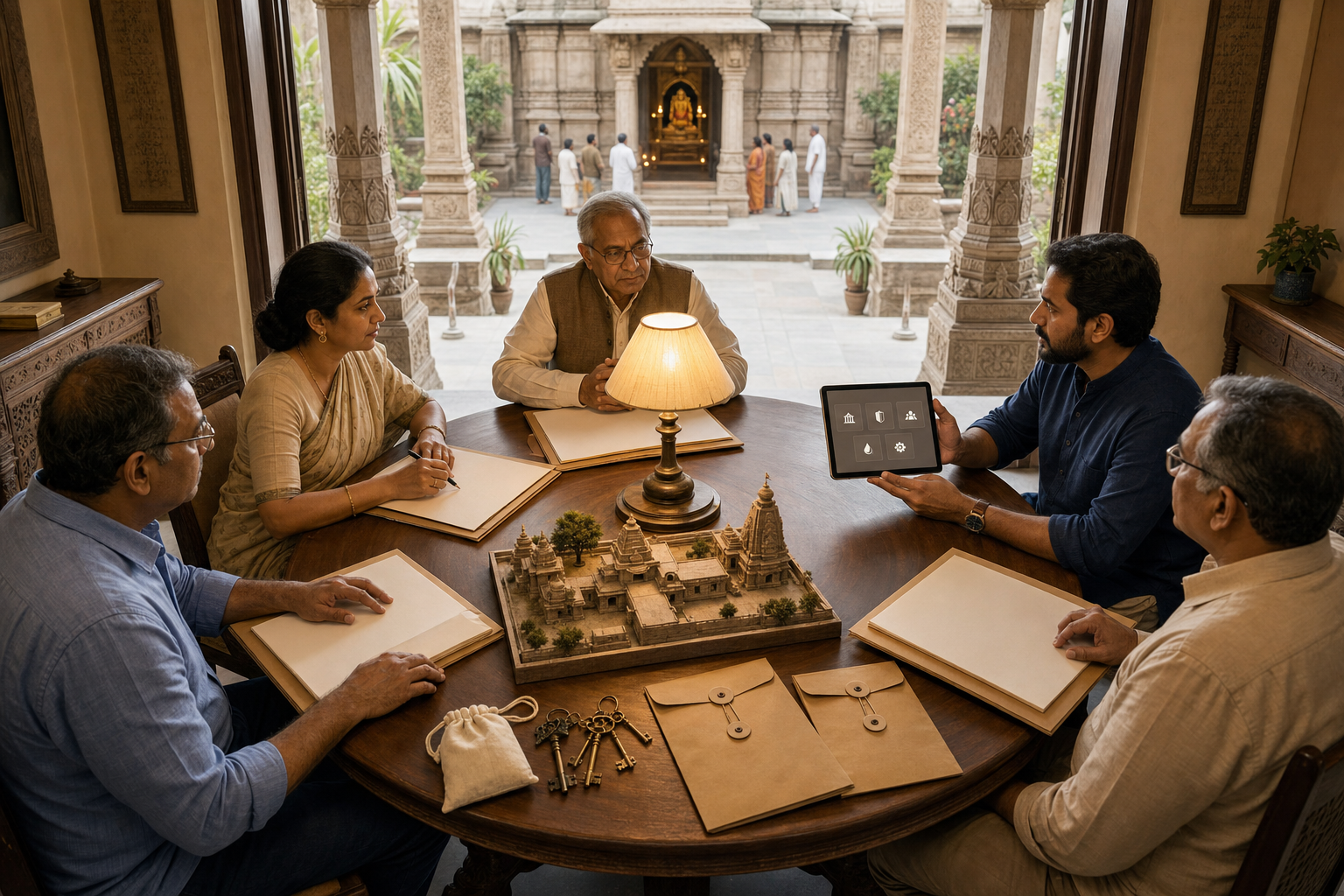
A temple can possess old deeds, generous donors, and devoted volunteers yet remain institutionally fragile. The weakness usually appears when nobody knows who may approve a payment, who holds the original title documents, whether a conflict was disclosed, or which version of a decision is final. Governance is the mechanism that turns collective responsibility into accountable action.
Start with a short board charter. It should identify the powers reserved for the full board, the duties delegated to office-bearers, the matters requiring specialist advice, and the process for recording dissent or conflicts of interest. Assign a named owner and a substitute for every critical function. A duty assigned to everyone is often a duty completed by no one.
For a Maharashtra public charitable trust, map the institution’s obligations under the Bombay Public Trusts Act, 1950, commonly referenced in the state as the Maharashtra Public Trusts framework. Add the trust’s Income Tax registrations or exemptions, including 12AB and 80G where applicable, and FCRA obligations only if foreign contributions are relevant. Temples elsewhere should build the same register using their own state and local requirements. Statutes, rules, forms, and filing practices can change, so have current obligations confirmed by a qualified professional in the relevant jurisdiction.
Use a compliance register with six fields: requirement, responsible person, due date, evidence of completion, reviewer, and unresolved exception. Review it at every regular board meeting. This is more useful than an annual scramble because an expired registration, unanswered audit point, or missing filing becomes visible while there is still time to act.
- Separate transaction roles. The person who creates a vendor or payment request should not be the only person approving, releasing, and reconciling it.
- Set a board-approved procurement rule. Above the threshold chosen for your institution, require documented competing quotations or an appropriately transparent electronic process.
- Issue traceable receipts for donations and reconcile collection records, bank credits, online gateways, and cash deposits every month.
- Maintain annual conflict-of-interest declarations and require a fresh disclosure whenever a specific agenda item affects a trustee, relative, or connected entity.
- Give an audit committee or suitably independent reviewers a written mandate to follow each audit observation until it is closed with evidence.
- Publish an intelligible annual financial and stewardship summary, while withholding personal, security-sensitive, and legally privileged information.
- Provide a grievance channel with an acknowledgement, a responsible officer, an escalation route, and a closure record.
Put digital administration inside this structure rather than treating it as the website operator’s concern. Online donations, e-darshan systems, volunteer lists, and grievance records can contain personal data. The Digital Personal Data Protection Act, 2023 makes purpose limitation, data minimisation, access control, retention, deletion, and breach response governance questions. Record why each category of data is collected, who may access it, how long it is kept, and how deletion is verified. Encrypt sensitive donor information, keep administrative systems separate from public Wi-Fi, and examine the security and regulatory standing of payment vendors. Obtain current professional advice when determining the Act’s application to a particular temple or incident.
A one-page board dashboard should then track what devotees cannot see directly: overdue compliance items, time taken to close audit findings, unresolved property matters, volunteer training coverage, fire-drill completion, significant incidents relative to visitor volume, and the time needed to detect and contain a cyber incident. Publish a suitable annual summary. Do not publish floor plans, access credentials, camera blind spots, personal records, or litigation strategy.
Make every parcel of temple land provable
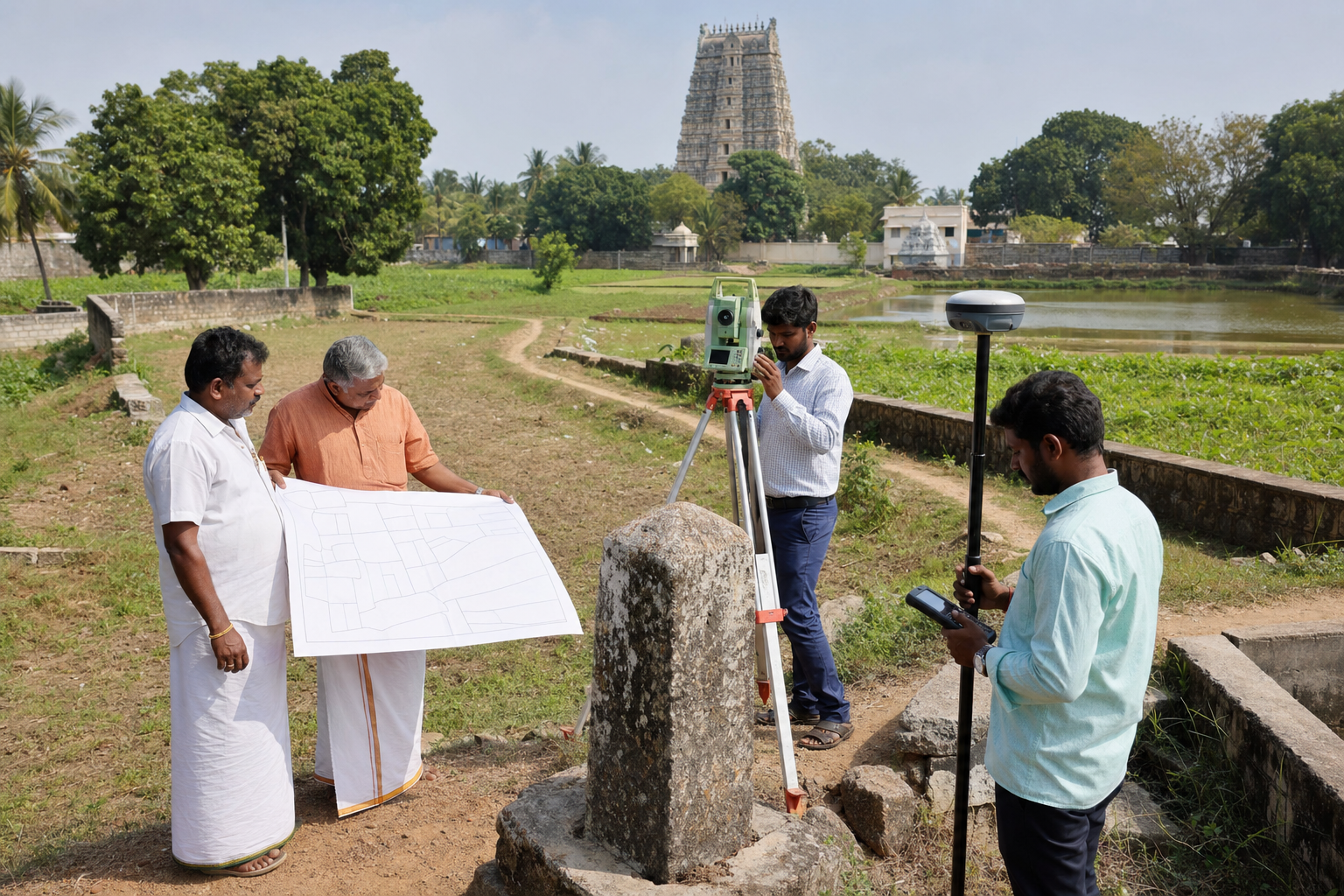
Land protection begins long before litigation. A trustee who waits for construction on a disputed boundary has already surrendered the easiest period for correcting records, locating witnesses, surveying the parcel, and resolving inconsistent descriptions.
Create one indexed file for every parcel, even when several parcels form a single temple precinct. Give each parcel a stable internal identifier and connect the paper originals, certified copies, digital scans, maps, photographs, and board decisions to that identifier. In Maharashtra, the working file may include the relevant 7/12 extract or property card, mutation entries, chain-of-title documents, old sanads, recognised court orders, survey material, and cadastral overlays. The exact record varies with the land and jurisdiction; do not force an urban property into a rural-record checklist or vice versa.
- Title folder: founding grants, conveyances, sanads, succession or transfer records, mutation documents, orders, pleadings, and counsel’s title review.
- Boundary folder: official maps, survey reports, coordinates where formally recorded, boundary-marker photographs, neighbouring parcel references, and dated site inspections.
- Use folder: evidence of worship, access, maintenance, leases or licences, authorized occupation, utilities, and board-approved changes in use.
- Event folder: each notice, objection, alleged intrusion, damaged marker, government communication, police acknowledgement, and dated photograph, preserved in chronological order.
Arrange a periodic boundary inspection rather than relying on institutional memory. Where the parcel is large, irregular, or contested, engage an authorised survey professional and determine whether total-station, drone, GIS, or official cadastral work is appropriate. A survey can document location and occupation; it does not by itself answer every question about legal title. Keep the survey and the title review connected, but do not confuse their functions.
When an overlap or encroachment claim appears, preserve the site and the record before escalating the rhetoric. Obtain authenticated land extracts and maps, commission a title audit, identify the competent survey and revenue authorities, and ask a property lawyer to determine the proper forum. A file that mentions the Waqf Act, 1995 does not by itself decide ownership or the current route of adjudication. Depending on the claim and governing law, the competent forum may involve a statutory tribunal, a civil court, or another authority. Only current, case-specific legal advice can settle that procedural question.
Do not sign away access, move a boundary, demolish an occupied structure, or attempt physical eviction on the strength of a committee discussion. Those actions can endanger people, alter evidence, and create serious legal exposure. Use district authorities for lawful demarcation or enforcement where they have jurisdiction, and let counsel control irreversible steps.
Your public language should be as disciplined as your evidence. Distinguish a claimed overlap, a disputed boundary, and a documented unauthorised occupation. State what record is being verified, which authority has been approached, and that the temple will pursue its rights through due process. Firmness does not require speculation. Factual communication protects the institution from avoidable escalation while keeping the underlying claim intact.
Conserve a living temple without erasing its life
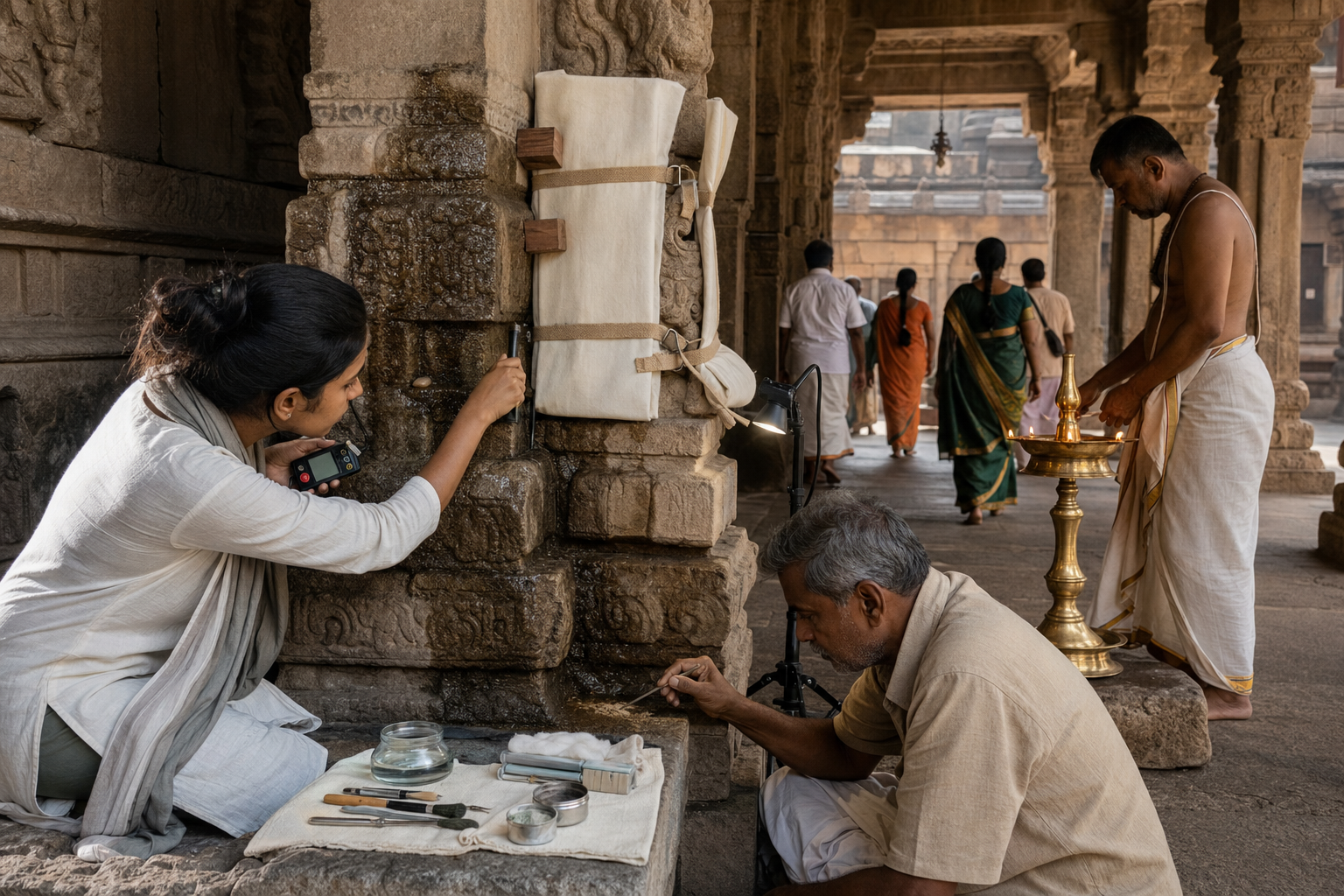
A temple is not merely an old building. Puja, movement, lamps, processions, seasonal gatherings, sound, food service, and daily cleaning are parts of its living significance. Conservation that ignores worship can make the institution unusable; alterations made without material knowledge can destroy the very fabric trustees hoped to improve. Ritual custodians and conservation professionals therefore need one plan, not two competing plans.
First, verify legal status. Record whether the temple, an object within it, an adjoining structure, or the surrounding precinct is protected by the Archaeological Survey of India, a state heritage authority, or another competent body. Legal age, public reverence, and formal notification are not interchangeable. The state protection granted in Goa to Mardangad Fort and Hath Katro Khamb illustrates how notification brings alterations, damaging activities, and conservation planning within a protective regime. If your site is protected or lies close to a protected monument, obtain the required heritage guidance and permissions before changing masonry, drainage, foundations, services, paths, or fixed installations.
If a significant temple lacks formal protection, ask the relevant authority to confirm its status and explain the applicable notification or listing process. Prepare an evidence file before seeking action: ownership and management records, a location plan, dated condition photographs, a concise account of historical and architectural significance, documentation of living traditions, and the immediate threats. Do not assume that a passionate letter can replace the authority’s required evidence.
Next, commission a condition assessment that maps the whole precinct by location. A useful condition entry names the material, visible symptom, likely mechanism requiring investigation, urgency, temporary precaution, responsible specialist, photograph, and next inspection date. This prevents the common mistake of treating every dark patch as dirt, every crack as cosmetic, or every modern repair as an improvement.
- Immediate risk control: restrict unsafe access, support an unstable element only under qualified direction, redirect active water entry where it can be done safely, and notify the competent authority when protected fabric is involved.
- Diagnosis: inspect drainage, foundations, vegetation, moisture, salts, mortar, stone or timber condition, structural movement, and the effects of visitor routes before selecting a treatment.
- Pilot treatment: test cleaning, repointing, shelter coats, or other material treatments on a limited area and record the result before wider use.
- Planned intervention: require drawings, specifications, method statements, permissions, contractor qualifications, supervision, and before-and-after records.
- Cyclical care: schedule inspections and maintenance before and after the monsoon, after major festivals, and whenever monitoring shows a material change.
Material compatibility matters. In laterite structures exposed to heavy coastal rain, for example, controlled vegetation treatment, drainage correction, compatible lime-based work, moisture management, and laboratory examination of mortar, porosity, and salts can be more appropriate than hard cement repairs or aggressive cleaning. That is not a universal recipe for every temple. It is a reminder to diagnose the actual material and environment before choosing a product.
Preserve patina unless investigation shows that a deposit is actively harmful. Avoid abrasive cleaning and heavy chemical consolidants simply because they produce an immediate visual change. An intervention should be evidence-led, proportionate to the risk, compatible with original fabric, and reversible where practical. The contractor’s familiarity with new construction is not proof of competence in historic masonry.
Documentation must continue during the work. Begin with measured drawings and systematic photographs. Use orthophotography, photogrammetry, laser scanning, or Heritage Building Information Modeling when the complexity and risk justify them. The value is not the sophistication of the file. It is the ability to locate a defect, compare change over time, record what was added, and tell future trustees exactly what happened. If funds are limited, begin with a consistent photographic register and measured plan rather than waiting for an elaborate digital model that may never be commissioned.
Treat crowd, fire, structural, and cyber risk as one duty
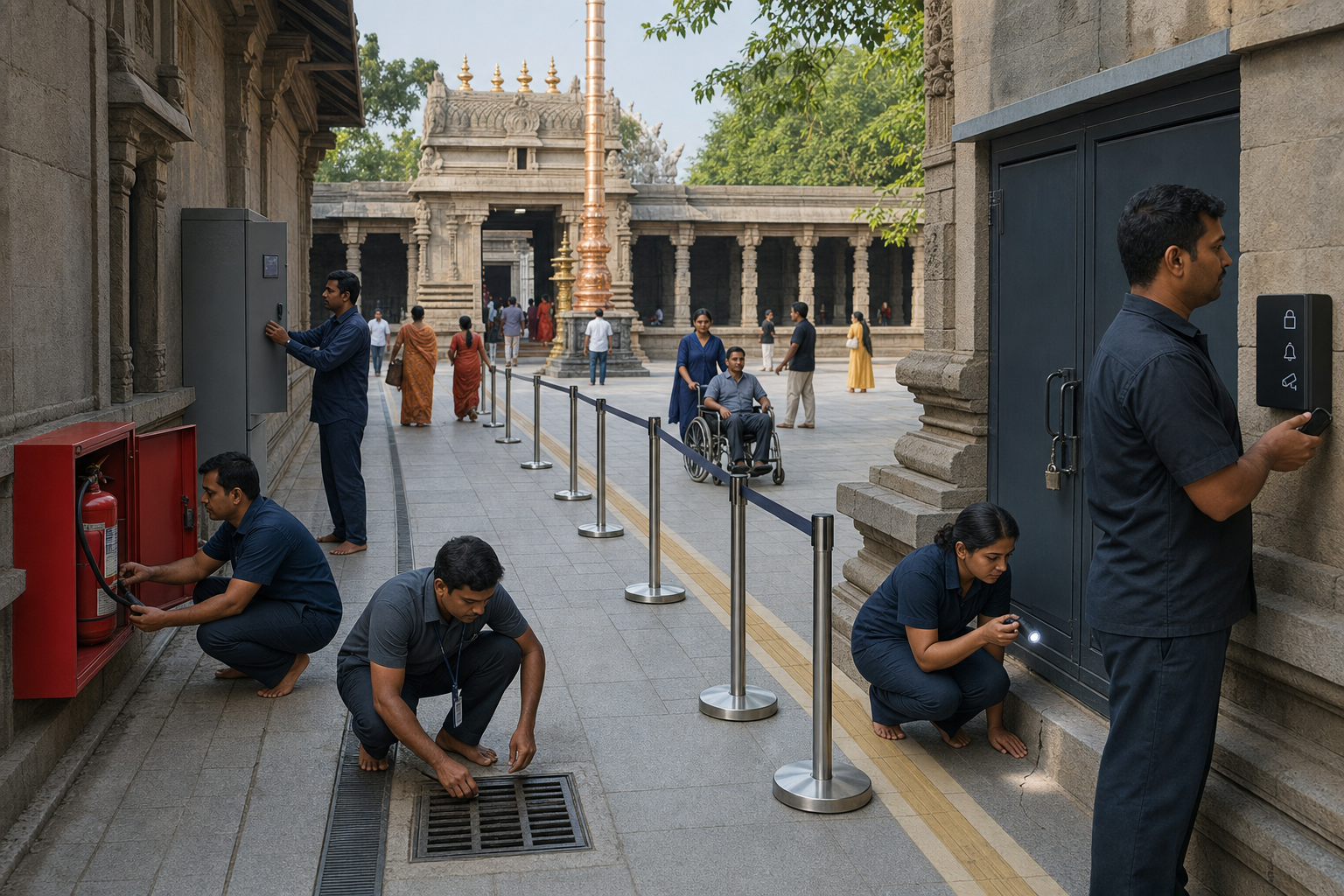
A queue failure can block an emergency exit. A temporary electrical cable can threaten old timber. A compromised donation terminal can conceal a financial discrepancy. These are not separate technical departments from a devotee’s point of view. They are one stewardship duty, and they belong in one risk register.
For each significant hazard, record the affected event or space, warning signs, preventive controls, person authorised to act, immediate response, external contact, communication method, and date of the last exercise. Overlay the register with the annual festival calendar. The ordinary weekday plan is not a peak-footfall plan.
For crowds, draw the actual journey from approach road to final exit. Mark entry and exit flows, queue turns, narrow passages, stairs, barriers, water points, shaded waiting areas, emergency corridors, first-aid posts, public-address coverage, and places where people naturally stop. The National Disaster Management Authority framework emphasises micro-zoning, bottleneck reduction, protected emergency routes, clear signage, flow-based queue design, public announcements, and coordinated exercises. Do not use the total area of the premises as a substitute for observed flow through its narrowest point.
Before a major utsav, agree with police, district administration, medical responders, fire services, volunteers, and security personnel who may slow or stop entry and how that decision will be communicated. Set site-specific operating limits with qualified authorities rather than copying a number from another temple. Conduct a tabletop exercise first, then a physical drill that tests communications, route diversion, emergency access, missing-child reunification, and evacuation assistance.
Fire and structural safety require logged inspections, not the presence of extinguishers as decoration. Map oil-lamp areas, kitchens, stalls, combustible decoration, old wooden components, electrical distribution, temporary loads, emergency lighting, exits, and assembly points. Check the site’s obligations under the National Building Code 2016 and the applicable state and municipal framework; in Maharashtra, that includes the Maharashtra Fire Prevention and Life Safety Measures Act. Use qualified structural and fire-safety professionals for audits, train evacuation marshals, place safety conditions in vendor contracts, and record every equipment inspection and drill.
Where private security is used, verify the agency’s legal standing and training, including applicable requirements under the Private Security Agencies (Regulation) Act, 2005. Give personnel written post orders and an escalation tree. CCTV, access controls, radios, and barriers help only when someone is responsible for watching, responding, preserving relevant records, and reporting a failure.
Apply the same discipline to cyber risk. Require phishing-resistant authentication for critical administrative accounts, restrict privileges by role, log sensitive actions, separate donor systems from public networks, assess vendors, and maintain an incident runbook. Connect digital and physical controls: watch cash-handling and donation-kiosk areas, secure devices against tampering, and reconcile system records against bank credits and collection records. Predetermine who isolates a compromised device, who preserves logs, who contacts the payment provider, and who approves any legally required notification.
If there is active structural movement, an uncontrolled fire hazard, dangerous crowd pressure, or an ongoing cyber compromise, do not wait for the next quarterly meeting or the completion of a long improvement plan. Restrict the affected activity where it can be done safely and bring in the appropriate emergency authority and qualified professional at once.
Use the next 90 days to create a working protection system
Ninety days is not a legal deadline or a promise that old disputes will be solved. It is a practical first cycle for turning scattered responsibilities into controlled work. Active danger still requires immediate action.
- Days 1-15: pass a board resolution establishing five connected workstreams: governance and finance, land, conservation, safety, and digital administration. Name an owner and substitute for each. Pause nonessential alterations to historic fabric and undocumented boundary changes until their status is reviewed.
- Days 1-30: inventory registrations, audited accounts, bank and donation workflows, parcel records, original deeds, drawings, heritage notifications, vendor contracts, data systems, emergency plans, and past incidents. Record what is missing rather than filling gaps with assumptions.
- Days 16-30: walk the entire precinct with responsible staff and ritual custodians. Mark unsafe fabric, water entry, boundary uncertainty, crowd bottlenecks, exits, electrical hazards, cash points, donation devices, server or network equipment, and areas requiring restricted access.
- Days 31-60: commission the necessary title, survey, structural, fire, conservation, financial, privacy, or cybersecurity reviews. Select each specialist for the actual risk. One general contractor or adviser should not be treated as qualified in every field.
- Days 31-60: index critical evidence and preserve controlled copies. Establish the compliance register, parcel files, condition ledger, risk register, incident log, conflict register, vendor register, and board dashboard.
- Days 61-75: correct urgent deficiencies that can be safely and lawfully closed. Define procurement checks, payment separation, document custody, access permissions, backup responsibility, inspection routines, emergency contacts, and public communication authority.
- Days 76-90: run a joint tabletop exercise, test a site-specific emergency scenario, review unresolved red flags at board level, and approve an annual calendar for audits, boundary inspections, monsoon checks, drills, volunteer training, data review, and festival preparation.
- By day 90: publish a concise stewardship note stating what systems have been established, what major work remains, and how devotees can submit a grievance or verified historical information. Keep confidential records and security details out of the public version.
Key takeaways
- Protect the temple as a living sacred institution: governance, worship, property, historic fabric, and devotee safety must operate as one system.
- Make land claims evidence-led. Index title records, verify boundaries, preserve events chronologically, and use the legally competent forum.
- Do not repair historic material before diagnosing it. Compatibility, minimal intervention, permissions, and complete documentation matter more than a quick visual transformation.
- Plan crowds from the narrowest point and the actual rate of movement, then protect emergency corridors and rehearse authority to slow entry.
- Treat donor data, payment systems, and connected devices as temple assets with controlled access, reconciliation, retention rules, and an incident response.
- Measure closure, not promises: overdue filings, open audit findings, unresolved parcel issues, safety exercises, training coverage, and response times should reach the board regularly.
At your next board meeting, table one resolution: assign the five workstream owners, approve the first 30-day inventory, and set a date to review the missing evidence. A temple’s inheritance is rarely lost in one moment. It is usually weakened through unrecorded decisions, deferred inspections, uncertain boundaries, and repairs nobody can later explain. Reversing that pattern can begin with the next properly recorded decision.
References
- Hindu Janajagruti Samiti – Satara Mandir Nyas Parishad: Stronger Temple Governance, Security, and Land Justice
- Hindu Janajagruti Samiti – Goa Declares Mardangad Fort and Hath Katro Khamb Protected: A Landmark Heritage Win
